

8th Pay Commission Allowances: HRA, TA, DA And Expected Revisions Explained


While one of the biggest components of government employees’ salary is the basic pay, there are a number of other parts, such as allowances, namely HRA (House Rent Allowance), TA (Travelling and Transportation Allowance), and DA (Dearness Allowance), which make up the total salary packages and in-hand income of the employees.
As discussions around the 8th pay commission allowances continue, it is important to understand how these factors and components will affect the exact salary structures of government and PSU employees. The expected recommendations will impact approximately 4.5 million CG employees and 6.8 million CG pensioners.1
What Are Government Employee Allowances?
Allowances are extra monetary rewards paid in addition to the basic salary, generally to meet specific expenditures such as rent or petrol/fuel expenses for official travel. The 8th pay commission salary benefits are meant to reimburse employees for expenses related to different factors, including housing, inflation, transportation, education, or special working conditions.
For example, if an employee’s base salary is INR 50,000 and, after receiving HRA, DA and TA totalling INR 25,000, the employee now receives a total compensation of INR 75,000 per month.
His total earnings are far greater than his basic salary. This makes central government employee allowances hikes almost as important as salary increments.
Types of Allowances Under Current Structure
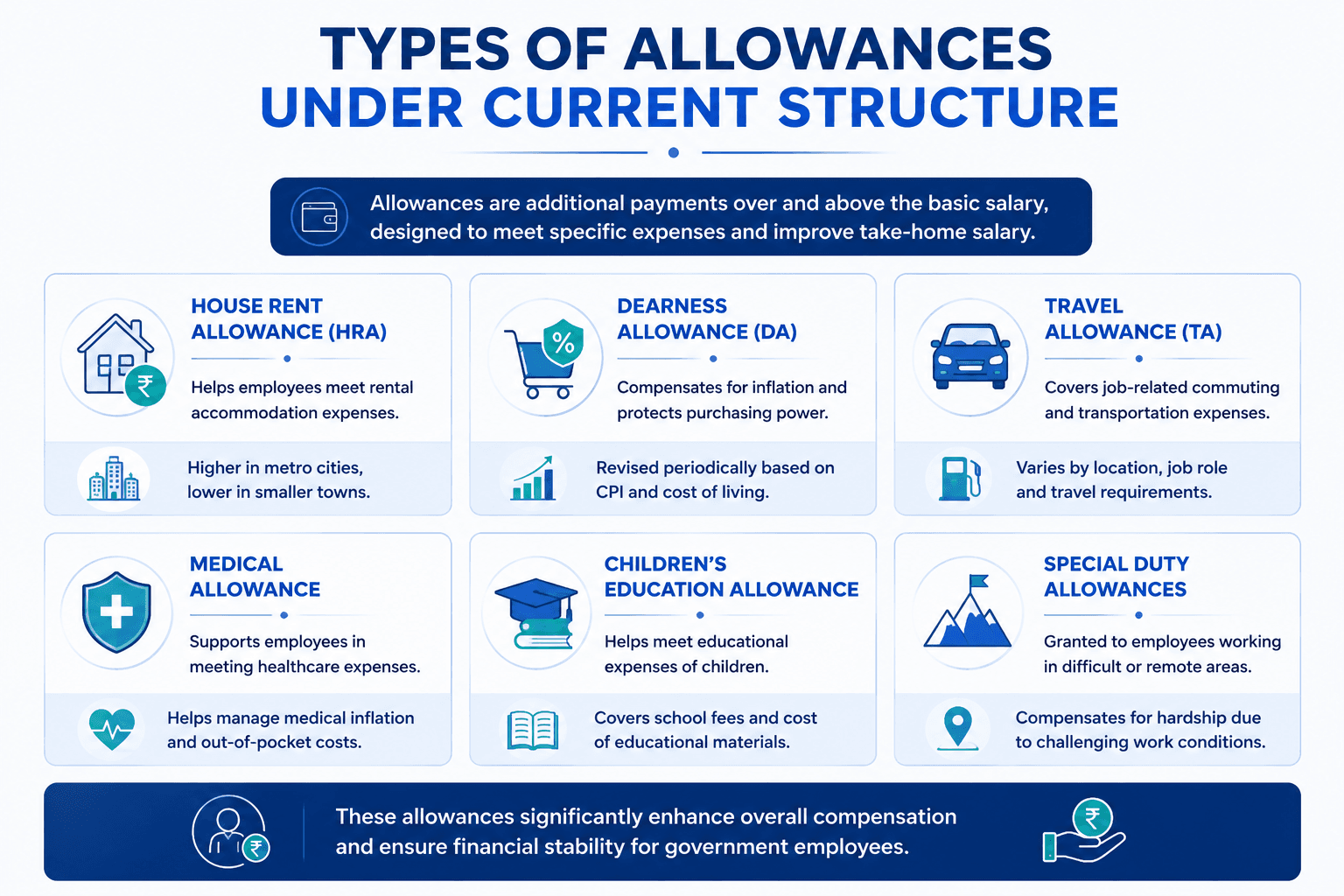
Various allowances are offered to government employees in addition to their basic salary. As explained before, expected DA and HRA hikes are intended to compensate for accommodation, inflation, transport, education, medicals, and special workplace situations.
1. House Rent Allowance (HRA)
The house rent allowance 8th pay commission is an allowance offered to employees to cover rental expenses. In this regard, the HRA is relatively higher for employees in metro cities than in small towns due to higher average rents in Tier I cities.
2. Dearness Allowance (DA)
The Dearness Allowance is introduced to counter the effects of inflation on employees' purchasing power. It is generally not revised only by the pay commission, and DA revisions are made periodically in response to changes in the cost of living and the consumer price index.
As inflation increases, DA revisions help ensure employees remain financially stable. However, a recommendation to change the DA (by an Additional 2%) has been included in the 8th Pay Commission draft.2
3. Travel Allowance (TA)
The 8th pay commission travel allowance will cover job-related commuting and other transportation costs. The TA could vary by location, job category, and travel needs. Due to rising fuel prices, the expectations around the 8th pay commission TA changes have become more interesting than ever.
Whether the government takes into account recent changes in fuel prices or pushes for electric vehicle adoption will be clearer once the actual changes are announced.
4. Medical Allowance
The medical allowance helps employees cover healthcare costs. As medical inflation continues to rise and employees often incur significant out-of-pocket expenses not covered by health insurance (e.g., hospital/clinic visits, general medications, dental care, preventive healthcare), the medical allowance helps ensure that both the employee and their dependents remain healthy.
5. Children's Education Allowance
The children’s education allowance is designed to help employees meet their children’s educational expenses. This type of allowance helps offset the costs incurred by qualifying employees for school attendance and the purchase of educational materials.
6. Special Duty Allowances
These allowances are awarded to employees who work in difficult and distant areas. Such allowances help compensate employees for any hardship faced due to being posted in difficult regions.
Why Allowances May Be Revised In 8th Pay Commission?
The allowances are adjusted from time to time to ensure that government employees receive compensation commensurate with their work, in light of rising inflation, economic conditions, and the rising cost of living across regions.
- Inflation Impact
An increase in inflation reduces one's purchasing power and, consequently, limits one's ability to buy products. The prices of food, shelter, education, healthcare, and many other items are always rising. Therefore, there is a need to increase allowances.
- Cost-of-Living Changes
The cost of living depends on both geography and the area's economic strength. Residents of big cities pay more for rent and other expenses than people in smaller towns.
Expected 8th Pay Commission HRA Changes
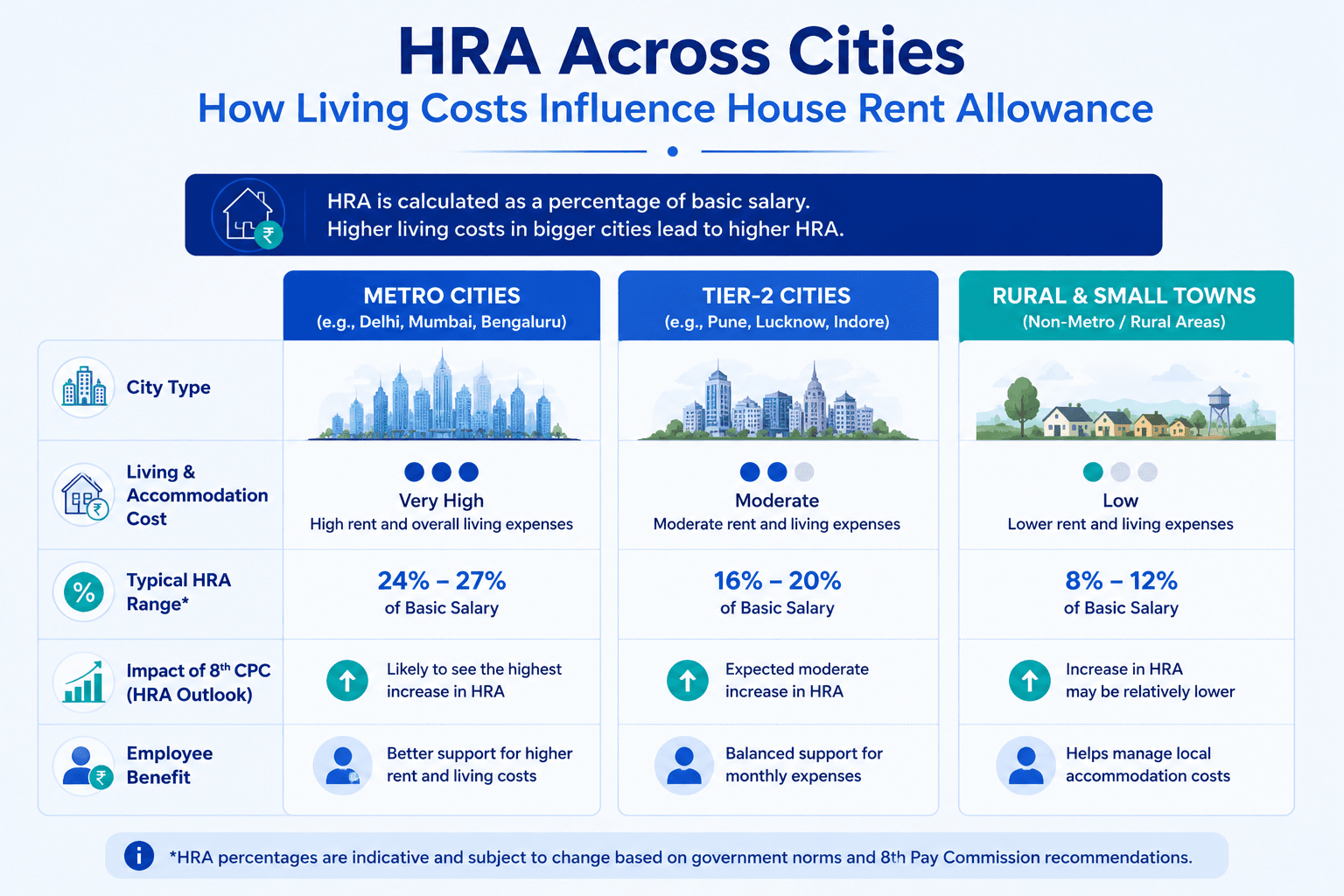
Since the cost of living and housing rates keep changing, the 8th pay commission HRA revision would be expected. This is because a different salary structure will be used depending on the city.
Metro Cities
Employees posted in metro cities generally face higher accommodation and rental costs compared to those living in non-metro regions. Since House Rent Allowance (HRA) is calculated as a percentage of the basic salary, any increase in basic pay under the 8th Central Pay Commission (8th CPC) could also lead to a higher HRA payout.
Historically, revisions under previous Pay Commissions have resulted in corresponding increases in HRA due to changes in salary structures. However, the final HRA revision under the 8th CPC will depend on the government’s approved pay structure, HRA slabs, and city classification guidelines.
Tier-2 Cities
There has been rapid urban growth in the tier-2 cities, thereby making accommodation more expensive in these regions. Employees in these areas may receive an increase in their HRA to help cover higher living costs.
Rural Zones
Though accommodation costs in rural areas might be lower than in urban areas, the overall cost of living and rental costs have increased. Employees in these regions are also expected to receive an HRA revision.
Also Read: 8th Pay Commission For Pensioners
Expected DA Impact: Inflation-Linked Adjustments
One of the most monitored news items is the 8th Pay Commission DA update. Traditionally, an increase in DA follows an increase in the inflation rate. Some predictions suggest that the DA could continue to rise even if the implementation process is not finalised.
The expectations are as follows:
- Accumulation of old DA
- Introduction of a new pay scale
- Calculation of new DA based on the new pay scale
- Additional 2% DA to the employees
However, nothing could be confirmed unless the new rules are notified by the government.
Transport Allowance Changes
Rising fuel prices and higher daily commuting costs may prompt revisions to Transport Allowance under the 8th Central Pay Commission (8th CPC). Employees working in cities with higher travel expenses or those commuting long distances could benefit from an updated allowance structure designed to better reflect current transportation costs.
In previous Pay Commissions, transport-related allowances were revised periodically to account for inflation and changing living expenses.
Any future revision under the 8th CPC is expected to follow a similar approach, depending on the government’s final recommendations and approved salary structure.
Conclusion
The revised allowances under the 8th Central Pay Commission (8th CPC) are expected to be influenced by factors such as inflation, economic conditions, and the government’s final recommendations. Changes to allowances like HRA, DA, and Transport Allowance (TA) could significantly affect employees’ overall take-home salaries, making allowance revisions just as important as basic pay hikes.
However, most figures and projections currently circulating are speculative. Employees and pensioners should therefore rely on official government notifications and verified announcements before drawing conclusions about the final salary and allowance structure under the 8th CPC.
FAQs On 8th Pay Commission Allowances 2026
References:
1. MOSPI, accessed from: https://www.mospi.gov.in/uploads/Marquee/doc-0aee0026-bf32-4213-ae4f-c5308088444e.pdf
2. Clear Tax, accessed from: https://cleartax.in/s/8th-pay-commission
 |
Author: Grip Invest Editorial Team The Grip Invest Editorial Team is a group of Chartered Accountants, MBA (Finance) graduates, and Qualified Research Analysts dedicated to helping you invest smarter. We dive deep into India's fixed income landscape to deliver content that is accurate, up-to-date, and easy to understand. Whether you're exploring bonds, fixed deposits, or other fixed income opportunities, our guides cut through the noise and give you the clarity to make better financial decisions. |
Want to stay at the top of your finances?
Join the community of 4 lakh+ investors and learn more about Grip Invest, the latest financial knick-knacks, and shenanigans in the world of investing.
Happy Investing!
Disclaimer - Investments in debt securities/municipal debt securities/securitised debt instruments are subject to risks including delay and/ or default in payment. Read all the offer related documents carefully. The investor is requested to take into consideration all the risk factors before the commencement of trading.
This communication is prepared by Grip Broking Private Limited (bearing SEBI Registration No. INZ000312836 and NSE ID 90319) and/or its affiliate/ group company(ies) (together referred to as “Grip”) and the contents of this disclaimer are applicable to this document and any and all written or oral communication(s) made by Grip or its directors, employees, associates, representatives and agents. This communication does not constitute advice relating to investing or otherwise dealing in securities and is not an offer or solicitation for the purchase or sale of any securities. Grip does not guarantee or assure any return on investments and accepts no liability for consequences of any actions taken based on the information provided. For more details, please visit www.gripinvest.in
Registered Address - 106, II F, New Asiatic Building, H Block, Connaught Place, New Delhi 110001


