

HRA For Central Government Employees: 7th Pay Commission Rates And Tax Rules


House Rent Allowance, which is often referred to as HRA, is a large portion of the salary package for a lot of people who work today.
For a central government employee, this allowance is important because it can support their costs of buying and renting properties throughout different areas of this country.
When an employee is not provided a government-provided home to live in, they will still need to pay rent to live in housing. Understanding how the computations of HRA work allows for better family planning financially.
All calculations regarding HRA for central government employees are done by the 7th Pay Commission. The commission depends on the location where the employee lives and many other economic factors. When this process is applied to each employee, it is fair to each individual and allows employees to have a quality of life that is acceptable, no matter where they are working from.
What Is HRA, And How Is It Determined?
HRA is an amount of money paid to employees of the government to help them pay rent to find housing that they are going to live in. The amount of HRA that will be received by a government employee is predetermined by the employee's basic salary and based on the city in which they live and work.
HRA is mainly for those who work in cities that have a high cost of living. However, the different aspects for HRA can be averaged to give employees a reasonable rent to live in areas that have a higher or lower rent.
HRA is designed to help employees relieve themselves of the financial expense of having to pay rent. Doing so will allow employees to focus on performing their job at the highest level.
City Classification: X, Y, Z Categories And HRA Rates
To classify cities in India for HRA, cities are grouped into three categories based on their population and cost of living.
- X Category: Includes large metropolitan areas that have a high cost of living. The following cities fall into this category: Delhi, Mumbai, Kolkata, Chennai, Bangalore, Hyderabad, Ahmedabad and Pune.
- Y Category: Includes important metropolitan areas not considered to have high costs. For example, cities such as Lucknow, Jaipur, Patna, Nagpur and Chandigarh are generally considered to have moderate living expenses.
- Z Category: Any cities/towns outside of the previously referenced cities have lower housing pressures than the other two groups.
Using the HRA city classification system allows HRA assistance to be provided to employees based on actual need from location to location. Employees in larger metropolitan areas will receive greater amounts of HRA assistance than those in smaller towns to help cover the high costs of renting a home.
HRA Rates After Latest DA Revision
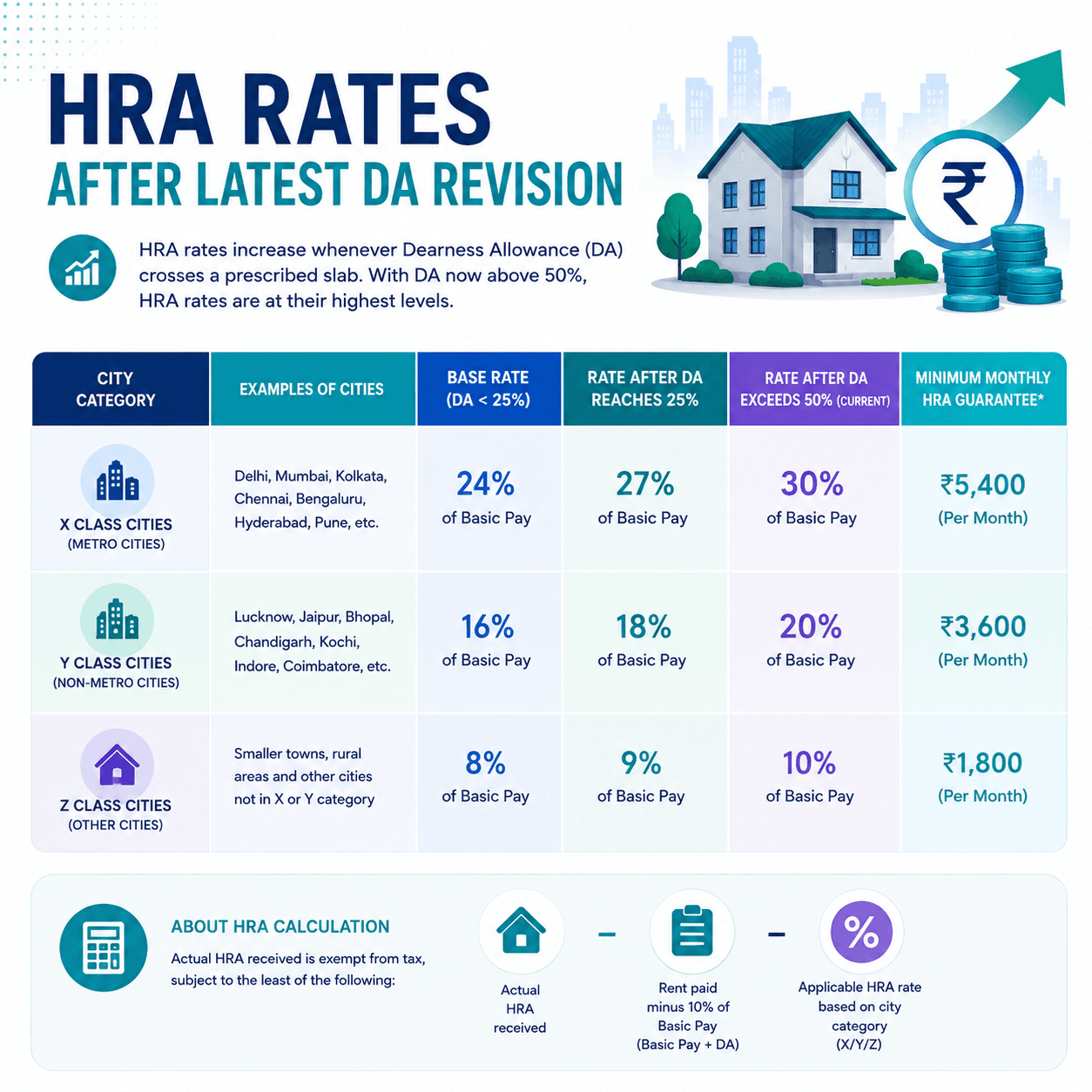
Changes in the HRA rate occur any time the Dearness Allowance reaches a specific percentage level above 50%. Due to recent increases in DA, HRA rates will revert to their highest levels due to DE exceeding 50 percent. According to the current regulations:
- X Class Cities: 30% of basic pay
- Y Class Cities: 20% of basic pay
- Z Class Cities: 10% of basic pay
Furthermore, the government employee HRA calculation system has established the following limits when calculating HRA benefits:
- An amount of INR 5,400 will be the lowest amount of HRA,
- INR 3,600 for Y category cities,
- And INR 1,800 for Z category cities.
These limits provide a safety net for lesser-paid employees.
The latest published data regarding the central government HRA percentage will provide much-needed relief to employees due to the ongoing increase in living expenses each year.
How HRA Is Calculated: Step By Step With Example
The calculation of HRA is a simple process.
1. You need to know your Basic pay
2. Next, apply the percentage of HRA according to the City category
3. Lastly, check if there is a minimum Floor amount or not and use that amount if it gives you a higher HRA.
For Example:
Ravi, a central government employee, works in New Delhi (X category). His Basic pay is INR 60,000 per month. If the current rate of HRA is 30%, then Ravi would receive an HRA of INR 18,000 (30% of INR 60,000) to help pay rent in the city of New Delhi.
If you have calculated your HRA and it is below the minimum amount (which is usually INR 800 or less), then you will receive the Floor amount as the HRA.
The simple, step-by-step methods for calculating Government Employees' HRA provide transparency and fairness to all employees. In fact, calculation of Government Employees HRA is now very easy. All you need to know is your Basic pay and city of posting that is available on your salary slip or through various online amenities.
HRA: Own House vs Rented Accommodation
The allowance varies depending on the type of housing you have. If you own your home, you usually cannot claim HRA or get a full tax deduction for it. This rule stops you from getting double benefits.
For those who rent, you are eligible for the entire amount of the allowance. Rent receipts and other documents must be submitted to your office in order to claim them. Many government employees rent temporary housing while away from home.
If you own a rental house and an owned house in different parts of the country for work purposes, you can often claim both the HRA and the home loan deductions. This helps employees who must live in two locations.
HRA Tax Exemption Under Section 10(13A): Rules And Limits
HRA tax exemption under Section 10(13A) has rules and limits related to this. The tax laws give HRA a partial tax exemption or relief to those who have been using the old tax system. You may claim an exemption for HRA, the exemption is the maximum amount of HRA received, the total rent paid, 10% of your basic salary, or 50% - 40% of your basic salary for X cities and non-X cities.
It is recommended that you keep documents such as rent receipts. If your annual rent exceeds INR 1 lakh, the landlord's PAN is required to make sure this is a legitimate claim and not a false one.
Central governmental employees who submit their HRA appropriately can receive substantial tax benefits.
Also Read: HRA Exemption & Calculations 2026
HRA Under New Tax Regime: What Changes?
By using the new tax structure, all individuals will benefit from lower slab rates; however, with all exemptions being removed, employees will no longer get HRA deductions. Therefore, if you were receiving an allowance for HRA, that money would now be taxable as part of your salary.
It's important that each employee considers the two tax structures when filing their taxes, since employees who are renting their accommodation may be better off using the old tax structure, even with the base rates having increased.
Each employee must make their best choice after considering their own situation. Also, starting in the assessment year 2026-2027, there are new updates regarding employee documentation that the government will enforce.
HRA: Old vs New Tax Regime
| Particulars | Old Tax Regime | New Tax Regime |
| HRA Exemption Available | Yes, under Section 10(13A) | No |
| HRA Taxability | Partially exempt | Fully taxable as salary |
| Rent Receipts Required | Yes | Not applicable |
| Landlord PAN Required (rent > INR 1 lakh) | Yes | Not applicable |
| Suitable For | Employees paying high rent | Employees with low HRA or low rent |
Also Read: HRA Tax Benefits 2026
HRA Tax Exemption: Calculation Breakdown
This fits right before or inside the "HRA Tax Exemption Under Section 10(13A)" section:
| Condition | Calculation |
| Actual HRA received from employer | Full amount as per salary slip |
| Rent paid minus 10% of basic pay | Annual rent – 10% of annual basic pay |
| 50% of basic pay (X category cities) | 50% of annual basic pay |
| 40% of basic pay (non-X category cities) | 40% of annual basic pay |
| Tax Exemption | Lowest of the above four amounts |
Conclusion
Understanding HRA under the 7th Pay Commission is more than just knowing salary components, it is about maximising financial benefits, planning transfers wisely, and managing rising living costs efficiently. Since HRA rates, DA revisions, and city classifications continue to evolve with economic conditions, government employees should regularly stay updated with the latest circulars and policy changes to make informed financial decisions.
Whether you are joining a new post, relocating to another city, or evaluating your in-hand salary, knowing how HRA is calculated can help you optimise savings and improve long-term financial stability. And while salary planning is important, building wealth beyond your monthly income matters equally.
To strengthen your financial future further, explore smart fixed-income investment opportunities, corporate bonds, and government bonds options with Grip Invest and take the next step towards better financial planning and passive income creation.
FAQs On HRA For Central Employees
 |
Author: Grip Invest Editorial Team The Grip Invest Editorial Team is a group of Chartered Accountants, MBA (Finance) graduates, and Qualified Research Analysts dedicated to helping you invest smarter. We dive deep into India's fixed income landscape to deliver content that is accurate, up-to-date, and easy to understand. Whether you're exploring bonds, fixed deposits, or other fixed income opportunities, our guides cut through the noise and give you the clarity to make better financial decisions. |
Want to stay at the top of your finances?
Join the community of 4 lakh+ investors and learn more about Grip Invest, the latest financial knick-knacks, and shenanigans in the world of investing.
Happy Investing!
Disclaimer - Investments in debt securities/municipal debt securities/securitised debt instruments are subject to risks including delay and/ or default in payment. Read all the offer related documents carefully. The investor is requested to take into consideration all the risk factors before the commencement of trading.
This communication is prepared by Grip Broking Private Limited (bearing SEBI Registration No. INZ000312836 and NSE ID 90319) and/or its affiliate/ group company(ies) (together referred to as “Grip”) and the contents of this disclaimer are applicable to this document and any and all written or oral communication(s) made by Grip or its directors, employees, associates, representatives and agents. This communication does not constitute advice relating to investing or otherwise dealing in securities and is not an offer or solicitation for the purchase or sale of any securities. Grip does not guarantee or assure any return on investments and accepts no liability for consequences of any actions taken based on the information provided. For more details, please visit www.gripinvest.in
Registered Address - 106, II F, New Asiatic Building, H Block, Connaught Place, New Delhi 110001


