

Arbitrage Fund Taxation India 2026: Rates, Returns, Filing Tips


Introduction To Arbitrage Fund Taxation
Arbitrage funds invest in buying and selling securities simultaneously across different markets to profit from price differences. They are treated as equity funds for taxation because they invest at least 65% in equities/equity derivatives (the 65% must be in Indian equity/equity derivatives for equity classification). Short-term capital gains (STCG) from arbitrage funds held less than one year are taxed at 20%, while long-term capital gains (LTCG) held over one year are taxed at 12.5%, with INR 1.25 lakh exempt annually1. Taxation matters as it directly influences net returns, making arbitrage funds more tax-efficient than debt funds, which are taxed at slab rates without indexation benefits. Compared to equity funds, arbitrage funds have similar tax rates but lower risk due to their strategy. This tax advantage and moderate risk make them popular for short/medium-term investors seeking stable returns1.
Arbitrage funds' tax efficiency and low risk have made them increasingly popular among hybrid mutual fund investors who want stability with better post-tax returns compared to traditional debt or equity funds.
Short-Term Capital Gains (STCG) vs Long-Term Capital Gains (LTCG)
- STCG: Holdings Less Than 1 Year
Short-term capital gains on arbitrage funds are applicable when units are held for less than one year. These gains are taxed at 20% (effective for transfers on/after 23 July 2024), similar to equity funds. STCG taxation impacts investors seeking quick returns and emphasises the importance of holding investments for at least one year to benefit from favourable LTCG rates. Arbitrage funds may show volatility in returns during shorter holding periods due to market conditions and transaction execution risks2.
- LTCG: Holdings More Than 1 Year
Long-term capital gains from arbitrage funds—when held for over one year, are taxed at 12.5% on gains exceeding INR 1.25 lakh per financial year, with no benefit of indexation. This favourable tax treatment relative to debt funds (which are taxed at slab rates without indexation) makes arbitrage funds attractive for medium to long-term investors seeking tax-efficient, relatively stable returns from market inefficiencies between cash and derivatives markets. These tax distinctions matter significantly for overall returns and investment planning in arbitrage mutual funds3.
- Dividends: Added to taxable income, with 10% TDS applicable for payouts above INR 5,000 in any financial year for Indian tax residents4.
Taxation’s Impact On Returns
The tax efficiency of arbitrage funds directly boosts net results versus FDs and most bonds. Here’s how real fund data compares (annualised post-tax returns for 2025):
Scheme Name | 1Y Returns | 3Y Returns | 5Y Returns | STCG Rate | LTCG Rate |
Axis Arbitrage Fund - Direct Plan - Growth | 7.29% | 7.57% | 6.35% | 20% | 12.50% |
Kotak Arbitrage Fund - Direct Plan - Growth | 7.40% | 7.80% | 6.50% | 20% | 12.50% |
Invesco India Arbitrage Fund - Direct Plan - Growth | 7.39% | 7.84% | 6.54% | 20% | 12.50% |
SBI Arbitrage Opportunities Fund - Direct Plan - Growth | 7.35% | 7.70% | 6.36% | 20% | 12.50% |
Source: Moneycontrol (as of 2nd Oct 2025)5
Fixed deposits typically offer 6.5–7% interest, fully taxable as per the investor's income slab—often up to 30% in the highest bracket. Bonds on the Grip Marketplace deliver pre-tax yields of 11–14%, but post-tax returns decline depending on holding period and income tax slab6.
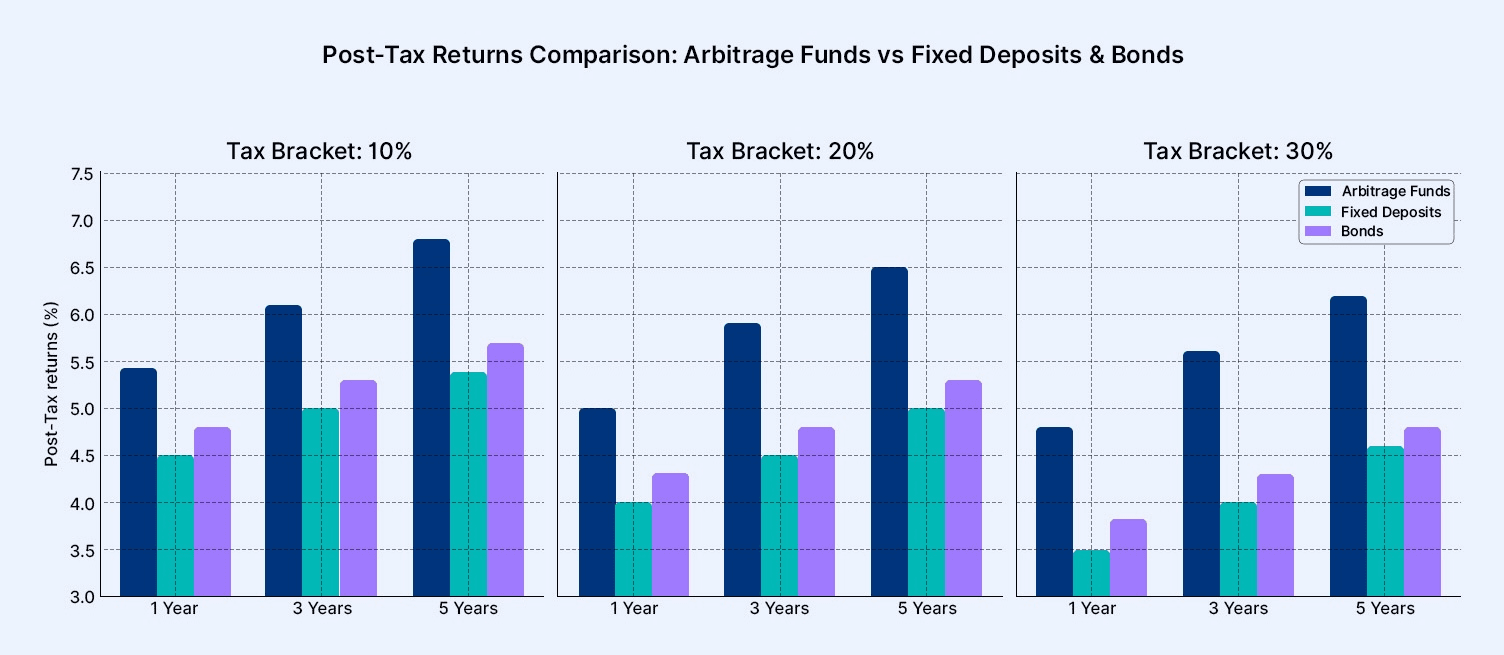
Grip Integration: Optimising With Tax-Efficient Bonds
Pairing arbitrage funds with tax-efficient bonds (like those offered via Grip Marketplace) creates a balanced, tax-optimised portfolio. Bonds have their own tax rules—listed bonds held > 12 months are taxed at 10%, while unlisted bonds held > 36 months are taxed at 20%. Investors following a dual approach—arbitrage funds for short-medium tenures and listed corporate bonds for longer periods—can maximise post-tax returns, especially for amounts exceeding annual LTCG exemption limits.
Tax Filing Considerations
- TDS Implications: 10% TDS on dividend payouts exceeding INR 5,000 per AMC per financial year for residents; no TDS on capital gains; 20% TDS without PAN
- Reporting Gains: Gains, both STCG and LTCG, must be reported in the “Capital Gains” section of the income tax return. Details like scheme name, purchase and redemption dates, and gain calculation (with TDS, if any) should be accurately filed to avoid scrutiny7.
Conclusion
Taxation significantly influences the attractiveness of arbitrage funds as investment vehicles in India. Their equity-like tax treatment, combined with relatively stable returns, positions them as ideal choices for investors keen on tax-efficient investment growth. When strategically combined with tax-efficient bonds from the Grip, investors can build well-rounded portfolios that balance liquidity, risk, and tax savings seamlessly.
This integrated approach not only enhances arbitrage fund returns after tax but also aligns with prudent portfolio management practices, enabling investors to harness the best of both worlds—consistent arbitrage fund gains and optimised fixed income from bonds—thereby maximising post-tax wealth creation. To learn more about mutual fund taxation and portfolio diversification, sign up on Grip Invest today.
References
- Cleartax, accessed from: https://cleartax.in/s/arbitrage-trading-and-arbitrage-funds
- Tickertape, accessed from: https://www.tickertape.in/blog/best-arbitrage-funds-meaning-features/
- The Economic Times, accessed from: https://economictimes.indiatimes.com/mf/analysis/best-arbitrage-mutual-funds-to-invest-in-august-2025/articleshow/123377299.cms
- Angelone, accessed from: https://www.angelone.in/mutual-funds/category/arbitrage-funds
- Money Control, accessed from: https://www.moneycontrol.com/mutual-funds/performance-tracker/returns/arbitrage-fund.html
- Financial Express, accessed from: https://www.financialexpress.com/money/grip-brings-corporate-bonds-with-8-10-pre-tax-yield-to-maturity-who-should-invest-2720583/
- Invesco Mutual Fund, accessed from: https://invescomutualfund.com/docs/default-source/default-document-library/invesco-india-arbitrage-fund-ppt-oct-23.pdf?sfvrsn=fe3a90c2_0
Want to stay at the top of your finances?
Join the community of 4 lakh+ investors and learn more about Grip Invest, the latest financial knick-knacks, and shenanigans in the world of investing.
Happy Investing!
Disclaimer - Investments in debt securities/municipal debt securities/securitised debt instruments are subject to risks including delay and/ or default in payment. Read all the offer related documents carefully. The investor is requested to take into consideration all the risk factors before the commencement of trading.
This communication is prepared by Grip Broking Private Limited (bearing SEBI Registration No. INZ000312836 and NSE ID 90319) and/or its affiliate/ group company(ies) (together referred to as “Grip”) and the contents of this disclaimer are applicable to this document and any and all written or oral communication(s) made by Grip or its directors, employees, associates, representatives and agents. This communication does not constitute advice relating to investing or otherwise dealing in securities and is not an offer or solicitation for the purchase or sale of any securities. Grip does not guarantee or assure any return on investments and accepts no liability for consequences of any actions taken based on the information provided. For more details, please visit www.gripinvest.in
Registered Address - 106, II F, New Asiatic Building, H Block, Connaught Place, New Delhi 110001


