

Bank Bonds In India 2026: Safe, Stable Investment Options Explained


Investors today are looking for investment platforms where the market is less volatile but gives sufficient returns. Bank bonds are one such niche that you, as an investor, can invest in. But first, it is important that you learn about the concept of bank bonds in India.
So, bank bonds in India are debt instruments issued by the bank. These are used to raise capital. What happens is you, as an investor, “lend money” to the bank in return for a fixed interest on your investment. Compared to equities, bank bonds provide investors with a fixed income setup, which proves to be an attractive choice for conservative investors.
Banks with high credit ratings and regulatory back-ups ensure an established financial structure, making bank bonds a low-risk investment scheme. We know that no investment is risk-free, but bank bonds have lower risks comparatively. This is due to the diversification of the portfolio. This has often proven to be advantageous for investors looking for a stable return who are also trying to preserve capital.
Types Of Bank Bonds
Bank bonds in India have multiple types. They are designed based on the investor's specific requirements. These specifications are for both investors and banks. Learning about these types is essential as it helps you to make the right choice.
Secured vs Unsecured
By definition, secured bonds are those that are backed up by collateral. These collaterals can be different assets or bank assets, which increases their risks. This allows investors to claim and recover their investments if the bank ever defaults.
Whereas unsecured bank bonds have no collateral as backup. The safety of these investments completely depends on the credit and financial condition of the issuing bank.
Perpetual Bonds and Callable Bonds
In the case of perpetual bonds in India, the bank continues to pay interest; in other words, it doesn't have a date of maturity. These bank bonds have a very high risk but also provide better returns. YES Bank provides a very popular example of perpetual bonds in India. These were written off in 2020, during a financial crisis. This led investors to suffer losses.
On the other hand, Callable bank bonds are ones in which the bank can redeem the bond even before the maturity date. This happens due to a fall in interest rates. This allows the bank to refinance, but on the other hand, it introduces risks for investors, who have to invest in low-yielding opportunities.
Exploring Alternative Fixed Income
Apart from bank bonds, there are other bond investment options in India, such as corporate bonds and Fixed-Income secure bonds. Although bank bonds in India provide stability, investors looking to diversify their portfolio can also explore these options.
Corporate Bonds
Corporate bonds are issued by private or public companies as debt instruments. These types of bonds provide a greater return compared to bank bonds but also have more credit risk.
Let's take an example, returns from a top-rated corporate bond might go up to 7 to 8% but on the other hand, a top-rated bank bond will give up to 5 to 6% return. Thus, investors who are risk-takers will be more inclined to invest in corporate bonds rather than in bank bonds.
Fixed-Income Bonds
Another option apart from traditional bank bonds is fixed-income secure bonds. These are newer investment schemes in India. These offer curated portfolios that may include short-term corporate debts, secured bonds, and others. These schemes provide a steady income while also maintaining security, which ought to significantly mitigate risks.
Interest Rates & Taxation
Bank bonds in India have gained popularity due to the predictable stream of income they provide for investors. Although they are a good option for financial growth, investors should always be aware of how bank bond interest and taxes work in this department before making any investments.
Regular Income
Investors seeking stability find bank bonds alluring as they offer a fixed payment of interest. The rate of interest return may differ depending on factors like the bond type, the credit rating of the issuing bank, or even the present market conditions.
To understand the concept better, let's take an example investment of 10 lakhs in a 7% bank bond. This investment will provide INR 70,000, which will make it an effective method for investors seeking a steady cash flow.
Tax implications
This is a very important topic when you plan to invest, and you should have full knowledge about it. For starters, all interest earned from bank bonds is taxed. This signifies the amount is added to your income based on your slab rate. Based on which platform or bond structure is used, investors are also required to pay TDS (Tax Deducted at Source)
Bank bonds are taxed directly, unlike traditional mutual funds, where tax is paid after redemption. Therefore, even if returns are predictable, they are based on your tax bracket.
Why Do Banks Issue Bonds Instead of Accepting Deposits?
Many investors wonder why banks need to issue bonds when they already receive customer deposits. It is because of a funding strategy, regulatory compliance and capital management.
Meeting Long-Term Funding Requirements
Deposits are often short-to medium-term liabilities, while banks provide long-term loans such as home loans and infrastructure financing. Bank bonds help match long-term assets with long-term funding.
Meeting Basel III Capital Requirements
Under Basel III regulation, banks must maintain an adequate capital buffer to absorb financial stress. To meet these norms, banks issue instruments such as Tier II bonds and AT1 bonds, which qualify as regulatory capital.
Infrastructure and Project Financing
Large infrastructure projects require funding over many years. Instead of relying solely on deposits, banks raise money through bonds to finance their long-term lending requirements.
Diversifying Funding Sources
Depending entirely on deposits may increase funding risk. Issuing bank bonds in India allows banks to diversify their source of capital by attracting institutional investors, insurance companies, pension funds and retail investors.
Better Asset-Liability Management
Banks constantly manage the maturity profile of their assets and liabilities. Long-duration bank bonds improve asset-liability matching and reduce refinancing risk.
Types of Bank Bonds in India
There are different categories of bonds issued by the banks. Based on their objectives and regulatory requirements, investors can choose different bonds.
| Type | Purpose | Typical Investors | Risk Level | Interest |
| Senior Bank | General funding | Retail & Institutional | Lower | Fixed/Floating |
| Tier || bonds | Regulatory capital | Instituional & HNI | Moderate | Higher than senior bonds |
| AT1 bonds | Additional Tier | capital | Institutional & Qualified Investors | High | Higher coupons |
| Basel ||| bonds | Capital adequacy compliance | Institutional Investors | Moderate to High | Competitive yields |
| Infrastructure Bonds | Long-term project financing | Retail & Institutional | Moderate | Fixed |
How To Evaluate A Bank Bond Before Investing?
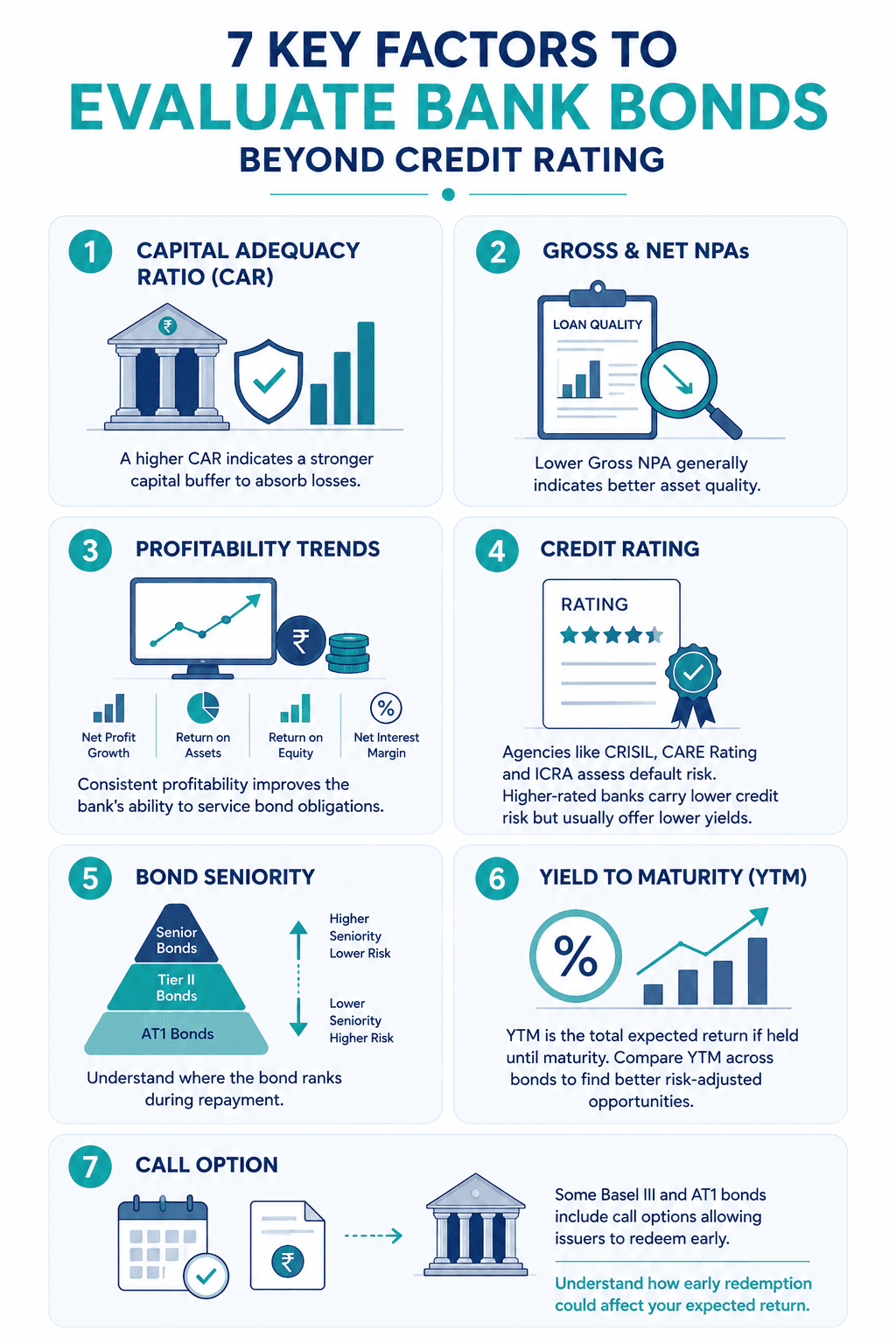
Many investors focus only on credit rating. However, evaluating bank bonds in India requires examining several financial and structural factors.
- Capital Adequacy Ratio (CAR) - A higher Capital Adequacy Ratio indicates that the bank has a stronger capital buffer to absorb potential losses.
- Gross and NET NPAs - Non-Performing Assets reflect loan quality. Lower Gross NPA generally indicates better asset quality.
- Profitability Trends - Review the bank’s net profit growth, return on assets, return on equity and Net Interest Margin. Consistent profitability improves the bank’s ability to service bond obligations.
- Credit Rating - Credit rating agencies such as CRISIL, CARE Rating and ICRA provide an assessment of default risk. Higher-rated banks generally carry lower credit but many offer lower yields.
- Bond Seniority - Understand where the bond ranks during repayment. Senior Bonds, Tier || bonds, AT1 bonds. Lower seniority usually means higher risk.
- Yield to Maturity (YTM) - Yield to Maturity represents the total expected return of the bond if it is held until maturity. Comparing YTM across different bonds issued by banks helps identify better risk-adjusted opportunities.
- Call Option - Some Basel ||| bonds and AT1 bonds include call options allowing the issuers to redeem the bond before maturity. Investors should understand how early redemption could affect expected return.
Bank Bonds vs Corporate Bonds vs Fixed Deposits
Here is a comparison table between Bank bonds vs Corporate bonds vs Fixed Deposits. It will help investors choose the correct investment option for them.
| Features | Bank Bonds | Corporate Bonds | Fixed Deposit |
| Issuer | Banks | Companies | Banks |
| Return | Moderate | Moderate to High | Fixed |
| Risk | Low to moderate | Moderate to High | Generally Low |
| Tradability | Usually Listed | Listed/Unlisted | Not Tradable |
| Deposit Insurance | No | No | Yes (up to applicable DICGC limit) |
| Capital Gains Opportunity | Yes | Yes | NO |
| Liquidity | Moderate | Moderate | Premature withdrawal is possible |
Common Risks Investors Overlook
Bank bonds are considered relatively stable; however, they do come with some risk.
- Interest Rate Risk - The bond prices generally decline when the market interest rates rise.
- Credit Risk - If the issuing bank’s financial health deteriorates, the bond's value may decline as well.
- Liquidity Risk - Some bonds issued by banks may have limited trading volumes. This makes them difficult to sell quickly in the market.
- Call Risk - Callable bonds may be redeemed early when interest rates decline. It reduces the future income potential.
- Regulatory Risk - Changes in the banking regulations may affect instruments such as AT1 bonds and Basel ||| bonds.
- Loss Absorption Risk - Unlike traditional deposits, AT1 bonds can absorb losses during severe financial stress under regulatory provisions.
Conclusion
Bank bonds remain a strong choice for investors who value safety, predictable interest income, and capital preservation over high-risk, high-return opportunities. While secured bonds offer additional protection, options like perpetual and callable bonds provide different risk-reward profiles depending on investor appetite. For those seeking diversification, corporate bonds and fixed-income portfolios can complement traditional bank bond holdings. However, taxation and interest rate movements must be carefully considered before investing.
If you want to explore bank bonds alongside other curated fixed-income opportunities, platforms like Grip Invest offer transparent, technology-driven access to bonds and alternative investments designed to match your risk-return needs.
FAQs On Bank Bonds In India
 |
Author: Grip Invest Editorial Team The Grip Invest Editorial Team is a group of Chartered Accountants, MBA (Finance) graduates, and Qualified Research Analysts dedicated to helping you invest smarter. We dive deep into India's fixed income landscape to deliver content that is accurate, up-to-date, and easy to understand. Whether you're exploring bonds, fixed deposits, or other fixed income opportunities, our guides cut through the noise and give you the clarity to make better financial decisions. |
Want to stay at the top of your finances?
Join the community of 4 lakh+ investors and learn more about Grip Invest, the latest financial knick-knacks, and shenanigans in the world of investing.
Happy Investing!
Disclaimer - Investments in debt securities/municipal debt securities/securitised debt instruments are subject to risks including delay and/ or default in payment. Read all the offer related documents carefully. The investor is requested to take into consideration all the risk factors before the commencement of trading.
This communication is prepared by Grip Broking Private Limited (bearing SEBI Registration No. INZ000312836 and NSE ID 90319) and/or its affiliate/ group company(ies) (together referred to as “Grip”) and the contents of this disclaimer are applicable to this document and any and all written or oral communication(s) made by Grip or its directors, employees, associates, representatives and agents. This communication does not constitute advice relating to investing or otherwise dealing in securities and is not an offer or solicitation for the purchase or sale of any securities. Grip does not guarantee or assure any return on investments and accepts no liability for consequences of any actions taken based on the information provided. For more details, please visit www.gripinvest.in
Registered Address - 106, II F, New Asiatic Building, H Block, Connaught Place, New Delhi 110001


