

Strip Bonds Explained: How Zero-Coupon Government Bonds Work


Looking for a unique way of investing in fixed-income securities? Start with strip bonds. These bonds are issued and backed by the government. This bond converts traditional bonds into different components via the process of bond stripping.
You can purchase strip bonds at a discounted price and later receive a full face value return, typically after maturity. With strip bonds, each payment you make is treated like an individual security. They are known as zero-coupon strip bonds, which indicate no regular interest.
Since there are no regular interest returns, they accumulate throughout the tenure. This is a major reason why strip bonds are suited for investors seeking long-term planning.
What Are Strip Bonds?
By definition, strip bonds are fixed-income instruments that are created by separating traditional bond payments. In strip bonds, the interest payments and principal repayment of the bond become separate securities. This process of having different components is called bond stripping.
Usually, you will receive periodic interest payments from a bond, which are called coupons. But in this case, since there are no regular interest payments, there are no coupons. Hence, the name zero-coupon bonds.
How Strip Bonds Work?
In comparison to traditional bonds, strip bonds function differently. There are no periodic interest payments. Instead, you can earn through price differences. So, you purchase the bond and redeem it later.
1. Purchase at a discount: A strip bond is usually bought at a discount price. This discount indicates your future returns. For instance, if the face value of a strip bond is INR 1,000, it can be purchased at INR 750. This attracts investors seeking predictable returns. This is also similar to zero-coupon bonds in India.
2. Redemption at face value: After the bond matures, you will receive the full face value. The returns received are equal to the difference between the purchase price and the maturity value. This is why G-strip investments are suitable for investors with long-term goals.
3. No periodic interest payments: Unlike traditional bonds, strip bonds do not provide periodic interest. Instead, all the earnings accumulate till maturity. This explains the comparison of strip bonds vs regular bonds.

Who Issues Strip Bonds in India?
The strip bonds in India are issued by the government. They are created by separating payments from existing bonds, which form tradable securities known as the G-sec strips.
- Government securities stripping mechanism
Regular bonds with periodic interest are offered by the government. These types of bonds are further distinguished into different components using the bond stripping method.
Each interest payment is converted into a coupon strip, and the final payment is converted into a principal strip. These securities are traded separately in the market. The maturity of the bond can be chosen according to the investor’s financial goals.
- Role of Reserve Bank of India
The Reserve Bank of India regulates the stripping mechanism. The RBI has introduced this system through the RBI G-Sec strips guidelines. The eligible securities can be stripped through these institutions. The process is usually carried out by banks and financial organisations.
Advantages And Risks of Strip Bonds
Strip bonds provide unique benefits, some of which are discussed below:
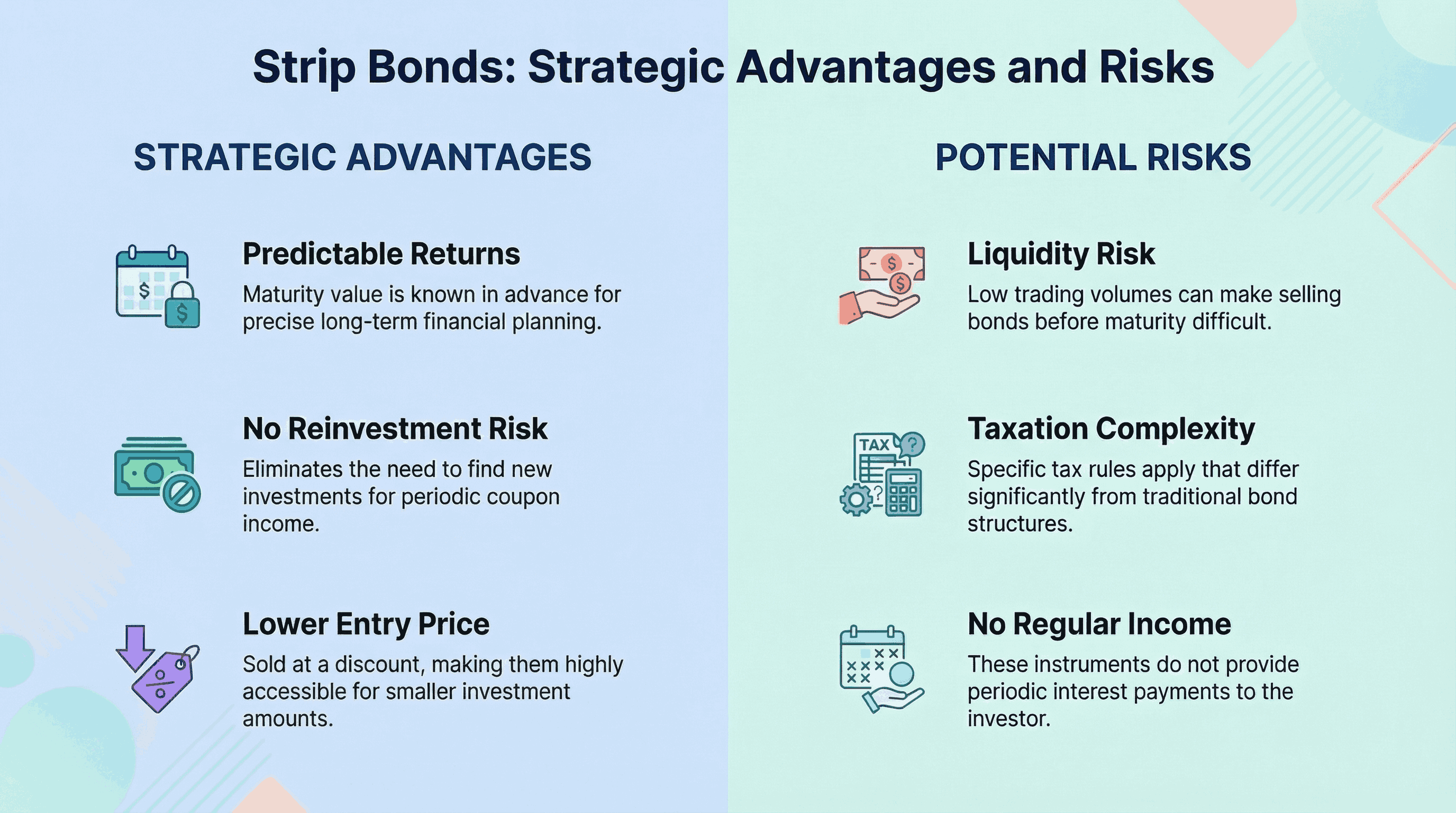
1. Predictable Returns: The maturity value is known in advance. This is useful for planning long-term financial goals.
2. No Reinvestment Risk: There are no periodic interest payments. Therefore, investors need not reinvest coupon income.
3. Lower Entry Price: Strip bonds are sold at a discounted price, making them easier for small investments.
4. Suitable For Long-Term Goals: These instruments are often used for long-term financial goals, such as education or retirement plans.
5. Government-Backed Security: The G-sec strips often come from government securities, making them low-risk investments.
Strip bonds also have their risks. These are shown below:
1. Liquidity Risk: There is a risk of low trading volume in strip bonds. It may not be easy to sell the bonds before the maturity date.
2. Taxation Complexity: Investors have to take into account the tax on strip bonds in India before investing in these bonds. Taxation is different in the case of strip bonds compared to other bonds.
3. No Regular Income: There is no regular income in these bonds. Traditional bonds are the best option if the investor wants regular returns.
Conclusion
Strip bonds provide a special opportunity to invest in fixed-income securities. This type of bond converts traditional bonds into separate parts using the bond stripping process. This enables investors to purchase securities at a discount, receiving face value at maturity.
Since investors do not make periodic interest payments, this enables long-term financial planning. However, investors need to consider interest rate risk and taxation. Understanding the comparison of strip bonds vs regular bonds enables investors to make informed decisions.
If you are planning to invest in bonds, sign up with Grip Invest today! Our platform emphasises transparency by showing the risk levels for each investment opportunity we offer. This enables investors to explore alternative fixed income opportunities.
FAQs
1. What is a strip bond?
By definition, a strip bond is a fixed-income security created by separating a traditional bond’s interest payments and principal into individual components. These components later become securities that can be traded, called principal strips and coupon strips.
2. Are strip bonds risk-free?
Strip bonds are not completely risk-free. Government-issued strip bonds have relatively lower risks. This is because they are backed by sovereign debt. These bonds are usually derived from the government strip securities under the Indian framework.
3. How are strip bonds taxed in India?
The tax on a strip bond in India depends on the investor's holding period. In simple terms, it refers to how long the investor holds onto the strip bond. You should always be thorough with the tax on strip bonds in India before making any investments. This is because, depending on the holding structure, the gains can be treated as interest income or capital gains.
Want to stay at the top of your finances?
Join the community of 4 lakh+ investors and learn more about Grip Invest, the latest financial knick-knacks, and shenanigans in the world of investing.
Happy Investing!
Disclaimer - Investments in debt securities/municipal debt securities/securitised debt instruments are subject to risks including delay and/ or default in payment. Read all the offer related documents carefully. The investor is requested to take into consideration all the risk factors before the commencement of trading.
This communication is prepared by Grip Broking Private Limited (bearing SEBI Registration No. INZ000312836 and NSE ID 90319) and/or its affiliate/ group company(ies) (together referred to as “Grip”) and the contents of this disclaimer are applicable to this document and any and all written or oral communication(s) made by Grip or its directors, employees, associates, representatives and agents. This communication does not constitute advice relating to investing or otherwise dealing in securities and is not an offer or solicitation for the purchase or sale of any securities. Grip does not guarantee or assure any return on investments and accepts no liability for consequences of any actions taken based on the information provided. For more details, please visit www.gripinvest.in
Registered Address - 106, II F, New Asiatic Building, H Block, Connaught Place, New Delhi 110001
Want to stay at the top of your finances?
Join the community of 22 lakh+ investors and learn more about Grip Invest, the latest financial knick-knacks, and shenanigans in the world of investing.
Happy Investing!
Disclaimer - Investments in debt securities/municipal debt securities/securitised debt instruments are subject to risks including delay and/ or default in payment. Read all the offer related documents carefully. The investor is requested to take into consideration all the risk factors before the commencement of trading.
This communication is prepared by Grip Broking Private Limited (bearing SEBI Registration No. INZ000312836 and NSE ID 90319) and/or its affiliate/ group company(ies) (together referred to as “Grip”) and the contents of this disclaimer are applicable to this document and any and all written or oral communication(s) made by Grip or its directors, employees, associates, representatives and agents. This communication does not constitute advice relating to investing or otherwise dealing in securities and is not an offer or solicitation for the purchase or sale of any securities. Grip does not guarantee or assure any return on investments and accepts no liability for consequences of any actions taken based on the information provided. For more details, please visit www.gripinvest.in
Registered Address - 106, II F, New Asiatic Building, H Block, Connaught Place, New Delhi 110001


