

Basic vs Diluted EPS: Key Differences, Formula And Examples


Shares have long been considered a valuable investment tool. Not only do they have the potential to increase the overall value of our portfolio through high market values, but they also usually generate regular income in the form of EPS (earnings per share).
Understanding the meaning of earnings per share helps investors evaluate a company’s profitability, compare it with other companies, and interpret the overall financial performance of their investment. However, relying on a single EPS number may not provide the full picture that investors are looking for.
This is where the difference between basic and diluted EPS comes into play, offering both a current and a more comprehensive view of earnings.
What Is Basic EPS?
The EPS calculation is simple and straightforward. It takes the company's net profit after paying any preference shares, if any, and divides it by the number of shares. The number that you get after this calculation is your Basic EPS.
Calculation method
The basic EPS formula is:
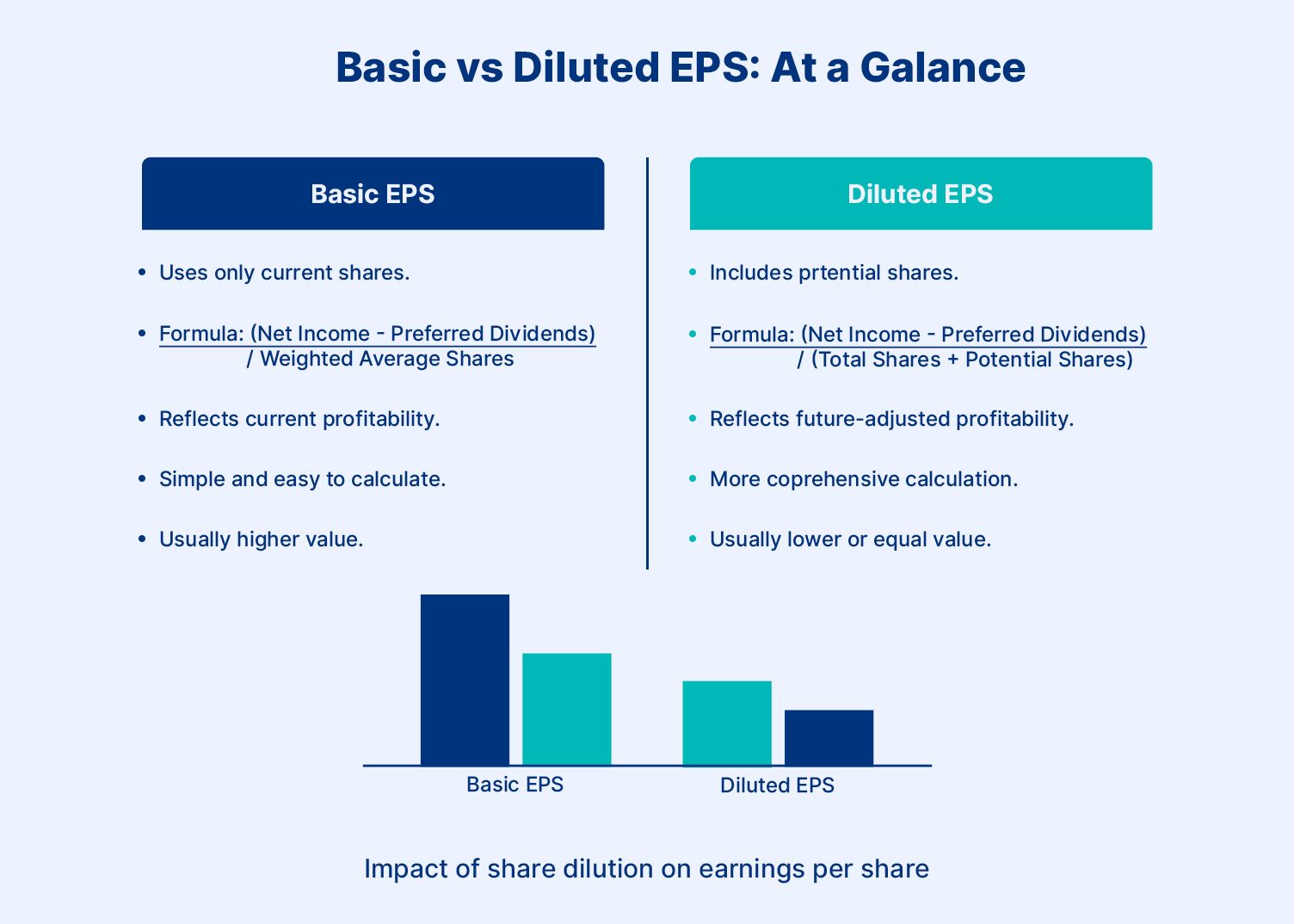
Basic EPS = (Net Income - Preferred Dividends) / Weighted Average Shares
Weighted Average Shares
The reason for using weighted average shares EPS instead of just the overall number of equity shares is that weighted average shares accounts for changes in the number of shares during a reporting period. It ensures that the calculation reflects a more accurate average rather than a simple ending share count.
As it is widely used in financial reporting, a company's EPS can be easily found in its annual reporting disclosures. It helps investors quickly assess how efficiently a company is generating profits relative to its current share base. However, it does not account for future dilution, which can affect actual earnings per share over time.
What Is Diluted EPS?
Diluted EPS is like a more accurate, standardised version of earnings per share. Unlike basic EPS, which only considers current shares. Diluted EPS also considers the impact of potential shares that could be created in the future. In simple terms, diluted shares outstanding meaning is that the total share count increases if all convertible securities are exercised; therefore, they are also considered even if they do not yet exist.
These may arise from instruments such as stock options, warrants, or convertible securities. Considering diluted shares provides a more conservative estimate of earnings.
The diluted EPS formula is:
Diluted EPS = (Net Income - Preferred Dividends) / (Total Shares + Potential Shares)
Why it accounts for potential share dilution
The reason diluted EPS accounts for potential share dilution is that it gives the investors a more realistic understanding of how their earnings may change if these additional shares enter the market. It also helps explain why diluted EPS is lower than basic EPS, as the same earnings are distributed across a larger number of shares.
Basic Vs Diluted EPS Comparison
While both basic and diluted EPS are important metrics for investors, understanding the difference between the two would allow investors to get a more comprehensive view of their earnings and what they might look like. It will also help investors better interpret a company’s financial performance from both current and future perspectives.
| Aspect | Basic EPS | Diluted EPS |
| Formula | Uses current shares only | Includes potential shares |
| Share Count | Weighted average shares | Shares + convertible securities |
| Complexity | Simple calculation | More comprehensive calculation |
| Interpretation | Current profitability | Future-adjusted profitability |
| EPS Value | Higher | Lower or equal |
1. Why Investors Should Track Both
Investing is already a time-consuming task that requires caution, regular oversight and intervention. Adding more to it by considering both basic and diluted EPS might look like a pointless addition.
However, the extra time you invest in looking into both might just be the difference between being exposed to adjusted returns in the future vs uninterrupted growth.
2. Evaluating company valuation
The first advantage of comparing basic and diluted EPS is that it allows you to assess the company more clearly by providing a clearer picture of both. The reason is that diluted EPS provides a more accurate estimate by accounting for future situations, whereas basic EPS offers only a brief glimpse of profitability.
To evaluate valuation, basic EPS is frequently used alongside metrics such as the EPS-to-PE ratio, whereas diluted EPS accounts for the potential for future earnings per share to be reduced by additional shares. Investors can avoid overestimating a company's genuine earning capability by being aware of both.
3. Identifying dilution risk
Another big reason to consider both basic and diluted EPS is that it helps in identifying the risk of dilution against the current scenarios. Diluted EPS helps investors better appreciate the risks of dilution by highlighting the potential impact of additional shares entering the market.
Additionally, it sheds light on how financial instruments such as stock options and convertible securities can affect profits. The emphasis remains on identifying situations where dilution might occur, even though some securities, known as anti-dilutive securities, do not always lower EPS.
Conclusion
Understanding the difference between basic and diluted EPS gives you a much clearer view of a company’s true earning power. While basic EPS shows what a company earns today, diluted EPS helps you see what those earnings could look like if all potential shares come into play.
What this really means is, if you only look at basic EPS, you might overestimate returns. But when you consider diluted EPS as well, you’re making a more realistic, risk-aware investment decision.
For investors exploring fixed-income or equity-linked opportunities, platforms like Grip Invest can help simplify this process by offering curated insights, transparent data, and easy access to investment options—so you can evaluate returns with more confidence and clarity.
FAQs
1. Why is diluted EPS important for investors?
For investors, diluted earnings per share (EPS) is an important indicator since it gives an indication of future earnings. It helps investors evaluate dilution risk and comprehend a company's actual profit potential by illustrating how current earnings can drop if more shares are issued.
2. Where can I find basic and diluted EPS in an annual report?
You can typically find both basic and diluted EPS in the company’s income statement or notes to financial statements in its annual report. Public companies are required to disclose both figures.
3. Can diluted EPS ever be higher than basic EPS?
No, diluted EPS is always equal to or lower than basic EPS. If including potential shares increases EPS, those securities are considered anti-dilutive and are excluded from the calculation.
4. How do stock options affect diluted EPS?
Stock options increase the total number of shares when exercised, which spreads the same earnings over more shares. This reduces EPS, making diluted EPS lower than basic EPS.
Want to stay at the top of your finances?
Join the community of 4 lakh+ investors and learn more about Grip Invest, the latest financial knick-knacks, and shenanigans in the world of investing.
Happy Investing!
Disclaimer - Investments in debt securities/municipal debt securities/securitised debt instruments are subject to risks including delay and/ or default in payment. Read all the offer related documents carefully. The investor is requested to take into consideration all the risk factors before the commencement of trading.
This communication is prepared by Grip Broking Private Limited (bearing SEBI Registration No. INZ000312836 and NSE ID 90319) and/or its affiliate/ group company(ies) (together referred to as “Grip”) and the contents of this disclaimer are applicable to this document and any and all written or oral communication(s) made by Grip or its directors, employees, associates, representatives and agents. This communication does not constitute advice relating to investing or otherwise dealing in securities and is not an offer or solicitation for the purchase or sale of any securities. Grip does not guarantee or assure any return on investments and accepts no liability for consequences of any actions taken based on the information provided. For more details, please visit www.gripinvest.in
Registered Address - 106, II F, New Asiatic Building, H Block, Connaught Place, New Delhi 110001


