

Bid Ask Spread Explained: Meaning, Formula And Bond Trading Example


While trading bonds, you might notice that the price buyers are willing to pay is a little different from the price sellers are asking. This difference is called the bid-ask spread, indicating a bond's liquidity and the cost of executing a trade. Understanding the bid-ask spread can help investors make better decisions about bond investments.
Bid-Ask Spread: Meaning And Why It Exists
The bid-ask spread refers to the difference between the highest price a buyer is willing to pay (bid) and the lowest price a seller is willing to accept (ask) at a given point in time. The spread exists because buyers and sellers generally value the bond differently. And it compensates market makers for providing liquidity and assuming the risk of facilitating trades.
When referring to the secondary market spread, the bid price is the price at which you can sell your bonds, while the ask price is the price at which you buy them. The difference gives you the implicit transaction cost of trading bonds that will affect your real returns.
Market makers are the ones who come between buyers and sellers and earn the spread for creating liquidity. They purchase at bid prices and sell at ask prices.
Hypothetical Example
Imagine a corporate bond with a bid and an ask price of INR 98 and INR 99, respectively. This means that the bid-ask spread is INR 1. If you buy the bond at the ask price (INR 99) and immediately sell it at the bid price (INR 98), you would incur a loss of INR 1 per bond due to the bid-ask spread.
How The Bid-Ask Spread Is Calculated?
The bid-ask spread calculation is simple. It is calculated by subtracting the bid price from the ask price to determine the absolute spread. The spread can also be expressed as a percentage of the asking price, allowing investors to compare the trading costs of different bonds more effectively.
- Formula Absolute Spread = Ask Price – Bid Price.
- Percentage Spread = (Ask Price – Bid Price) / Ask Price x 100.
This percentage can help investors understand the cost of trading a bond and compare trading costs across different bonds.
Hypothetical Example
A government bond has the bid of INR 99.50 and the ask of INR 99.80. This gives the absolute spread of INR 0.30 and a percentage spread of around 0.3%. If we consider a corporate bond with bid INR 95 and ask INR 97, we can see that it has a larger spread of INR 2 or 2.1%. This indicates that less liquid bonds generally have wider bid-ask spreads than more liquid bonds.
What Influences the Bid-Ask Spread?
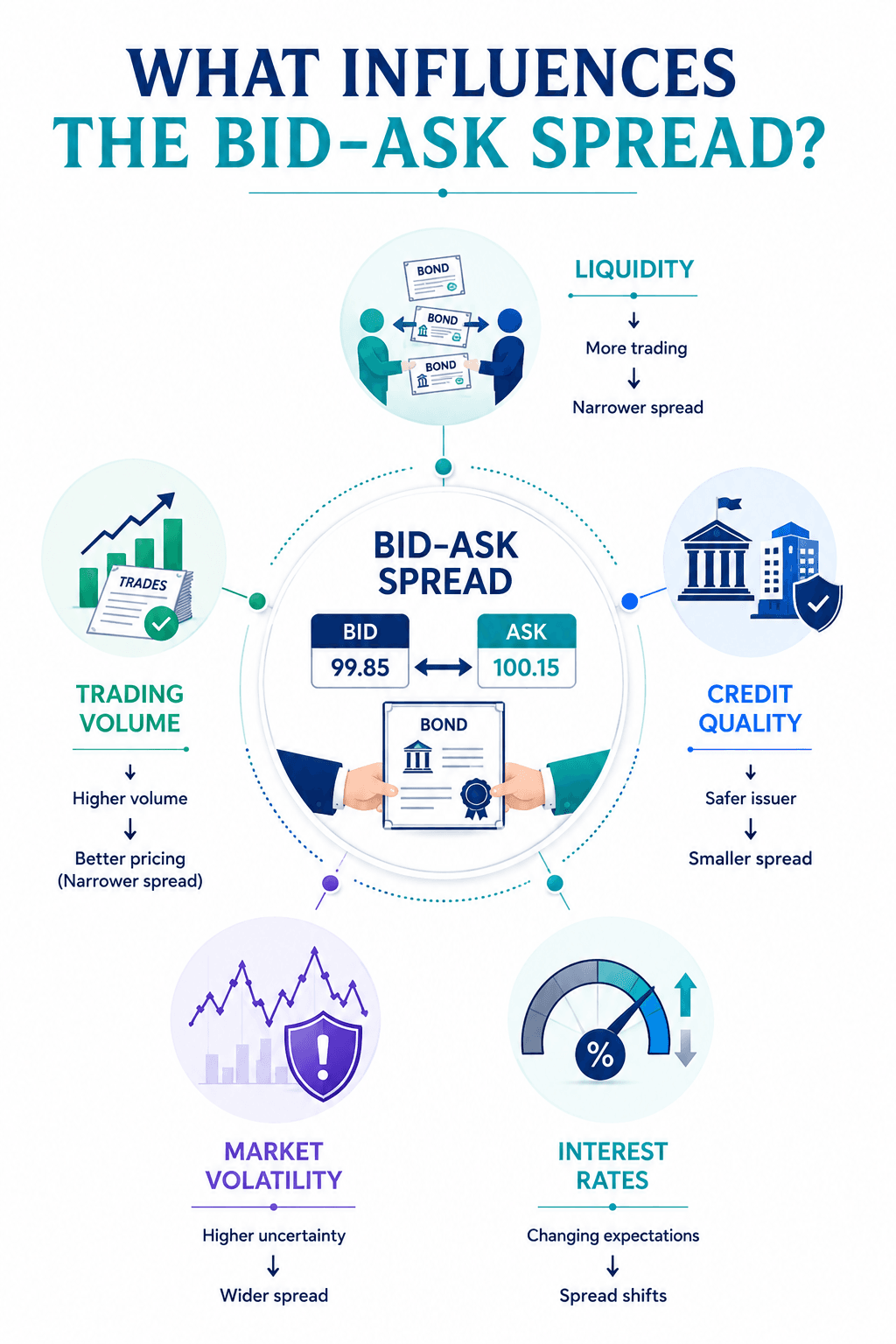
Multiple aspects play a role in determining whether the spread is large or small:
- Bond Liquidity: The more bonds in supply and demand on the market, the smaller the spreads.
- Credit Quality: The safest financial instruments are government bonds that normally have smaller spreads than more risky corporate bonds.
- Interest Rates: Changes in interest rate expectations can influence the volume of operations and spreads.
- Market Volatility: Uncertain situations are quite often followed by wider spreads that are used by market makers for protection.
- Volume of Transactions: The higher the volume, the smaller the spread.
How Bid Ask Spread Affects Your Actual Returns
The bid ask spread represents an indirect trading cost that investors incur whenever they buy and sell bonds in the secondary market.
Consider two investors purchasing the same corporate bond.
- Investor A buys at INR 100 and sells later at INR 99.80 because of a narrow spread.
- Investor B buys another bond at INR 100 but sells at INR 98 due to a wider spread.
Although both bonds generated similar coupon income, Investor A retains a larger portion of the investment because lower transaction costs reduce the impact on overall returns.
For investors who trade frequently or invest in less liquid bonds, the cumulative effect of wider bid ask spreads can materially reduce realised returns.
This is why investors should evaluate not only the coupon rate and yield but also the liquidity of the bond before investing.
Why Investors Should Pay Attention To The Bid Ask Spread?
Bid-ask spreads represent the transaction cost bonds investors pay when buying and selling in the secondary market. Wider spreads mean higher trading costs and lower net returns from selling.
In active trading, such costs can accumulate into significant sums. Understanding bid-ask spreads can help investors achieve better trade execution. Buying and selling a lot of liquid bonds with narrow spreads makes it easier to enter and exit positions. Though long-term investors trade less frequently, it is still necessary to remember the expenses involved.
Real-world Comparison
Government bonds are usually characterised by narrow spreads because of their high liquidity in the market. On the contrary, corporate bonds (especially those issued by small issuers) can have wider spreads. Less-liquid bonds are even more likely to have wider spreads.
Market making is also important. Market makers give liquidity to the market, but they charge for the service provided through the bid-ask spread.
Wide Spread vs Narrow Spread: What Does It Indicate?
The size of the bid ask spread often reflects how easily a bond can be traded.
| Narrow Spread | Wide Spread |
| Higher liquidity | Lower liquidity |
| Active trading | Limited buyers and sellers |
| Lower transaction cost | Higher transaction cost |
| Common in government bonds | More common in lower-traded corporate bonds |
A narrow spread generally indicates an active market where buyers and sellers are readily available. A wider spread may indicate lower liquidity, greater uncertainty or higher risk perceived by market participants.
However, a wider spread does not automatically mean that a bond is a poor investment. Investors should interpret the spread alongside factors such as credit quality, maturity, issuer strength and market conditions.
Looking Beyond Prices While Investing In Bonds
Although the bid-ask spread holds major significance in transaction expenses, successful bond investing requires you to consider numerous other factors. This means you should consider credit quality, yield, maturity, and duration. Besides, diversifying across different types of bonds can minimise risks associated with liquidity premiums, since different markets have different levels of risk.
Grip Invest provides its clients with access to unique practices pertaining to fixed income opportunities that have been evaluated beforehand. Furthermore, it provides customers with detailed information about the issuer of the security.
FAQs On Bid-Ask Spread
 |
Author: Grip Invest Editorial Team The Grip Invest Editorial Team is a group of Chartered Accountants, MBA (Finance) graduates, and Qualified Research Analysts dedicated to helping you invest smarter. We dive deep into India's fixed income landscape to deliver content that is accurate, up-to-date, and easy to understand. Whether you're exploring bonds, fixed deposits, or other fixed income opportunities, our guides cut through the noise and give you the clarity to make better financial decisions. |
Want to stay at the top of your finances?
Join the community of 4 lakh+ investors and learn more about Grip Invest, the latest financial knick-knacks, and shenanigans in the world of investing.
Happy Investing!
Disclaimer - Investments in debt securities/municipal debt securities/securitised debt instruments are subject to risks including delay and/ or default in payment. Read all the offer related documents carefully. The investor is requested to take into consideration all the risk factors before the commencement of trading.
This communication is prepared by Grip Broking Private Limited (bearing SEBI Registration No. INZ000312836 and NSE ID 90319) and/or its affiliate/ group company(ies) (together referred to as “Grip”) and the contents of this disclaimer are applicable to this document and any and all written or oral communication(s) made by Grip or its directors, employees, associates, representatives and agents. This communication does not constitute advice relating to investing or otherwise dealing in securities and is not an offer or solicitation for the purchase or sale of any securities. Grip does not guarantee or assure any return on investments and accepts no liability for consequences of any actions taken based on the information provided. For more details, please visit www.gripinvest.in
Registered Address - 106, II F, New Asiatic Building, H Block, Connaught Place, New Delhi 110001


