

Collateral Coverage Ratio: Formula, Calculation And Importance For Bond Investors


A bond may offer an attractive interest rate, but what happens if the issuer cannot repay investors? One way to assess this risk is through the Collateral Coverage Ratio (CCR), which measures whether the value of pledged assets is sufficient to cover secured borrowings. Understanding CCR helps investors evaluate the level of protection available before investing in secured bonds or loans.
Collateral Coverage Ratio: Meaning And Importance
The Collateral Coverage Ratio compares the value of the assets pledged as collateral with the amount of the loan or bond issued. The ratio is used by lenders in order to determine the level of protection against problems in case something happens to the borrower. The higher the ratio, the better the coverage and lower the risk for the lender.
The Collateral Coverage Ratio is important because it shows that the amount of collateral (assets) is more than the amount borrowed. It helps to find out how good the secured bond collateral is and how much could be recovered in case of difficulties. For investors, this ratio gives a good idea about the safety of the debt investment.
Hypothetical Example
Priya lent money to a company and took machinery as collateral. The collateral coverage ratio allows Priya to find out whether the value of the machinery will be sufficient for the repayment of the loan.
Why Is Collateral Coverage Ratio Important?
- Helps estimate downside protection
- Indicates cushion available for lenders
- Useful for comparing secured issuers
- Supports credit analysis
- Complements credit ratings
Types Of Assets Used As Collateral
Not all collateral provides the same level of protection. Lenders generally prefer assets that can be valued accurately and sold quickly if repayment issues arise.
| Type Of Asset | Typical Quality As Collateral |
| Cash and Bank Deposits | Very High |
| Government Securities | High |
| Residential or Commercial Property | High to Moderate |
| Plant and Machinery | Moderate |
| Inventory | Moderate to Low |
| Receivables | Moderate |
| Intangible Assets (Patents, Trademarks) | Generally Lower |
Assets with stable values and active markets usually require smaller valuation discounts. In contrast, specialised machinery or inventory may attract higher discounts because they can be more difficult to sell during recovery proceedings.
How To Calculate The Collateral Coverage Ratio?
The process of determining CCR is quite simple. It can be calculated by dividing the discounted value of the assets by the total amount secured in the form of bonds or loans.
Basic Formula: Collateral Coverage Ratio = Discounted Collateral Value ÷ Total Loan Amount
The formula components include the current fair market value of the assets and the discount rate decided by lenders. The discount rates differ based on the type of asset being valued. For example, the rate of discount for real estate will be lower than in the case of equipment.
Numerical Example
Let’s suppose that a company pledges its assets of INR 1 crore as security against a loan of INR 60 lakh. Say the lender is applying a discount rate of 20%, which results in a discounted value of assets being INR 80 lakh. So, the ratio turns out to be INR 80 lakh/INR 60 lakh = 1.33, thereby meaning that the pledge covers the entire amount of the loan effectively.
What Is Considered A Good Collateral Coverage Ratio?
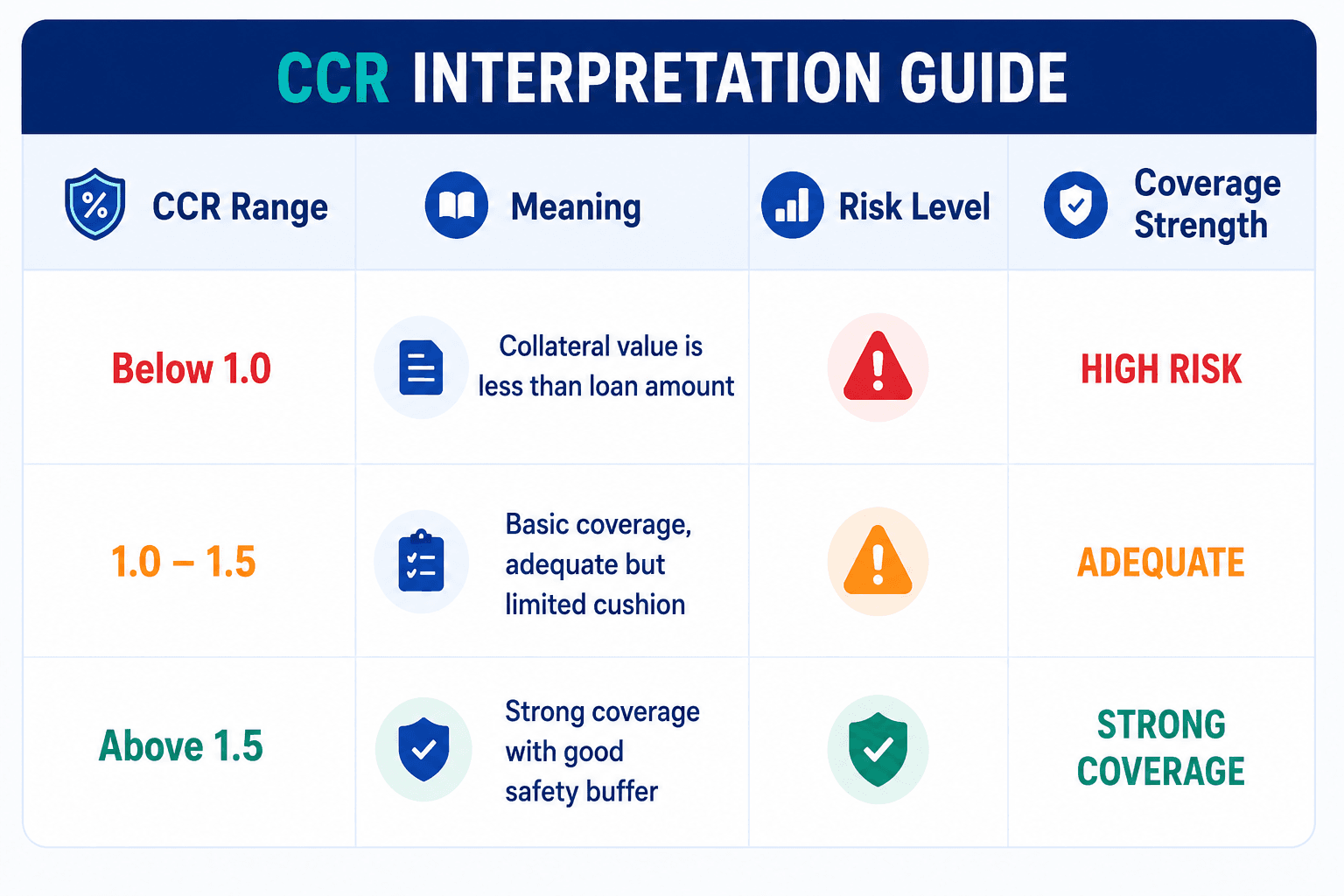
Usually, any ratio higher than 1 is considered the bare minimum because it means that a borrower has sufficient collateral to cover any debt.
However, many lenders will prefer ratios of 1.5 and higher for added safety.
Different industries also matter. Some businesses work in stable sectors that accept lower ratios while some in risky industries call for a higher coverage.
Limitations
The Collateral Coverage Ratio must be evaluated alongside the credit ratings, financial health, cash flows, and debt-servicing ability of the issuer for a comprehensive assessment. Note that this ratio is based on certain calculations and assumptions. Any change in the market conditions or depreciation of the assets may influence the recovery after default. It should never be used alone.
Hypothetical Example
A manufacturing company enjoys a good 2.0 collateral coverage ratio due to the presence of great machinery. However, if these assets become obsolete, the effective coverage may be lower in practice.
Factors That Affect The Collateral Coverage Ratio
There are various factors that can impact the Collateral Coverage Ratio:
- Value of Assets: The increased quality helps improve the CCR
- Additional Borrowing: More debt against the collateral indicates a lower CCR
- Depreciation: Decreasing value of assets eventually reduces coverage
- Market Conditions: Slow economic times may increase haircuts and influence valuations.
Common Mistakes Investors Make
Only relying on the ratio while neglecting asset quality and the industry situation is one such mistake that most investors make. Always ensure combining the Collateral Coverage Ratio with recovery analysis, issuer’s financial health, and other credit metrics.
Compare ratios for different types of bonds. Government bonds generally rely on the creditworthiness of the sovereign rather than pledged collateral, whereas collateral analysis is more relevant for many secured corporate borrowings.
Investors must always compare the ratio across similar issuers rather than relying on it as a standalone measure. As stated, combining it with other credit metrics gives a more balanced view of investment risk.
Using Financial Ratios Before Investing In Bonds
Astute investors do not rely on credit ratings and issuers' fundamentals solely. Instead, they assess various ratios, including the Collateral Coverage ratio, which is particularly significant in determining the coverage of secured borrowings. The Collateral Coverage Ratio complements loan to value for bonds by helping investors analyse if pledged assets offer enough protection against default.
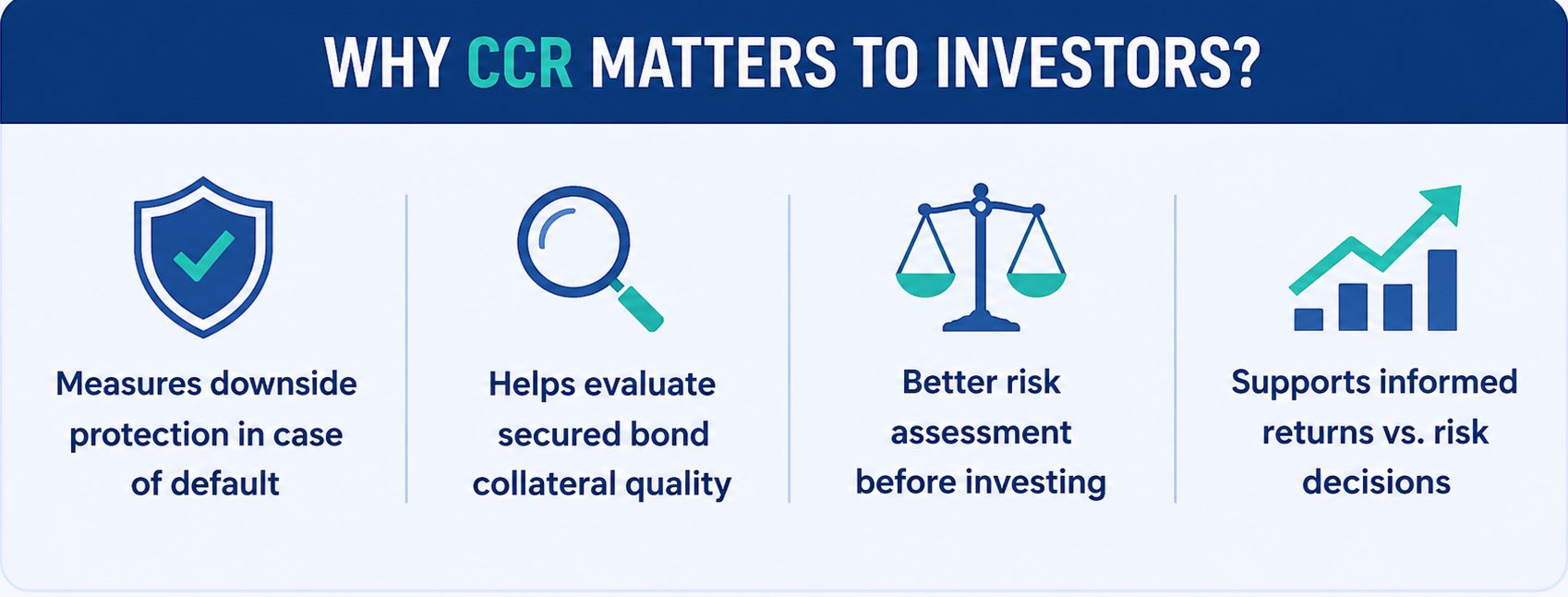
While the collateral coverage ratio helps assess downside protection, investors must also review debt levels, credit ratings, issuer fundamentals, and industry outlook before making an investment decision.
Moreover, platforms such as Grip Invest provide users with complete information regarding the issuer, making ratio analysis easier and investment decisions more accurate. Investors need to diversify their investments and monitor their portfolio and the issuer's financial performance regularly to reduce the overall risks.
FAQs On Collateral Coverage Ratio
 |
Author: Grip Invest Editorial Team The Grip Invest Editorial Team is a group of Chartered Accountants, MBA (Finance) graduates, and Qualified Research Analysts dedicated to helping you invest smarter. We dive deep into India's fixed income landscape to deliver content that is accurate, up-to-date, and easy to understand. Whether you're exploring bonds, fixed deposits, or other fixed income opportunities, our guides cut through the noise and give you the clarity to make better financial decisions. |
Want to stay at the top of your finances?
Join the community of 4 lakh+ investors and learn more about Grip Invest, the latest financial knick-knacks, and shenanigans in the world of investing.
Happy Investing!
Disclaimer - Investments in debt securities/municipal debt securities/securitised debt instruments are subject to risks including delay and/ or default in payment. Read all the offer related documents carefully. The investor is requested to take into consideration all the risk factors before the commencement of trading.
This communication is prepared by Grip Broking Private Limited (bearing SEBI Registration No. INZ000312836 and NSE ID 90319) and/or its affiliate/ group company(ies) (together referred to as “Grip”) and the contents of this disclaimer are applicable to this document and any and all written or oral communication(s) made by Grip or its directors, employees, associates, representatives and agents. This communication does not constitute advice relating to investing or otherwise dealing in securities and is not an offer or solicitation for the purchase or sale of any securities. Grip does not guarantee or assure any return on investments and accepts no liability for consequences of any actions taken based on the information provided. For more details, please visit www.gripinvest.in
Registered Address - 106, II F, New Asiatic Building, H Block, Connaught Place, New Delhi 110001


