

City Compensatory Allowance Explained: Meaning, Eligibility, And Tax Impact


Over the years, living in Indian cities has become expensive. Witnessing a stretch in monthly budgets due to rising rent, commuting costs, food prices, and healthcare expenses has continued for salaried professionals. Employers often include a city compensatory allowance as part of the salary structure to manage the rising imbalance.
More than 56% of the world's population lives in urban areas, as stated by the United Nations, which will reach 68% by 20501. With cities growing in population, the cost of living is also rising above the average wage growth.
Due to this, the city compensatory allowance plays a crucial role in supporting employees against location-specific expenses. Read through to understand the CCA allowance meaning, how it works, and who is eligible for it.
Why City Compensatory Allowance Matters For Salaried Employees?
When compared to small towns, salaried city employees face a different financial reality. Even when the nominal salary appears competitive, higher daily expenses reduce disposable income. This highlights the significance of a city's compensatory allowance.
1. Rising urban living costs
People living in urban households have higher expenditure on housing, transport, healthcare, and food. According to studies done at the McKinsey Global Institute, housing and mobility costs account for a disproportionately large share of urban spending worldwide. This reduces monthly savings for salaried employees and increases dependence on allowances to maintain financial stability.
2. Why CCA exists
To compensate employees for location-based cost differences, a compensatory allowance exists. It is used by employers as a uniform method to balance salaries across postings without changing base pay.
To attract and retain talent, government departments and public sector undertakings use them in expensive cities where cost pressures are structurally higher.
3. What this blog will cover
In this blog, we will discuss the CCA allowance, meaning, eligibility criteria, calculation methods, and applicable cities. We will also break down the city compensatory allowance tax impact on your salary.
What Is City Compensatory Allowance (CCA)?
The city compensatory allowance is a salaried component designed to offset increased expenses related to housing, transport, and daily necessities. CCA is location-based and remains fixed as long as the employee is posted in an eligible city.
1. Definition and purpose
The city compensatory allowance is a compensatory payment made to an employee's basic salary account to offset high living costs. The primary purpose of this allowance is to maintain the employees’ purchasing power without altering the base pay structure. The city compensatory allowance helps employers ensure fairness in compensation across different locations.
2. Who receives it
Employees working in a designated position in a high-cost city are eligible for the CCA, which is subject to employer policy. This allowance is commonly provided to government employees, bank employees, and public sector staff. Eligibility is highly dependent on the employee’s place of posting rather than designation or performance.
3. Cities where CCA is applicable
The CCA is applicable in metro cities and select tier-1 urban centres. These include cities like Delhi, Mumbai, Kolkata, Chennai, Bengaluru, and Hyderabad. Employers are also extending city compensatory allowances to emerging urban hubs where living costs are rising rapidly.
How is City Compensatory Allowance Calculated?
The amount of city compensatory allowance given to an employee depends on where they work and the employer’s policy. Let's understand this using examples:
1. Salary structure placement
Let us consider two employees. Employee A works in Kolkata, and Employee B works in a tier-3 town, where both earn a basic salary of Rs. 35,000 per month. Now Employee A receives an additional Rs. 1800 as a CCA because Kolkata is classified as a high-cost city, whereas Employee B does not receive any CCA because living costs in that location are comparatively lower.
2. Employer discretion
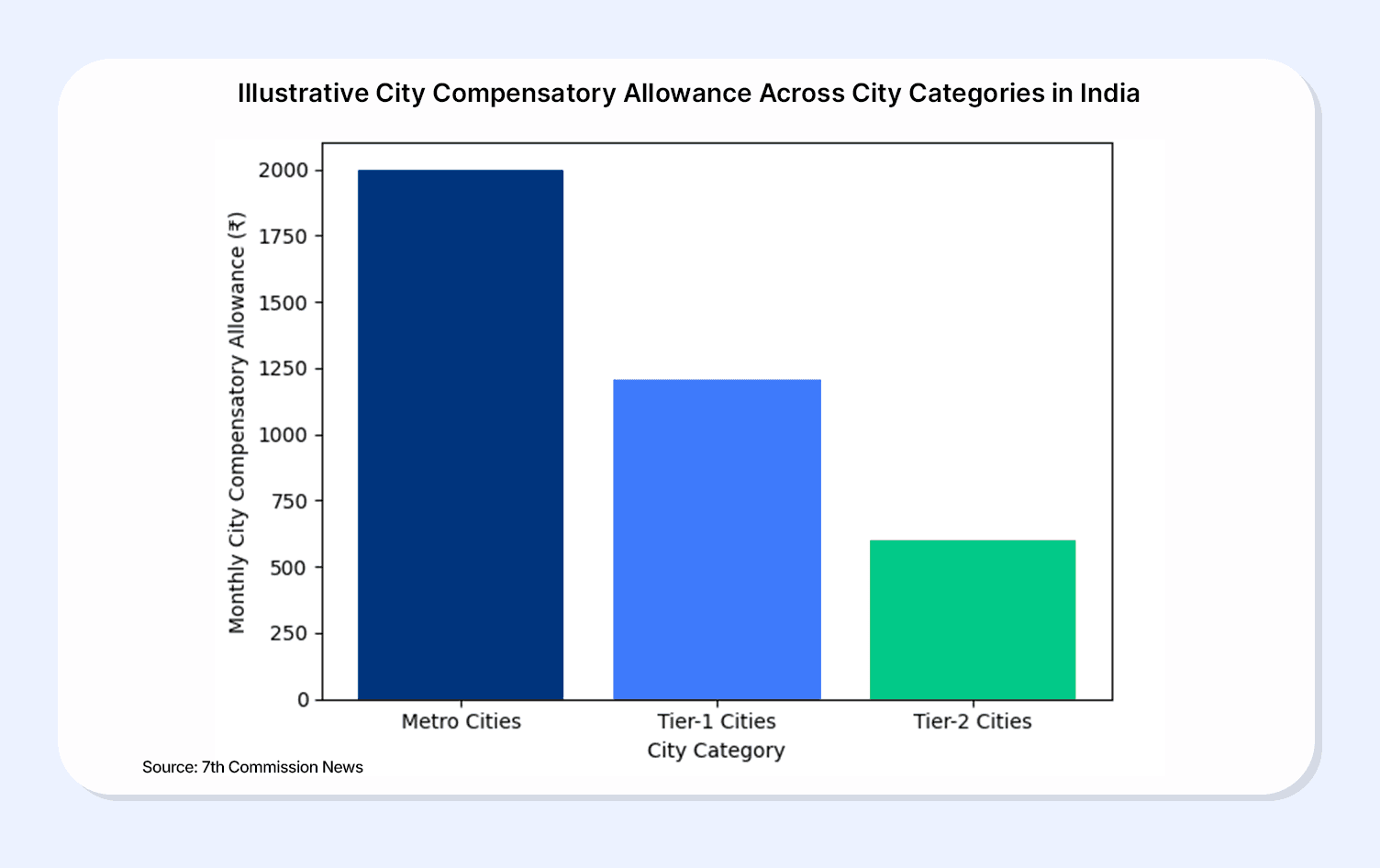
Usually, a public sector bank pays a fixed CCA amount based on the city category. For example, employees with metro city postings will get Rs. 2000 per month, Tier 1 city postings will receive Rs. 1200, and Tier 2 city postings will receive Rs. 600 per month. So an employee transferring from Mumbai to a tier 2 location will have a reduction in city allowance from Rs. 2000 to Rs. 600 per month.
3. Variation across states and sectors
Let's say we have an employee in Delhi who may receive Rs. 1000 as CCA under a standardised pay structure, while an employee in the private sector, in the same city, is receiving a CCA of Rs. 4000 under a flexible salary allowance in India. Here we can see a considerable hike in CCA depending on the sector, where both are in the same city.
Tax Treatment of City Compensatory Allowance
Under the Income Tax Act, 1961, the city compensatory allowance is treated as a fully taxable component of the salary. There are no specific exemptions or deductions available for CCA, unlike certain other allowances.
Aspect | City Compensatory Allowance (CCA) |
Taxability | Fully taxable |
Applicable Law | Income Tax Act, 1961 |
Included In | Gross salary income |
Availability of Tax Exemption | None |
Slab-Based Tax | Yes, taxed as per the applicable income tax slab |
Impact on Take-Home Salary | Reduces net benefit due to tax deduction |
Eligible for Deductions | No direct deductions linked to CCA |
How Salaried Employees Can Offset CCA Tax Impact?
Managing the impact of city compensatory allowances should be thoughtful financial planning rather than tax exemptions, since they are taxable.
Using predictable income instruments
The City compensatory allowance, which is a taxable salary component, increases monthly cash flow, also raising tax liability. You can create a structured post-tax cash flow by allocating a portion of this income to predictable investment instruments. Fixed-income products are best suited for salaried individuals as they provide visibility on return and maturity timelines.
Fixed income options to manage post-tax cash flows
Fixed income products include corporate bonds, non-market-linked debt instruments, and other income-generating assets that can help balance the impact of allowances.
Trusted platforms like Grip Invest offer employees a curated list of fixed-income options that align their salary planning with predictable income instruments.
Conclusion
The City compensatory allowance plays a major role in helping salaried employees. It helps them manage the higher costs of living in urban cities while also providing additional income support. You can assess the real impact of CCA by learning how it is structured, calculated, and taxed.
Aligning your salary planning effectively, rather than relying on tax exemptions, is the key to managing taxes for a salaried professional. This can be achieved by optimising your earnings beyond traditional salary components. Platforms like Grip make it easier for you to invest without any safety concerns, as they offer a curated list of such investment instruments.
To explore your investment options while also ensuring transparency and discipline, invest with Grip Invest today!
FAQs
1. Is the city compensatory allowance taxable?
The city compensatory allowance is fully taxable under the Income Tax Act, 1961. This is treated as your salary and is also added to your gross taxable income.
2. Is CCA applicable to private sector employees?
The CCA applies to private sector employees. But it depends entirely on employer policy. CCA is more common in the government and public sectors, but is also included by various private companies offering a location-based allowance within the overall salary allowance in the Indian framework.
3. How is CCA different from HRA?
The major difference between CCA and HRA lies in the taxation and purpose. The city compensatory allowance is paid to offset higher living costs and is also fully taxable. Whereas, house rent allowance is specifically meant for rental expenses and offers partial tax exemptions.
4. Can fixed-income investments help manage salary taxes?
Fixed income investment can help manage the tax impact of taxable components, which include the city compensatory allowance. You can create a stable income flow with the help of predictable income options such as corporate
References:
1. United Nations, accessed from: https://www.un.org/development/desa/pd/sites/www.un.org.development.desa.pd/files/undesa_pd_2025_wup2025_summary_of_results.pdf?utm_
2. 7th Commission News, accessed form: https://7thpaycommissionnews.in/7th-cpc-allowances-list-of-abolished-allowances/
Want to stay at the top of your finances?
Join the community of 4 lakh+ investors and learn more about Grip Invest, the latest financial knick-knacks and shenanigans that take place in the world of investing.
Happy Investing!
Disclaimer - Investments in debt securities/municipal debt securities/securitised debt instruments are subject to risks including delay and/ or default in payment. Read all the offer related documents carefully. The investor is requested to take into consideration all the risk factors before the commencement of trading.
This communication is prepared by Grip Broking Private Limited (bearing SEBI Registration No. INZ000312836 and NSE ID 90319) and/or its affiliate/ group company(ies) (together referred to as “Grip”) and the contents of this disclaimer are applicable to this document and any and all written or oral communication(s) made by Grip or its directors, employees, associates, representatives and agents. This communication does not constitute advice relating to investing or otherwise dealing in securities and is not an offer or solicitation for the purchase or sale of any securities. Grip does not guarantee or assure any return on investments and accepts no liability for consequences of any actions taken based on the information provided. For more details, please visit www.gripinvest.in
Registered Address - 106, II F, New Asiatic Building, H Block, Connaught Place, New Delhi 110001


