

Debenture Redemption Reserve Explained: Why It Matters To Investors


Lending money to a company through the purchase of a debenture is a bet on that company's future ability to pay you. What if, five years into the term, the company suddenly finds it has been too optimistic about setting aside sufficient cash to cover its debt?
That is where the Debenture Redemption Reserve (DRR) comes in. The DRR is basically a regulatory safety net that would prevent that "fixed income" from becoming a "fixed loss" for the retail investor. In this guide, we will break down the intricacies of the DRR, its legal requirements in 2025, and how it protects your capital.
What Is A Debenture Redemption Reserve?
Essentially, debenture redemption reserve applicability tool. According to the DRR creation Companies Act 2013, every Indian company that issues debentures is required to make available a certain amount of its profits in a specific account called the DRR.
Think of this as a kind of "repayment bucket." The company cannot use money that is deposited into this bucket for either dividends to its shareholders or business operations in general. It is only intended for one purpose: repaying the debenture holders when the debt matures.
The Legal Logic
This was made mandatory by the MCA to ensure that companies do not default in servicing their debt due to liquidity shortages. By building this reserve out of divisible profits, the law ensures that the company's net worth is preserved for servicing its debt.
When Is DRR required? - The 2025 Rules
The rules concerning DRR rules India have undergone much change. Whereas it was once compulsory for almost everybody, the government has relaxed debenture redemption reserve percentage 2025 for some entities in a bid to encourage ease of doing business.
DRR requirement Unlisted Companies India by Entity Type
| Type of Issuer | DRR Requirement | Rationale |
| All India Financial Institutions (AIFIs) | Exempt | Regulated directly by RBI. |
| Banking Companies | Exempt | Strict SLR/CRR requirements already exist. |
| Listed NBFCs & HFCs | Exempt | Regulated by RBI/NHB; high transparency. |
| Unlisted NBFCs & HFCs | Exempt | Simplified for financial intermediaries. |
| Listed Companies (Non-NBFC) | Exempt | Disclosure norms provide enough safety. |
| Unlisted Companies (Non-NBFC) | 10% of Outstanding Value | Protects investors in less transparent entities. |
The "10% Rule" for Unlisted Companies
In case an unlisted entity issues debentures through a public issue or on private placement, it shall create a DRR 10% outstanding debentures of the value of its outstanding debentures.
Hypothetical Example: Let DRR exemptions listed companies like Solaris Tech Pvt Ltd, being an unlisted company issues debentures amounting to INR 100 Crores. According to the DRR requirement for unlisted companies in India, Solaris needs to transfer an amount of INR 10 Crores from its profit-and-loss account to the unlisted company DRR rules account before the maturity of the debentures.
DRR Vs DRI Difference
Investors seem to confuse DRR very often with Debenture Redemption Investment DRI. While DRR is only an accounting entry, DRI is the actual "cash" element.
- DRR: A book entry transferring profits to a reserve.
- DRI: A requirement to invest a minimum of 15% of the debentures maturing during a year in specified safe assets on or before April 30th of that year.
How DRR Impacts Debenture Safety
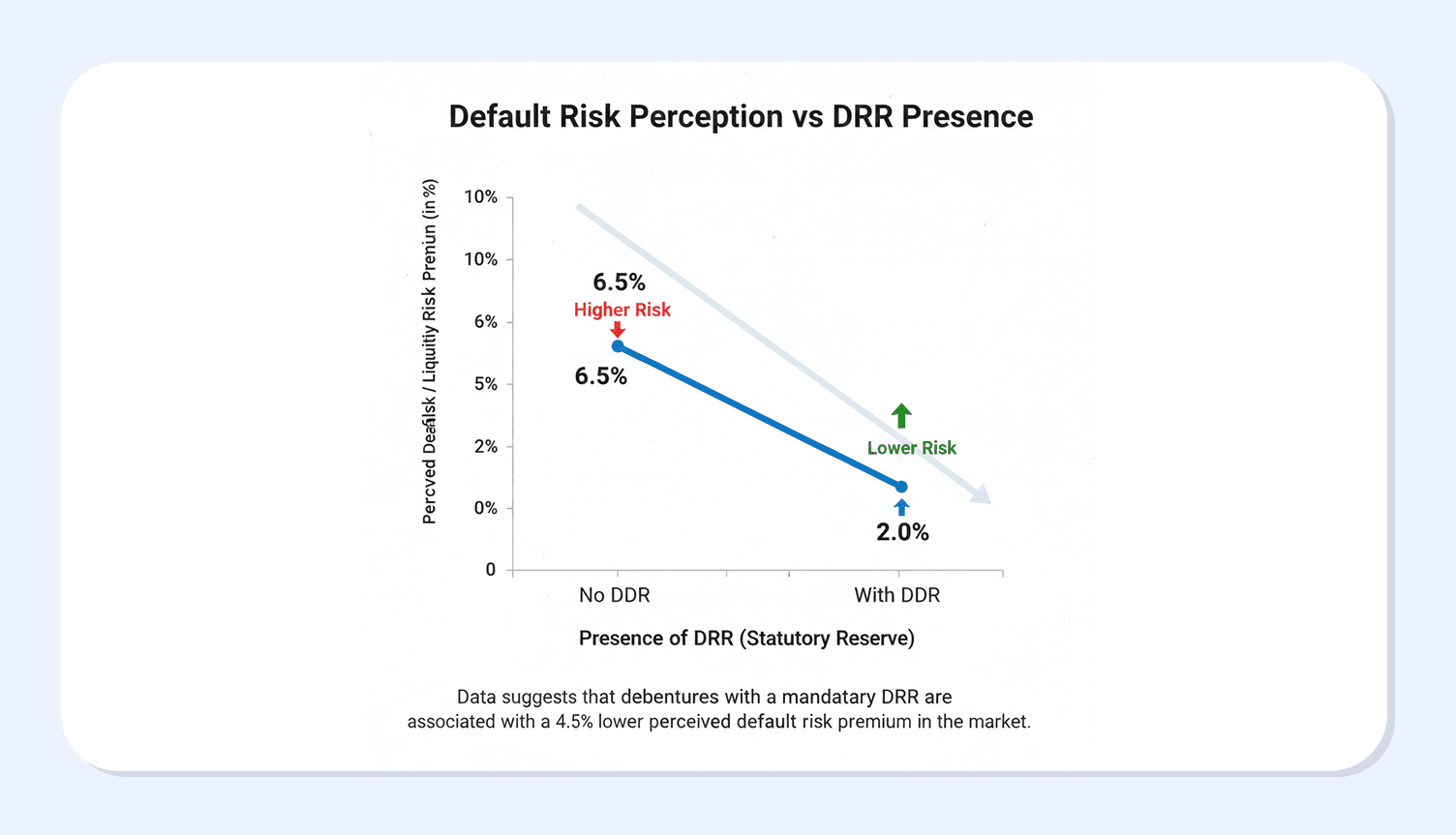
Is the debenture with a DRR inherently safer? Yes, here is why you sould consider debenture
maturity redemption India:
- Liquidity Assurance: It forces the company to plan its cash flows years in advance.
- Dividend Restriction: Since DRR is created from "divisible profits," the company is legally prohibited from giving that money away to the shareholders till the debenture holders are paid.
- Penalty for Non-Compliance: In the case of non-compliance with DRR rules or when a company is unable to repay, there will be a DRR penalty 2% interest payable to the debenture holders. Additionally, the company will face legal consequences under the NCLT.
Evaluating Debentures Beyond DRR
While DRR is an excellent safety feature, it is not a "guarantee." An investor has to look at the holistic picture:
- Credit Rating: A rating of 'AAA' or 'AA' from agencies like CRISIL or ICRA is often a stronger indicator of safety than a 10% reserve.
- Asset Cover: Ensure that the debentures are "Secured." That means, in case of failure of the company, you have a claim on specific assets (land, machinery, etc.).
- Adequacy of Cash Flow: What is the Debt Service Coverage Ratio? Does the company bring in enough each month to cover the interest?
Why Platform-Level Due Diligence Matters
For retail investors, all these legalities are often daunting to navigate. Platforms like Grip simplify this by performing rigorous due diligence. They vet the issuer's financial health, ensure the security structure is robust, and list only those opportunities where the risk-reward ratio is optimized for individual investors.
Looking to diversify your portfolio with curated fixed-income opportunities? Explore how you can invest in high-yield, vetted debentures through Grip Invest today.
FAQs
1. Is DRR mandatory for all debentures?
No. After amendments in 2019 and 2021, DRR is essentially applicable only to unlisted companies, i.e., Non-NBFCs/HFCs. Listed companies and all NBFC HFC DRR exemption at present.
2. Does DRR guarantee repayment?
No. The DRR is a reserve, not a guarantee. When a company entirely declares bankruptcy and has no remaining assets, it cannot conjure money via the DRR entry alone. One should always look at the DRI(Investment) for the actual availability of cash.
3. How can investors check if a company maintains DRR?
Investors can refer to the Annual Report of the company under the "Notes to Accounts" or the "Statutory Reserves" section. In the case of new issues, the same information is available in the Information Memorandum(IM).
Want to stay at the top of your finances?
Join the community of 4 lakh+ investors and learn more about Grip Invest, the latest financial knick-knacks and shenanigans that take place in the world of investing.
Happy Investing!
Disclaimer - Investments in debt securities/municipal debt securities/securitised debt instruments are subject to risks including delay and/ or default in payment. Read all the offer related documents carefully. The investor is requested to take into consideration all the risk factors before the commencement of trading.
This communication is prepared by Grip Broking Private Limited (bearing SEBI Registration No. INZ000312836 and NSE ID 90319) and/or its affiliate/ group company(ies) (together referred to as “Grip”) and the contents of this disclaimer are applicable to this document and any and all written or oral communication(s) made by Grip or its directors, employees, associates, representatives and agents. This communication does not constitute advice relating to investing or otherwise dealing in securities and is not an offer or solicitation for the purchase or sale of any securities. Grip does not guarantee or assure any return on investments and accepts no liability for consequences of any actions taken based on the information provided. For more details, please visit www.gripinvest.in
Registered Address - 106, II F, New Asiatic Building, H Block, Connaught Place, New Delhi 110001


