

Decision Fatigue: What It Is, How It Hurts Your Finances & How to Beat It


Imagine it is 8 PM. After a long day of replying to emails, attending meetings, managing deadlines, and taking constant decisions, someone asks, “Should we invest INR 10,000 in that mid cap fund or wait?” and you casually respond, “Just do it.”
That is not laziness, it is definitely decision fatigue.
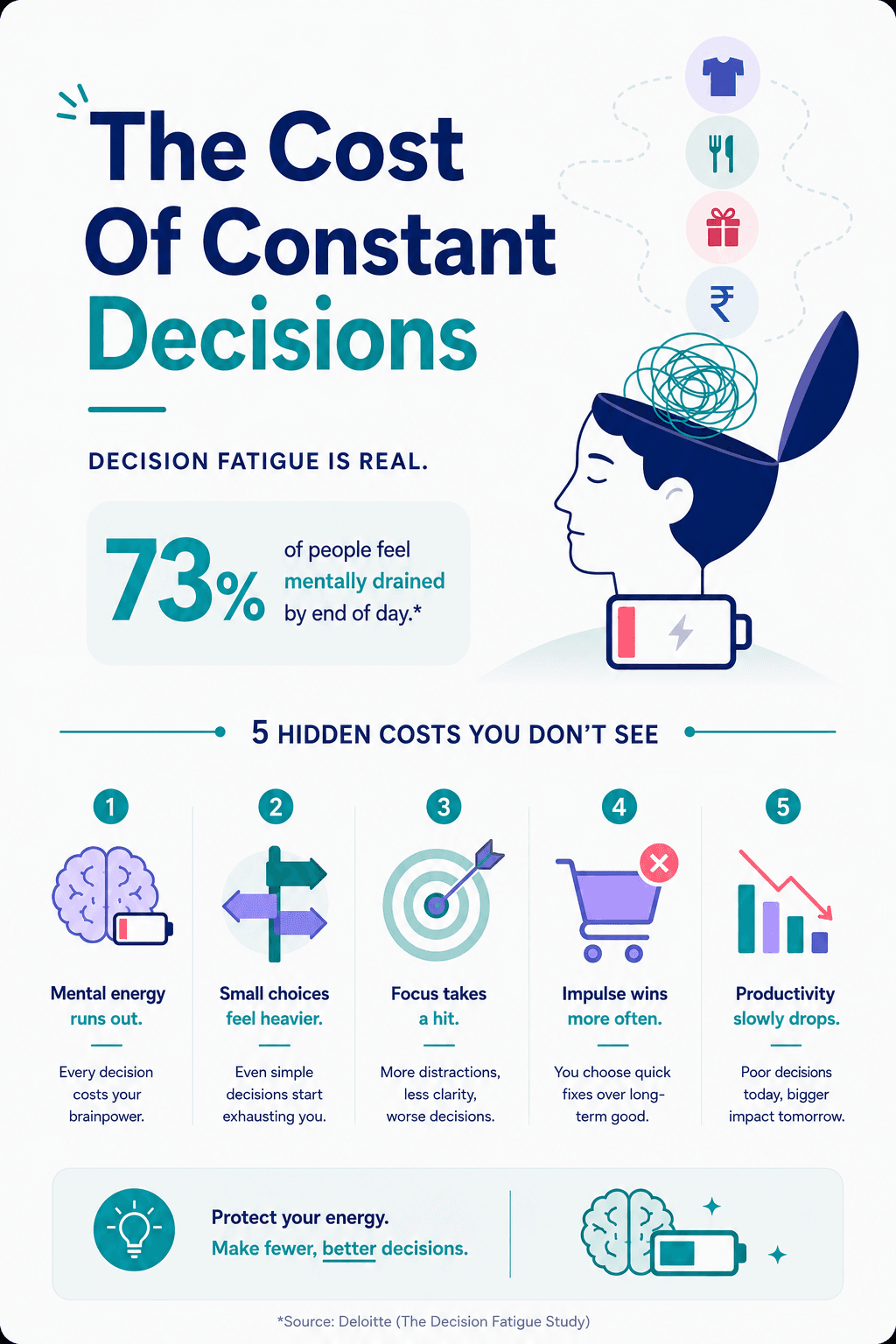
Decision fatigue defines the mental exhaustion that happens after making too many choices throughout the day. As the brain gets tired, the quality of decisions starts declining. Even small choices become difficult, and people either make impulsive decisions or avoid them completely. Psychologist Roy F. Baumeister explained that self control and decision making depend on limited mental energy, which gets depleted over time.
In daily life, this may lead to unhealthy or careless choices. But in investing, the impact can be much more serious leading to impulsive trades, emotional investing, and poor financial decisions that can harm long term wealth creation. Understanding how it builds throughout the day helps investors recognize it before it affects their next trade.
How Decision Fatigue Develops?
Decision fatigue does not arrive suddenly it builds gradually throughout the day as you process information and make choices. Here is how it typically unfolds:
1. Morning: You start fresh. Decisions are clear, deliberate, and well reasoned.
2. Midday: Mental energy starts to dip. You may begin relying on shortcuts (heuristics) rather than careful analysis.
3. Evening: Willpower and judgement are at their lowest. You default to the path of least resistance either an impulsive choice or no choice at all.
Research published in the Proceedings of the National Academy of Sciences found that Israeli judges approved parole about 65% of the time at the start of a session but that approval rate dropped to nearly 0% by the end, only to reset after a break. The judges were not becoming harsher; they were mentally depleted.
The same mechanism operates in financial decisions, often without investors realising it.1
Decision Fatigue In Everyday Life vs Financial Decisions
In daily life, decision fatigue might cause you to:
1. Pick the first item on a restaurant menu without reading further
2. Agree to a purchase you had not planned just to end the conversation
3. Scroll endlessly through a streaming platform without actually watching anything
In financial decisions, the stakes are dramatically higher. The complexity of investment choices, asset classes, risk profiles, market timing, tax implications demands sustained cognitive resources.
When those resources are depleted, even experienced investors fall prey to cognitive overload in financial decisions.
Decision Quality Curve How Mental Energy Declines Through the Day
Time of Day | Decision Quality | Mental Energy | Risk Level |
Morning (7–9 AM) | Excellent | High | Low |
Mid-Morning (9–11 AM) | Very Good | High | Low |
Noon (12–1 PM) | Good | Moderate | Medium |
Afternoon (2–4 PM) | Declining | Low | Medium-High |
Late Afternoon (4–6 PM) | Poor | Very Low | High |
Evening (7–9 PM) | Very Poor | Depleted | Very High |
For example: Priya, a 35 year old marketing professional, spends her workday making project decisions. In the evening, she checks her trading app.
Tired and overwhelmed, she notices a trending stock of a small cap pharma company with a "Buy" signal. Without researching its fundamentals, she invests INR 20,000 on impulse.
The stock drops 18% over the next two weeks. Had she made this decision in the morning with fresh eyes, she might have done her research first.2
Signs You Are Experiencing Decision Fatigue
Decision fatigue often goes unnoticed because it mimics normal tiredness. Here are the red flags specific to investing:
- You feel overwhelmed when opening your investment app even to check a balance.
- You make large financial moves “just to get it over with.”
- You repeatedly delay financial tasks like tax planning or SIP review.
- You agree to financial products (insurance, credit cards) mid-day or late at night without comparing alternatives.
- You find yourself making contradictory decisions, aggressive one day, overly cautious the next.
If any of these feel familiar, your financial decision-making may be compromised by cognitive overload.
Strategies To Overcome Decision Fatigue
1. Make Important Financial Decisions in the Morning
Willpower and cognitive clarity peak early in the day. Schedule portfolio reviews, SIP setup, and any major investment decisions before noon ideally before checking emails or social media.
2. Automate Wherever Possible
Automation is the single most powerful antidote to decision fatigue in investing. Set up auto-debit for SIPs, automate EMI payments, and use goal based investing platforms that reduce the number of active decisions you need to make.
3. Reduce the Number of Choices
Fewer options mean less fatigue. Instead of monitoring 20 stocks, simplify your portfolio to a manageable number of well researched positions. Use index funds or curated baskets to minimise daily noise.
4. Take Breaks and Rest Before Deciding
Even a 10 minute break can partially restore decision-making quality. Before making any significant financial move especially in the evening sleep on it. The Israeli judges made better decisions after a meal break. Your portfolio deserves the same consideration.
5. Create Decision Rules (Pre-Commitments)
Establish rules in advance: "I will not buy any stock without reading its last two annual reports." or "I will only rebalance on the first Saturday of each quarter." Pre-commitments remove the need to make a fresh decision each time, conserving mental energy.
6. Use Trusted, Simplified Investment Platforms
Platforms that offer curated options, clear analytics, and goal aligned recommendations significantly reduce cognitive load. This is where GRIP Invest stands apart.
Conclusion
Decision fatigue is not a weakness, it is how the human brain works. After making too many decisions throughout the day, mental energy gets drained, and financial choices often become impulsive or delayed. This can lead to panic investing, missed SIPs, poor risk management, or unnecessary trading decisions.
Smart investors understand that wealth is not built by making more decisions, but by making better and simpler ones. That is where platforms like Grip Invest help reduce financial stress and cognitive overload.
With Grip Invest, investors get curated investment opportunities, fixed-income products with transparent returns, goal based investing options, and predictable income streams all through a simple and easy to use platform. Instead of constantly reacting to market noise, investors can focus on long-term wealth creation with fewer but smarter decisions.
The idea is simple: less confusion, less overthinking, and more disciplined investing.
Grip offers corporate bonds and other fixed-income investment options with yields up to 12.5% and institutional-grade security features. Visit Grip Invest Today!
FAQs On Decision Fatigue
 |
Author: Grip Invest Editorial Team The Grip Invest Editorial Team is a group of Chartered Accountants, MBA (Finance) graduates, and Qualified Research Analysts dedicated to helping you invest smarter. We dive deep into India's fixed income landscape to deliver content that is accurate, up-to-date, and easy to understand. Whether you're exploring bonds, fixed deposits, or other fixed income opportunities, our guides cut through the noise and give you the clarity to make better financial decisions. |
Want to stay at the top of your finances?
Join the community of 4 lakh+ investors and learn more about Grip Invest, the latest financial knick-knacks, and shenanigans in the world of investing.
Happy Investing!
Disclaimer - Investments in debt securities/municipal debt securities/securitised debt instruments are subject to risks including delay and/ or default in payment. Read all the offer related documents carefully. The investor is requested to take into consideration all the risk factors before the commencement of trading.
This communication is prepared by Grip Broking Private Limited (bearing SEBI Registration No. INZ000312836 and NSE ID 90319) and/or its affiliate/ group company(ies) (together referred to as “Grip”) and the contents of this disclaimer are applicable to this document and any and all written or oral communication(s) made by Grip or its directors, employees, associates, representatives and agents. This communication does not constitute advice relating to investing or otherwise dealing in securities and is not an offer or solicitation for the purchase or sale of any securities. Grip does not guarantee or assure any return on investments and accepts no liability for consequences of any actions taken based on the information provided. For more details, please visit www.gripinvest.in
Registered Address - 106, II F, New Asiatic Building, H Block, Connaught Place, New Delhi 110001


