

Factor Investing In India: How Value, Quality And Momentum Work


As Warren Buffett quotes, “The stock market is a device to transfer money from the impatient to the patient”. If you know the right time to exit or enter a fund or a stock, you would never end up losing money. However, this is not possible. What is really possible is to improve the chances of earning on your investments through value, quality and momentum. There are different strategies to achieve it, and one of the strategies is called factor based investing.
In recent years, factor based investing has gained considerable popularity among investors in India looking for a rational, data-led method to build their portfolios. Investors have begun seeking out smart beta India-based strategies as an alternative to creating wealth through investing in India’s capital markets.
The goal of factor investing is to keep on capturing the same proven drivers of returns: value, quality, and momentum. The increasing number of factor ETFs India, including Factor Index Funds from NSE and BSE, gives retail investors more opportunities than ever to invest in factors on a systematic basis. To develop more robust portfolios, investors need to understand how factors behave and perform across different market conditions.
What Is Factor Based Investing?
The factor-based investing approach can help identify which smart beta ETFs Nifty equities are likely to provide the best returns. This is achieved through systematic screening of companies based on various measures, such as valuation metrics and price performance, rather than solely on market cap.
In contrast to traditional passive investments that simply track broad-based indices, active investors require overall judgment when selecting securities. However, factor-based investing offers both a rules-based method for identifying potentially outperforming securities and greater transparency and lower costs than traditional index-tracking methods.
Essentially, factor-based investing asks, "What do successful companies have in common?" Studies have repeatedly confirmed that several characteristics have contributed to long-term success in equities. This has led to quality being the most common factor used in India, followed by value vs momentum investing.
The Three Core Factors
Factor-based investing is founded on three critical variables that shape stock performance: value, quality, and momentum. By understanding these three basic factors, investors will create multi factor portfolios for the future.
1. Value Investing
The value investment strategy is when investors purchase assets based on their perceived undervaluation relative to fundamentals. The approach of value factor stocks India is simple: investors will often react sharply to short-term issues, resulting in fundamentally sound companies being (often) sold for lower prices. As market sentiment returns to normal, these undervalued stocks will likely re-align with their true value and provide excess returns.
2. Quality Investing
A quality investing strategy is based on companies with strong financial positions, consistent cash flows, low debt, and high returns on equity, which tend to exhibit quality characteristics. High-quality companies generally exhibit strong corporate governance and healthy balance sheets.
Quality stocks may not always be the most inexpensive investments available, but they are commonly much low volatility factor investing than lower-quality stocks during periods of market correction. In India, the following sectors typically exhibit high-quality characteristics: Fast-Moving Consumer Goods, private banking, and prominent Information Technology companies.
3. Momentum Investing
Momentum factor funds select stocks that have shown recent strong price performance. This philosophy works because the winner keeps winning in the short- to medium-term. It is more of a trend-based than a valuation-based approach, for investors rely on behavioural biases rather than factual reports.
Momentum investing has produced strong returns in India during strong upward market trends; however, it can also see sharp declines quickly when the market experiences a sudden correction.
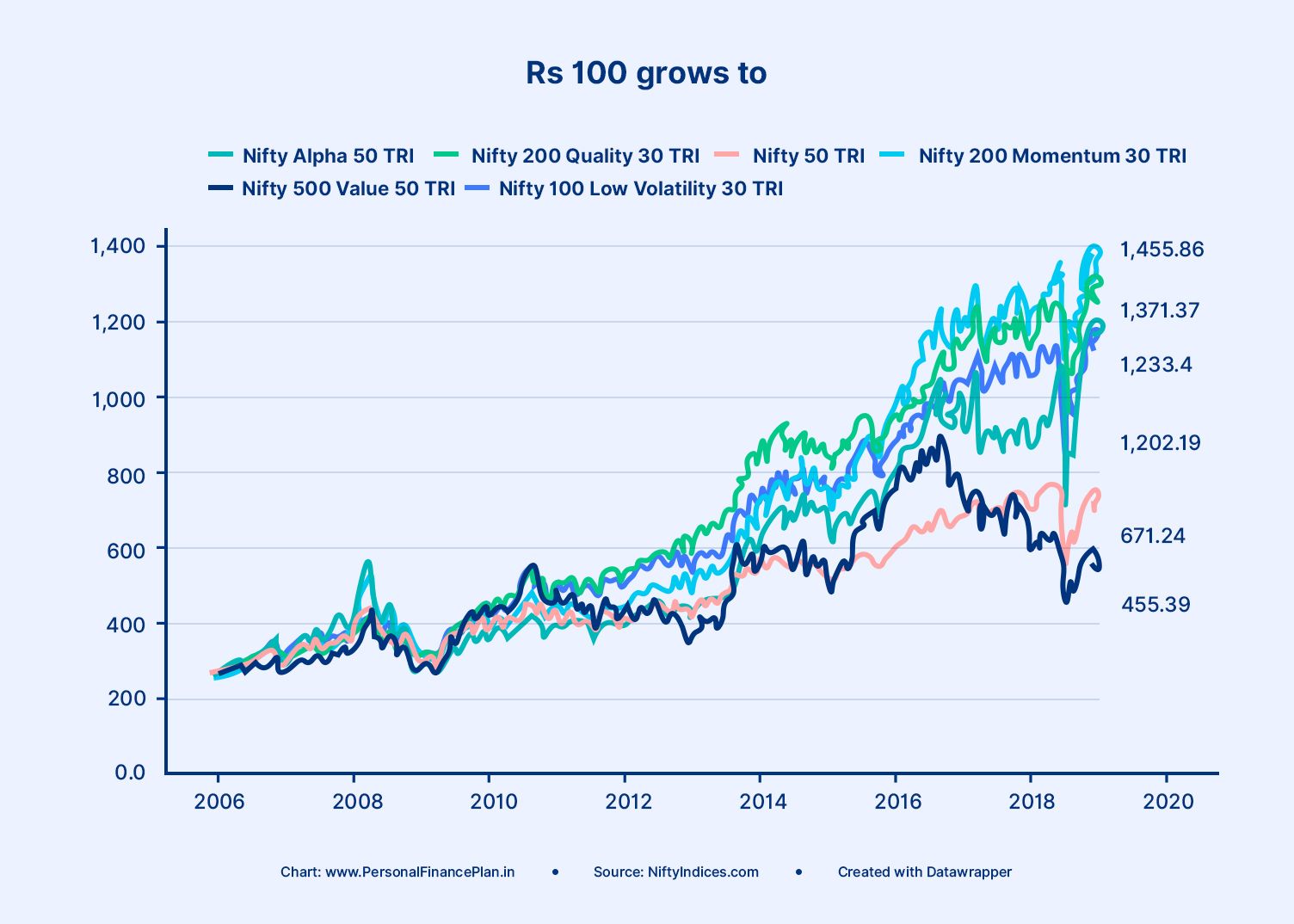
How Factor Investing Works in India
Factor-based investing is created and operated through the rule-based exchanges NSE and BSE. These indices screen stocks based on various historical data points and serve as input to the process of creating Smart Beta portfolios.
Thus, asset managers create both index & factor ETFs India that mirror the performance of various indices, allowing retail investors to access the same.
Retail investors can purchase these index & factor ETFs in the same way as a mutual fund or an ETF. It allows them to gain exposure to systematic strategies without the need for active stock selection. Regularly rebalance their portfolios to ensure they maintain the target level of exposure to each factor.
Value Vs Quality Vs Momentum Comparison
| Feature | Value Investing | Quality Investing | Momentum Investing |
| Core Idea | Buy undervalued stocks | Buy financially strong firms | Buy recent outperformers |
| Typical Metrics | Low P/E, low P/B | High ROE, low debt | Price trend strength |
| Risk Level | Moderate | Relatively lower | Higher |
| Best Market Phase | Early recovery | Volatile markets | Strong bull runs |
| Drawdown Behaviour | Can lag in growth phases | More stable | Sharp reversals possible |
| Investor Profile | Patient investors | Conservative investors | Tactical investors |
Should Retail Investors Use Factor Funds?
Retail investors looking for a strategy that offers a systematic and disciplined approach to investing, in addition to traditional index funds, should consider factor based investing as part of their portfolio. Factor-based investing provides a way for them to access historically successful drivers of return at relatively low cost.
However, investors need to understand that not all factors behave the same way across market cycles or phases. For example, momentum factor-based funds can generate significant gains in upward-trending markets; however, they may underperform during sudden reversals or sideways markets.
Most individual investors would benefit from constructing a well-diversified portfolio that contains exposures to value, quality, and momentum. Doing so reduces their risk of losing money by timing the market incorrectly and, in turn, increases the long-term performance of their factor-based portfolios.
Conclusion
Factor based investing gives structure to what many investors try to do instinctively. Instead of guessing which stock might outperform next, it focuses on measurable characteristics like value, quality and momentum that have historically driven returns across market cycles. What this really means is you are not relying on headlines or short-term noise, but on data-backed patterns that have worked over time.
In India, with the rise of smart beta strategies and factor ETFs, retail investors now have access to systematic approaches that were once largely institutional. But no single factor wins forever. Value can shine in recoveries, quality often holds up in volatile phases, and momentum tends to lead in strong bull markets. The smarter approach for most investors is not to choose one, but to blend them through diversified multi factor portfolios.
For investors exploring factor based investing alongside fixed income or alternative assets, platforms like Grip Invest can play a complementary role. While factor strategies aim to capture equity-driven returns, Grip Invest offers access to curated fixed-income and alternative investment opportunities that can help balance portfolio risk. Combining disciplined equity factor exposure with stable income-generating instruments can lead to a more resilient, well-rounded portfolio over the long term.
FAQs
1. What is factor-based investing?
Factor-based investing is a systematic approach that employs defined rules to select a group of stocks based on quantifiable characteristics such as value, quality, or momentum, thereby systematically enhancing portfolio returns over time.
2. Which factor performs best in India?
In India, no one factor consistently outperforms the others. In bull markets, momentum tends to outperform, whereas in periods of high volatility, quality tends to outperform. In the early stages of economic recovery, value has traditionally produced the highest returns.
3. Is momentum investing risky?
Yes. Because momentum trends can change direction quickly, momentum investing runs a higher risk. Momentum factor fund prices may experience very large declines and, therefore, require disciplined rebalancing and diversification to manage risk.
Reference:
1. Personal finance, accessed from: https://www.personalfinanceplan.in/wp-content/uploads/2020/10/20201006_Nifty_Factors-rs-100-grows-to-1024x694.png
Want to stay at the top of your finances?
Join the community of 4 lakh+ investors and learn more about Grip Invest, the latest financial knick-knacks, and shenanigans in the world of investing.
Happy Investing!
Disclaimer - Investments in debt securities/municipal debt securities/securitised debt instruments are subject to risks including delay and/ or default in payment. Read all the offer related documents carefully. The investor is requested to take into consideration all the risk factors before the commencement of trading.
This communication is prepared by Grip Broking Private Limited (bearing SEBI Registration No. INZ000312836 and NSE ID 90319) and/or its affiliate/ group company(ies) (together referred to as “Grip”) and the contents of this disclaimer are applicable to this document and any and all written or oral communication(s) made by Grip or its directors, employees, associates, representatives and agents. This communication does not constitute advice relating to investing or otherwise dealing in securities and is not an offer or solicitation for the purchase or sale of any securities. Grip does not guarantee or assure any return on investments and accepts no liability for consequences of any actions taken based on the information provided. For more details, please visit www.gripinvest.in
Registered Address - 106, II F, New Asiatic Building, H Block, Connaught Place, New Delhi 110001


