

Jet Airways Share Price History: Rise, Fall and Investor Lessons (2005–2026)


Introduction: About Jet Airways
Over the last 30 years, Jet Airways has represented premium aviation services in India, emerging as a leading private airline.
Established by Naresh Goyal in 1992, it launched air taxi services in April 1993 with a fleet of four Boeing 737-400 aircraft.
It later became India’s first private carrier to achieve scheduled airline status in January 1995 and eventually listed on the National Stock Exchange.1
At its peak, Jet commanded over 21% of India's domestic passenger market and operated more than 300 daily flights to 74 destinations worldwide.
It was also the preferred choice for business travellers, who associated its gold-and-blue livery with reliability and class. A strategic partnership with Etihad Airways (24% equity stake for USD 379 million in 2013) added international credibility.
But the story of Jet Airways is ultimately a cautionary tale. From an all-time high share price of INR 1,379 in April 2005 to an all-time low of INR 13 in March 2020, the airline's stock charted one of the most dramatic collapses in Indian corporate history.
Its ultimate Supreme Court-ordered liquidation in November 2024 further underscores critical lessons for every investor.
Jet Airways Share Price History
Jet Airways is not only known for its aviation; it also has a history in share price.
Before checking the strategy of the organization, let us check its history from where and how it started to become the one of the best aviations in India:
The IPO and Peak Phase (2005–2017)
In February 2005, Jet Airways launched its initial public offering at INR 950–INR 1,125 per share. (price band INR 950–INR 1,125), raising approximately INR 1,899 crore.
The issue was oversubscribed 16.2 times. The stock was listed on the NSE and BSE on 14 March 2005, and by 26 April 2005 had touched its all-time high of INR 1,379.2
In the year 2013, Etihad Airways acquired its 24% stake, injecting fresh capital and restoring investor confidence.
The share price recovered into the INR 700–INR 800 range during FY2016-FY2017 after the airline briefly posted profits due to low crude oil prices
Jet Airways Share Price - Key Milestones
Year / Period | Approx. Share Price (INR ) | Key Event |
| Feb 2005 (IPO) | INR 1,100 | IPO at INR 1,100; subscribed 16.2x |
| Apr 2005 (ATH) | INR 1,379 | All-Time High on NSE/BSE |
| 2007–2009 | INR 350–INR 500 | Air Sahara acquisition debt begins to bite |
| 2013 | INR 420–INR 500 | Etihad 24% stake — brief confidence boost |
| FY 2016–17 | INR 700–INR 780 | Low crude prices ? temporary profit; recovery |
| Mar 2018 | INR 550–INR 600 | Decline begins; share price falls >85% in 12 months |
| Apr 2019 | INR 100–INR 150 | Operations suspended (17 April 2019) |
| Mar 2020 (ATL) | INR 13 | All-Time Low post-suspension |
| Nov 2024 | ~INR 34 | Supreme Court liquidation order; stock still listed |
| Feb–Mar 2026 | ~INR 34 | Current price; zero operating business |
Source: NSE/BSE historical data, Business Standard, ValueResearchOnline, ICICI Direct, BusinessToday (2019–2026)
The Collapse Phase (2018–2019)
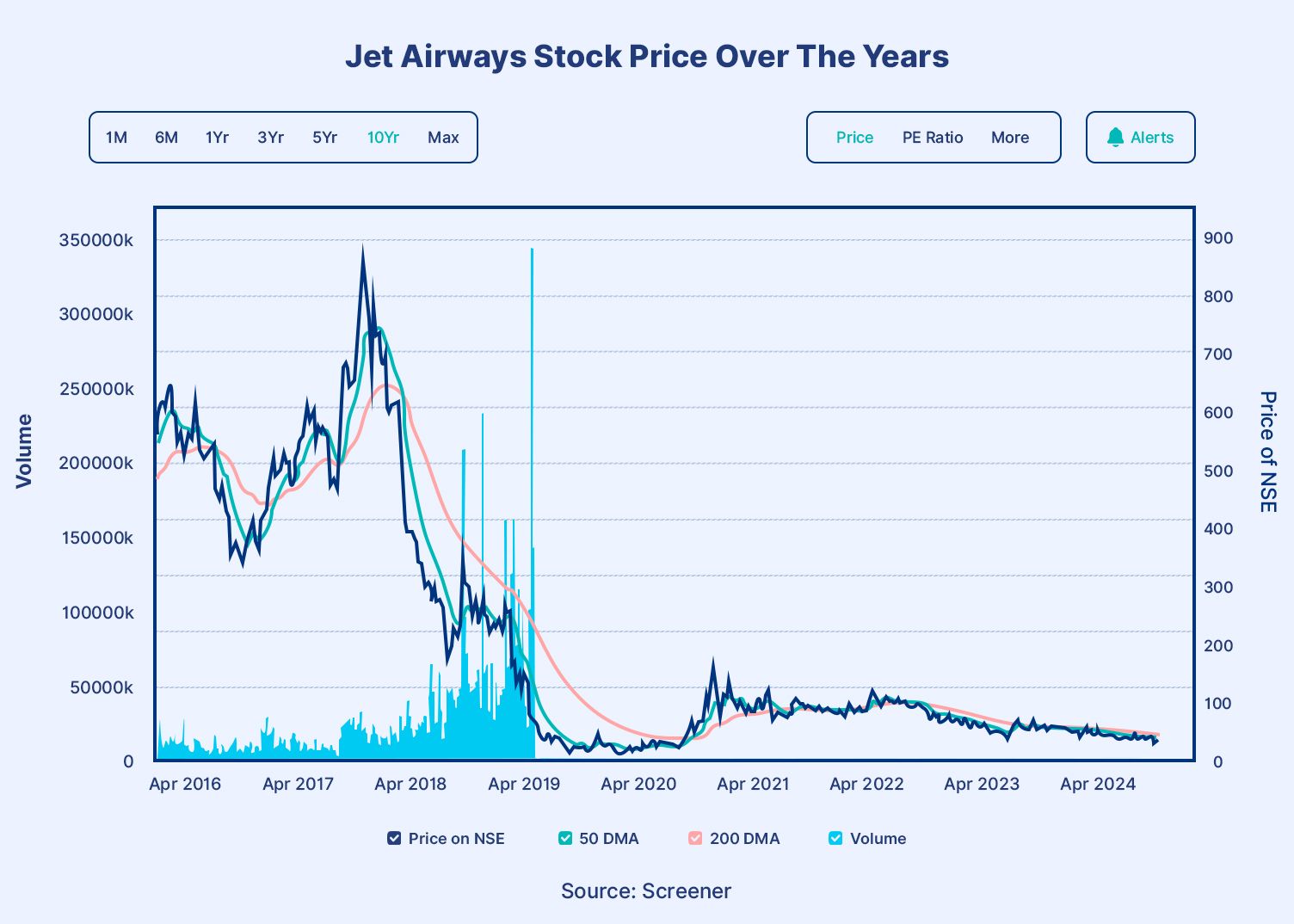
In the time period from March 2018, Jet's share price fell by more than 85% in just 12 months. By early 2019, the airline was flying only five aircraft, down from a fleet of 119, as lessors repossessed planes due to unpaid rentals.
20,000 employees' salaries were delayed for months due to the financial crisis. On 17 April 2019, the SBI-led consortium of 26 lenders rejected a plea for emergency funds and Jet suspended all operations.
What Went Wrong: The Three Fault Lines
The Three Fault Lines on which the company faces the financial crisis and the huge burden of Debt and these fault lines are Debt burden; operational challenge and competitive disruption-
A Debt Burden That Never Healed
Jet's financial distress traces back to its acquisition of Air Sahara in April 2007 for INR 1,450 crore, a deal that saddled the airline with integration costs and unclear terms over airport infrastructure.
The transaction proved expensive and the rebranded entity Jet Lite suffered losses from its first year of operations (Sage Journals, 2022).
By the time of its collapse, the SBI-led consortium of 26 banks had an exposure of over INR 8,500 crore.
Adding unpaid vendor dues (~INR 3,000 crore), employee salary arrears (~INR 3,000+ crore for ~23,000 staff), and aircraft lessor dues, total liabilities stood at approximately INR 15,000 crore.
Jet Airways - Liability Breakdown at Collapse (April 2019)
Creditor Category | Estimated Amount (INR Crore) |
| SBI-led consortium of 26 banks (primary debt) | ~INR 8,500 Cr |
| Aircraft lessors (lease dues) | ~INR 1,200 Cr (est.) |
| Vendors & airport operators | ~INR 3,000 Cr |
| Employee salary arrears (23,000+ staff) | ~INR 3,000+ Cr |
| TOTAL LIABILITIES (approx.) | ~INR 15,000 Cr |
Source: Investing3
Operational Challenges
Aviation Turbine Fuel (ATF) costs consumed 30–40% of Jet's revenues, which is well above international benchmarks.
ATF prices in India were approximately 40% higher than in South Asia and ASEAN nations due to its tax structures such as a structural disadvantage that full-service carriers like Jet could not absorb.
Meanwhile, Jet used short-term liabilities to service long-term debt- which is creating a structural fragility that any revenue downturn would expose.
During FY 2015–16 and FY 2016–17, low crude prices briefly masked this weakness, but when it comes to fuel costs, it has been found that it rose again, the model unravelled rapidly.
Competitive Disruption
The entry of low-cost carriers from the year 2006 has fundamentally changed the Indian market. IndiGo, with its lean, point-to-point, no-frills model, grew to hold nearly 47% market share by the year 2019.
Jet was simultaneously trying to compete on fares while maintaining a premium cost structure, the worst possible combination. The airline had a total of 440 flight slots at various airports, which were temporarily reallocated to other carriers when it suspended operations.
Current Status: Insolvency, NCLT And Supreme Court Liquidation
The CIRP Timeline
Jet Airways Insolvency Timeline
17-Apr-19 | Jet Airways suspends all flight operations due to severe cash shortage |
20-Jun-19 | National Company Law Tribunal admits Jet Airways into insolvency under IBC after SBI-led lenders file a petition |
13-Mar-20 | Airline seeks extension from NCLT after failing to receive viable bids. |
18-Mar-20 | NCLT grants additional time to continue the resolution process. |
14-Jun-20 | NCLT permits sale of the Bandra Kurla Complex (BKC) office to reduce debt. |
17-Oct-20 | Committee of Creditors approves the Jalan–Kalrock Consortium (JKC) resolution plan. |
22-Jun-21 | NCLT formally approves the JKC resolution plan, raising revival hopes. |
2022 (May) | Jet Airways conducts a test flight, signaling possible restart of operations. |
2022–2023 | Revival delays due to funding gaps, regulatory issues, and non-compliance by JKC. |
Mar-24 | National Company Law Appellate Tribunal upholds transfer of ownership to JKC; lenders escalate the matter. |
7-Nov-24 | Supreme Court of India orders liquidation of Jet Airways, ending revival attempts. |
Dec-25 | NCLT rejects JKC’s plea for refund of infused funds; liquidation proceedings continue. |
Source: Indian Express4
Jet Airways Share Price In 2026
If you have searched for Jet Airways' share price in 2026, here's the short answer- the stock still exists, but the airline does not.
Despite the Supreme Court ordering Jet Airways to liquidate, its shares (ticker: JETAIRWAYS) are still listed on both the NSE and BSE (BSE code: 532617).
As of February–March 2026, the stock trades at around INR 34 per share, with a total market capitalisation of roughly INR 388 crore, a far cry from its peak years.
| Metric | Value |
| Current Share Price | ~INR 34 |
| Market Cap | ~INR 388 crore |
| 52-Week High | INR 65.90 |
| 52-Week Low | INR 34.00 |
| P/B Ratio | -0.02 (negative) |
Investor Takeaways: Lessons From Jet's Crash Landing
The Jet Airways collapse is a masterclass in what can go wrong when fundamental analysis is ignored in favour of brand faith.
Here are five hard-won lessons:
1. Brand Value vs Financial Reality. Jet was one of India's most trusted brands, yet its debt obligations could not be serviced by passenger loyalty alone.
Always scrutinise the debt-to-equity ratio and interest coverage ratio before investing.
2. Airlines are capital-intensive and cyclical. Fuel costs, regulatory hurdles, intense fare competition, and economic sensitivity make airline stocks globally high-risk. India has lost Kingfisher Airlines, Air Deccan, and Jet Airways within a decade, a pattern investors cannot ignore5
3. Early warning signs were visible for years. By FY2016–17, Jet's cash flow statements showed persistent operational losses. Delayed salaries, vendor dues, and aircraft repossessions were all publicly reported years before the collapse.
4. Insolvency processes are slow, uncertain, and often fail. Jet's CIRP dragged on for five years and ended in liquidation despite a court-approved resolution plan. Buying shares of a company in NCLT resolution is high-risk speculation, not investment.
5. A low share price is not a buying signal. Jet at INR 34 with negative book value, zero revenue, and a liquidation order has no underlying business value. In distressed stocks, cheap can always get cheaper and the floor may be zero.
6. Equity volatility vs predictable income. Jet’s collapse highlights how stock markets can be highly volatile, especially in cyclical sectors. For investors seeking relatively stable and predictable returns, fixed-income options like bonds can offer a more balanced approach.
Platforms like Grip Invest enable access to curated bond opportunities with defined cash flows, helping diversify risk beyond equities.
Conclusion
The Jet Airways saga, from a celebrated INR 1,100 IPO in 2005 to a Supreme Court ordered liquidation in 2024, is a powerful reminder of how structural debt, intense competition, and regulatory challenges can erode even the most trusted brands. Investors who stayed invested through the decline saw over 96% of their capital wiped out, reinforcing the importance of tracking fundamentals over market sentiment.
Jet Airways’ share price journey, rising to INR 1,379 and collapsing to INR 13, highlights how stock prices can remain disconnected from business reality for extended periods before correcting sharply.
This makes fundamental analysis, risk assessment, and timely decision making critical for long term investing success.
For investors wondering how to avoid such outcomes, the focus should be on diversification and choosing transparent, well structured investment options. Platforms like Grip Invest provide access to fixed income opportunities with defined cash flows, offering a more predictable approach alongside equity investments.
FAQs On Jet Airways Stock Price 2026
References:
1. Jet Airways, accessed from: https://www.jetairways.com/about.html
2. Times Of India, accessed from: https://timesofindia.indiatimes.com/business/india-business/jet-airs-ipo-fixed-at-rs-1100-per-share/articleshow/1034829.cms
3. Investing, accessed from: https://in.investing.com/equities/jet-airways-(india)-historical-data
4. Indian Express, accessed from: https://indianexpress.com/article/business/aviation/jet-airways-insolvency-resolution-journey-timeline-7370647/
5. CNBCTV18, accessed from: https://www.cnbctv18.com/aviation/5-lessons-for-entrepreneurs-from-the-jet-airways-saga-3482101.htm
 |
Author: Grip Invest Editorial Team The Grip Invest Editorial Team is a group of Chartered Accountants, MBA (Finance) graduates, and Qualified Research Analysts dedicated to helping you invest smarter. We dive deep into India's fixed income landscape to deliver content that is accurate, up-to-date, and easy to understand. Whether you're exploring bonds, fixed deposits, or other fixed income opportunities, our guides cut through the noise and give you the clarity to make better financial decisions. |
Want to stay at the top of your finances?
Join the community of 4 lakh+ investors and learn more about Grip Invest, the latest financial knick-knacks, and shenanigans in the world of investing.
Happy Investing!
Disclaimer - Investments in debt securities/municipal debt securities/securitised debt instruments are subject to risks including delay and/ or default in payment. Read all the offer related documents carefully. The investor is requested to take into consideration all the risk factors before the commencement of trading.
This communication is prepared by Grip Broking Private Limited (bearing SEBI Registration No. INZ000312836 and NSE ID 90319) and/or its affiliate/ group company(ies) (together referred to as “Grip”) and the contents of this disclaimer are applicable to this document and any and all written or oral communication(s) made by Grip or its directors, employees, associates, representatives and agents. This communication does not constitute advice relating to investing or otherwise dealing in securities and is not an offer or solicitation for the purchase or sale of any securities. Grip does not guarantee or assure any return on investments and accepts no liability for consequences of any actions taken based on the information provided. For more details, please visit www.gripinvest.in
Registered Address - 106, II F, New Asiatic Building, H Block, Connaught Place, New Delhi 110001


