

Leverage Ratio: Meaning, Formula And Why It Matters For Investors


Introduction
A company's financial health has a great impact on its investor engagement. The more stable a company is, the better investors it will attract. However, understanding a company’s financial health is not straightforward. A company's financial health is about more than profits and revenue. The true litmus test of a company's stability, or risks, is the leverage ratio.
Leverage ratio helps investors measure how much debt a company uses to finance its assets and operations relative to its equity. Whether you invest in stocks or bonds, analyzing leverage helps you evaluate financial risk, growth potential, and long-term sustainability.
What Is a Leverage Ratio?
The leverage ratio is a financial metric that measures the extent to which a company relies on borrowed funds (debt) to finance its assets. In simple terms, it is a ratio that shows the proportion of debt relative to equity or total assets.
Financial Leverage Meaning
Financial leverage is a financial metric that shows how a company uses borrowed capital to increase the potential return on investment. If the company uses its debt wisely, it can enhance shareholder returns. However, if it has excessive leverage, the financial risk increases, especially during economic downturns.
Why do companies use leverage?
When used correctly, financial leverage can be a great tool for companies. In several instances, borrowing can be cheaper than issuing new equity, especially when interest rates are low. It also allows companies to maintain control of ownership. Using leverage also allows companies to:
- Expand operations
- Invest in new projects
- Acquire assets
- Improve shareholder returns
Good vs high-risk leverage
The key when using debt is to maintain a healthy financial leverage. It is this balance between the debt and equity that determines whether leverage works in the company’s favor or becomes a burden:
- Good leverage: A company has good financial leverage when its debt generates returns higher than the borrowing cost.
- High-risk leverage: A company has a high-risk leverage when its debt levels are too high, increasing default risk and financial instability.
Types of Leverage Ratios
While the basic concept of the leverage ratio is somewhat known within the financial community, it is still usually assumed to be just the simple debt-to-assets ratio. However, there are kinds of leverage ratios, knowing which will make your investment decisions even more crisp:
1. Debt to Equity Ratio
The debt-to-equity ratio compares a company’s total liabilities to its shareholder equity. It indicates how much debt is used for every unit of equity. A higher ratio suggests greater financial risk, while a lower ratio indicates conservative financing.
Formula:
Total Debt / Shareholders’ Equity
2. Debt Ratio
The debt ratio measures the proportion of a company’s assets financed through debt. If a company has a higher debt ratio, it means a larger portion of its assets is financed by borrowing, which increases financial risk.
Formula:
Total Debt / Total Assets
3. Interest Coverage Ratio
The interest coverage ratio evaluates a company’s ability to meet its interest obligations. Having a high interest coverage ratio indicates a stronger ability to service debt. Whereas having a lower ratio may signal financial stress.
Formula:
Earnings Before Interest and Taxes (EBIT) / Interest Expense
How to Calculate Leverage Ratio
As already noted, the leverage ratio formula varies depending on the type of ratio you are calculating. Most leverage ratios involve dividing a debt-related component by equity, assets, or earnings.
Let us understand these with the help of an example:
Assume the company has:
Total Debt: INR 2,00,000 crore
Shareholders’ Equity: INR 4,00,000 crore
Total Assets: INR 6,00,000 crore
EBIT: INR 80,000 crore
Interest Expense: INR 10,000 crore
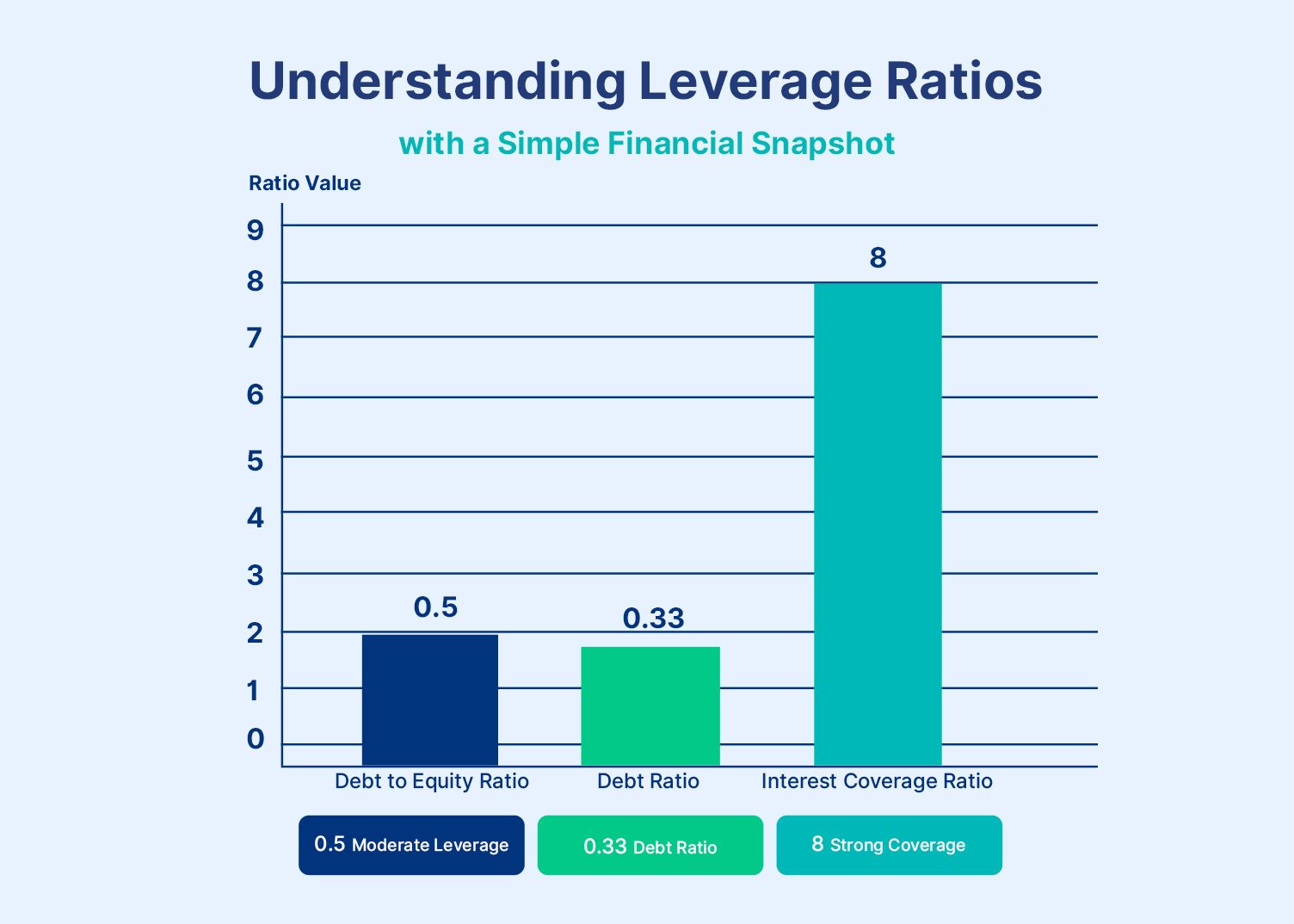
Debt to Equity Ratio = 2,00,000 / 4,00,000 = 0.5
Debt Ratio = 2,00,000 / 6,00,000 = 0.33
Interest Coverage Ratio = 80,000 / 10,000 = 8
Interpretation tips
In the example above, a debt-to-equity ratio of 0.5 indicates moderate leverage. A debt ratio of 0.33 shows one-third of assets are debt-financed. An interest coverage ratio of 8 indicates a strong ability to meet interest payments. But is it all that you need to properly interpret the ratio? No, you need some more tips:
- Compare ratios with industry averages.
- Track trends over multiple years.
- Higher debt-to-equity may indicate a growth strategy, but also higher risk.
- A declining interest coverage ratio may signal financial trouble.
Why Investors Should Track Leverage Ratio
Tracking the leverage ratio offers many benefits, helping ensure lower risk and greater stability at the top. They give a more accurate picture of how the company is utilizing its debts, and what impact that can have on the company and, in extension, their own investment.
- Impact on stock valuation
Leverages have a great impact on the company’s stock valuation. If a company has high leverage, it can amplify returns when business conditions are favorable. However, during downturns, high debt increases risk, which may negatively impact stock prices.
- Credit risk assessment in bonds
Lenders and credit analysts rely heavily on leverage ratios to assess a company’s creditworthiness; bond investors should also read them, as higher leverage increases default risk.
- Red flags to watch
When studying the leverage ratio before making an investment decision, you should look out for the red flags. These are basically some factors that indicate rising financial risk.
- Rapid increase in debt levels
- Low interest coverage ratio
- Consistently rising debt-to-equity ratio
- Debt is significantly higher than that of industry peers
Limitations of Leverage Ratios
While leverage ratios are a good indicator of financial performance and stability, as they highlight the company debt analysis India, they warrant careful analysis. Remember, Leverage ratios should be used alongside other financial metrics for better decision-making, as they, like all tools have some inherit limitation:
- They do not consider future growth prospects.
- Industry differences make cross-sector comparison difficult.
- Accounting methods can affect ratio calculations.
- They provide a snapshot, not a complete financial picture.
Conclusion
Understanding the leverage ratio is not just about memorising formulas — it is about understanding risk. Debt can help a company grow faster, improve returns, and expand operations. But if it is not managed carefully, it can quickly turn into financial pressure, especially during uncertain market conditions.
For investors, leverage ratios act like an early warning system. They help you see whether a company is building smart growth or quietly increasing risk. Looking at debt-to-equity, debt ratio, and interest coverage together gives a clearer picture of financial stability before you invest.
If you are exploring investment opportunities, whether in equities or fixed-income instruments, platforms like Grip Invest allow you to analyse structured debt opportunities with transparent risk insights. Combining ratio analysis with informed investment platforms can help you make smarter, more balanced financial decisions.
FAQs On Leverage Ratio
1. What is a good leverage ratio?
A good leverage ratio depends on the industry; however, the rule of thumb is that a lower debt to equity ratio and a higher interest coverage ratio are considered safer. But before making any decisions, investors should compare ratios within the same sector for meaningful analysis.
2. How does leverage affect profitability?
Leverage can increase profitability if borrowed funds generate returns higher than the interest cost. However, if earnings decline, fixed debt obligations can reduce net profits and increase financial risk.
3. Is high leverage always risky?
High leverage is not inherently a risky thing. It can support growth and enhance returns in stable industries with predictable cash flows. However, excessive debt increases vulnerability during economic downturns and market volatility.
4. What is the difference between leverage ratio and liquidity ratio?
A leverage ratio measures how much debt a company uses to finance its operations, while a liquidity ratio measures a company’s ability to meet short-term obligations. Leverage focuses on long-term financial structure, whereas liquidity focuses on short-term financial health.
5. Can leverage ratios vary across industries?
Yes, leverage ratios differ significantly across industries. Capital-intensive sectors like infrastructure, telecom, or manufacturing typically operate with higher debt levels, while technology or service-based companies may have lower leverage.
6. How often should investors check a company’s leverage ratio?
Investors should review leverage ratios at least once every quarter when financial results are announced. Tracking changes over time helps identify rising debt trends or improving financial stability before making investment decisions.
Want to stay at the top of your finances?
Join the community of 4 lakh+ investors and learn more about Grip Invest, the latest financial knick-knacks, and shenanigans in the world of investing.
Happy Investing!
Disclaimer - Investments in debt securities/municipal debt securities/securitised debt instruments are subject to risks including delay and/ or default in payment. Read all the offer related documents carefully. The investor is requested to take into consideration all the risk factors before the commencement of trading.
This communication is prepared by Grip Broking Private Limited (bearing SEBI Registration No. INZ000312836 and NSE ID 90319) and/or its affiliate/ group company(ies) (together referred to as “Grip”) and the contents of this disclaimer are applicable to this document and any and all written or oral communication(s) made by Grip or its directors, employees, associates, representatives and agents. This communication does not constitute advice relating to investing or otherwise dealing in securities and is not an offer or solicitation for the purchase or sale of any securities. Grip does not guarantee or assure any return on investments and accepts no liability for consequences of any actions taken based on the information provided. For more details, please visit www.gripinvest.in
Registered Address - 106, II F, New Asiatic Building, H Block, Connaught Place, New Delhi 110001


