

Multibagger Stocks Explained: Meaning, Examples, And Key Risks


Introduction — Why Investors Chase Multibagger Stocks
You see a company’s share price jump from INR 100 to INR 500, and the first reaction is not analysis. It is a curiosity. How did that happen, and could it happen again? That is why multibagger stocks sit on many watch lists, especially for investors who can stay patient and selective.
The attraction is simple upside, where a modest allocation can compound into a meaningful slice of long-term wealth. Still, the journey rarely comes from luck alone. It usually follows earnings growth, disciplined capital use, and clean governance. Read on to learn what creates these outcomes, what can go wrong, and how this blog breaks it down.
What Are Multibagger Stocks?
Multibagger's meaning is simple. It refers to a stock that delivers stock market returns that are multiple times your original buying price. A 2-bagger doubles your money. A 10-bagger grows 10x. The label became popular through investor Peter Lynch, especially via his book- One Up on Wall Street1.
For example, if you invest INR 10,000
- If it becomes INR 20000, that is a 2-bagger (100% return).
- If it becomes INR 50000, that is a 5-bagger (400% return).
Like TechEra’s stock has gained 233% as of October 2025, since its issue price of INR 82 on October 3, 20242.
However, note that past multibagger returns do not guarantee future performance.
How Multibagger Stocks Are Identified
Multibagger returns usually come from steady business compounding, not sudden price spikes.
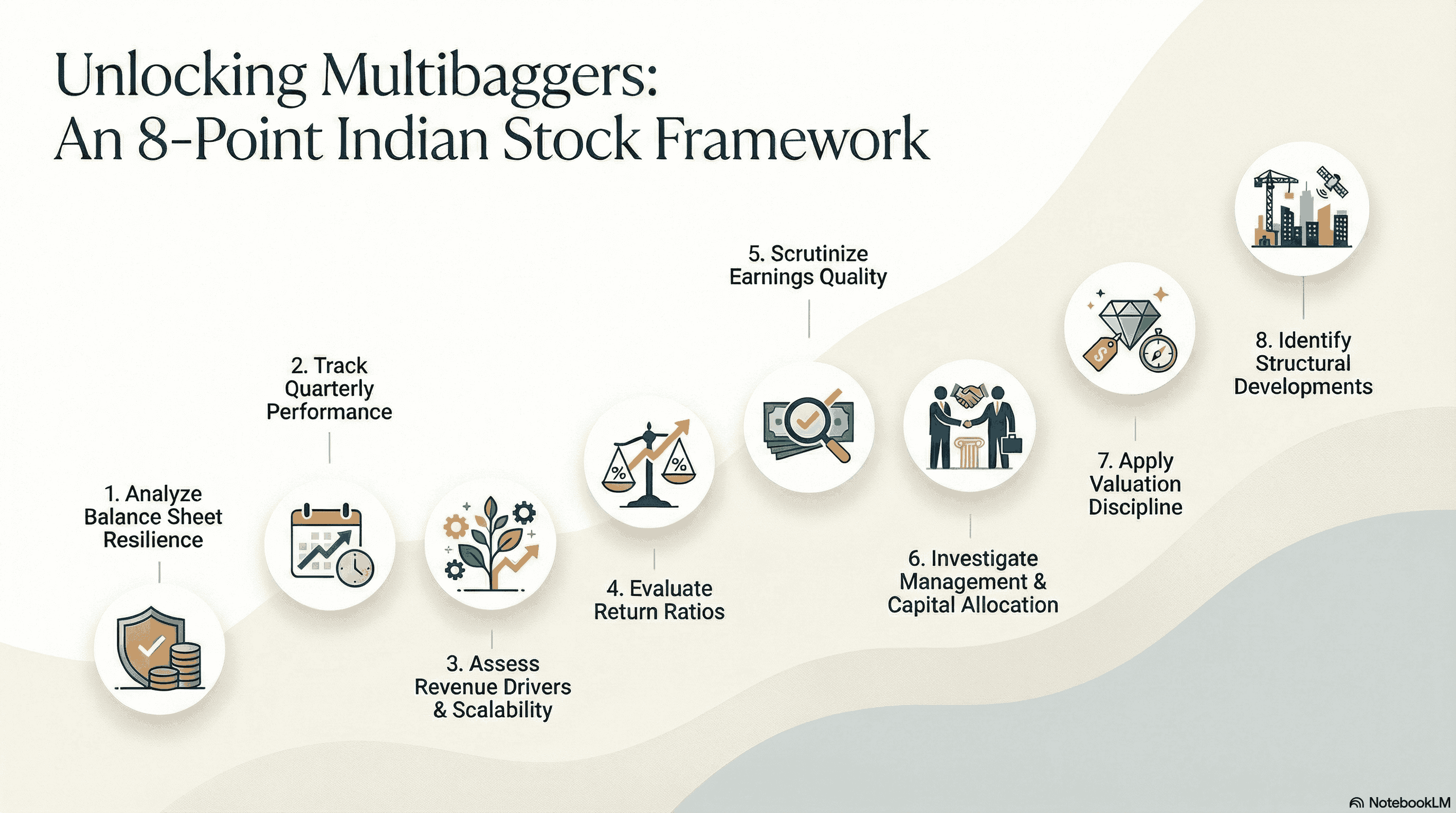
Here is how to identify multibaggers in India.
1. Balance sheet resilience: Begin with leverage and liquidity. Borrowings should remain sensible for the industry, because heavy debt can turn a mild slowdown into a serious strain. As a broad yardstick, some investors prefer debt below 30% of equity value3.
2. Quarterly performance: Watch the trend. Track quarter-on-quarter revenue multiples against operating delivery, because improving execution with modest multiples can point to mispricing.
3. Revenue drivers and scalability: Identify the segment that contributes the bulk of sales and profit. Then assess whether that segment can expand at the macro level and whether the company can scale without costs rising at the same pace.
4. Return ratios: Use return on capital to judge how effectively the firm converts invested funds into profit. Focus on consistency and an improving trend across years, rather than one exceptional period.
5. Earnings quality: Separate core operating profit from one-off items that inflate results. A simple test is whether operating cash flow broadly supports reported profit over time.
6. Management quality and capital allocation: Study how management deploys capital through reinvestment, acquisitions, and fundraising. Frequent dilution, weak governance signals, or erratic spending can undermine long-range outcomes.
7. Valuation discipline: Calculate trailing 12-month EPS and revenue, then review PE and price to sales. Compare valuation with the long growth runway, because high expectations can reduce future upside even when the company performs well.
8. Structural developments: Read annual reports and quarterly notes for capex shifts, business model changes, and leadership moves. Such developments can change the trajectory and deserve close attention.
Risks Of Investing In Multibagger Stocks
Multibagger investing can reward patience, but it also comes with risks that many first-time investors underestimate.
- High volatility: Prices can swing sharply on sentiment, news flow, or a single quarter of weak numbers. A sudden fall can take far longer to repair than the rally that came before.
- Low predictability of outcomes: Even strong numbers do not map neatly to future returns. A sudden shift in demand, regulation, or competition may derail the trajectory quickly.
- Overvaluation and bad entry price: Paying up after a rally leaves little room for error. A small earnings miss may trigger a harsh re-rating in the market.
- Business execution and management risk: Many potential multibaggers come from firms still scaling. This brings delays, cost overruns, and strategic missteps that erode margins. Weak governance or poor disclosures can also surface late and hit trust hard.
- Liquidity and concentration risk: Thin trading can trap you during stress because exits do not come easily at fair prices. Oversizing one idea can then magnify the damage when that single thesis breaks.
Given the risks, take time to study the company before you commit your money. Look beyond the narrative and check the financial statements, business drivers, and governance. Avoid tying your portfolio to a single idea. If one holding disappoints, broader exposure across sectors and market caps can contain the fallout.
Balancing High-Risk Bets With Stability
As noted above, multibagger hunting is, by nature, a high-risk game. Even the “right” stock can fall hard on bad news, weak quarters, or a broad market sell-off. That is why many investors try to pair a small slice of high-upside ideas with a steadier core. It is a simple way to stay invested without every dip forcing a panic decision. Therefore, one can consider stable assets to do the job of protecting the portfolio, while the high-growth bets do the job of trying to boost returns.
Bonds are often treated as lower-risk assets than equities, so they can reduce overall portfolio volatility when held alongside stocks. The bigger point is diversification. When you combine assets that do not rely on the same drivers to perform well, a weak patch in one area may be softened by steadier behaviour elsewhere.
If you want a steadier leg in the mix, consider fixed-income exposure. Platforms such as Grip may make it easier to browse and compare bonds in one place.
Conclusion
Multibagger stocks can play a role in long-term wealth creation, but they are rarely the result of chance or short-term excitement. Sustainable multibagger returns usually come from businesses that compound earnings steadily, allocate capital wisely, and operate with sound governance over many years. Identifying such opportunities requires discipline, financial analysis, and the ability to stay invested through volatility.
At the same time, the risks are real. High price swings, valuation mistakes, and execution failures can erode capital quickly, especially when portfolios are concentrated in a few high-growth ideas. This makes position sizing, diversification, and a clear investment framework just as important as spotting potential upside.
For many investors, the goal is not to chase every multibagger story, but to build a portfolio that can grow while remaining resilient across market cycles. Pairing selective equity exposure with relatively stable income-oriented assets can help reduce volatility and support more consistent decision-making over time.
If you are exploring ways to balance growth-oriented investments with predictable income, platforms like Grip Invest allow investors to discover and compare fixed-income opportunities in one place, helping bring structure and stability to a diversified portfolio.
Visit Grip today!
FAQs On Multi Bagger Stocks In India
1. Can retail investors find multibagger stocks?
Yes, it is possible with patient research and a long holding period. Outcomes still vary, so keep position sizes sensible and stay diversified.
2. Are multibagger stocks risky?
Often, yes. Price swings can be sharp, and outcomes can stay uncertain even when the business looks sound.
3. How long does it usually take for a stock to become a multibagger?
There is no fixed timeline. Some stocks multiply over several years through steady earnings growth, while others take a decade or more. Short-term price spikes rarely sustain multibagger returns.
4. Are multibagger stocks the same as penny stocks?
No. While some multibaggers may start small, most successful ones are backed by improving fundamentals, scalable businesses, and sound governance. Penny stocks often rely on speculation rather than business strength.
5. Is it better to buy multibagger stocks early or after some growth is visible?
Buying very early carries higher risk due to uncertainty, while buying later reduces upside but improves visibility. Many investors prefer entering once earnings quality and business execution are clearly established.
References:
1. Investopedia, accessed from: https://www.investopedia.com/terms/t/tenbagger.asp
2. Economic times, accessed from: https://economictimes.indiatimes.com/markets/stocks/news/ashish-kacholia-picks-1-12-lakh-shares-in-this-smallcap-multibagger-thats-up-over-200-in-1-year/articleshow/124445795.cms
3. Economic times, accessed from: https://economictimes.indiatimes.com/definition/multibagger
Want to stay at the top of your finances?
Join the community of 4 lakh+ investors and learn more about Grip Invest, the latest financial knick-knacks, and shenanigans in the world of investing.
Happy Investing!
Disclaimer - Investments in debt securities are subject to risks. Read all the offer-related documents carefully. The investor is requested to take into consideration all the risk factors before the commencement of trading. This communication is prepared by Grip Broking Private Limited (bearing SEBI Registration No. INZ000312836 and NSE ID 90319) and/or its affiliate/ group company(ies) (together referred to as “Grip Invest”) and the contents of this disclaimer are applicable to this document and any and all written or oral communication(s) made by Grip Invest or its directors, employees, associates, representatives and agents. This communication does not constitute advice relating to investing or otherwise dealing in securities and is not an offer or solicitation for the purchase or sale of any securities. Grip Invest does not guarantee or assure any return on investments and accepts no liability for the consequences of any actions taken based on the information provided. For more details, please visit https://www.gripinvest.in/.
Registered Address - 106, II F, New Asiatic Building, H Block, Connaught Place, New Delhi 110001.


