

NSDL’s New Bond-Selling Platform: A Boost For Retail Liquidity In India’s Bond Market


According to RBI reports, Indian conglomerates raised a record INR 9.9 Lakh Crore using corporate bonds in FY25, marking a 28% growth from the previous year1. This rise in corporate bond issuance reiterates the rising investor interest in fixed-income debt securities like bonds.
However, the process of liquidating a bond investment through the secondary market sale is often cumbersome. Retail Bond Trading India takes 3-7 days to settle, unlike highly liquid equity2. The restricted liquidity often steers retail investors away from bond investments.
National Stock Depository Limited (NSDL), the largest depository in India, is gearing up to address this concern of the bond market. With an aim to increase the secondary bond liquidity in India, the NSDL is set to launch the NSDL Bond Selling Platform. This blog decodes the key takeaways from the development and analyses its impact.
The Problem: Cumbersome Bond Sell-Side Process
Before decoding the NSDL bond platform in 2026 and its impact, it is important to gauge the existing problem that it aims to solve. A secondary trade of a bond is considered legally complete only after the completion of two steps. Firstly, the buyer must get ownership of the bond, and secondly, the seller must receive their money. The bond settlement in India partly remains manual, resulting in 3-7 days till settlement. Discussed below are some of these steps.
- Physical Delivery Instructions (DI) Slips: In India, investors liquidating their funds must submit a physical DI slip to the depository, that is, NSDL or CDSL, to authorise the transfer of bonds to the buyer. The process of filling, submitting, and verifying the DI slips occurs manually and thus can take several days. Additionally, if there are errors, extra delays can occur.
- Manual Processing Between Agencies: Once a DI slip is submitted, the broker and depository review and verify the slip. Additional verification is added if the buyer holds an account with another depository. Such inter-depository transactions need manual checks, reconciliation, and messaging between systems.
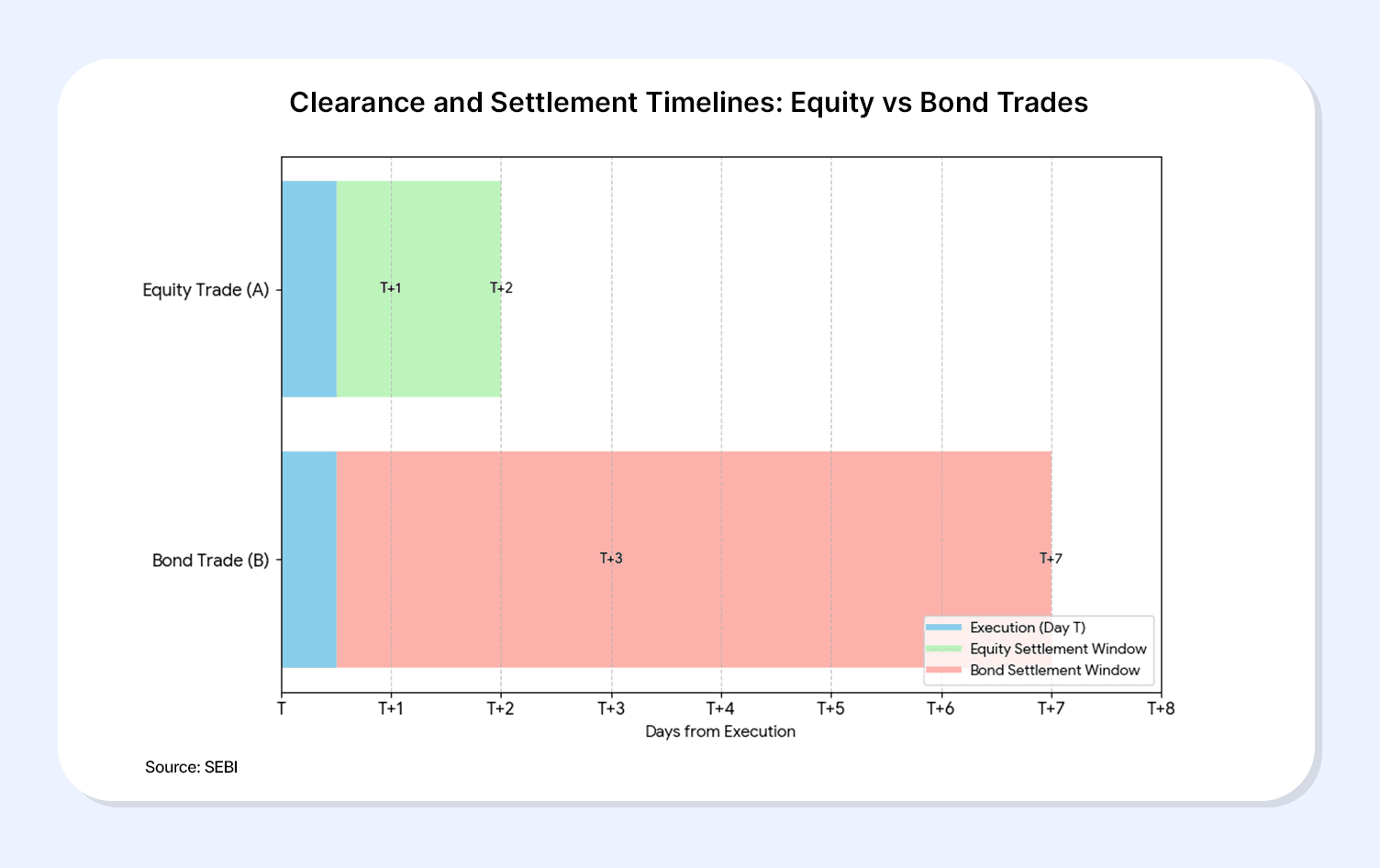
These operational steps often diminish the liquidity of bond trading. For instance, if A executes an equity trade on T day and B executes a bond trade on T day, the clearance and settlement of A can be done by T+1 or T+2 day, while the settlement of B can extend till T+3 or T+7 day.
With the aim of addressing these concerns, the NSDL Bond Selling Platform is gearing up for a debut.
NSDL’s Solution: A New Bond-Selling Platform
NSDL is creating a specialised digital platform that offers simplified and faster corporate bond sales in India, solving long-standing challenges that hindered liquidity. The move was after a SEBI mandate. Discussed below are the major takeaways from this recent development.
1. Timeline: The SEBI directive aims for a launch of the platform within a quarter, that is, by Q4FY26. However, according to the latest claims, it is difficult to ensure whether the platform will go live by March 2026 or the following quarter.
2. Key Features Launched: NSDL has already launched two API interfaces. One aids in retrieving client demat details across depositories via OTP authentication, while the other issues post-trade debit mandates to seller accounts.
3. Upcoming Phase: While the two APIs are already launched, the next phase aims at automating debit depending upon pre-authorised mandates. This will eliminate the need for physical DI slips and make bond transfers between different brokers and depositories almost instantaneous.
The NSDL Bond Selling Platform can revolutionise the secondary corporate bond market in India by reducing the time required for selling bonds.
Why Faster Bond Selling Matters?
The ability to sell bonds faster matters significantly to investors and the market in general. Listed below are the reasons why.
1. Liquidity Builds Investor Confidence: The NSDL Bond Selling Platform will allow investors to liquidate their bond investments faster, within a shorter time span. This can boost the confidence of investors to invest in the bond market.
2. Further Diminish Risk: The increased liquidity will further diminish the risk profile of bonds, a fixed-income generating debt investment.
3. Increase Cashflow: Investors can enjoy a better cashflow structure, which can improve the sophistication of the overall investment attitude in India.
4. Reduce Error: Human effort is prone to error. The platform upholds automation that can reduce the scope of error caused by manual processes of bond trade.
Therefore, the upcoming NSDL Bond Selling Platform can have a significant impact on the corporate bond market and retail investors.
Impact On Corporate Bond Market And Retail Investors
The upcoming NSDL platform is expected to increase transparency and tradability of the corporate bond market, thereby aiding increased participation of retail investors. The points below explain this phenomenon.
1. Boost Tradability: Similar to equity markets, this platform is expected to make anonymous order matching and guaranteed settlement on online bond platforms (OBPs). Simply put, this will reduce paperwork, manual labour, and gestation period, resulting in greater liquidity and tradability to investors.
2. Market Volumes: The rise in tradability in the secondary bond market can aid in greater participation of retail investors. As secondary market trade becomes easier and faster, investors who were initially hesitant can now increase their bond investment.
3. Potential Yield Tightening: As the bond market becomes more liquid due to the entry of the NSDL Bond Selling Platform, the gap between bid price (what buyers are willing to pay) and ask price (what sellers want) reduces. Investors who initially expected a higher bond yield due to less liquidity can now settle for a comparatively lower yield due to increased liquidity. Therefore, the platform creates a positive situation for investors as they get more liquidity and bond issuers due to lower yields.
Therefore, the NSDL platform sophisticates a fixed-income asset like bonds by incorporating useful liquidity benefits of market assets, enhancing diversification.
Where This Fits Into Fixed Income Investing
The upcoming NSDL Bond Selling Platform enables better infrastructure. This, coupled with recent regulatory changes like improved disclosures and compliance, can build investor trust in bonds and increase access to retail investors. For long fixed-income investors, traded liquidity for regular returns.
This new development marks a new step for the entire fixed-income asset ecosystem by providing access and exit options similar to market assets like equity. In such a scenario, platforms like Grip offer a secondary marketplace for bonds, aiding easy exits and investor autonomy.
Conclusion
The proposed NSDL Bond Selling Platform signals a meaningful upgrade in India’s fixed income market infrastructure. By reducing settlement timelines, eliminating manual processes, and enabling smoother secondary market transactions, the platform directly addresses one of the biggest barriers to retail participation in corporate bonds liquidity.
As bond trading becomes faster and more transparent, investor confidence is likely to improve, market participation can broaden, and yield discovery may become more efficient. Over time, this can help position corporate bonds as a more accessible and practical investment option alongside traditional market-linked assets.
In this evolving ecosystem, platforms like Grip Invest complement these reforms by offering investors easier access to curated bond opportunities and structured exit options, making fixed income investing more flexible and investor-friendly.
FAQs
1. How long does bond settlement currently take?
Currently, bond settlement takes up to 3-7 days due to manual processing and physical delivery of Instructions (DI) slips.
2. Will this platform increase liquidity for investors?
Yes, the NSDL Bond Selling Platform is expected to increase bond liquidity by allowing faster settlement of secondary bond trades.
3. How does improved infrastructure impact corporate bond yields?
The improved infrastructure of the NSDL Bond Selling Platform increases liquidity, thereby reducing the gap between bid price and ask price, resulting in a tighter bond yield.
References:
1. Economic times, accessed from: https://economictimes.indiatimes.com/markets/bonds/corporate-bonds-in-india-from-institutional-stronghold-to-broader-participation/articleshow/122808987.cms
2. Financial express, accessed from: https://www.financialexpress.com/market/nsdl-building-bond-selling-platform-4092819/
3. SEBI, accessed fron: https://www.sebi.gov.in/legal/circulars/jul-2022/clarification-on-settlement-cycle-for-equity-securities_60319.html
Want to stay at the top of your finances?
Join the community of 4 lakh+ investors and learn more about Grip Invest, the latest financial knick-knacks and shenanigans that take place in the world of investing.
Happy Investing!
Disclaimer - Investments in debt securities/municipal debt securities/securitised debt instruments are subject to risks including delay and/ or default in payment. Read all the offer related documents carefully. The investor is requested to take into consideration all the risk factors before the commencement of trading.
This communication is prepared by Grip Broking Private Limited (bearing SEBI Registration No. INZ000312836 and NSE ID 90319) and/or its affiliate/ group company(ies) (together referred to as “Grip”) and the contents of this disclaimer are applicable to this document and any and all written or oral communication(s) made by Grip or its directors, employees, associates, representatives and agents. This communication does not constitute advice relating to investing or otherwise dealing in securities and is not an offer or solicitation for the purchase or sale of any securities. Grip does not guarantee or assure any return on investments and accepts no liability for consequences of any actions taken based on the information provided. For more details, please visit www.gripinvest.in
Registered Address - 106, II F, New Asiatic Building, H Block, Connaught Place, New Delhi 110001


