

Open-Ended vs Closed-Ended Mutual Funds: Key Differences


If you have noticed new mutual fund scheme announcements, you might have come across the terms “open-ended fund” and “closed-ended fund”. Both categories of mutual funds are professionally managed and have portfolios spanning equity, debt, hybrid, and other classes. However, in order to understand how an investor can enter, exit and manage their investments, you should know the difference between open ended vs close ended mutual funds.
Let us understand the differences between the two categories and evaluate how knowing them can help you make a better, more informed investment decision.
Open-Ended vs Closed-Ended Mutual Funds: What's The Difference?
Before comparing the two, it is important to understand what these mutual fund types are and why many first-time investors find them confusing.
Meaning of Open-Ended and Closed-Ended Funds
Open-ended MFs are those in which you can enter or exit at any time after the scheme is launched. There is no fixed maturity date, and investors can invest in or redeem units based on their financial goals, subject to the fund’s terms and conditions.
On the other hand, closed-ended mutual funds have a fixed investment duration and generally accept investments during the NFO (New Fund Offer) period. Once the NFO closes, fresh investments are generally not permitted. These schemes have a predefined maturity period, after which investors receive the proceeds based on the prevailing Net Asset Value (NAV).
How They Work
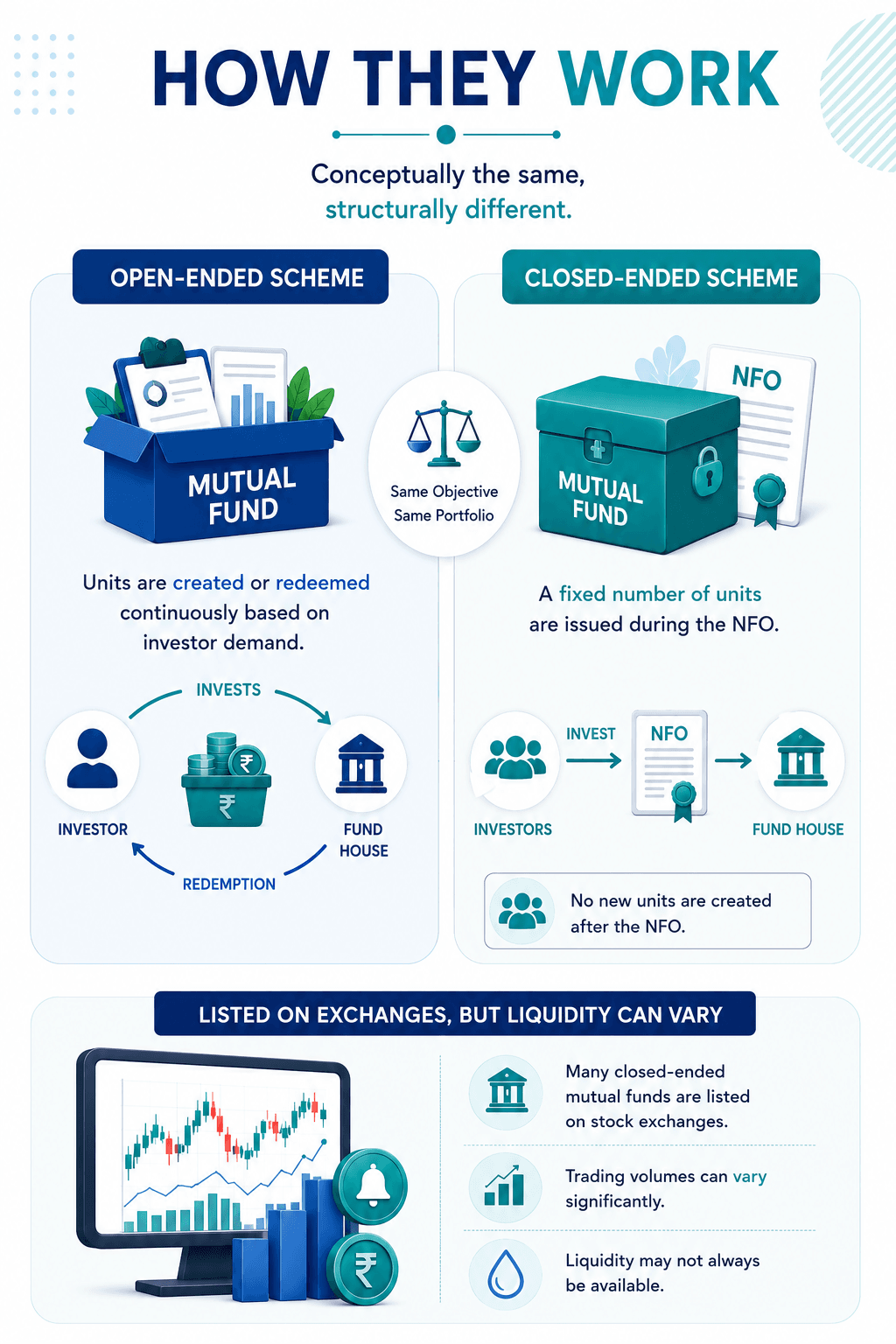
Conceptually, the two categories of mutual funds are the same, but the difference lies in their investment structure. An open-ended scheme continuously creates or redeems units based on investor demand, whereas a closed-ended scheme issues a fixed number of units during the NFO.
Many closed-ended mutual funds are listed on the exchanges, but trading volumes can vary, and liquidity may not always be available.
Why Investors Often Get Confused
Both categories invest in similar asset classes and are managed by professional fund managers, which often makes them appear identical at first glance. The primary distinction is not what they invest in, but how investors buy, sell and hold their investments. Investors can get confused as they might think that one fund might be better than the other in terms of returns, risks, or overall management. However, this is not generally the case, as the difference is largely in their investment structure.
How Open-Ended Mutual Funds Work?
If you wish to invest INR 1 lakh today in a small cap mutual fund, there are numerous available options to choose from. You can simply place an order request, and the units will be allocated to your Demat account within the prescribed period (2-5 working days). This is possible only with an open-ended mutual fund. Because, an open-ended mutual fund remains available for investment even after its New Fund Offer (NFO) closes.
Investors can purchase additional units directly from the asset management company (AMC) or redeem existing units on any business day at the prevailing Net Asset Value (NAV), subject to the scheme's terms and conditions.
Since there is no fixed maturity period, investors can stay invested for as long as they wish. They may also invest through a lump sum or via a SIP in mutual funds, making these schemes suitable for building wealth gradually over the long term.
How Closed-Ended Mutual Funds Work?
A closed-ended mutual fund accepts investments only during its NFO period. Once the subscription window closes, the scheme is closed to new investors until it reaches its predetermined maturity date.
The fund manager invests the pooled capital in accordance with the scheme's objective and generally does not need to manage frequent investor inflows or redemptions over the scheme's tenure. For investors with a defined investment horizon who do not require frequent access to their money, these schemes can offer a structured approach to mutual fund investment.
Open-Ended vs Closed-Ended Mutual Funds: Complete Comparison
Here is a table comparing how open-ended mutual funds differ from their closed-ended counterparts:
Parameter | Open-Ended Mutual Funds | Closed-Ended Mutual Funds |
Liquidity | Investors can typically buy or redeem units from the AMC on any business day, making them suitable for those who value mutual fund liquidity. | Investments are generally locked in until maturity. While units may be listed on stock exchanges, finding buyers or sellers may not always be easy. |
Investment Flexibility | Investors can enter or exit the scheme at any time and can increase or reduce their investment based on their financial goals. | Investment is generally allowed only during the NFO period, with limited flexibility thereafter. |
Pricing | Units are bought and redeemed at the prevailing Net Asset Value (NAV). | Although the scheme has an NAV, units traded on stock exchanges may be available at a premium or discount depending on market demand. |
Risk | Market risk depends on the underlying securities, while liquidity risk is generally lower due to continuous redemption. | Market risk remains similar, but investors may also face liquidity risk if they wish to exit before maturity through the stock exchange. |
Returns | Returns depend on the fund's portfolio, market performance and the fund manager's investment decisions. | Returns are influenced by the same factors. The fund structure itself does not guarantee higher or lower returns. |
Suitability | Suitable for investors looking for flexibility, long-term wealth creation and easy access to their investments. | Suitable for investors with a fixed investment horizon who are comfortable remaining invested until maturity. |
Exit Options | Units can generally be redeemed directly with the AMC, subject to applicable exit loads and scheme conditions. | Investors may either hold the scheme until maturity or sell units on the stock exchange if sufficient liquidity is available. |
Which Type of Mutual Fund Should You Choose?
This is quite a tricky one to answer, as fundamentally, both mutual funds operate in a similar manner. The eventual decision depends on your financial goals, investment horizon and cash flow requirements.
For example, if you need the flexibility to invest or redeem at any time and wish to build wealth over a long period, open-ended funds can be a suitable alternative. On the other hand, if you have a defined investment horizon and are comfortable holding until the fund's maturity (for non-listed funds), you can choose a closed-ended fund.
Conclusion
Irrespective of whether you choose a closed or open ended fund, you get similar benefits: a professionally managed corpus and investment opportunities across different asset classes and sectors. However, there is a definite difference in terms of liquidity, investment flexibility and exit options. You need to consider these before making an investment decision.
While mutual funds can form the core of a long-term portfolio, investors seeking relatively stable income and diversification may also consider fixed-income investment opportunities such as corporate bonds through Grip Invest, depending on their financial objectives and risk appetite.
FAQs On Open-Ended vs Closed-Ended Mutual Funds
 |
Author: Grip Invest Editorial Team The Grip Invest Editorial Team is a group of Chartered Accountants, MBA (Finance) graduates, and Qualified Research Analysts dedicated to helping you invest smarter. We dive deep into India's fixed income landscape to deliver content that is accurate, up-to-date, and easy to understand. Whether you're exploring bonds, fixed deposits, or other fixed income opportunities, our guides cut through the noise and give you the clarity to make better financial decisions. |
Want to stay at the top of your finances?
Join the community of 4 lakh+ investors and learn more about Grip Invest, the latest financial knick-knacks, and shenanigans in the world of investing.
Happy Investing!
Disclaimer - Investments in debt securities/municipal debt securities/securitised debt instruments are subject to risks including delay and/ or default in payment. Read all the offer related documents carefully. The investor is requested to take into consideration all the risk factors before the commencement of trading.
This communication is prepared by Grip Broking Private Limited (bearing SEBI Registration No. INZ000312836 and NSE ID 90319) and/or its affiliate/ group company(ies) (together referred to as “Grip”) and the contents of this disclaimer are applicable to this document and any and all written or oral communication(s) made by Grip or its directors, employees, associates, representatives and agents. This communication does not constitute advice relating to investing or otherwise dealing in securities and is not an offer or solicitation for the purchase or sale of any securities. Grip does not guarantee or assure any return on investments and accepts no liability for consequences of any actions taken based on the information provided. For more details, please visit www.gripinvest.in
Registered Address - 106, II F, New Asiatic Building, H Block, Connaught Place, New Delhi 110001


