

Passive Index Funds Explained: How They Work And Why Investors Prefer Them


Investments today are all about consistency, cost control, and long-term discipline, not about chasing bigger stocks. This mindset has led many investors to passive index funds, where the goal is to mirror the market rather than outperform it.
Passive Index funds track well-known indices that deliver returns in accordance with the overall market growth. Passive funds account for over 50% of global equity fund assets, according to reports by Morningstar.
The rising market access in India, combined with digital access, has accelerated trust in simple yet rules-based strategies. This gives young investors a chance who seek clarity, lower costs, and fewer surprises. Read through to understand how passive income works and the increasing interest taken by investors.
What Are Passive Index Funds?
Passive index funds are described as investment funds that are designed to replicate a market index. They do not focus on selecting winning stocks or market timing. Instead, they focus on tracking predefined indices, including the Nifty index funds or Sensex.
Passive Index Funds are available as ETFs and mutual funds in India, where both aim to deliver index-matching returns. The fund value rises with a rise in indexes and has no downside protection.
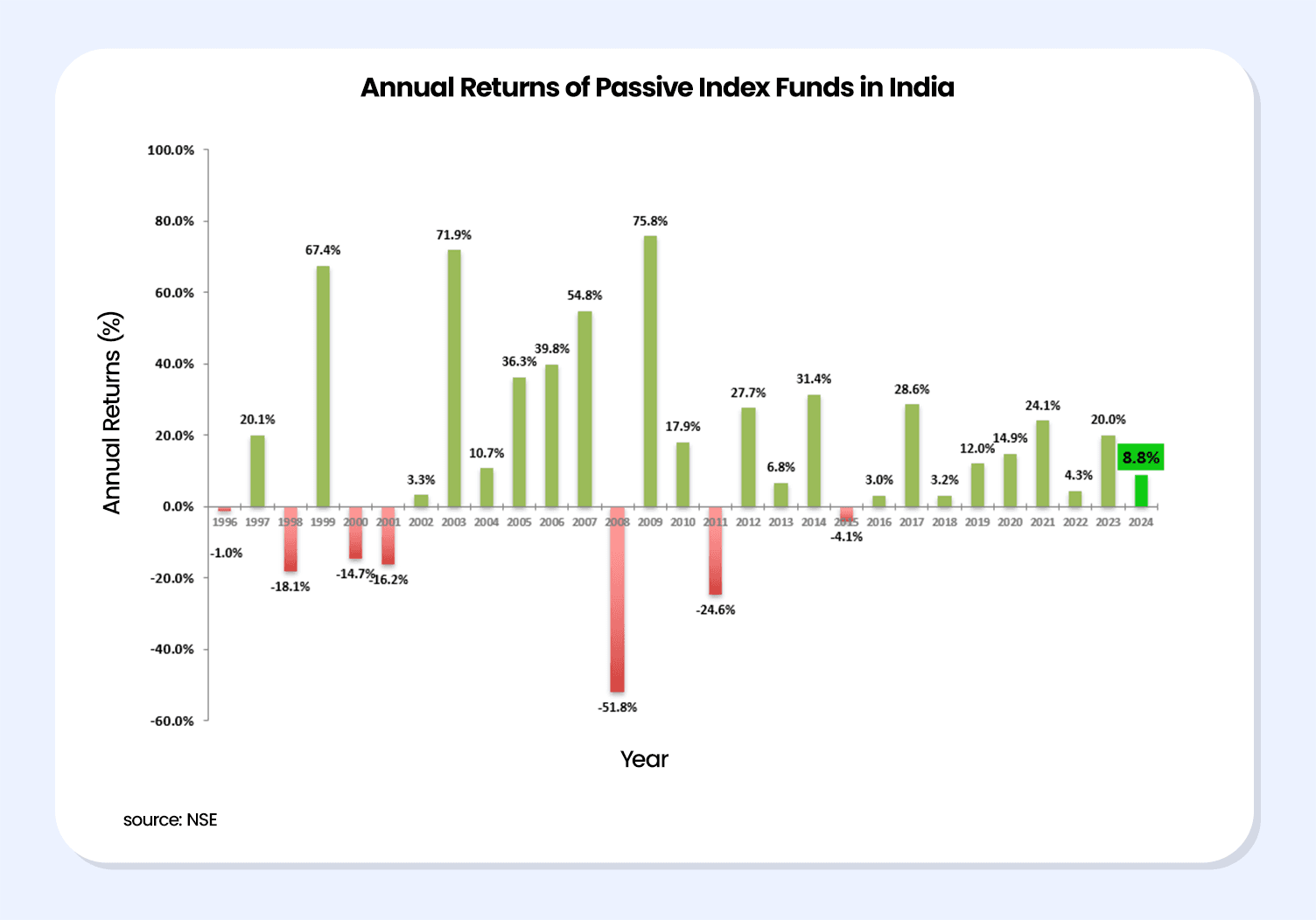
Benefits Of Passive Index Funds
Before moving forward with investing in passive funds, let’s discuss the major benefits. Passive Index funds have a simple and disciplined approach towards equity investments.
1. Low expense ratios
The passive index funds have a relatively low expense ratio compared to active funds. The reason being, the fund managers do no research or trade stocks purposefully. The expense ratio of numerous index funds in India ranged between 0.10% and 0.30%, whereas actively managed funds charge up to 1.50% or more1.
On a global scale, passive adoption has been majorly driven by cost efficiency. Investors using SIPs benefit from low expenses and improved outcomes without extra effort.
2. Market-linked returns
Since passive index funds focus on matching market performance, they do not attempt to beat the index, making it easy to participate in market growth. Losses also reflect the broader market trends when the market falls.
The reports and data from the Credit Suisse Global Investment Returns show that equities have outperformed most asset classes over long horizons2. This is what makes it suitable for long-term wealth creation. Investors can stay invested for a longer time frame, provided they avoid timing errors and emotional decisions.
Limitations Of Passive Investing
Although passive index funds offer cost efficiency and simplicity, they do come with certain drawbacks. These include the following:
1. No downside protection
The passive index is in accordance with the market. When the market rises, they rise and fall during corrections without any active intervention to reduce losses.
2. Lack of Opportunity to Outperform the Market
Passive Index funds do not aim to generate alpha, but in case any stock outperforms, they are unable to increase exposure selectively. This is beneficial to active managers. This might also seem limiting to investors seeking higher-than-market returns as passive funds prioritise predictability over excess returns.
3. Risk of Market Concentration
Market capitalism weighs indices; in other words, index composition is dominated by larger companies. This increases concentration risks and can impact overall return due to the presence of underperforming stocks.
Which Option Suits Different Investors?
Your financial goals are the deciding factors for your investment choices. These factors also include time horizon and appetite for risk. Some investors are better suited to passive index funds than others.
Combining growth assets with fixed income stability
Passive index funds that are equity-focused are built to perform best over long-term investments. Having a steady income alongside higher equity exposure is beneficial. This forms the growth engine for your financial portfolio.
However, relying completely on equities can increase exposure to volatility. This can be sorted by having a more balanced approach. In other words, combine your passive equity with fixed-income assets. This will improve your risk-adjusted returns over time.
How Passive Funds Fit In A Balanced Portfolio
Combining passive index funds with other asset classes can provide growth and a balanced and structured portfolio.
1. Accrued interest treatment
Since index funds do not generate regular interest income, primary returns come from capital appreciation. This makes them tax-efficient, and they have no periodic interest payout to reinvest. When utilized together, they can bring predictable cash flows and can optimize both growth and income planning.
2. Investor cash outflow
The passive index funds are best suited for investors with limited cash flow needs, as they are not designed for regular withdrawals. Too many redemption erodes returns and can reduce the benefits of long-term compounding. Withdrawal can easily be tackled by combining index funds with fixed-income assets.
Use cases Of Passive Index Funds
Passive index funds are most effective for long-term investment goals such as wealth creation, retirement planning, and building a financial corpus over decades. Since these funds aim to mirror a market index rather than beat it, they benefit significantly from the power of compounding over time. They are especially suitable for disciplined investors who invest regularly through SIPs and are comfortable staying invested through market cycles.
These funds work well for goals with flexible timelines, where short-term market volatility does not require immediate withdrawals. However, for short-term objectives, passive index funds can be risky, as market fluctuations may impact returns when funds are needed. In such cases, relying solely on passive strategies may not be ideal. Building a balanced portfolio by combining passive index funds with relatively stable instruments such as debt funds, bonds, or fixed-income investments can help manage risk while maintaining steady growth.
Alternatives For Predictable Returns
Since building a balanced portfolio is a better option, let's discuss some of these fixed-income options. Below, we have discussed some commonly used alternatives.
Government bonds provide high safety and offer predictable interest payments. They have a greater stability compared to equities but offer lower returns.
Corporate bonds are usually issued by companies. They provide high yields compared to government bonds, but credit quality is dependent on risk and returns.
With debt mutual funds, you can invest in a mix of bonds, including money market instruments. They are best suited for short-term goals.
Fixed deposits are known to provide capital protection and assured returns. You might face struggles in terms of returns, but they are a great way to hedge against inflation.
Instruments like these are listed on trusted platforms such as Grip Invest. Here, you will gain access to a selected and curated list of non-market-linked alternative investment opportunities across the entire risk-reward spectrum that best caters to your wealth creation.
Conclusion
An investor's approach to the equity market has been reshaped due to passive index funds, as they offer simplicity, cost efficiency, and transparency. These instruments omit complexity by tracking the market instead of attempting to beat it. They also reduce the impact of emotional decision-making.
However, the passive index funds are not a solution to all financial goals and could use something to balance their effects. These include alternatives such as corporate bonds, government bonds, debt mutual funds, or fixed deposits.
Build a balanced and resilient portfolio by investing with platforms like Grip Invest.
To gain access to a curated list of investment options and make investing easier, explore your options with Grip Invest.
FAQs
1. Are passive index funds safe?
Yes, passive index funds are safe and best suited for long-term investors. The safety doesn't come from guaranteed returns but from diversification. However, a passive index fund is a market-linked instrument that doesn't offer capital protection during market downturns.
2. Do passive funds beat active funds?
Yes, passive funds do outperform active funds, which is observed over both developed and emerging markets. Passive funds do not focus on beating the market. They aim to match market performance with a lower risk of underperformance.
3. Can beginners start investing in passive index funds?
Yes, passive index funds are ideal for beginners because they are easy to understand, low-cost, and do not require active monitoring or stock selection.
4. How are passive index funds taxed in India?
Passive index funds are taxed like equity mutual funds in India, with long-term capital gains taxed at 10% above the exemption limit and short-term gains taxed at 15%.
References:
1.Kotak bank, accessed from: https://www.kotak.bank.in/en/stories-in-focus/mutual-funds/index-funds-vs-mutual-funds.html?utm_
2. UBS, accessed from: https://www.ubs.com/global/en/media/display-page-ndp/en-20250304-global-investment-returns-yearbook-2025.html?utm_
Want to stay at the top of your finances?
Join the community of 4 lakh+ investors and learn more about Grip Invest, the latest financial knick-knacks, and shenanigans in the world of investing.
Happy Investing!
Disclaimer - Investments in debt securities are subject to risks. Read all the offer-related documents carefully. The investor is requested to take into consideration all the risk factors before the commencement of trading. This communication is prepared by Grip Broking Private Limited (bearing SEBI Registration No. INZ000312836 and NSE ID 90319) and/or its affiliate/ group company(ies) (together referred to as “Grip Invest”) and the contents of this disclaimer are applicable to this document and any and all written or oral communication(s) made by Grip Invest or its directors, employees, associates, representatives and agents. This communication does not constitute advice relating to investing or otherwise dealing in securities and is not an offer or solicitation for the purchase or sale of any securities. Grip Invest does not guarantee or assure any return on investments and accepts no liability for the consequences of any actions taken based on the information provided. For more details, please visit https://www.gripinvest.in/.
Registered Address - 106, II F, New Asiatic Building, H Block, Connaught Place, New Delhi 110001.


