

Rolling Returns Explained: Clearer Insights Into Mutual Fund Performance


Rolling returns provide a better way to determine mutual fund performance through the noise of market fluctuations. This method allows you to see how the fund has performed over time and not just between two fixed dates.
If you are tired of reviews based on lucky rallies or short bursts, rolling returns are the best choice. Read on to discover why using this method can help you make better, smarter investment decisions, especially when you're seeking stable gains through volatile periods.
What Are Rolling Returns?
Rolling returns give you a window into mutual fund performance across a wide range of perspectives, not just from two random dates. Roll returns, unlike point-to-point returns, which measure only the gain between the beginning and end of a fixed period, cover any time in the chosen period.
This method is less ambiguous, as the underlying market state of the fund can be seen in the most accurate sense at any given stage of the market.
Investors and analysts choose rolling returns because they want to know how money works when markets are up or down. Only a single period can reveal a massive rally or a decline, but rolling averages flatten out spikes and dips to give a more honest assessment.
- Rolling returns show consistency as they track the average annual gain on each interval within a time span.
- They feature funds with excellent performances at all market cycles, not just lucky stretches.
- Rolling returns provide a fair comparison of funds over similar periods.
- They can help to confirm the results irrespective of short-term luck.
How To Calculate Rolling Returns?
Rolling returns measure how a mutual fund performs across time spans using average returns for all possible periods, not just one fixed time period. This provides you with a clearer picture of how a fund is going through its life, showing that it keeps going and that it's still putting up solid performance, not just in a bad or even pathetic year.
The investment period is the first thing needed to calculate rolling returns in India.
For example, first, you start from the first three years and add those returns, add them up, and then you find a 3-year rolling return with the average.
Next, take one period away from the window and subtract the average for the next block, then add the average and multiply this by that over a year. When all periods are covered, the average is the rolling return.
- 1 year Rolling Returns: Calculate the annual return for each possible 12-month period from your data. If you have five years, you will have returns from Year 1–2, Year 2–3, Year 3–4, and so on.
- 3-year Rolling Returns: Average each block of three years (like Years 1–3, 2–4, 3–5) and average these results. This shows the fund performing over the course of three years, not just a single season.
- 5-year Rolling Returns: Apply the same idea for each 5-year block. This demonstrates how a fund coped in different five-year markets, smoothing out short-term gains or losses.
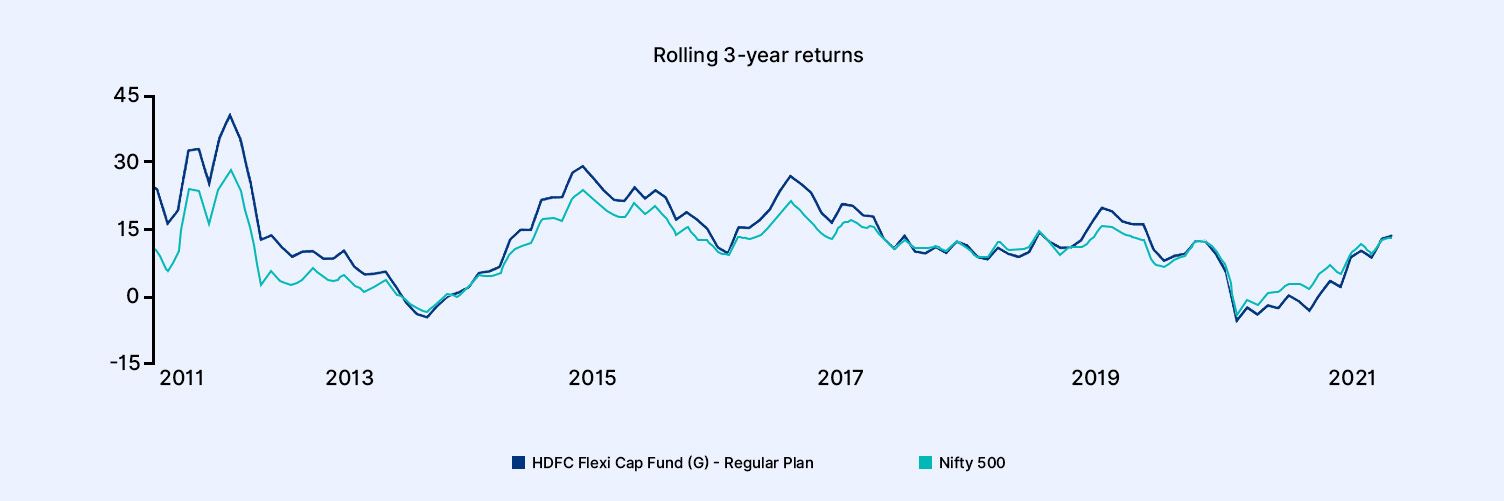
Importance Of Consistency Over Isolated Performance
Consistency matters more than just one-off strong performances. Rolling returns reveal if a fund performs well in good markets and tough ones by smoothing out short-term spikes and dips. This makes it easier to trust funds that can deliver stable, repeatable results rather than those that shine just once and fade1.
Why Rolling Returns Matter For Investors?
Rolling returns are for investors because they provide an easier and more reliable description of the performance of a mutual fund over time.
This deeper insight also helps investors avoid misleading conclusions based on lucky timing or an isolated performance increase.
1. Helps Identify Consistency and Volatility
Rolling returns help determine whether a fund consistently delivers positive returns on interest or if its performance fluctuates. In particular, stable patterns are evidence of reliability while large fluctuations indicate risk. It also helps investors see the true stability of a fund, other than the headline profits.
2. Avoiding the "Good Timing Bias" Trap
From point to point, returns can produce the illusion of solid performance while it is drawn in a lucky or bullish period. Rolling returns eliminate this bias by estimating multiple time periods, giving a more balanced view of the historical power of the fund.
3. Better Risk Assessment
By looking at the returns in an analysis of market conditions, investors can better understand how the fund responds to volatility and downside. This helps to align investments with their risk tolerance.
Using Rolling Returns To Make Better Investment Decisions
Rolling returns are a useful tool that investors can use to measure mutual fund performance over time, a less general perspective than point-to-point returns. They measure the real-life consistency of a fund by measuring average returns over time over the span of overlapping periods, smoothing out short-run variance.
Rolling returns from similar category funds make it possible to assess reliable performers and do not exclude highly reliable performers who simply had luck at certain times in the past. This results in greater selection based on sustained performance.
In addition, such rolling returns for equity funds could stabilize the overall portfolio returns by connecting them with fixed-income assets. Grip Invest is a transparent fixed income option offering steady income streams and low volatility of portfolios.
Rolling returns analysis tools combined with fixed income investments can also provide a balanced portfolio that has the potential to grow and smooth out its returns over time, both growth and smooth returns over time.
Conclusion
Rolling returns offer a comprehensive view of mutual fund performance by evaluating returns over multiple overlapping periods. They reveal consistency, reduce the impact of market timing, and help investors compare funds effectively. This approach enables informed, long-term investment decisions focused on reliability and managing risk.
To take control of your investments with smarter strategies like rolling returns, login to Grip Invest. We help you use rolling returns insights for steady investments. We offer SEBI-regulated bonds with low minimums, helping you build consistent, reliable portfolios easily. Let us grow your wealth with confidence and clarity.
FAQs On Rolling Returns
1. What is the difference between rolling returns and annual returns?
Rolling returns show average returns over many overlapping periods, smoothing out ups and downs. Annual returns measure performance in just one calendar year.
2. Are rolling returns a reliable way to judge mutual fund performance?
Yes, rolling returns reveal mutual fund consistency better by showing how a fund performs across different market phases.
3. How can beginners calculate rolling returns easily?
Beginners can use online calculators or spreadsheets, enter periodic NAVs, set the rolling period, and compute averages easily for clearer insights.
Want to stay at the top of your finances?
Join the community of 4 lakh+ investors and learn more about Grip Invest, the latest financial knick-knacks, and shenanigans in the world of investing.
Happy Investing!
Disclaimer - Investments in debt securities/municipal debt securities/securitised debt instruments are subject to risks, including delay and/ or default in payment. Read all the offer-related documents carefully. The investor is requested to take into consideration all the risk factors before the commencement of trading.
This communication is prepared by Grip Broking Private Limited (bearing SEBI Registration No. INZ000312836 and NSE ID 90319) and/or its affiliate/ group company(ies) (together referred to as “Grip”) and the contents of this disclaimer are applicable to this document and any and all written or oral communication(s) made by Grip or its directors, employees, associates, representatives and agents. This communication does not constitute advice relating to investing or otherwise dealing in securities and is not an offer or solicitation for the purchase or sale of any securities. Grip does not guarantee or assure any return on investments and accepts no liability for the consequences of any actions taken based on the information provided. For more details, please visit www.gripinvest.in
Registered Address - 106, II F, New Asiatic Building, H Block, Connaught Place, New Delhi 110001


