

SEBI’s New Bond Distributor Model And Retail Investors


While bonds provide a reliable investment option, India’s bond market has long remained dominated by institutional investors such as banks, insurance companies and mutual funds. Retail participation in the bond market has stayed relatively low. For many individual investors, bonds often appear more complicated than equities or mutual funds due to documentation requirements and limited awareness.
The Securities and Exchange Board of India (SEBI) is evaluating a new distributor-led framework to address the same. The new SEBI bond distributor model framework will make debt products more accessible to retail investors. Announced by SEBI Whole-Time Member Amarjeet Singh at the FICCI Financial Products Distribution Summit, the proposal could reshape how individuals participate in India’s debt market.
What Is SEBI’s Proposed Bond Distributor Model?
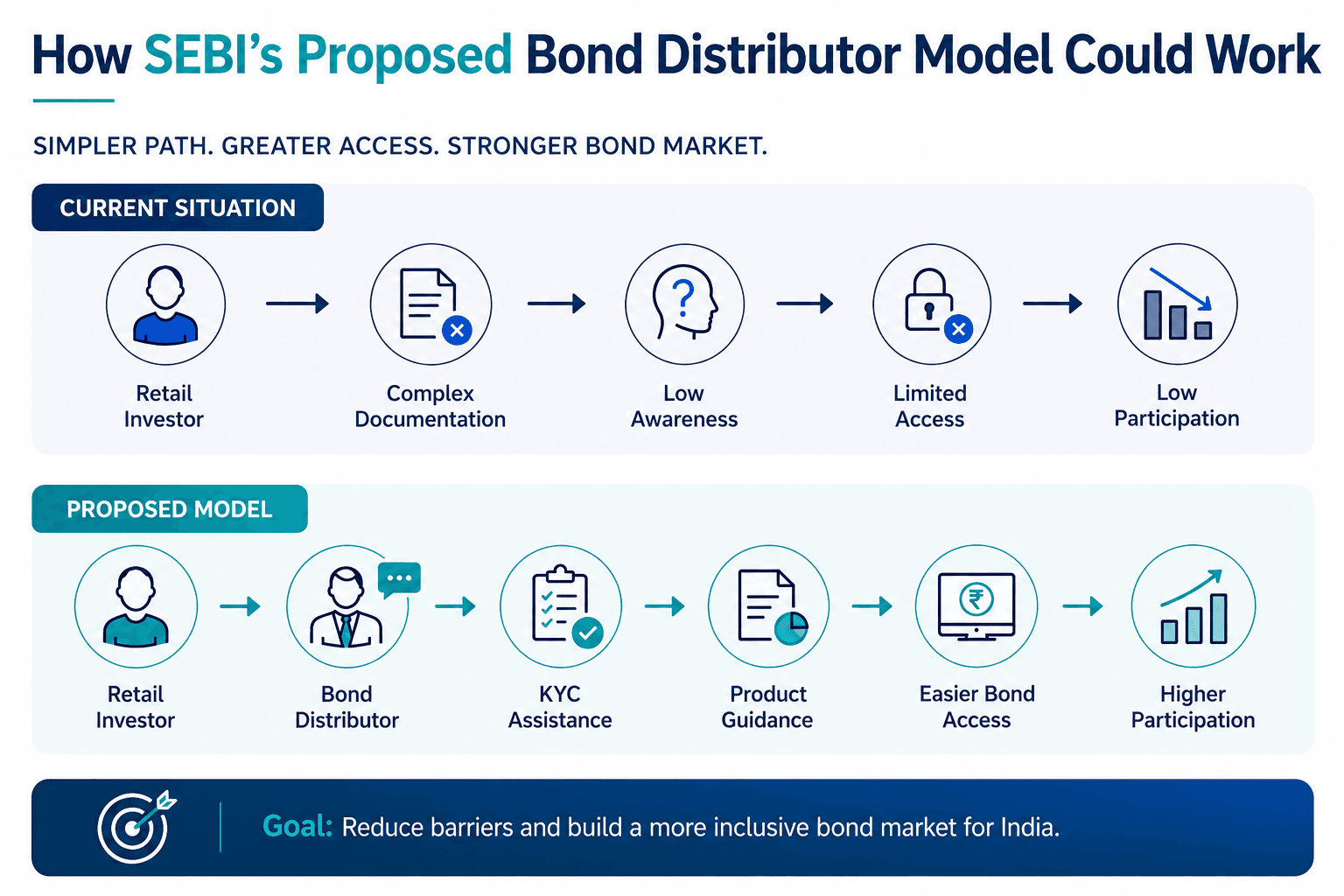
SEBI is exploring the creation of specialised distributors focused specifically on debt products. These distributors would operate similarly to mutual fund distributors, helping retail investors complete investment-related processes. These distributors may assist with:
- Completing Know Your Customer (KYC) formalities
- Managing documentation requirements
- Helping investors initiate bond transactions
- Making debt products easier to understand
The goal is to reduce the operational barriers that currently discourage many retail investors from entering the bond market. SEBI appears to be drawing inspiration from mutual fund distribution networks, which have played a major role in bringing first-time investors into financial markets.
How Retail Bond Investing Could Change?
The SEBI bond distributor model is envisioned to make the debt market India more accessible to retail investors. At present, many retail investors find bond investing less convenient than investing in equities. Stock investing can often be completed quickly through trading platforms, whereas bond investing may require more effort and less familiarity.
A specialised distributor network could simplify this process by offering guidance at the entry level. This may encourage first-time investors seeking exposure to fixed-income products but unsure how to begin. It could also improve participation in both government securities and corporate bonds India by making access easier for ordinary investors.
Opportunities And Risks For Investors
While SEBI’s new distribution channel certainly promises to open new avenues for retail investors in the bond market, no opportunity comes without risks. Knowing both the opportunities and risks of these SEBI bond market reforms will help you make a better decision.
Opportunities:
For retail investors, the biggest opportunity lies in improved access to previously underutilised debt products. Beyond that, other potential advantages include:
- Easier market access
- Greater awareness of bond investment options
- More diversified investment choices
- Improved participation in fixed-income investing in India
Risks:
Like any investment option, bond investing for beginners also raises concerns. Some of the well-pointed concerns include:
- Mis-selling due to poorly designed distributor incentive structures
- Misinformation through unverified investment advice
- Limited investor understanding of risks and returns
- Overdependence on distributors
- Weak regulatory oversight
Why Understanding Risk Still Matters?
SEBI’s bond distributor model definitely makes retail bond investing in India much easier; investors still need to understand what they are buying. In fact, accessibility should not replace responsible investing. Despite the encouragement the simplified distribution system offers, investors must still evaluate whether debt products align with their financial goals. Needless to say, education and transparency will remain essential as the retail debt market expands.
What Does This Mean For India’s Debt Market?
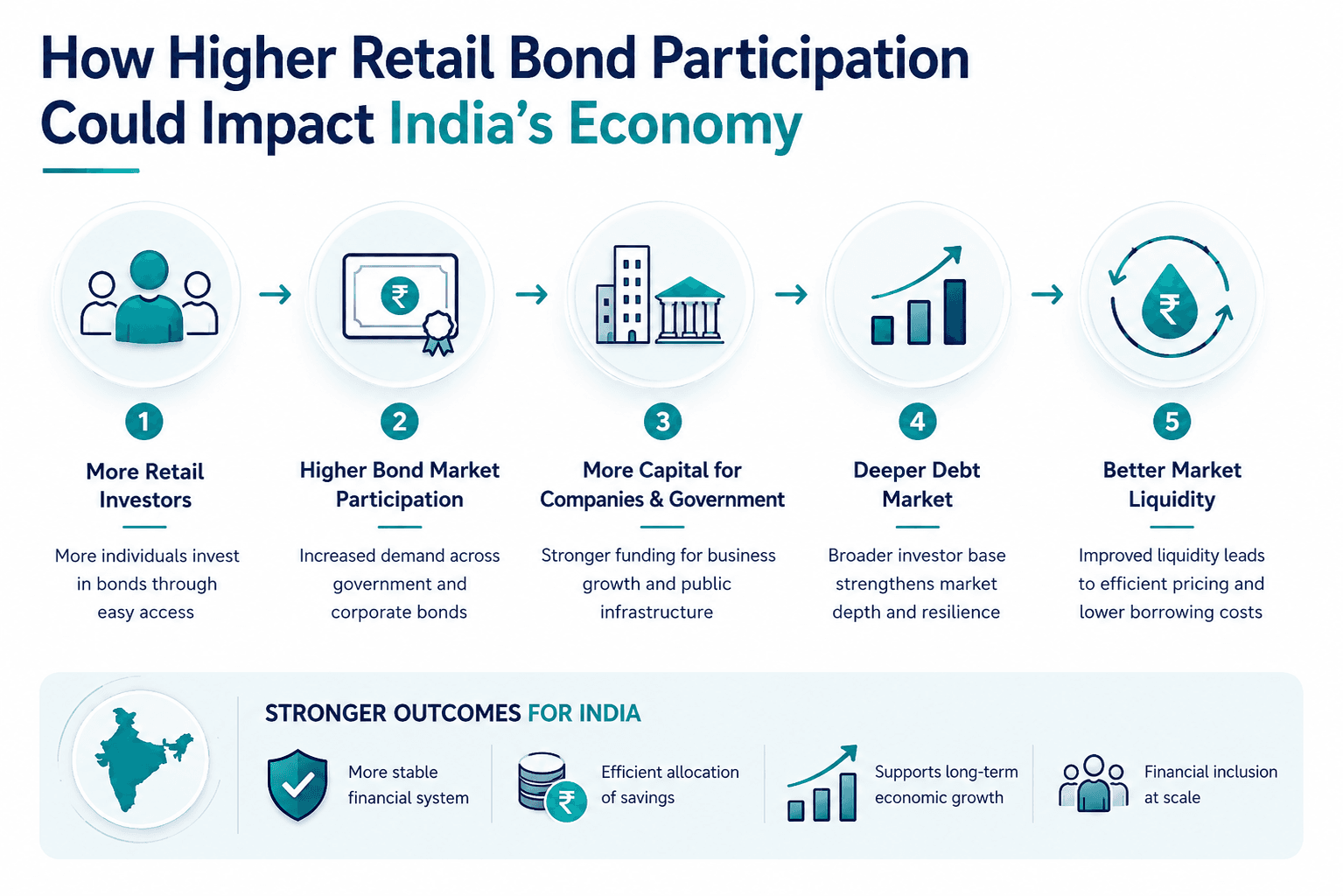
A broader retail investor base could contribute to the long-term growth of India's debt market. India’s broader asset management industry has expanded significantly, and SEBI appears to view retail participation in debt as the next growth opportunity.
1. Potential Growth in Retail Debt Investing
The proposed model may increase the use of debt products in household savings by making them easier to access. This could help balance investment flows that currently favour equities and mutual funds.
2. Impact on Companies and Government Borrowing
Greater participation in corporate bonds in India is expected to widen the pool of capital available to companies. Also, higher retail demand for government bonds could boost participation in borrowing beyond institutional investors.
3. Could Bonds Become Mainstream in India?
Whether bonds will go mainstream remains to be seen, but SEBI’s proposal points to a broader push to build a deeper bond market in India. And if the execution is good and investor protections are strong, bonds could gradually become a more familiar investment option for retail investors.
Conclusion
SEBI’s bond distributor model could mark an important shift in how retail investors access debt products. By reducing barriers to entry, the regulator aims to increase retail participation and improve liquidity in India's bond market.
However, the success of the initiative will depend on maintaining transparency, preventing mis-selling and ensuring investors fully understand the risks involved. If these challenges are addressed, the proposal could help make bond investing for beginners far more accessible.
Grip offers corporate bonds and other fixed-income investment options with yields up to 12.5% and institutional-grade security features. Visit Grip Today!
FAQ: New Bond Distributor Model
 |
Author: Grip Invest Editorial Team The Grip Invest Editorial Team is a group of Chartered Accountants, MBA (Finance) graduates, and Qualified Research Analysts dedicated to helping you invest smarter. We dive deep into India's fixed income landscape to deliver content that is accurate, up-to-date, and easy to understand. Whether you're exploring bonds, fixed deposits, or other fixed income opportunities, our guides cut through the noise and give you the clarity to make better financial decisions. |
Want to stay at the top of your finances?
Join the community of 4 lakh+ investors and learn more about Grip Invest, the latest financial knick-knacks, and shenanigans in the world of investing.
Happy Investing!
Disclaimer - Investments in debt securities/municipal debt securities/securitised debt instruments are subject to risks including delay and/ or default in payment. Read all the offer related documents carefully. The investor is requested to take into consideration all the risk factors before the commencement of trading.
This communication is prepared by Grip Broking Private Limited (bearing SEBI Registration No. INZ000312836 and NSE ID 90319) and/or its affiliate/ group company(ies) (together referred to as “Grip”) and the contents of this disclaimer are applicable to this document and any and all written or oral communication(s) made by Grip or its directors, employees, associates, representatives and agents. This communication does not constitute advice relating to investing or otherwise dealing in securities and is not an offer or solicitation for the purchase or sale of any securities. Grip does not guarantee or assure any return on investments and accepts no liability for consequences of any actions taken based on the information provided. For more details, please visit www.gripinvest.in
Registered Address - 106, II F, New Asiatic Building, H Block, Connaught Place, New Delhi 110001


