

NHAI Bond Interest Rate 2026: Features, Tax Benefits And How To Buy


Selling a long-term asset such as land, property, or unlisted shares? and Worrying about paying a huge capital gains tax? Then, NHAI 54EC Capital Gain Bonds can help you to save that tax in a legal and safe way.
These bonds are issued by the National Highways Authority of India and those are backed by the Government of India, which makes them a trusted investment option for many investors. By investing your long-term capital gains in these bonds, that you can reduce or even avoid paying tax under Section 54EC of the Income Tax Act
In the year 2026, NHAI bonds will continue to be a popular choice for people who are looking for fixed returns, safety, and tax benefits. They are not only a tax-saving investment but also a method to contribute to India’s infrastructure development, which includes highways and road projects across the country.1
This blog will explain the NHAI bond interest rate in the year 2026, their main features, how to invest in them, and whether they are the right fit for your financial goals.
What Are NHAI Bonds?
NHAI Capital Gain Bonds are fixed-income bonds issued by the National Highways Authority of India under Section 54EC of the Income Tax Act, 1961. They are designed to help investors save tax on long-term capital gains.3
The main purpose of these bonds is to provide tax relief to people selling property or other long-term assets. The money collected is used for building and maintaining India’s highway infrastructure.
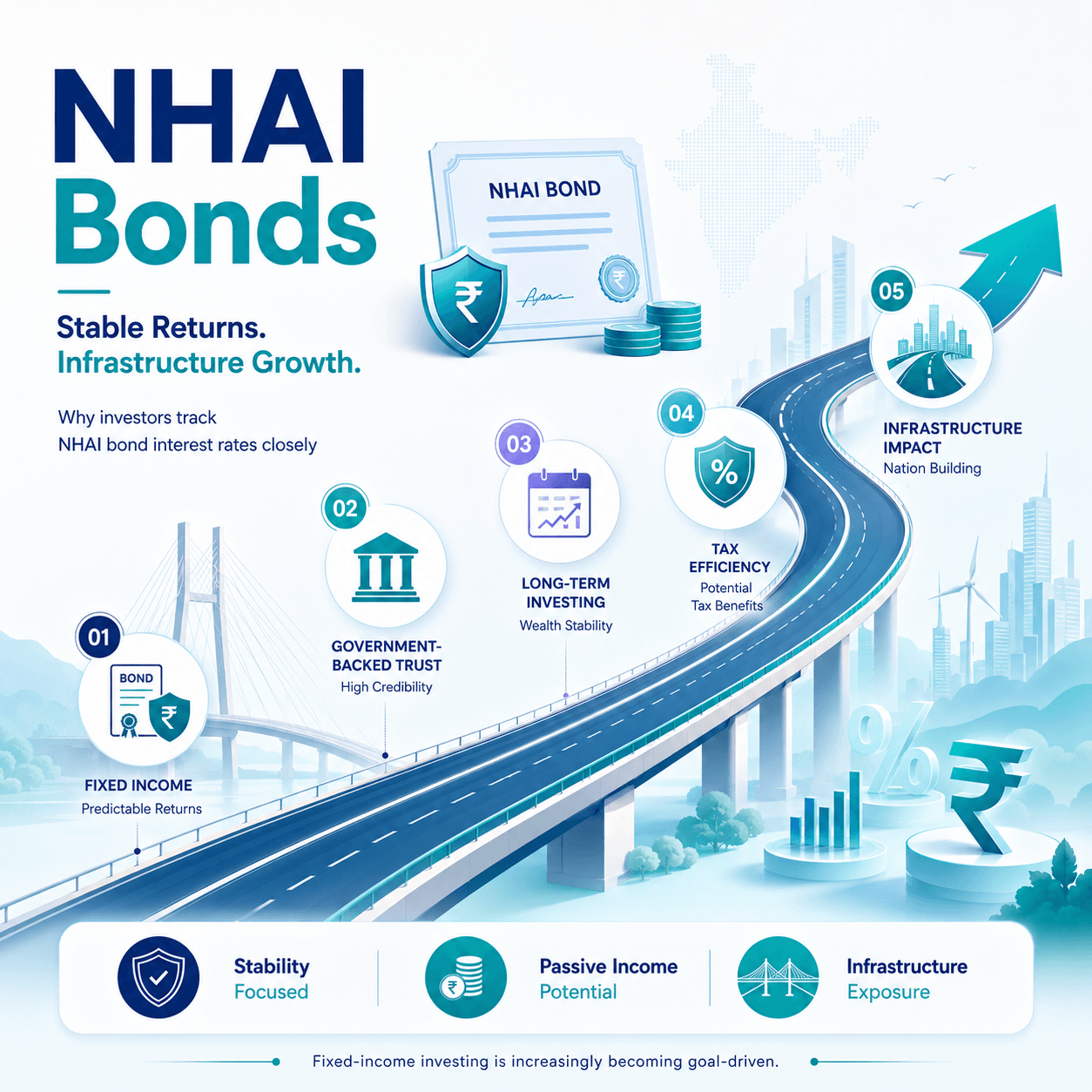
Since NHAI is backed by the Government of India, these bonds are considered one of the safest fixed-income investment options in the country.
Key Features at a Glance
| Feature | Details |
| Issuer | National Highways Authority of India (NHAI) |
| Bond Type | 54EC Capital Gain Bonds |
| Interest Rate | 5.00% per annum (FY 2025-26) |
| Investment Tenure | 5 Years (Lock-in) |
| Minimum Investment | INR 10,000 (1 Bond) |
| Maximum Investment | INR 50 Lakh per financial year |
| Interest Payment | Annually |
| Listing | Not listed on stock exchanges |
| Tax Benefit | Section 54EC – LTCG exemption |
| Redemption | At face value on maturity |
Source: Tax2wi4
Why Are NHAI Bonds So Popular?
NHAI bonds enjoy wide trust among investors for a compelling combination of reasons:
1. Government Backing: Issued by NHAI, a statutory body under the Ministry of Road Transport & Highways, these bonds carry sovereign-level assurance.
2. Tax Exemption Under Section 54EC: Investors can exempt their Long-Term Capital Gains (LTCG) from tax by investing in these bonds within 6 months of the asset sale.2
3. Predictable Returns: A fixed annual interest rate means no market volatility, no surprises.
4. No Credit Risk: Since the issuer is a government authority, the risk of default is virtually nil.
5. Ease of Investment: Available through designated banks, brokers, and online platforms.
NHAI Bond Interest Rate 2026: What To Expect?
| Point | Details |
| Current interest rate | NHAI 54EC bonds currently offer 5.00% per annum for FY 2025-26. The interest is paid annually on the face value of INR 10,000 per bond, which works out to INR 500 per bond each year. |
| Why investors consider it | These bonds are mainly used for Section 54EC tax exemption on long-term capital gains, not for maximum yield. |
| Key takeaway | NHAI bonds may look lower on nominal return than some other fixed-income options, but they can still be attractive for eligible investors who want to save capital gains tax legally. |
What Happens At Maturity: Taxation Of Principal And Interest
On Maturity (After 5 Years):
• After the 5-year lock-in period, the invested principal amount is returned to the investor tax-free. There is no capital gains tax on the maturity amount of NHAI 54EC bonds.
• However, if the bonds are sold or transferred before 5 years, the tax exemption claimed earlier becomes taxable.
On Interest Earned:
• The annual interest of 5-7.5% is taxable as 'Income from Other Sources' under the Income Tax Act.
• TDS (Tax Deducted at Source) is not applicable on NHAI bond interest investors must self-report and pay tax.
• For investors in the 30% tax bracket, the post-tax return may come down to around 3.5% per year. Still, the overall benefit remains attractive because of the large tax savings on long-term capital gains.8
Know your numbers before making investment decisions:
How To Buy NHAI Bonds: Online And Offline Process?
Online Process
Step 1: Visit the official NHAI bond portal or the websites of registered registrars such as Karvy (KFintech) or Link Intime.
Step 2: Download and fill out the application form. Enter personal details, PAN card, bank account, and demat account information.
Step 3: Upload KYC documents (PAN, Aadhaar, address proof).
Step 4: Transfer funds online via NEFT/RTGS to the designated collection account.
Step 5: Receive bond allotment confirmation via email/SMS. Bonds may be held in demat or physical form.6
Offline Process
Step 1: Obtain the application form from designated branches of authorised banks (e.g., HDFC Bank, ICICI Bank, Axis Bank, PNB, etc.) or from registered brokers.
Step 2: Fill the form and attach self-attested KYC documents.
Step 3: Submit the form along with a cheque or demand draft in favour of 'NHAI 54EC Bonds.'
Step 4: Collect the acknowledgement receipt. Allotment letter is sent to your registered address.7
NHAI vs REC / PFC / IRFC: Which 54EC Bond Is Better?
If you are comparing NHAI with REC, PFC, and IRFC, the key difference is that NHAI and REC are relevant for Section 54EC tax-saving, while PFC and IRFC are generally better known for fixed-income investing. The right choice depends on whether your priority is tax exemption, regular returns, or overall portfolio suitability.
| Bond / Instrument | Typical Rate | Tax Benefit | Lock-in / Tenure | Best Suited For |
| NHAI 54EC Bonds | 5.00% p.a. | Section 54EC LTCG exemption | 5 years | Investors who sold property or other long-term assets and want tax savings. |
| REC 54EC Bonds | Usually similar to NHAI 54EC rates | Section 54EC LTCG exemption | 5 years | Tax-saving investors looking for another government-backed 54EC option. |
| PFC Bonds | Varies by issue | No 54EC exemption | Varies by issue | Investors seeking fixed-income exposure with a focus on yield. |
| IRFC Bonds | Varies by issue | No 54EC exemption | Varies by issue | Conservative investors looking for regular debt-market returns. |
Should You Invest In NHAI Bonds?
Ideal For:
• Individuals who have sold immovable property or other long-term assets and earned capital gains.
• Conservative investors looking for a government-backed, risk-free fixed-income investment.
• Those in the higher tax brackets (20–30%) who benefit most from the LTCG exemption.
Not Ideal For:
• Investors seeking liquidity bonds have a strict 5-year lock-in with no premature withdrawal.
• Those looking for high-yield returns at 5% p.a., the nominal return is lower than several market alternatives.
• Investors without an LTCG event without capital gains to offset, the primary benefit of 54EC bonds is lost.
Explore Listed Bond Opportunities: If you are looking for higher yields, liquidity, or a broader fixed-income portfolio, platforms like Grip Invest offer access to a curated selection of listed bonds, corporate fixed deposit, and alternative fixed-income products. These complement NHAI bonds by providing yield enhancement opportunities within a regulated framework.
Conclusion
NHAI 54EC Capital Gain Bonds remain a trusted way to save long-term capital gains tax in India. With a 5.00% interest rate in 2026 and government backing, they offer safety and tax benefits under Section 54EC. However, due to the 5-year lock-in and fixed returns, they work best as part of a larger investment strategy.
While NHAI bonds help save taxes, Grip Invest helps investors explore listed bonds, debentures, and other fixed-income options for better returns and diversification. Simply put, NHAI bonds act as a tax saver, while Grip Invest helps grow your wealth further.
FAQs On NHAI Interest Rates 2026
 |
Author: Grip Invest Editorial Team The Grip Invest Editorial Team is a group of Chartered Accountants, MBA (Finance) graduates, and Qualified Research Analysts dedicated to helping you invest smarter. We dive deep into India's fixed income landscape to deliver content that is accurate, up-to-date, and easy to understand. Whether you're exploring bonds, fixed deposits, or other fixed income opportunities, our guides cut through the noise and give you the clarity to make better financial decisions. |
Want to stay at the top of your finances?
Join the community of 4 lakh+ investors and learn more about Grip Invest, the latest financial knick-knacks, and shenanigans in the world of investing.
Happy Investing!
Disclaimer - Investments in debt securities/municipal debt securities/securitised debt instruments are subject to risks including delay and/ or default in payment. Read all the offer related documents carefully. The investor is requested to take into consideration all the risk factors before the commencement of trading.
This communication is prepared by Grip Broking Private Limited (bearing SEBI Registration No. INZ000312836 and NSE ID 90319) and/or its affiliate/ group company(ies) (together referred to as “Grip”) and the contents of this disclaimer are applicable to this document and any and all written or oral communication(s) made by Grip or its directors, employees, associates, representatives and agents. This communication does not constitute advice relating to investing or otherwise dealing in securities and is not an offer or solicitation for the purchase or sale of any securities. Grip does not guarantee or assure any return on investments and accepts no liability for consequences of any actions taken based on the information provided. For more details, please visit www.gripinvest.in
Registered Address - 106, II F, New Asiatic Building, H Block, Connaught Place, New Delhi 110001


