

Highly Safe Bonds in India: A Complete Guide to Low Risk Fixed Income Investments


Safety and risk are two things that concern every investor when they are investing their money, especially when it involves a long-term investment. Unfortunately, there are not many investment avenues that are the best of both worlds. One such reliable avenue is corporate bonds.
As of 2024, India’s debt market has grown to over INR 217 trillion, making it the second-largest debt market globally. This highlights its growing importance in the country’s financial ecosystem. That said, identifying the safest bonds in India can be challenging due to varying credit ratings and issuer credibility.
But for those seeking a balance between low risk and predictable returns, well-rated corporate bonds offer a compelling solution.
Read along to learn more about highly safe bonds, their types, benefits, and risks associated with them.
What Are Highly Safe Bonds?
Highly safe bonds are debt instruments issued by companies with high creditworthiness or backed by government authorities. These are the types of bonds that offer you risk-free returns and are rated AAA or AA by credit rating agencies such as CRISIL, ICRA, etc. Although there is no guarantee in any investment, highly safe bonds (AAA, AA) provide you with financial security for your investment.
Types Of Highly Safe Bonds
There are various kinds of high-grade bonds. Some of them are:
1. Government Bonds
Government bonds are backed by sovereign guarantees. They are issued by the central and state governments. They are often considered safe bond investment options as they provide you with capital preservation and consistent return.
2. Municipal Bonds
Municipal bonds are issued by local or municipal government authorities for public projects and infrastructure. They are a safe choice for conservative investors as they are often tax-free and have lower risk.
3. High-Grade Corporate Bonds
All the bonds issued by stable financial companies or organisations that are rated AAA or AA fall under the high-grade corporate bonds category. They have a low-risk profile while offering better returns than fixed deposits.
Looking to invest in corporate bonds that offer stability and predictable returns? Explore a curated selection of AAA and AA-rated corporate bonds on Grip Invest. With a seamless digital process and transparent pricing, you can invest in top-rated companies and build a low-risk, high-reward portfolio.
How Credit Ratings Are Determined For Bonds?
The credit rating is important in determining the safety of AAA rated bonds India and AA rated bonds India. In India, credit rating agencies include CRISIL, ICRA, CARE, and India Ratings, which issue these ratings. The rating represents the capacity of an issuer to make interest and principal payments on time. It is a data-driven, structured process that is implemented on the basis of various financial and qualitative considerations.
What Credit Rating Agencies Look For?
There are numerous pointers that are examined by credit rating agencies in India. These are the factors involved, and they are:
1. Financial power: The agency will look at the sales trends, profitability, cash flow stability, liquidity positions, and earnings stability. Strong and predictable cash flows are beneficial to a higher rating.
2. Leverage and coverage: Fixed income matters, debt to equity ratio, interest coverage ratio and repayment schedules will reflect the ability of the issuer to structure debt.
3.Assets of quality: Agencies carry out the evaluation of the quality of underlying assets, exposure to risky sectors and counterparty concentration.
4. Qualities of management: The ultimate rating depends on governance standards, background, management experience and track record of the promoters.
5.Industry risk: Stability of the industry, regulatory framework and the intensity of competition determine the likelihood of repayment on time.
6. Market position: Companies with strong brands, established franchises, and diversified operations tend to receive higher ratings.
These inputs help agencies determine the overall safety level of highly rated bonds investment in India.
Rating Methodology
The rating process moves through defined stages. To start with, the issuer files audited financial reports, debt and business records. Analysts subsequently perform ratio analysis, benchmark performance against industry performance and analyse stress scenarios. Strategic discussions with management give a good understanding of how to allocate capital and risk limits.
Upon review, the rating committee comes up with a rating of AAA to D. The rating is observed during the life of the bond. Any financial health decline can result in a downgrade. Continuous surveillance protects the transparency of the low risk bonds India segment.
Difference Between AAA Rated Bonds India and AA Rated Bonds India
The AAA ratings depict the most powerful credit profile. Bonds that have this rating have the least anticipated default risk. Issuers typically show high liquidity, robust cash flows, conservative leverage and stable operating performance. Examples include top NBFCs and large corporations that consistently meet financial obligations.
AA ratings remain strong but reflect a slightly higher risk level. Issuers may show minor volatility in earnings or moderately higher leverage. Interest coverage ratios may be lower than AAA peers, and sensitivity to economic cycles may be higher.
Key differences include:
Factor | AAA Rated Bonds | AA Rated Bonds |
| Probability of Default | Highest repayment strength; lowest default risk | Strong but slightly lower repayment capability compared to AAA |
| Yield | Lower yields due to minimal risk | Marginally higher yields to compensate for added risk |
| Stability | Ratings generally remain stable across market cycles | Ratings may fluctuate with earnings swings or sector conditions |
| Liquidity | Higher liquidity and stronger secondary market demand; supports better price stability | Liquidity may be comparatively lower, depending on market demand |
Both ratings qualify as safe corporate bonds India, and both are widely used in best low risk bonds to invest in India 2026 lists. The choice depends on risk tolerance and return expectations.
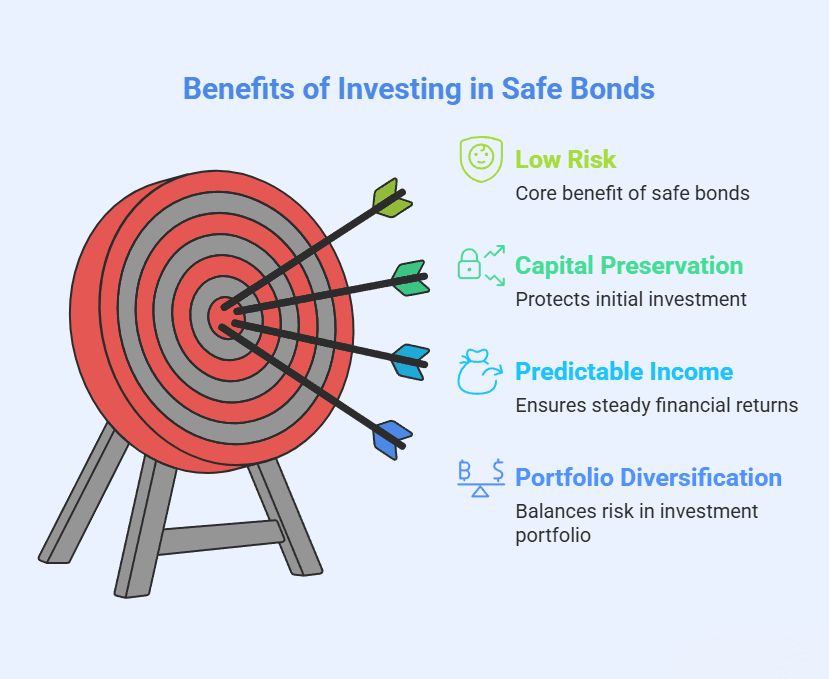
Benefits Of Investing In Highly Safe Bonds
Highly safe bonds offer investors multiple advantages. Some of them are:
1. Low Risk
Bonds rated AAA, AA, or those issued by government authorities are considered low risk bonds. These bonds come with minimal credit risk. In fact, they offer you security and stability, even during the volatile periods of the market and economy.
2. Preservation Of Capital
Highly safe bonds offer you safety against the fluctuations in the market, helping you protect your initial investment. These bonds are the safest choice for investors with low-risk appetite.
3. Predictable Income
These bonds are ideal for investors looking for financial and return predictability. These bonds often offer fixed interest rates, so you will know exactly how much you will earn in a specific period.
4. Portfolio Diversification
High-grade bonds can also help you balance your diverse investment portfolio. Adding these bonds to your portfolio can help you in countering the high risk associated with other risky investments like equities. It can help reduce overall risk and provide a way to earn a steady income.
Risks Associated With Highly Safe Bonds
Even though highly safe bonds have a low-risk profile, they are not entirely free from risk. Some of the risks associated with highly safe bonds are:
1. Interest Rate Risk
Interest rate risk is when market interest rates rise, leading to decreases in the value of existing bonds. This inverse relationship can make old bonds look less attractive compared to those that are new and issued with a high rate of interest. However, the risk can be balanced by diversifying your investment portfolio by investing in both short-term and long-term bonds.
2. Inflation Risk
Inflation risk occurs when the inflation rate exceeds the rate of yield of the bonds. It can decrease the purchasing power of returns from these bonds, making them less profitable over time. You can counter the risk of inflation by investing in Inflation-linked bonds, such as Treasury Inflation-Protected Securities (TIPS).
3. Tax Implications
Unless the bonds are explicitly tax-exempt, the interest earned on bonds is usually taxable. Tax liability can significantly reduce the income of investors, depending on their tax bracket. To counter the risk of taxes, you can invest in tax-free government bonds.

How To Invest In Highly Safe Bonds?
Investing in highly safe bonds is easy and can be done after considering some factors. A few steps you can take before investing in these types of bonds are:
Step 1: You must start by understanding your goals to find out the type of bond that suits your goals the best. Assessing your financial goals and your risk appetite can help you determine the ideal bond type.
Step 2: Choose the right platform for starting your investment journey. You must focus on choosing a platform that offers a wide variety of highly safe bonds that are rated high by credit agencies.
Step 3: Sign up for your chosen platform and complete the necessary documentation formalities. KYC verification with PAN and Aadhar, a Demat account for holding and trading bonds, and bank account verification for seamless transactions.
Step 4: In the next step, analyse and evaluate the rating (AAA, AA) of the bonds. You just ensure you check the issuer’s reputation, creditworthiness, and yield of bonds before choosing to invest.
Step 5: Once you select the right bond for investment and invest in it, monitor the performance of the bond. Try keeping track of its maturity period and payouts. Diversify your investment portfolio across various issuers and bonds to balance risk while maintaining steady returns.
A few examples of highly safe bonds that you can consider are:
Bond Issuer | Yield | Payment Frequency | Maturity Date | Credit Rating |
HDB Financial Services Ltd. | 8.15% | Yearly | 27-Oct-2034 | CRISIL AAA |
Aditya Birla Finance Ltd. | 8.13% | Yearly | 11-Jul-2034 | ICRA AAA |
Axis Finance Ltd. | 8.10% | Yearly | 23-Jun-2034 | CRISIL AAA |
Bajaj Finance Ltd. | 7.64% | Yearly | 18-Apr-2031 | CRISIL AAA |
SBI Cards & Payment Services Ltd. | 7.58% | Yearly | 17-May-2028 | CRISIL AAA |
Food Corporation of India | 7.14% | Yearly | 23-Oct-2030 | CARE AAA |
How To Evaluate A Bond Issuer’s Financial Health
Strong financial health is central to the safety of AAA rated bonds India, AA rated bonds India, and other safe corporate bonds India. A clear review of financial indicators helps determine whether an issuer can meet repayment commitments without stress. The following factors provide a practical framework for evaluating issuer strength in the highly rated bonds investment category.
How to Evaluate a Bond Issuer’s Financial Health
Strong financial health is central to the safety of AAA rated bonds India, AA rated bonds India, and other safe corporate bonds India. A clear review of financial indicators helps determine whether an issuer can meet repayment commitments without stress. The following factors provide a practical framework for evaluating issuer strength in the highly rated bonds investment category.
1. Cash Flows
Stable operating cash flow signals the ability to handle regular interest payouts. Agencies and analysts review multi-year cash flow statements to check consistency. Positive cash flow during economic slowdowns strengthens the case for high ratings. This indicator is critical because low risk bonds India depend on predictable inflows for the timely servicing of obligations.
2. Debt to Equity
Financial resilience is achieved through a balanced capital structure. The debt-to-equity ratio informs the extent to which the issuer relies on debt as compared to the capital of the shareholders. Reduced ratios are signs of conservative leverage. An increase in ratios provides greater susceptibility to the stresses experienced in the market and may reduce access to new borrowing. Issuers of bonds that are highly rated tend to have moderate levels of leverage to ensure stability in the long term.
3. Interest Coverage
Interest coverage measures the issuer’s ability to meet interest expenses through operating profits. Analysts often prefer coverage comfortably above industry norms. Weak coverage creates repayment pressure and raises refinancing risk. Strong coverage supports higher ratings and improves investor confidence in segments often listed as best low risk bonds to invest in India 2026.
4. Promoter Background
Promoter credibility matters. Agencies verify governance quality, transparency, and the track record of the promoter group. Stable leadership, professional management, and clean compliance records reduce operational and financial risks. This evaluation helps differentiate strong issuers in the safe corporate bonds India space from those with governance gaps.
5. Default History
The behaviour of the past is a significant indicator. Agencies ensure that no payments are missed, events are restructured, delayed or covenant breached. A clean default history supports higher ratings. A weak history lowers rating potential and increases the risk premium demanded by the market. This assessment contributes to identifying truly reliable issuers within AAA rated bonds India and AA rated bonds India.
Evaluating these factors helps create a clearer picture of issuer strength. It also supports better assessment of repayment capacity and the overall quality of bond liquidity India within the fixed income market.
6. Liquidity Considerations in Highly Safe Bonds
Liquidity plays an important role in assessing AAA rated bonds India, AA rated bonds India, and other highly rated bonds investment options. Liquidity affects exit flexibility, pricing, and overall portfolio stability. Strong liquidity also supports better confidence in segments often viewed as low risk bonds India.
7. How Easy Bonds Are to Resell
Resale ease depends on the depth of the secondary market. Highly safe bonds issued by large NBFCs, banks, and government-backed entities usually attract more buyers. Strong demand leads to faster trade execution. Bonds with active participation from institutional investors often show easier resale conditions, which supports consistent market access for smaller participants.
8. Trading Volumes
Trading volumes show how frequently a bond changes hands. Higher volumes improve bond liquidity India because they result in stable price discovery. Bonds with low volumes can be harder to exit and may require price concessions. AAA and AA instruments tend to show higher activity compared to lower-rated bonds, especially in the corporate bond market on NSE and BSE.
9. Bid Ask Spread
The difference between the highest price that a buyer can agree to pay and the lowest that a seller can agree to take is the so-called bid-ask spread. Narrow spreads are a good indication of liquidity and effective pricing. Wider spreads indicate fewer market participants and higher transaction costs. Bonds listed among best low risk bonds to invest in India 2026 usually show tighter spreads due to steady demand.
10. Importance of Liquidity for Retail Investors
Liquidity is relevant as it influences the timing of exit and the certainty of the prices and rebalancing. Improved liquidity limits the selling at a high discount amidst market strain. It also supports smoother transitions between different safe corporate bonds India as interest rates and market conditions change. Strong liquidity adds another layer of comfort to highly rated fixed income products and enhances overall portfolio quality.
AAA vs AA Rated Bonds: What’s the Difference?
When it comes to investing in safe bonds, credit ratings are your first checkpoint. AAA rated bonds are considered the most secure — backed by companies with the strongest ability to repay debt on time. They offer slightly lower returns but come with minimal risk, making them ideal for conservative investors.
On the other hand, AA rated bonds are still high-quality investments but carry a marginally higher risk. In return, they often offer better yields than AAA bonds. If you’re comfortable with a little extra risk for slightly higher returns, AA rated bonds can be a smart addition to a well-diversified portfolio.
Both AAA and AA rated bonds are commonly used by investors seeking stable, fixed-income options. Choosing between the two depends on your return expectations and risk appetite.
Interest Rates Of AAA-Rated Bonds
AAA-rated bonds typically offer interest rates ranging between 7% to 10% pre-tax, depending on the tenure, issuer profile, and prevailing market conditions. Since these bonds are backed by companies with the highest creditworthiness, the returns are slightly lower compared to lower-rated or high-yield bonds—but what you gain is unmatched safety and predictable income.
For conservative investors, these bonds are an attractive option to diversify a fixed-income portfolio while enjoying stable returns with minimal credit risk.
Whether you are planning long-term wealth creation or simply looking for reliable passive income, AAA-rated bonds provide a compelling balance of safety, liquidity, and moderate returns.
Plan your investment journey with our calculator.
Tax-Efficient Strategies With Highly Safe Bonds
Tax planning increases the effectiveness of AAA rated bonds India, AA rated bonds India, and other instruments included in highly rated bonds investment lists. A clear understanding of tax rules helps improve net returns from low risk bonds India.
1. Tax Benefits of Municipal Bonds India
Municipal bonds often provide tax-free interest income. Many issues fall under the category of public infrastructure financing. The exemption reduces the total tax burden and increases post tax returns. This benefit positions municipal securities as attractive options within best low risk bonds to invest in India 2026, especially for investors in higher tax brackets.
2. Indexation Benefits
Indexation applies when long-term capital gains arise from selling listed bonds after the defined holding period. The cost is adjusted for inflation. This lowers taxable gains and reduces the effective tax rate. Indexation is relevant only when the bonds qualify under current tax rules. It supports inflation-adjusted returns and improves long-term efficiency for certain safe corporate bonds India.
How To Assess The Safety Of A Bond Before Investing?
There are several aspects that need to be considered when looking from the point of view of the safest bonds in India. It is not just a matter of finding good rates and reputable issuers. Every kind of bond involves various degrees of risks and it is important to know the reasons for bond safety.
1. Credit Rating Is a Good Starting Point, Not the Final Decision
The very first thing that one should look at is the credit rating of a bond. There are independent agencies that assess the financial health and ability to make prompt payments of interest and principal. AAA bonds are considered the safest, while AA bonds provide comparatively lower risk.
Again, ratings should not be the only basis for taking decisions. It is important to remember that the credit rating can change due to changes in the financial position of the issuer or market conditions. Therefore, credit ratings should be viewed as an important starting point rather than the sole basis for investment.
2. Financial Strength of the Issuer
The financial condition of an issuer is a significant factor. Issuers that show steady revenue, satisfactory income, reasonable debt levels, and solid cash flows can pay their debts. In the case of corporate bonds, studying annual reports, financial statements, and debts is enlightening to know the issuer’s capacity to fulfil its obligations.
Since the primary claimants of government bonds is the government, government bonds are popular among conservative investors.
3. Government Backing vs Corporate Issuers
The fact that government bonds are backed by sovereign or public authorities makes them one of the most trustworthy investments. Governments have the right to tax their citizens and have more ways to finance their needs, thus reducing the risk level.
Corporations issue corporate bonds to finance corporate activities, including expansion, infrastructure, and operations. While a lot of corporate bonds yield a higher return than other securities, it is prudent to check the financial state of the issuer in advance.
4. Secured vs Unsecured Bonds
Secured bonds are those that come with a particular asset that is owned by the issuer. When a secured bond issuer gets into financial difficulties, the asset can be used to recover the investor's money at the time of repayment. Due to this extra layer of security, the secured bonds are seen as better investments compared to the non-secured ones.
Unsecured bonds, also known as debentures, do not come with the backing of any specific asset. Their repayment will be full dependent on the issuer’s ability to pay. This means that even AAA-rated bonds might end up being unsecured.
5. Liquidity
Government bonds, which are normally traded in the markets on a regular basis, have great liquidity. Some corporate bonds also tend to be really liquid since they are issued by corporations that are very well-known. On the contrary, bonds that trade less often might be harder to sell in the market.
Investors who might require withdrawals from their investments before maturity should always look at liquidity in addition to yields in the process of comparing safe bonds.
6. Default History
A good record with no deferrals, restructurings, or defaults can be an indicator of good financial management. Though past performance does not mean that repayments will be made in the future. Analysing the record of issuers can help investors find bonds that are secure.
Safest Bond Types Compared
Many investment alternatives are available in the Indian bond market for investors looking for safe and regular earnings. There are no 100 percent safe investments, but several bond types generally have less risk due to the strength of their issuer or support from the government.
1. Government Bonds
Government bonds are considered to be the safest bonds in India as they are guaranteed either by the Government of India or the state government. Such securities are characterised by a high degree of repayment security and, hence, are highly preferred by conservative investors who value capital preservation more than gains.
Though with relatively lower earnings as compared to some corporate bonds, the default rate of these bonds is amongst the lowest, which makes them one of the safest instruments for the long-term portfolio.
2. High-Quality Corporate Bond
Firstly, corporate bonds that are highly rated and issued by financially wealthy companies to find a good balance between safety and earnings opportunity. For example, many investment-grade securities with AAA or AA ratings guarantee constant payments along with a reasonable credit risk level.
Investors who wish to earn more than government bonds prefer to invest in AAA-rated bonds offered by top financial institutions and reputed firms. AAA-rated bonds are yet another good pick of secure bonds for those who want to invest in low-risk, but still get higher returns.
3. Municipal Bonds
Municipal bonds are issued by different municipalities in order to fund public works projects. Depending on the issuer and related regulations, part of the municipal bonds may be tax-exempt.
While the size of the municipal bonds market is smaller when compared with the government and corporate bonds market, it still manages to draw investors who want diversified and low-risk bonds.
4. Public Sector Undertaking (PSU) Bonds
Public sector undertaking bonds are issued by the enterprises owned by the government. Since these companies get plenty of support from the government, the bonds issued by these companies are usually considered to be safe investments as compared to a number of privately issued securities.
Most PSU bonds are classified as investment-grade bonds.
Can Safe Bonds Still Lose Value?
There are many investors who believe that fixed-income bonds cannot generate any losses since they are guaranteed to pay a fixed rate of interest. Although they do have a lesser degree of credit risk than equities, the most secure bonds in India are subject to some market risks that investors must be aware of before making an investment.
1. Interest Rate Risk
The rate of interest directly influences the prices of the bonds. When the interest rates rise in the market, newly issued bonds will pay higher interest. For this reason, older bonds that are paying lower interest rates become less desirable and lead to a fall in their value.
This situation has an effect on the investors wishing to sell their bonds before maturity, but if an investor has chosen to hold their government bonds or corporate bonds till the time of maturity, they will be able to keep on receiving the interest payments and the principal amount.
2. Inflation Risk
Inflation steadily eats at the purchasing power of fixed-income investment returns. Whenever inflation rises rapidly and bond returns remain unchanged, the actual return from the investment drops.
For this reason, some investors choose to have low-risk bonds in their portfolios along with other options that secure them from inflation and maintain their portfolios in balance over time.
3. Credit Downgrade Risk
Even very successful issuers may undergo changes in financial conditions. As a result of a credit downgrade, the bond prices drop as well.
Despite the fact that the majority of AAA-rated bonds are characterised by a low risk of default, investors should keep track of the changes in rates from time to time and not assume that their bonds will always have the same class.
4. Liquidity Risk
Not all bonds are equally liquid. In active markets, when there are not many buyers to purchase a bond early, it could be quite difficult to get rid of it at a satisfactory price.
Government bonds are often liquid, while certain corporate bonds are traded less frequently. If you want to make sure your money is released early, you should think about liquidity when purchasing low-risk bonds.
Checklist Before Buying A Safe Bond
If you are going to invest in any bond, it can be useful to understand the different factors influencing safety and long-term returns. Evaluating the investment in an organised way makes it easier for a person to see the distinctions and select one of the best low-risk bonds that fit the purpose of investing.
1. Check the Credit Rating
The first thing to do is check the bond’s credit rating. Ideally, investment-grade bonds will be rated AAA, but one should check updates rather than just be satisfied with the first rating.
2. Compare the Yield
Higher interest rates generally correspond with increased risks.. When selecting the bond with the highest return, it is essential to take the factors impacting the bond's return into consideration, including the issuer's credit rating, term, and financial status.
3. Understand the Maturity Period
Choose a maturity period that is in line with your financial needs. While shorter-term bonds are characterised by reduced interest rate risk, longer-term bonds prevent one from getting revenues for a longer period of time.
4. Review the Security Cover
It is also important to find out whether the bond is secured or not. Secured bonds will be more advantageous due to some security provided by underlying assets.
5. Consider Taxation
Most corporate bonds generate taxed income that falls under the investor's tax bracket. Some state and local bonds may have some tax benefits for the investor, according to some regulations.
7. Evaluate Exit Options
Finally, assess how easily the bond can be sold before maturity if required. Bonds with better liquidity provide greater flexibility during changing financial situations.
Who Should Consider Tax-Free vs Taxable Bonds?
Tax-free bonds suit individuals in higher tax slabs because tax-exempt interest improves net income. Taxable bonds suit investors in lower tax brackets or those seeking higher pre-tax yields. AAA and AA instruments often fall in the taxable category but compensate through stronger credit quality. The choice depends on tax position, risk preference, and target income levels.
Taxation Of Interest
Interest from most corporate bonds is taxed as per the individual’s income tax slab. This includes many bonds listed under AAA rated bonds India and AA rated bonds India. Tax deducted at source may apply based on regulatory requirements. The effective return, therefore, depends on the post-tax yield. Tax planning becomes important for maintaining the value of fixed income portfolios, especially in the bond liquidity India segment, where investors actively shift between instruments.
These strategies help strengthen long-term outcomes from highly safe fixed-income products and improve the overall tax efficiency of a stable bond portfolio.
Conclusion
Highly safe bonds are one of the safest investment choices, especially for investors with low-risk appetite. These bonds offer you low risk while allowing you to preserve your original investment, and they offer you predictable income while diversifying your investment portfolio.
If you are looking for an easy-to-use platform that allows you to invest in highly safe bonds, sign up with Grip today. It is a user-friendly investment platform that allows you to invest in a wide array of high-yield investment securities.
FAQs On Highly Safe Bonds
 |
Author: Grip Invest Editorial Team The Grip Invest Editorial Team is a group of Chartered Accountants, MBA (Finance) graduates, and Qualified Research Analysts dedicated to helping you invest smarter. We dive deep into India's fixed income landscape to deliver content that is accurate, up-to-date, and easy to understand. Whether you're exploring bonds, fixed deposits, or other fixed income opportunities, our guides cut through the noise and give you the clarity to make better financial decisions. |
Want to stay at the top of your finances?
Join the community of 4 lakh+ investors and learn more about Grip Invest, the latest financial knick-knacks, and shenanigans in the world of investing.
Happy Investing!
Disclaimer - Investments in debt securities/municipal debt securities/securitised debt instruments are subject to risks including delay and/ or default in payment. Read all the offer related documents carefully. The investor is requested to take into consideration all the risk factors before the commencement of trading.
This communication is prepared by Grip Broking Private Limited (bearing SEBI Registration No. INZ000312836 and NSE ID 90319) and/or its affiliate/ group company(ies) (together referred to as “Grip”) and the contents of this disclaimer are applicable to this document and any and all written or oral communication(s) made by Grip or its directors, employees, associates, representatives and agents. This communication does not constitute advice relating to investing or otherwise dealing in securities and is not an offer or solicitation for the purchase or sale of any securities. Grip does not guarantee or assure any return on investments and accepts no liability for consequences of any actions taken based on the information provided. For more details, please visit www.gripinvest.in
Registered Address - 106, II F, New Asiatic Building, H Block, Connaught Place, New Delhi 110001


