

Silver Futures India : Meaning, Trading, Risks And How They Work In India


Investors in India have long enjoyed the allure of the metal known as silver. It has provided unique investing options for centuries, with everything from goldsmithing to traditional jewelry and more modern-day investing instruments.
Nowadays, many people use silver futures contracts to participate in the pricing of silver without needing to own the physical bar or coin.
Here we will provide you with a full and concise explanation of silver futures contracts so that you can understand how they work.
What Are Silver Future Contracts?
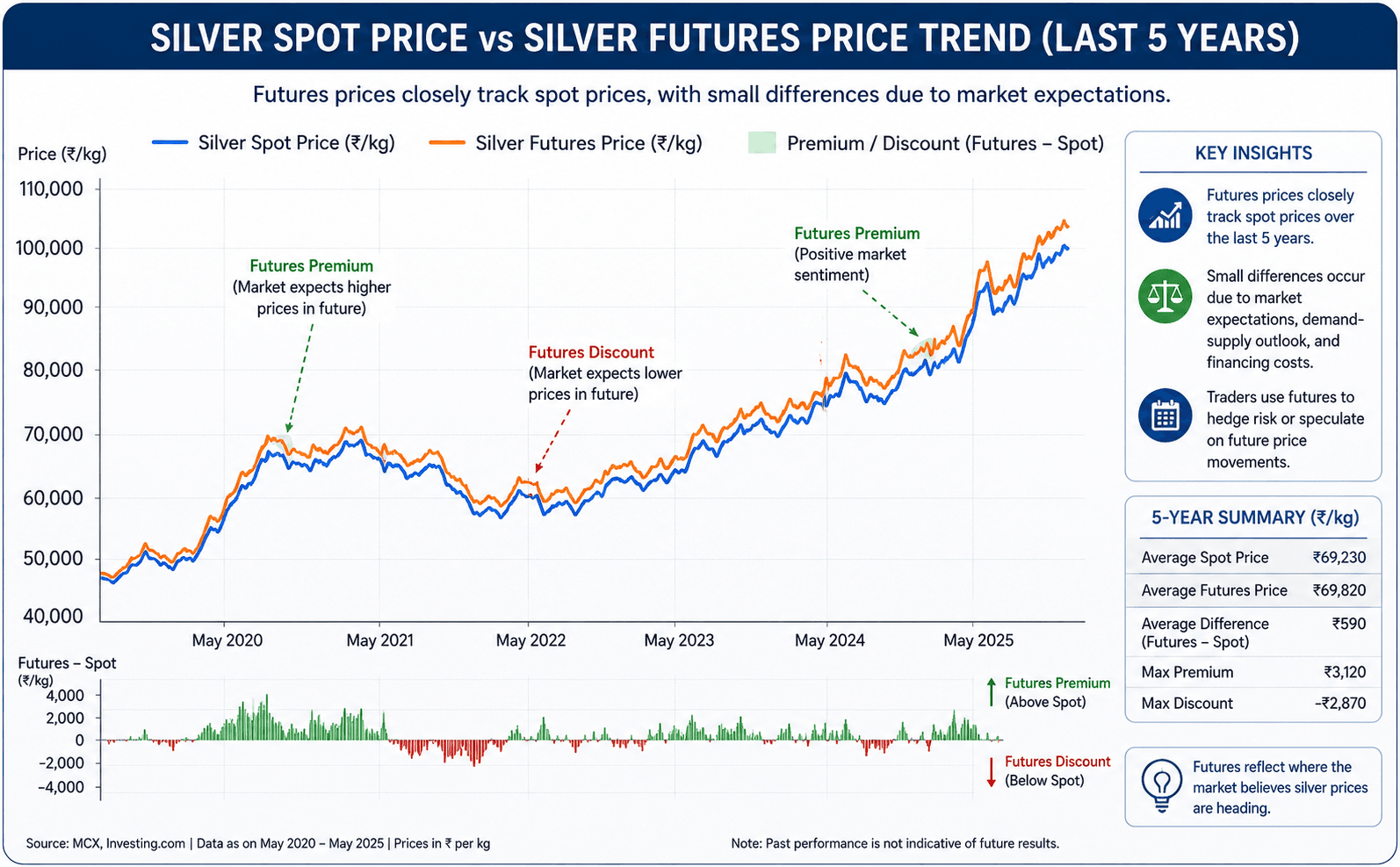
Futures contracts are agreements to either buy or sell a precise quantity of silver at a predetermined price on a future date. These futures contracts allow investors to hedge against price volatility or capture profits based on expected price volatility.
Silver futures contracts are primarily traded in India on the Multi-Commodity Exchange (MCX Silver futures). By entering into a futures contract, investors need only to put up a small margin rather than pay for 100% of the value of the contract.
This allows traders to control a very large long or short position by tying up only a fraction of the capital necessary to purchase the silver outright.
Silver futures are generally available in several sizes to accommodate different types of investors. The standard futures contract size for silver is 30 kg. The mini contract is 5 kg, and the micro contract is 1 kg.
All of these futures contracts have a monthly expiration that occurs at a specific point in time, allowing traders to have well-defined timelines to work with in the silver futures market. The silver futures margin requirement varies depending on the condition of the silver market.
For Example:
Let us assume the price of silver is INR 80000 for a kg today. You think that it will increase in price and decide to buy a 1.5 kg mini contract. The total value of that contract is INR 400000, the margin you will pay could be between INR 40000 and INR 60000. If the price were to go up to INR 82000, your profit would be INR 10000 (INR 2000 x 5) before taking into account any fees you may owe.
You are also able to close your position prior to expiration for a profit without having to take delivery.
How Silver Futures Trading Works In India?
All silver commodity trading at the Multi-Commodity Exchange (MCX) are subject to the same guidelines and regulations. Trading is conducted on weekdays from morning until after the sun has set in order to provide Indian investors with an opportunity to respond to international market movements that influence commodity pricing.
Settlement of silver contract MCX may take place either via physical delivery or in cash. The majority of traders close their positions prior to expiration to avoid taking delivery. The MCX MC is a mark-to-market (MTP) exchange. Your account is reconciled on a daily basis based on the closing price of the commodity. Profits will be credited to your account, while losses will be debited. Daily MPT settlements provide a method by which to manage risk.
Silver Futures are typically traded using leverage (margin trading). Margin trading involves using a small amount to control a large position. You are subject to a much higher potential profit and loss using margin. Always use caution when trading with leverage.
How to trade silver futures step by step:
- To trade in commodities, use an authorized commodity broker who is a member of SEBI.
- KYC is required before depositing money into your broker's account.
- Trading stocks: Check trade prices and execute trades on your strategy.
- With your broker, you should expect to maintain an active trading position every day.
- Close your positions either on the expiration date or by rolling over into the next contract’s expiry date.
The margin on silver futures can be 5 – 17%, depending on market conditions, so investors can use leverage to gain significant returns.
Also read on Best Silver Investment For Indian Investors
Key Factors Affecting Silver Futures Prices
Several factors affect the price of silver futures options in India. Understanding these factors allows users to make informed investment decisions.
- One key driver of demand for silver is industrial use. Electric vehicles, solar energy, electronics such as smartphones, and a number of other developing technology applications (e.g., AI and data centers) use a significant amount of silver as an input. As green technologies become more widely adopted, there will be increasing demand for silver.
- The other main influences are US interest rates as set by the Federal Reserve and how the US dollar moves. Lower interest rates from the Fed tend to make silver more attractive, while a rising US dollar may tend to push silver prices down.
- Inflation and geopolitical uncertainties drive investors toward silver as a safe-haven investment. The volatility of global events produces rapid fluctuations in price.
- The gold-silver ratio can also provide signals about silver pricing. A high gold-silver ratio may indicate that the market views silver as being undervalued relative to gold. The cycles of commodity prices around the world also affect how silver is priced.
- Additional influences include mine production, the rupee-dollar exchange rate, and overall investor sentiment.
Benefits And Risks Of Silver Futures
Benefits of Silver Futures
1. No physical storage needed: You can get exposure to silver prices without buying or storing physical silver, making it convenient and easy to manage.
2. High liquidity: Silver futures are actively traded, so entering and exiting positions is usually quick and smooth.
3. Leverage advantage: You can control a larger contract value with relatively less capital, which can improve capital efficiency if used properly.
4. Hedging tool: Silver futures can help businesses and investors protect against price volatility by locking in prices in advance.
5. Portfolio diversification: Silver futures add non-equity exposure to your portfolio and may help balance risk during volatile market conditions.
Risks of Silver Futures
1. Price volatility: Silver prices can move sharply due to global events, economic data, and market sentiment, leading to sudden gains or losses.
2. Leverage risk: Leverage can amplify returns, but it can also magnify losses, even from a small adverse price move.
3. Margin calls: Futures contracts are marked to market daily, so losses may require you to add more money to maintain your position.
4. Complexity for beginners: Silver futures are more suitable for experienced traders, as poor timing or weak risk management can lead to losses.
5. Emotional trading: Fast price swings can trigger impulsive decisions, and without stop-loss discipline, the risk of losses increases.
Silver Futures vs Other Silver Investments
In terms of comparing silver future contracts with physical silver purchases, futures have no storage/security costs. Therefore, it allows for much less total cost of ownership. On the other hand, although it provides a tangible asset (purpose for holding), physical silver purchases are subject to making charges, GST, and locker costs.
Furthermore, futures contracts are a better vehicle for short-term speculative purposes, while physical silver purchases are typically viewed as long-term, cultural, or gifting purposes.
Comparing Silver Futures and Silver ETFs.
The main difference between silver futures and silver ETFs is that ETFs (Exchange Traded Funds) invest in silver by owning many units of it based on current prices. Whereas silver futures involve the use of leverage to gain an advantage when trading on a commodity exchange and require careful tracking of expiration dates.
| Aspect | Silver ETFs | Silver Futures |
| Basic structure | Silver ETFs invest in silver through a fund that tracks its price. | Silver futures are exchange-traded contracts that give exposure to silver prices. |
| Trading style | Better suited for long-term investors. | Better suited for active traders and hedgers. |
| Leverage | No leverage in the usual sense. | Uses leverage, so you can control a larger position with less capital. |
| Contract expiry | No expiry tracking needed. | You need to track expiry dates and contract rollovers. |
| Ease of use | Simpler and easier to manage. | More complex and requires active monitoring. |
| Risk level | Generally lower than futures. | Higher due to leverage and price volatility. |
| Best for | Investors who want straightforward silver exposure. | Traders who want liquidity, leverage, and exchange-based exposure. |
Understanding the various types of silver investments and selecting the right investment for yourself will depend on your trading strategy and your overall risk profile.
Conclusion
Silver futures can offer flexibility, leverage, and liquidity for active traders, while silver ETFs provide a simpler and more passive way to gain exposure to silver prices. The right choice ultimately depends on your investment goals, risk appetite, and trading style.
As investors increasingly explore alternative investment opportunities beyond traditional assets, understanding market-linked instruments like silver futures becomes essential. Whether you prefer active commodity trading or diversified fixed-income opportunities, making informed decisions is key to building a stronger portfolio.
Platforms like Grip Invest help investors discover modern investment avenues across fixed-income and alternative asset categories, enabling smarter diversification aligned with evolving financial goals.
FAQs On Silver Future Contracts
 |
Author: Grip Invest Editorial Team The Grip Invest Editorial Team is a group of Chartered Accountants, MBA (Finance) graduates, and Qualified Research Analysts dedicated to helping you invest smarter. We dive deep into India's fixed income landscape to deliver content that is accurate, up-to-date, and easy to understand. Whether you're exploring bonds, fixed deposits, or other fixed income opportunities, our guides cut through the noise and give you the clarity to make better financial decisions. |
Want to stay at the top of your finances?
Join the community of 4 lakh+ investors and learn more about Grip Invest, the latest financial knick-knacks, and shenanigans in the world of investing.
Happy Investing!
Disclaimer - Investments in debt securities/municipal debt securities/securitised debt instruments are subject to risks including delay and/ or default in payment. Read all the offer related documents carefully. The investor is requested to take into consideration all the risk factors before the commencement of trading.
This communication is prepared by Grip Broking Private Limited (bearing SEBI Registration No. INZ000312836 and NSE ID 90319) and/or its affiliate/ group company(ies) (together referred to as “Grip”) and the contents of this disclaimer are applicable to this document and any and all written or oral communication(s) made by Grip or its directors, employees, associates, representatives and agents. This communication does not constitute advice relating to investing or otherwise dealing in securities and is not an offer or solicitation for the purchase or sale of any securities. Grip does not guarantee or assure any return on investments and accepts no liability for consequences of any actions taken based on the information provided. For more details, please visit www.gripinvest.in
Registered Address - 106, II F, New Asiatic Building, H Block, Connaught Place, New Delhi 110001


