

Tata Motors Share Price: What Is Driving The Stock And What To Watch


Over the past few years, Tata Motors (NSE: TMPV) has been among the most frequently discussed companies on the Indian stock market within the flourishing automobiles sector. As a well-known automotive manufacturer operating in both India and internationally, Tata’s stock price is based on more than just the company's overall automobile sales. The company underwent a demerger a few months ago, creating two entities: Tata Motors Limited (Commercial Vehicles) and Tata Motors Passenger Vehicles Limited1. This blog is focused on the Passenger Vehicles company.
Tata’s stock price movements reflect broader trends in the automobile industry, such as electric vehicle adoption and global trade and economic conditions. The company is one of the pioneers and an industry leader in the EV segment in India. Investors and analysts frequently review Tata Motors stock analysis, taking into account fundamental and macroeconomic factors that could affect its future direction.
Tata Motors Share Price Overview
Understanding how the stock is trending will give you insight into where Tata Motors currently sits in the broader market. How has Tata Motors share price today, is a commonly asked question on Dalal Street.
- Recent Performance
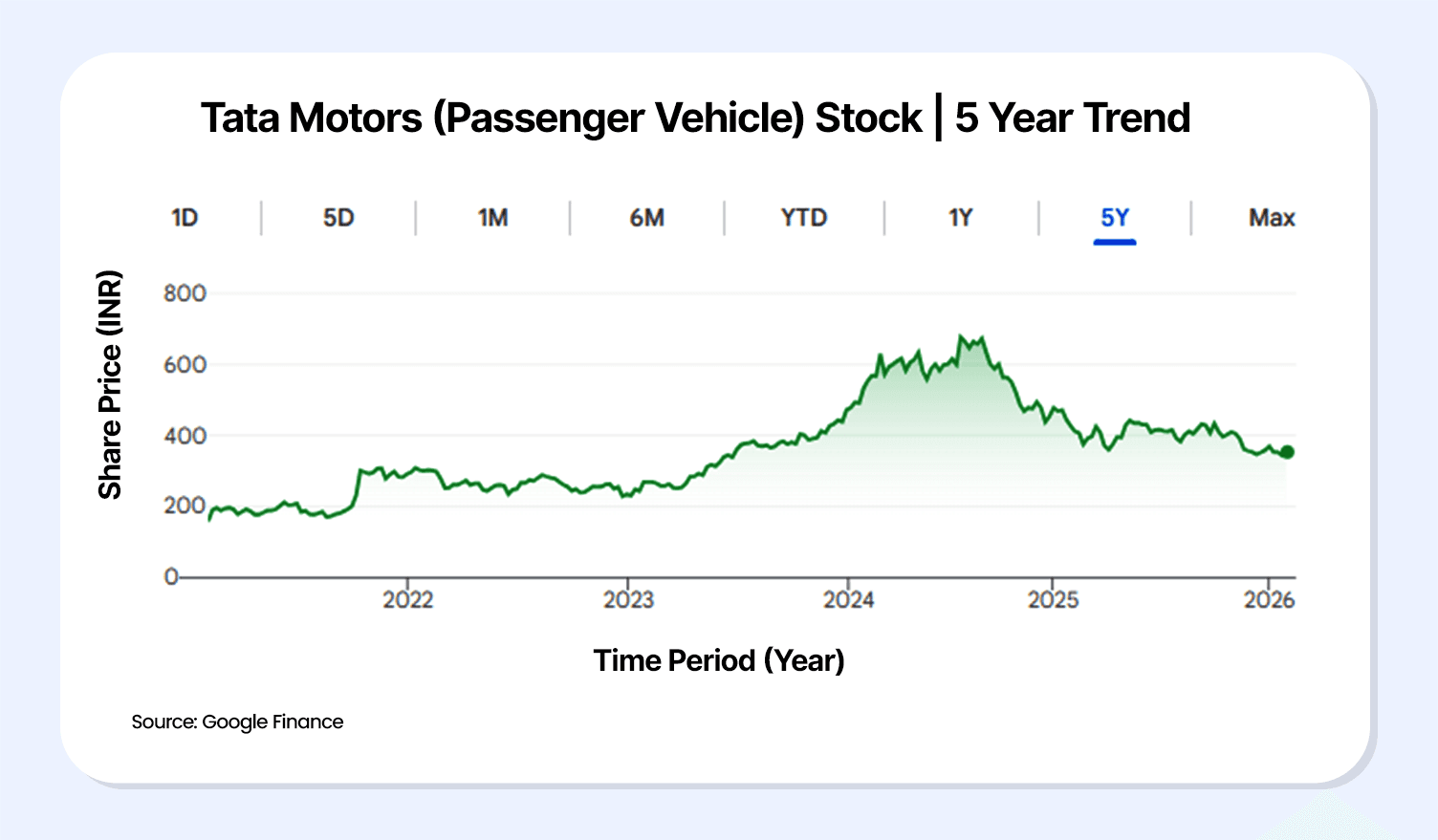
Currently, Tata Motors’ main exchange-listed business is trading at INR 350 on the Stock Exchanges (NSE & BSE), with a 52-week price range of approximately INR 324 - INR 476.
Even though there are strong domestic sales of certain types of vehicles, the overall stock market is driven by both worldwide and automobile-specific factors, such as trade tariffs, earnings reports, and restructuring, which continue to drive volatility in stock prices. Tata Motors had an excellent festive season and managed to sell more than 100,000 cars between Navratri and Diwali 2025, with the momentum continuing even in November and December2.
- Long-term trends
Tata Motors exhibited very strong cumulative gains over a five-year period leading up to the previous phases of demerger. Historical datasets showed a +121.00% move over 5 years, suggesting potential for long-term success when assessed from earlier lows.
Key Drivers Powering Tata Motors Stock In 2026
Besides being a legacy brand and one of the few India-based automobile companies, the reason for the stock surge can be attributed to the following critical points:
1. EV Business
Tata Motors EV business is often looked to as a major component of the company's overall growth potential going forward. The company has made significant investments in electric vehicle development in India and has become one of the largest players in the electric vehicle passenger vehicle market. Tata's electric vehicles, such as the Nexon EV and Tigor EV, are seeing strong sales across India, supported by a growing number of charging stations and the widespread adoption of electric vehicles. The newly launched Tata Curvv is also quite popular among EV enthusiasts due to its high range per single charge and its overall features and performance.
From an investment perspective, Tata Motors' strength in electric vehicle sales drives growth stories and attracts investors.
Tata Motors future outlook will depend on overall EV adaptability in the Indian market. The company has also reintroduced the Tata Sierra, which has met with an exciting market demand. Besides the EV sector, the conventional Tata car portfolio continues to strengthen the overall portfolio. The company’s focus on innovation and post-sales service shall be critical in shaping the share price in the next few months.
2. JLR Performance
Tata Motors also depends on Jaguar Land Rover for a significant portion of its global revenue and profitability, as JLR has had a significant historical impact on Tata Motors stock price. Luxury sales and global demand have driven large swings in sentiment for Tata Motors' equity, given its significant historical correlation with JLR's performance.
The following are key takeaways regarding the outlook for 2026:
- JLR Recovery and Positioning Within the Electric Luxury Vehicle Market
- Global SUV Demand Trends, and how will trends support the continued premium pricing of products?
3. Auto Sector Trends
Developments regarding broad auto sector stocks also depend on the Indian landscape. Reports highlight that there will be a record number (30+) of vehicle launches by major manufacturers (including Tata Motors) in 2026, creating a highly competitive landscape for Manufacturers3.
The trend in the Auto Sector Stock India also affects company valuation multiples and owner confidence in auto stocks as a whole. Trends include:
- Share expansion in both Commercial and Passenger vehicles.
- Shift toward SUV and EV use.
- Supply chain pricing policies and increased costs within the auto ecosystem.
All these trends influence how the trader and maker manager will create positions in relation to companies such as Tata Motors, Maruti Suzuki and Mahindra.
Tata Motors: Short Term Vs Long Term Outlook
Investors often investigate whether Tata Motors presents better prospects in the short term or as a long-term hold.
Short term
- A variety of factors can affect the price of a short-term stock, including earnings reports, tariff announcements, sector rotation, and technical trading activity.
- Volatility can be pronounced in the near future due to earnings announcements or macroeconomic news, such as interest rate changes.
Long-Term
- Tata Motors' fundamental aspects, including electric vehicle growth potential, global competitive position and commercial vehicle demand, will provide the basis for sustainable value creation in the long run.
- Structural developments such as electrification, infrastructure growth, and market expansion will allow for appreciation over the longer term, assuming execution is maintained and remains high quality.
So, if you are a long-term investor, looking for a fundamentally strong stock with a fair bit of potential for the next 5-10 years within the automotive industry, Tata Motors stock can be a good choice for you to consider.
Smart Allocation: Tata Motors In Your Portfolio
When allocating stocks such as Tata Motors to build an investment portfolio in a diversified manner, you need an appropriate level of risk and return for each stock allocation. Here is one way to look at this.
Role of Equities vs Fixed Income
Equity
- Investments in stocks tend to offer greater growth opportunities than other asset types, especially in industries such as automotive, electricity, and global luxury goods.
- However, investments in stocks can be a bit volatile and subject to broader economic factors and cycles than other assets (such as fixed income securities).
Fixed Income
- Bonds or fixed-income investments tend to provide lower relative risk and steady income.
- Bonds provide a stabilising buffer for equities; when equity prices drop, they will limit your overall losses from those equities.
For conservative or risk-averse investors, bonds are a good investment to preserve capital. It is an excellent tool for attaining consistent returns and portfolio diversification. Given your long-term financial goals, you should not ignore investing in bonds and can explore a wide range of fixed-income securities through platforms such as Grip.
Bonds Via Platforms Like Grip: Diversification Method
Bonds and fixed-income investments help balance equity exposure by reducing overall portfolio risk and adding stability. A diversified investment approach typically includes core equity funds for long-term growth, select stocks for targeted sector exposure, and bonds for predictable returns and downside protection.
Platforms like Grip make it easier to access bond investments, enabling investors to build portfolios that combine growth potential with financial resilience: an important strategy in volatile or uncertain market conditions.
Conclusion
Tata Motors stands at an interesting crossroads. On one side is strong long-term potential driven by EV leadership, a sharper post-demerger focus on passenger vehicles, and recovery prospects at JLR. On the other is short-term volatility tied to global auto cycles, competition, and macroeconomic shifts.
What this really means is that Tata Motors can work well as a growth-oriented equity allocation, but it should not stand alone. Smart portfolios balance high-growth stocks with stable income assets to smooth out market swings.
That is where fixed-income investing comes in. Platforms like Grip Invest allow investors to access high-quality bonds and structured fixed-return products that offer predictable cash flows and lower volatility. Combining equities like Tata Motors with bonds via Grip helps create a more resilient portfolio, especially in uncertain market conditions.
In short, Tata Motors can play the growth engine in your portfolio, while fixed-income investments through Grip help keep the ride steady.
FAQs
1. What factors influence Tata Motors share price the most?
Tata Motors share price is mainly driven by passenger vehicle sales, EV adoption trends, Jaguar Land Rover performance, input costs, and overall auto sector sentiment in India and global markets.
2. Is Tata Motors a long-term investment after the demerger?
Post-demerger, the passenger vehicle business of Tata Motors is more clearly aligned with EV growth, brand positioning, and domestic demand, making it attractive for long-term investors who can handle equity volatility.
3. How important is Tata Motors’ EV business for future growth?
The EV segment is a key growth pillar. Strong demand for models like Nexon EV and Curvv, along with expanding charging infrastructure, makes EV performance a major factor in Tata Motors’ future outlook.
4. How does Jaguar Land Rover affect Tata Motors stock analysis?
Jaguar Land Rover contributes significantly to global revenues and profitability. Its performance in luxury SUVs and electric vehicles has a direct impact on Tata Motors’ valuation and investor sentiment.
References:
1. Economic times, accessed from: https://economictimes.indiatimes.com/markets/stocks/news/decoding-tata-motors-demerger-what-investors-need-to-know-about-cost-of-acquisition/articleshow/125294276.cms?from=mdr
2. Car dekho, accessed from: https://www.cardekho.com/india-car-news/tata-motors-festive-season-sales-record-sells-over-1-lakh-cars-between-navratri-and-diwali-2025-35204.htm
3. Gaadi waadi, accessed from: https://gaadiwaadi.com/over-30-new-cars-set-to-launch-in-2026-in-india-across-segments/#:~:text=After%20several%20years%20of%20cautious,scheduled%20for%20calendar%20year%202026
Want to stay at the top of your finances?
Join the community of 4 lakh+ investors and learn more about Grip Invest, the latest financial knick-knacks, and shenanigans in the world of investing.
Happy Investing!
Disclaimer - Investments in debt securities/municipal debt securities/securitised debt instruments are subject to risks including delay and/ or default in payment. Read all the offer related documents carefully. The investor is requested to take into consideration all the risk factors before the commencement of trading.
This communication is prepared by Grip Broking Private Limited (bearing SEBI Registration No. INZ000312836 and NSE ID 90319) and/or its affiliate/ group company(ies) (together referred to as “Grip”) and the contents of this disclaimer are applicable to this document and any and all written or oral communication(s) made by Grip or its directors, employees, associates, representatives and agents. This communication does not constitute advice relating to investing or otherwise dealing in securities and is not an offer or solicitation for the purchase or sale of any securities. Grip does not guarantee or assure any return on investments and accepts no liability for consequences of any actions taken based on the information provided. For more details, please visit www.gripinvest.in
Registered Address - 106, II F, New Asiatic Building, H Block, Connaught Place, New Delhi 110001


