

Micro Cap Mutual Funds: Meaning, Risks, Returns And Should You Invest?


Many big and successful companies once started as small businesses. Investors who identify promising companies early may benefit from long-term wealth. For such investments, Micro Cap Mutual Funds provide exposure to small listed companies, offering potential for higher long-term returns.
Many investors are looking beyond large, mid or small-cap funds in search of higher returns. Micro-cap investing has become an attractive option these days. Unlike established companies, micro-cap stocks can experience sharp price movements due to limited liquidity. However, the possibility of higher returns comes with equally higher risk.
Learn more about micro-cap mutual funds, their risks, and returns.
How Do Micro Cap Mutual Funds Build Their Portfolio?
Unlike passive funds that simply track an index, most micro-cap mutual fund portfolios rely heavily on active research and stock selection.
Fund managers conduct detailed fundamental research before selecting companies. They evaluate factors such as
- Revenue and earnings growth
- Business model
- Competitive advantage
- Quality of management
- Industry potential
- Financial strength
Many micro-cap companies receive limited analyst coverage. Fund managers spend considerable time identifying businesses with long-term growth potential before they become big.
1. Portfolio Diversification
Micro-cap funds focus on small companies. They invest across multiple stocks rather than concentrating on a single one. Diversification helps reduce the impact if one or two companies underperform. A typical portfolio may contain 50-100 stocks spread across different countries.
2. Sector Concentration
Depending on market opportunities, fund managers may allocate higher exposure to sectors such as manufacturing, capital goods, healthcare, chemicals, consumer products and technology. The allocation of sectors changes based on valuation and future growth expectations.
3. Liquidity Consideration
Liquidity is the biggest challenge in micro-cap investing. Many micro-cap stocks have lower trading volume, and during market corrections, buying and selling large quantities can become difficult without affecting the price. This is the reason why a fund manager carefully manages position size.
4. Active Management Roles
Small companies change rapidly, and that is why active management is required. The fund manager continuously monitors company performance, financial results, governance practices, and market conditions. It helps them decide whether a stock should remain in the portfolio or not.
The Opportunity Comes With Trade-Offs
Micro-cap mutual funds offer attractive growth opportunities. However, they do carry some risk, like any other investment option. Understanding both the potential and risks of these mutual funds can help you make a better decision.
Potential Opportunities
The potential benefits of micro-cap mutual funds are as follows.
- Early-stage business growth - Micro-cap companies are often at an early stage of expansion. They can deliver significant earnings growth over time. Investors can participate in this growth before companies become big and earn great profits.
- Long-term wealth creation potential - Companies that once were small businesses have later become mid- or large-cap companies. Investors who remain invested over the long term may benefit from this expansion.
- Diversification beyond traditional equity funds - These funds provide exposure to companies that are not present in a large-cap or diversified equity portfolio. They can improve diversification by adding a different segment of the market.
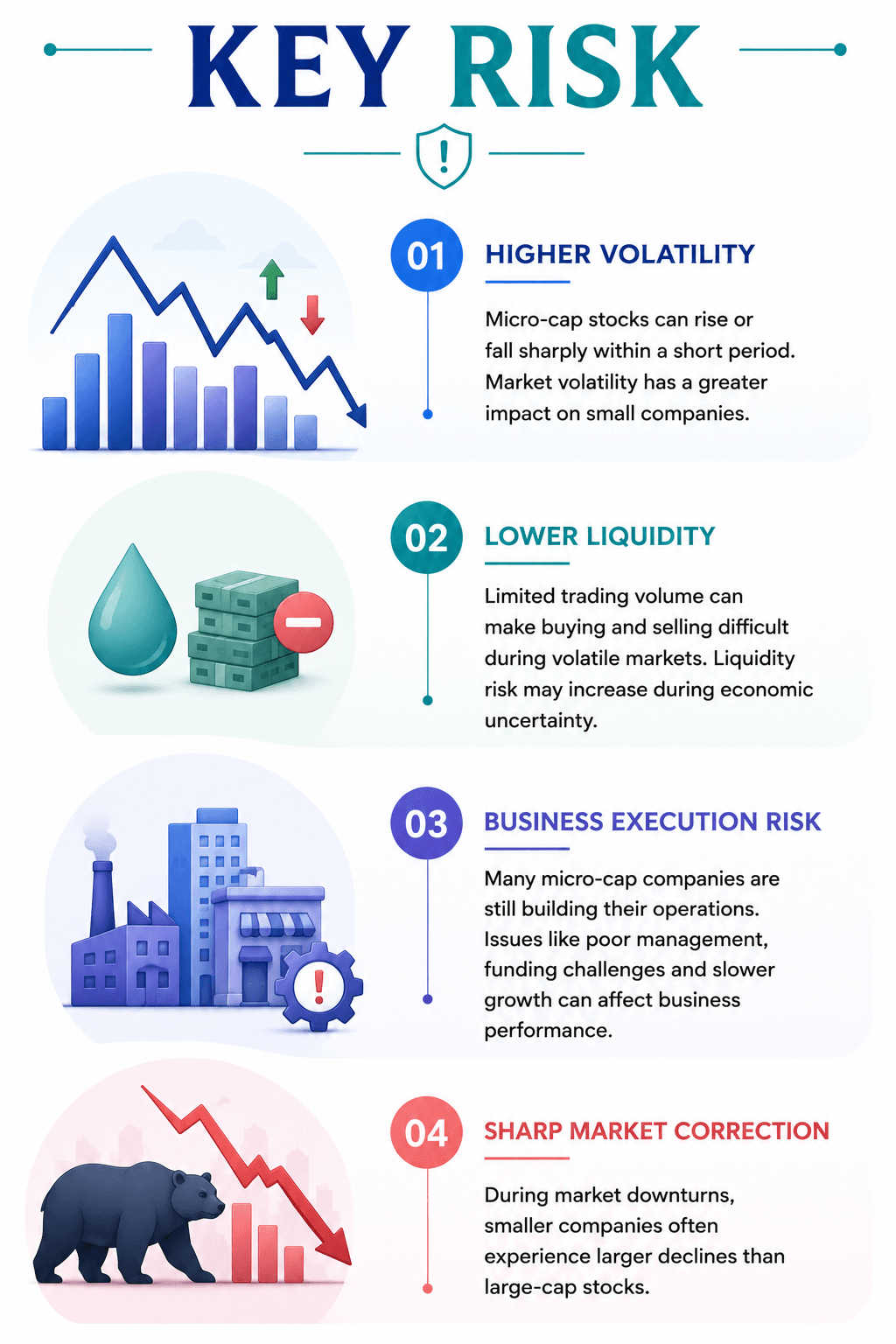
Key Risk
- Higher Volatility - Micro-cap stocks can rise or fall sharply within a short period. Market volatility has a greater impact on small companies.
- Lower Liquidity - Limited trading volume can make buying and selling difficult during volatile markets. Liquidity risk may increase during economic uncertainty.
- Business execution risk - Many micro-cap companies are still building their operations. Issues like poor management, funding challenges and slower growth can affect business performance.
- Sharp Market Correction - During market downturns, smaller companies often experience larger declines than large-cap stocks.
Potential Reward vs Associated Risk
Potential Reward | Associated Risk |
High growth potential | High Volatility |
Early investment opportunities | Business uncertainty |
Long-term wealth creation | Liquidity challenges |
Portfolio Diversification | Larger drawdown during market correction |
Should Micro Cap Mutual Funds Be Part Of Your Portfolio?
Your financial goals, Investment horizon and other factors can help you decide whether micro-cap mutual funds should be a part of your portfolio or not.
1. Investment Horizon
Since smaller businesses require time to grow. Therefore, micro-cap mutual funds are more suitable for investors with a long-term horizon of at least 7 to 10 years.
2. Risk Appetite
Micro-cap funds involve some risk. It may not suit investors who are not comfortable with temporary declines or frequent price fluctuations.
3. Existing Portfolio Allocation
These funds should ideally complement an already diversified portfolio. The portfolio includes large-cap funds, debt investments, and other asset classes.
4. Limited Allocation Within a Diversified Portfolio
Given their higher risk, many financial experts suggest treating micro-cap exposure as a satellite allocation rather than making it the core of an investment portfolio.
Portfolio Allocation Framework
Investor Type | Approach towards Micro Cap Funds |
Conservative | Focus on stable investments with limited exposure to micro-cap funds. |
Moderate | Limited exposure alongside diversified equity and debt investments |
Aggressive | May consider relatively higher exposure while maintaining diversification. |
What Should You Evaluate Before Choosing A Micro Cap Fund?
Before investing, here are some things you should evaluate before choosing a micro-cap fund.
1. Diversification of Portfolio
You should check if the funds are diversified across companies and sectors instead of depending heavily on a few stocks.
2. Fund manager experience
An experienced fund manager and others have better research capabilities to identify a promising business.
3. Portfolio Turnover
A very high turnover ratio indicates frequent buying and selling. It could increase the transaction cost. While a lower ratio suggests that the fund manager follows a relatively long-term investment approach.
4. Expense Ratio
You can also compare expense ratios across similar funds since higher costs can affect the long-term returns.
5. Investment Philosophy
Try to understand the philosophy of the fund manager. It is important to know whether they follow a value investing, growth or quality-focused strategy.
6. Consistency Across Market Cycles
Instead of looking for a one-year return. You can evaluate how the fund has performed during both bull and bear markets.
Checklist: 7 Questions To Ask Before Investing
Here are some questions whose answers you should know before investing.
- Is the portfolio sufficiently diversified?
- How experienced is the fund manager?
- What sectors dominate the portfolio?
- Is the expense ratio reasonable?
- Does the fund have a consistent investment strategy?
- How did the fund perform across different market cycles?
- Does the fund align with your investment horizon and risk tolerance?
Diversification Matters More Than Chasing High Returns
Micro-cap Mutual Funds are a new investment for investors who can see potential growth in smaller companies. Investors are willing to take the risk for higher returns in a long-term investment.
While micro-cap mutual funds may offer attractive long-term growth potential, they should be balanced with relatively stable asset classes. Investors can diversify their portfolios by combining equity investments with fixed-income options such as corporate bonds and Corporate FDs available through Grip Invest. It is a platform which will help investors with a diversified approach to balance growth opportunities and risk management.
FAQs On Micro Cap Mutual Funds
 |
Author: Grip Invest Editorial Team The Grip Invest Editorial Team is a group of Chartered Accountants, MBA (Finance) graduates, and Qualified Research Analysts dedicated to helping you invest smarter. We dive deep into India's fixed income landscape to deliver content that is accurate, up-to-date, and easy to understand. Whether you're exploring bonds, fixed deposits, or other fixed income opportunities, our guides cut through the noise and give you the clarity to make better financial decisions. |
Want to stay at the top of your finances?
Join the community of 4 lakh+ investors and learn more about Grip Invest, the latest financial knick-knacks, and shenanigans in the world of investing.
Happy Investing!
Disclaimer - Investments in debt securities/municipal debt securities/securitised debt instruments are subject to risks including delay and/ or default in payment. Read all the offer related documents carefully. The investor is requested to take into consideration all the risk factors before the commencement of trading.
This communication is prepared by Grip Broking Private Limited (bearing SEBI Registration No. INZ000312836 and NSE ID 90319) and/or its affiliate/ group company(ies) (together referred to as “Grip”) and the contents of this disclaimer are applicable to this document and any and all written or oral communication(s) made by Grip or its directors, employees, associates, representatives and agents. This communication does not constitute advice relating to investing or otherwise dealing in securities and is not an offer or solicitation for the purchase or sale of any securities. Grip does not guarantee or assure any return on investments and accepts no liability for consequences of any actions taken based on the information provided. For more details, please visit www.gripinvest.in
Registered Address - 106, II F, New Asiatic Building, H Block, Connaught Place, New Delhi 110001


