

AA Rated Bonds
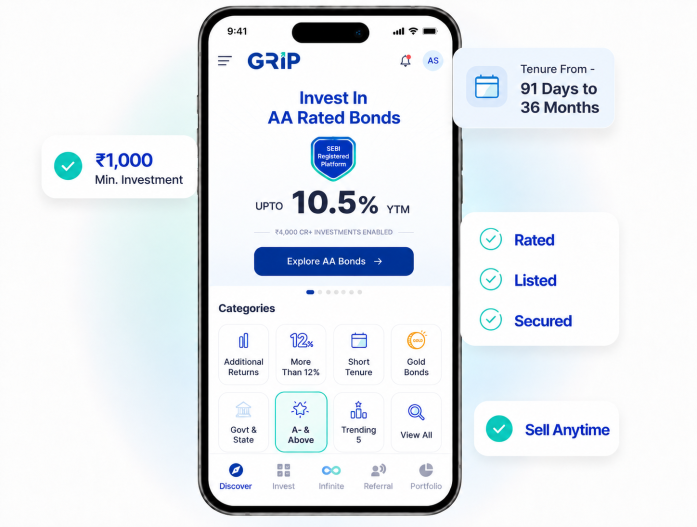
AA-rated bonds are debt instruments rated ‘AA’ by SEBI-registered, independent credit rating agencies like CRISIL, ICRA and CARE. These bonds offer a high degree of safety and very low credit risk.
AA-rated corporate bonds are considered investment-grade corporate bonds, and they come with sub-grades too, including ‘AA+’ and ‘AA-’, indicating the issuer’s strong capacity to pay interest and repay the principal on time.
These AA-rated corporate bonds are issued by large NBFCs, banks, and select PSUs. These bonds offer higher yields than AAA-rated bonds for the marginally higher credit risk that they carry.
According to SEBI, the corporate bond market in India has grown at around 12% annually, with outstanding bonds crossing INR 60 trillion by July 2026. Nearly 85% to 90% of papers in this market are high-rated papers, including AAA and AA.
Investors seeking stability along with inflation-beating returns prefer investing in corporate bonds rated AA or higher.


Make Plan For Your Investment
Calculate your returns from AA rated bond
Use our bond calculator to estimate the returns you will receive by investing in an AA-rated bond
- Add investment amount
- Set the tenure, YTM and coupon frequency
- See the instant results
Disclaimer: This calculator is for illustration purposes only and does not guarantee or represent actual returns.

BENEFITS OF INVESTING IN AA RATED BONDS

High Credit Quality
SEBI-registered credit rating agencies assess these bonds and offer a higher rating of ‘AA’, considering strong capacity to meet the repayment obligations.

Higher ‘AA’ Bond Yields
AA-rated bonds typically offer higher returns than AAA-rated bonds due to the marginally higher risk that investors take.

Lower Minimum Investment
You can start investing in AA-rated bonds on Grip Invest with just INR 1,000

Predictable Income
AA-rated bonds offer a steady income stream, as the coupon payout is fixed on a monthly, quarterly, or annual schedule.

Portfolio Diversification
The returns received from AA-rated bonds are non-market-linked returns, hence offering stability during market volatility

Liquidity & Flexibility
AA rated bonds on Grip are exchange-listed and can be sold before maturity, giving investors the flexibility to exit if their financial priorities change

How to Invest?


- Issuer Financials: Check the financial strength of the issuer, their profitability, asset quality, and repayment track record. Two issuers issuing AA-rated bonds can carry very different underlying credit strength.
- Rating Agency & Outlook: Check which credit rating agency has assigned the AA rating and what the outlook is, whether it is stable, positive, or negative.
- Security & Seniority: AA-rated corporate bonds can be unsecured too, so check whether they are secured by assets or not and where they rank in the repayment.
- Tenure Fit: Before investing in an AA-rated bond, check the tenure and match it with your investment horizon. A longer-tenure AA-rated bond can offer higher yield, but it is more exposed to interest rate risk and rating downgrades.

OTHER OFFERINGS
Other Secured Fixed-Income Products By Grip Invest

Corporate Bonds
- Securities issued by corporates & NBFCs
- Up to 12.5% pre-tax YTM
- Start investing with Rs 1,000
- Exchange listed and credit rated

InvoiceX
- Loans backed by Invoice Discounting
- Up to 14% pre-tax YTM
- Start investing with Rs 1,00,000
- SEBI/RBI compliant and credit rated

LoanX
- Diverse pool of loans from top NBFCs
- Up to 14% pre-tax
- Start investing with Rs 1,00,000
- SEBI/RBI compliant and credit rated

Baskets
- Theme based investing
- Up to 14% pre-tax YTM
- Start investing with Rs 5,000
- SEBI/RBI compliant and credit rated

Corporate FDs
- High Yield Fixed Deposit Investments
- Up to 10% pre-tax
- Start investing with Rs 1,000
- SEBI/RBI compliant and credit rated
FOR YOUR KNOWLEDGE
Some of our partners






Insightful Blogs
Read Our Blogs For Detailed Insights On Bond Investing
Insightful Videos
Learn More About Bonds Investment With Our Videos
Why Smart Investors Are Moving From FD to Bonds? Are Bonds Better Than FD?
What is Yield in Bonds? Bond Yields Explained Simply
Best Bonds for Beginners & Conservative Investors in India
To help you
Frequently Asked Questions
Are AA rated bonds safe to invest in India?
Yes, AA-rated bonds are safe to invest in India, but it does not mean that they are risk-free. AA-rated bonds are considered investment-grade bonds and carry very low credit risk. However, the rating can be downgraded if the financial health of the issuer weakens.
What is the current interest rate on AA rated bonds?
AA bond interest rates vary by issuer, tenure and market conditions. AA rated bonds on Grip currently offer 9% - 10.5% pre-tax YTM, which varies by tenure and issuer.
What is the yield on AA rated corporate bonds?
The AA corporate bond yield is the annualised return you earn by holding the bond to maturity, factoring in its price, coupon and remaining tenure. You can earn up to 9% to 10.5% YTM on an AA-rated corporate bond on Grip Invest.
What is the 5-year AA corporate bond yield in India?
As of late September 2026, the 5-year AA corporate bond yield in India was about 8.55%, compared with about 7.73% for 5-year AAA corporate bonds. This benchmark moves with interest rates and credit spreads, so check the latest yield before investing.
What is the difference between AAA and AA rated bonds?
‘AAA’ is the highest credit rating that is offered by a credit rating agency to a bond. ‘AA’ is just below AAA. AAA means the highest safety with the lowest credit risk. Whereas ‘AA’ means high safety with very low credit risk. Since ‘AA’ is slightly riskier than an AAA-rated bond, the yield offered by AA-rated bonds is also higher than that of a AAA-rated bond. Below ‘AA’ are ‘A’ (adequate safety) and ‘BBB’ (moderate safety), the lowest investment-grade rating.
What is the difference between AA+, AA and AA- rated bonds?
These are subcategories within the ‘AA’ rating, where a plus sign shows that the bond is very close to the AAA-rated category, and a minus sign shows that this bond is very close to an A-rated category.
Who issues AA rated bonds in India?
Large banks, NBFCs, housing finance companies, and select PSUs offer AA-rated bonds in India.
What happens if an AA rated bond is downgraded?
If the rating of an AA-rated bond is downgraded, it means the market price of the existing bond will fall because investors will demand a higher yield for the added risk. If the investor holds the bond till maturity, it does not affect the overall returns, but if he wants to sell it before maturity, he may have to face lower prices. A downgrade means the credit strength of the issuer is weakening, and default risk is increasing.
Can I sell AA rated bonds before maturity?
Yes. AA rated bonds on Grip are exchange-listed, so you can sell them before maturity. The price you receive depends on prevailing market yields and demand for the bond, and it may be higher or lower than your purchase price.
How are AA rated bonds taxed in India?
Interest from AA rated bonds is taxed at your income tax slab rate, and TDS of 10% applies if interest exceeds the prescribed threshold. For listed bonds, gains on a sale within 12 months are taxed at slab rates, while gains after 12 months are taxed at 12.5% without indexation.


