

Treasury Bills (T-Bills)
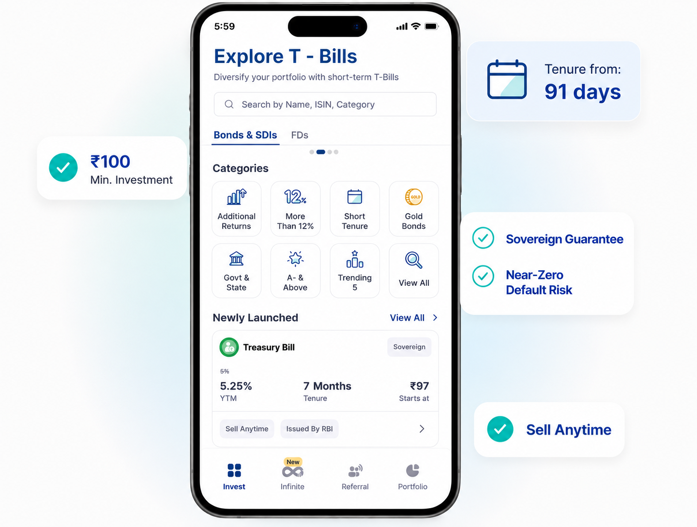
Treasury Bills (T-Bills) are short-term money market instruments, issued by the Central Government through the Reserve Bank of India (RBI) for 91, 182, or 364 days.
T-Bills are auctioned weekly by the RBI on behalf of the government, with the notified amount for each tenure published in advance via a quarterly auction calendar.
The 91-day auctions were oversubscribed by over three times the specified amount, as of 4 March 2026, demonstrating strong investor participation.
The treasury bill rates, which are determined by the RBI monetary policy and system liquidity, indicate the overall short-term borrowing costs in the economy.
T-Bills are issued at a discount and redeemed at par or face value. The difference acts as a return to investors.


Plan your T-Bill investment
Estimate the returns from T-Bills
Use this bond calculator to analyse the returns you will receive from your Treasury Bill investment. Please note, for T-Bills, there is no coupon or periodic interest; the return comes solely from the difference between the purchase price and the maturity (face) value of the T-Bill.
- Add the investment amount
- Choose the desired Tenure
- Provide the expected YTM
- See instant returns
Disclaimer: This calculator is for illustration purposes only and does not guarantee or represent actual returns.
REASON AND BENEFITS

Sovereign Guarantee
T-Bills come with near-zero default risk as they are backed by the central government, and hence they are safer than regular bank FDs, which are insured for up to INR 5 lacs only.

Short-Term Maturity
Treasury Bills are issued with 91, 182 or 364-day maturities and can be efficient for investors who want to invest for short-term maturity.

High Liquidity
Investors can sell their holdings before maturity on Grip Invest at the prevailing T-bill rates, offering high liquidity to investors.

Capital Preservation
T-Bills are designed primarily for capital preservation rather than aggressive growth, making them suitable for conservative investors and for parking surplus funds temporarily.
Affordable Diversification
Investments in T-Bills start with INR 100 on Grip, allowing investors to balance their growth holdings with debt assets.

How to Invest?


- Government Backing: Issued by the Indian Government, T-Bills provide investors with near-zero default risk and the sovereign guarantee.
- Zero-Coupon Structure: T-Bills do not pay periodic interest; returns are realised entirely at maturity via the discount-to-par structure, which simplifies cash-flow tracking.
- Weekly RBI Auctions: T-Bills are auctioned once a week by the Reserve Bank of India, ensuring that the prices charged for different T-Bills are the right market prices.
- Transparent Cut-off Yields: RBI publishes auction results, including cut-off prices and yields for each tenure, giving investors full transparency into current T-Bill rates.

OTHER OFFERINGS
Other Secured Fixed-Income Products By Grip Invest

Corporate Bonds
- Securities issued by corporates & NBFCs
- Up to 14% pre-tax YTM
- Start investing with Rs 1,000
- Exchange listed and credit rated

InvoiceX
- Loans backed by Invoice Discounting
- Up to 14% pre-tax YTM
- Start investing with Rs 1,00,000
- SEBI/RBI complaint and credit rated

LoanX
- Diverse pool of loans from top NBFCs
- Up to 14% pre-tax
- Start investing with Rs 1,00,000
- SEBI/RBI complaint and credit rated

Baskets
- Theme based investing
- Up to 14% pre-tax YTM
- Start investing with Rs 5,000
- SEBI/RBI complaint and credit rated

Corporate FDs
- High Yield Fixed Deposit Investments
- Up to 10% pre-tax
- Start investing with Rs 1,000
- SEBI/RBI compliant and credit rated
For your knowledge
Some of our partners


Market Insights
Latest Update on T-Bills Market

Indian Govt Plans To Borrow INR 3 Lakh Crore Through T-Bills In Q2 of FY27
The RBI has revealed that the central government is planning to borrow up to INR 3.36 lakh crore through the issuance of Treasury Bills in the July-September quarter of the current financial year 2026-27. The government is conducting 14 bi-weekly T-Bill auctions between July 1st and September 30th 2026, with each auction involving INR 9,000 crore of 91-day T-Bills, INR 8,000 crore of 182-day T-Bills and INR 7,000 crore of 364-day T-Bills. Such plans from the Government of India clearly indicate that the T-Bills market in India is growing.
Read MoreInsightful Blogs
Following Blogs Provide Detailed Insights On T-Bill Investment
Insightful Videos
Watch & Learn More About Fixed Income Investing
What is Yield in Bonds? Bond Yields Explained Simply
What Are RBI Floating Rate Savings Bonds? Interest, Tax Rules & How to Invest?
3 Low-Risk Investments Better Than FDs?
To help you
Frequently Asked Questions
How do Treasury Bills work in India?
How to buy Treasury Bills in India?
Can the state government issue Treasury Bills?
How much interest will I get from T-Bills?


