

Corporate Bonds Benefits For Investors: Why They Matter In 2026


A portfolio can sometimes feel split between two extremes. Equities offer growth potential but bring market volatility, while fixed deposits provide stability but may offer lower returns.
Corporate bonds sit between these options. Companies issue them to borrow money from investors for a fixed period. In return, investors generally receive coupon payments and principal repayment at maturity.
The main corporate bonds benefits include regular income, portfolio diversification and a defined investment period. Even so, interest and principal payments depend on the issuer’s ability to repay. This blog explains where corporate bonds may fit, the risks involved and what to check before investing.
Why Investors Choose Corporate Bonds?
For many investors, corporate bonds' benefits go beyond interest income. There are added reasons why they may fit into a wider investment plan.
1. Regular Income
Most corporate bonds pay interest at a predetermined coupon rate. Depending on the issue, payments may be monthly, quarterly, half-yearly or annually. Bonds generally pay coupons during the tenure and repay principal at maturity.
Retirees and other investors may use these cash flows to meet recurring expenses, provided the payment dates match their needs.
The coupon rate remains fixed for a fixed-rate bond. However, timely receipt depends on the issuer meeting its obligations.
2. Better Yield Potential Than Traditional FDs
Corporate bonds may offer higher yields than bank fixed deposits with a similar tenure. This difference is not automatic, and it is not free of risk.
Companies generally offer additional yield to compensate investors for credit risk, lower liquidity or a longer maturity. Therefore, higher corporate bond returns should be evaluated alongside the issuer’s ability to repay.
3. Predictable Cash Flows
The coupon rate, payment dates and maturity are known before you invest. However, the bond’s market price may rise or fall during its tenure.
This gives investors a schedule of expected cash flows.
For example, a bond may pay interest every quarter and return the face value after 24 months. Such visibility can make a corporate bond investment easier to align with planned expenses.
Predictability does not mean certainty. Credit events, call provisions or a sale before maturity can change the expected outcome.
4. Portfolio Diversification
An equity-heavy portfolio can react sharply when markets turn volatile. Adding fixed income investments gives the portfolio another source of income and return.
Corporate bonds may behave differently from shares, which can help spread risk across asset classes. This remains one of the practical advantages of corporate bonds.
Diversification can soften the impact of equity market swings. It does not, however, protect against issuer default or losses across the wider market.
5. Goal-Based Investing
Defined maturities are another of the advantages of corporate bonds. They can help investors plan for expenses with a known date.
Examples include education fees, a home renovation or a planned purchase.
An investor may select a bond that matures close to the financial goal. This approach reduces the need to sell early, when market prices may be unfavourable.
The benefits of corporate bonds are clearer when the tenure serves a specific purpose. A bond should not be chosen only because its coupon appears attractive.
6. Accessible Investment Options
The minimum amount depends on the bond and the platform offering it. On Grip Invest, selected corporate bonds are currently available beginning at INR 1000.
The benefits of corporate bonds can also include access through smaller denominations. This can make fixed income investments accessible to investors who do not want to commit a large lump sum.
Still, a low entry amount does not make every bond suitable.
Before making a corporate bond investment, review the bond terms and issuer risk. Accessibility should support due diligence, not replace it.
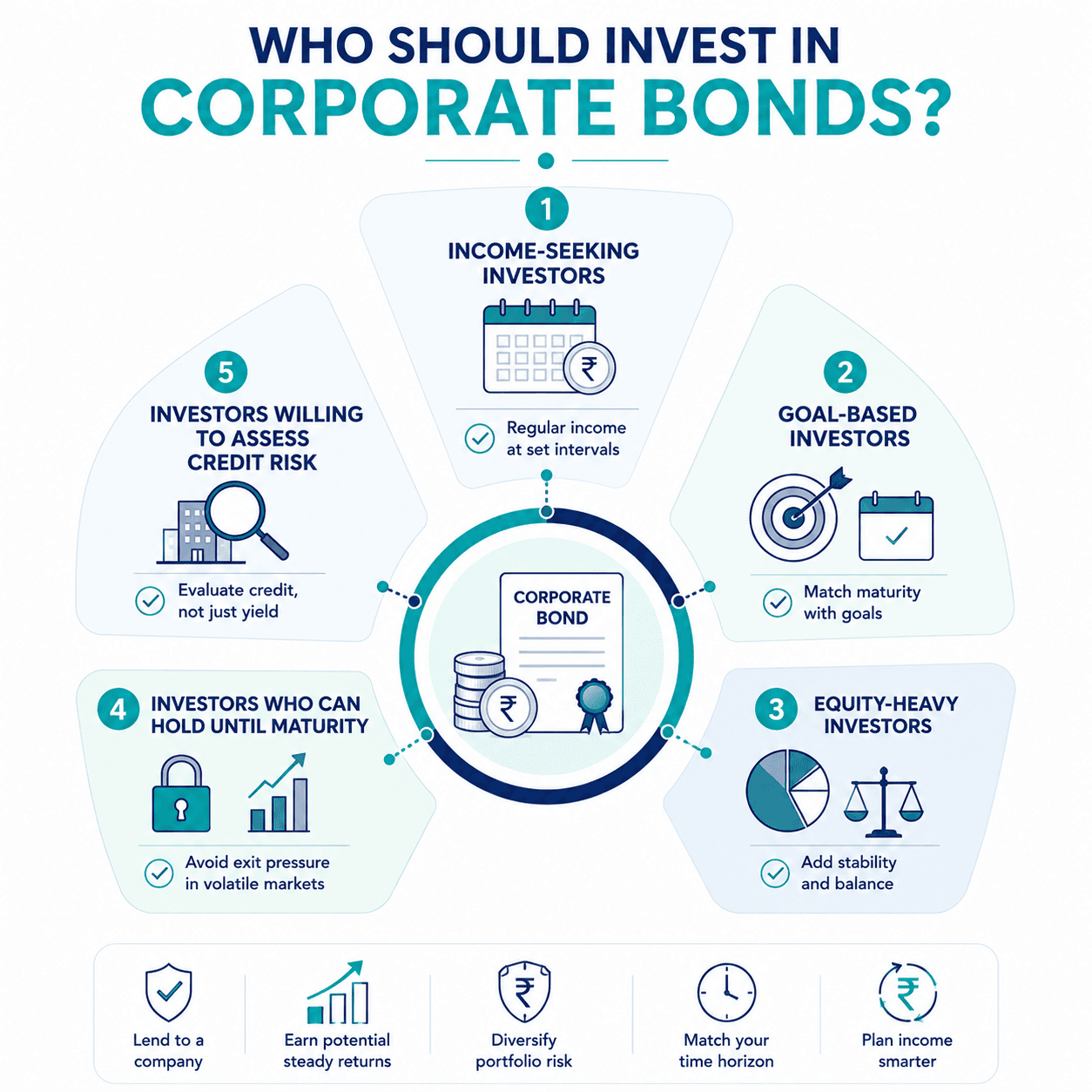
Who Should Invest in Corporate Bonds?
Understanding corporate bonds benefits requires looking at the investor’s needs. Corporate bonds for investors are not a single-purpose product.
Different bonds suit different income needs, timelines and risk levels.
Income-Seeking Investors
Regular coupon payments can help retirees or working professionals plan income at set intervals. Check the payment schedule and the issuer’s repayment record before investing.
The benefits of corporate bonds are more useful when this income forms only part of the portfolio. Spreading money across issuers can also reduce concentration risk.
Goal-Based Investors
Investors with a known future expense may choose a maturity close to that date. This can help reduce uncertainty around when the principal becomes available.
A corporate bond investment may support medium-term goals when the bond tenure corresponds to the required timeline. Emergency money should remain in more liquid options.
Equity-Heavy Investors
A portfolio dominated by shares can rise and fall considerably with the market. Adding corporate bonds brings in a more stable income component.
Here, the advantages of corporate bonds come from balance rather than higher returns alone. The right allocation will vary with the investor’s goals, timeline and ability to take risk.
Investors Who Can Hold Until Maturity
Listed bonds may be sold before maturity, but a buyer may not always be available at a suitable price. The limited market demand may force an investor to sell at a loss.
Investors who can hold through the full tenure face less pressure to exit during weak market conditions.
Corporate bonds for investors with a stable holding period may therefore work better than for those needing immediate access. The expected cash flow should match the investor’s liquidity needs.
Investors Willing to Assess Credit Risk
Investors who invest in corporate bonds lend directly to a company. They must be comfortable checking its rating, financial position and repayment record.
These investments may not suit someone seeking government-backed capital protection. They are also unsuitable for investors who focus only on the highest available yield.
Risks That Offset The Benefits
Corporate bonds benefits must be considered together with the risks. A higher coupon can compensate for risk rather than represent a better investment by itself.
Credit Risk
Credit risk is the possibility that the issuer delays or fails to pay interest or principal. SEBI identifies default risk as a core risk of bond investing.
A rating downgrade can also reduce the bond’s market price.
Higher-rated bonds generally carry lower credit risk and may offer lower yields. Lower-rated issues can offer more income, but the possibility of loss is also higher.
Among all corporate bond risks, default risk can have the greatest effect on capital. Investors should review the issuer, not only the credit-rating symbol.
Liquidity Risk
A listed bond is not necessarily actively traded. SEBI notes that liquidity conditions and the availability of buyers can affect the exit price.
If few buyers are available, an investor may have to accept a lower price or wait longer to sell.
This risk matters less when the bond can be held until maturity. It becomes important when the investor may need the money earlier.
Interest Rate Risk
Bond prices generally move in the opposite direction to market interest rates. When rates rise, existing fixed-rate bonds may become less attractive and their market prices may fall.
This affects investors who sell before maturity. Longer-maturity bonds usually show greater price sensitivity than shorter-maturity bonds.
Reinvestment Risk
Coupons received during the tenure may need to be reinvested. If market rates have fallen, the investor may earn less on those payments.
Callable bonds create another form of reinvestment risk. Plus, early repayment can leave investors unable to find a replacement investment with the same yield.
The issuer may repay early under the bond terms, leaving the investor to reinvest at prevailing rates.
Inflation Risk
A fixed coupon does not rise automatically with living costs. High inflation can reduce the real purchasing power of interest income and principal repayment.
This risk is more relevant for long maturities. Investors should compare the expected post-tax return with their inflation expectations.
Together, these corporate bond risks explain why yield should never be considered alone. The return must justify the credit, liquidity and maturity exposure taken.
Checklist Before Buying Corporate Bonds
A basic checklist can help investors compare issues consistently. Review the following factors before buying a bond.
| Factor | Details to Review | Investment Relevance |
| Credit rating | Current rating, outlook and recent changes | Shows the issuer’s credit quality and the likelihood of timely repayment. |
| Yield to Maturity | YTM based on the current purchase price | Reflects the expected annualised return when the bond is held until maturity. |
| Coupon | Rate, payment frequency and fixed or floating structure | Determines the interest paid on the bond’s face value. |
| Issuer fundamentals | Revenue, profitability, debt, cash flow and repayment history | Indicates whether the company can continue paying interest and principal. |
| Maturity | Remaining tenure and repayment date | Helps match the bond with the investor’s financial goal and holding period. |
| Secured or unsecured | Assets backing the bond and repayment priority | Affects the investor’s claim on assets if the issuer defaults. |
| Liquidity | Trading activity and likely exit price | Shows how easily the bond may be sold before maturity. |
| Taxation | Tax on coupon income and capital gains | Determines the post-tax return from the investment. |
| Call or put terms | Early redemption rights available to the issuer or investor | Can change the bond’s expected tenure and future reinvestment plans. |
A credit rating is useful, but it is only one opinion. SEBI advises investors to examine profitability, solvency and repayment capacity rather than relying on the rating alone.
Investors should also read the offer document and the latest rating rationale.
Coupon and YTM require separate attention. A bond with a 10% coupon does not necessarily provide a 10% return if it is purchased above or below face value.
Tax also affects the final return. Interest on securities is generally included under income from other sources when it is not business income.
Capital-gains treatment depends on factors such as listing status and holding period.
Corporate Bonds vs Other Fixed Income Investments
No single fixed-income product is suitable for every purpose. The table below compares common options on the factors that usually matter to investors.
Factor | Corporate Bonds | Bank Fixed Deposits | Government Securities | Debt Mutual Funds |
Return structure | Coupon income and possible price gain or loss | Fixed interest based on the deposit rate | Coupon income or discount, plus possible market-price movement | Market-linked NAV based on the underlying debt portfolio |
Credit risk | Depends on the corporate issuer | Depends on the bank; eligible deposits receive DICGC cover up to INR 5 lakh per depositor per bank | No credit risk in the domestic sovereign context | Depends on the securities held by the fund |
Return potential | May exceed comparable FDs or government securities, with additional risk | Usually lower than higher-yield corporate bonds | Generally lower for a comparable tenure because sovereign credit risk is absent | Varies with portfolio yield, duration, expenses and market movements |
Liquidity | Varies by issue and trading activity | Premature withdrawal may be available with a penalty | Can be sold, but price and liquidity vary by security | Units are generally redeemable, subject to scheme rules and any exit load |
Price risk | Market price can change before maturity | No daily market-price movement for a held deposit | Prices change with interest rates | NAV changes with interest rates, credit events and portfolio movements |
Income predictability | High when a fixed-rate bond is held and the issuer pays as scheduled | High under the deposit terms | High for held-to-maturity coupon securities | Lower because returns are not fixed |
Taxation | Coupon income is generally taxed at the applicable rate; capital gains depend on the bond and holding period | Interest is generally taxed at the applicable slab rate | Interest is generally taxable; sale-related gains follow applicable capital-gains rules | Tax treatment depends on the fund category and acquisition date |
Suitable for | Investors seeking defined tenure and potentially higher yield who can assess issuer risk | Investors prioritising simplicity and deposit protection within the insured limit | Investors prioritising sovereign credit quality | Investors seeking a managed and diversified debt portfolio |
Corporate bonds for investors can offer a middle path between bank deposits and market-linked debt funds.
Eligible bank deposits receive insurance cover on principal and interest up to INR 5 lakh per depositor per bank. Corporate bonds do not receive this protection.
However, they require more issuer-level analysis than an FD.
The benefits of corporate bonds may be more relevant when the investor wants to lock into a particular yield and maturity.
Debt mutual funds may suit those who prefer portfolio diversification and professional management. Their NAV can still move with interest rates, credit events and liquidity conditions.
Growth Of India’s Corporate Bond Market
Trading activity in India’s corporate bond market has grown over the last decade. The settlement data covers both the value of completed trades and the number of transactions across market platforms.
Settled trade value rose starting from INR 7.54 lakh crore in FY2015 increasing to INR 22.07 lakh crore in FY2026. This works out to an increase of about 193%.1
Trade volumes grew faster. The number of settled transactions increased from 6,57,354 to 28,41,854 during the same period, a rise of roughly 332%.
Financial Year | Value of Trades Settled | Number of Trades Settled |
FY2015 | INR 7,53,628.50 crore | 6,57,354 |
FY2020 | INR 14,93,139.69 crore | 10,82,921 |
FY2025 | INR 17,09,932.54 crore | 11,90,822 |
FY2026 | INR 22,07,147.25 crore | 28,41,854 |
These figures show trading and settlement activity, not the amount of corporate debt outstanding.
SEBI reported net outstanding corporate debt of about INR 51.58 lakh crore as of December 2024.2
CRISIL Ratings projected that the outstanding market could reach INR 100-120 lakh crore by FY2030, compared with around INR 43 lakh crore at FY2023-end.3
This projection indicates the possible long-term expansion of corporate borrowing through bonds.
Market growth does not alter the need for bond-level assessment. Investors must still evaluate each issuer, issue structure and maturity separately.
Conclusion
Corporate bonds can add income, tenure visibility and diversification to a portfolio. These corporate bonds benefits are most useful when the bond matches the investor’s goal, risk tolerance and liquidity needs.
The benefits of corporate bonds also come with trade-offs. Higher yield may indicate higher credit risk, while an early exit may expose the investor to price and liquidity risk.
Before you invest in corporate bonds, compare the YTM, coupon, rating, issuer finances and security structure. A well-selected corporate bond investment can support a balanced fixed-income allocation, but it should not be treated as risk-free.
And if you want transparent, curated corporate bond opportunities starting at just INR 1,000, Grip Invest helps you explore high-quality fixed-income deals with ease.
FAQs On Corporate Bonds Benefits
 |
Author: Grip Invest Editorial Team The Grip Invest Editorial Team is a group of Chartered Accountants, MBA (Finance) graduates, and Qualified Research Analysts dedicated to helping you invest smarter. We dive deep into India's fixed income landscape to deliver content that is accurate, up-to-date, and easy to understand. Whether you're exploring bonds, fixed deposits, or other fixed income opportunities, our guides cut through the noise and give you the clarity to make better financial decisions. |
Want to stay at the top of your finances?
Join the community of 4 lakh+ investors and learn more about Grip Invest, the latest financial knick-knacks, and shenanigans in the world of investing.
Happy Investing!
Disclaimer - Investments in debt securities/municipal debt securities/securitised debt instruments are subject to risks including delay and/ or default in payment. Read all the offer related documents carefully. The investor is requested to take into consideration all the risk factors before the commencement of trading.
This communication is prepared by Grip Broking Private Limited (bearing SEBI Registration No. INZ000312836 and NSE ID 90319) and/or its affiliate/ group company(ies) (together referred to as “Grip”) and the contents of this disclaimer are applicable to this document and any and all written or oral communication(s) made by Grip or its directors, employees, associates, representatives and agents. This communication does not constitute advice relating to investing or otherwise dealing in securities and is not an offer or solicitation for the purchase or sale of any securities. Grip does not guarantee or assure any return on investments and accepts no liability for consequences of any actions taken based on the information provided. For more details, please visit www.gripinvest.in
Registered Address - 106, II F, New Asiatic Building, H Block, Connaught Place, New Delhi 110001


