

Debt Service Coverage Ratio (DSCR): Meaning, Formula, Calculation And Importance


Investors as well as lenders have to find reliable ways of confirming if a borrower will be able to handle several debt payments. One of the most widely used metrics for this purpose is the Debt Service Coverage Ratio (DSCR). The Debt Service Coverage Ratio presents a good picture of cash flow by indicating whether a borrower's operating income is sufficient to meet its debt obligations.
The ratio is important because it allows for evaluating the financial position before giving a loan or investing in bonds. By understanding the Debt Service Coverage Ratio, investors and lenders can make more informed credit and investment decisions.
Debt Service Coverage Ratio: What Is It?
The Debt Service Coverage Ratio (DSCR) is an indicator that shows how successfully a company’s income generated from operations can cover its debt obligations. This indicator also shows whether operating income is sufficient to cover interest and principal repayments on debt. Lenders as well as investors tend to track the indicator since it helps to assess their repayment as well as risks.
It has the following definition: If the ratio is high, it means that the borrower will be able to service his or her debt with comfort, while if the ratio is low, the borrower might have difficulties in repaying the debt.
Hypothetical Example
For instance, a manufacturing organisation receives constant revenue. The Debt Service Coverage Ratio can help a bank make a decision on the possibility of giving a loan for the development of the production.
How To Calculate DSCR?
Calculating the Debt Service Coverage Ratio (DSCR) may seem complicated. However, depending on the lender and the industry, DSCR may be calculated using net operating income (NOI) or EBITDA, divided by total debt service for a specific period of time. Total debt service includes both the principal repayments and interest on the loan.
Formula: DSCR = Net Operating Income ÷ Total Debt Service
Step-by-step Example
Let’s take Ramesh’s business, which has a net operating income of INR 15 lakh. Annual debt payments will be in the range of INR 10 lakh, which comes from interest and principal payments as well. Therefore, after calculation, the ratio would be 15 lakh ÷ 10 lakh = 1.5. This ratio indicates that the business generates 1.5 times the cash flow required to meet its annual debt obligations.
What Does A Good DSCR Look Like?
The 1 to 1 ratio means that cash flow is just enough to make payments on debts without saving anything. Things such as financial institutions prefer the ratio to be higher. 1.5 is a comfortable ratio in most industries, where less than 1 signifies difficulties in repaying debts.
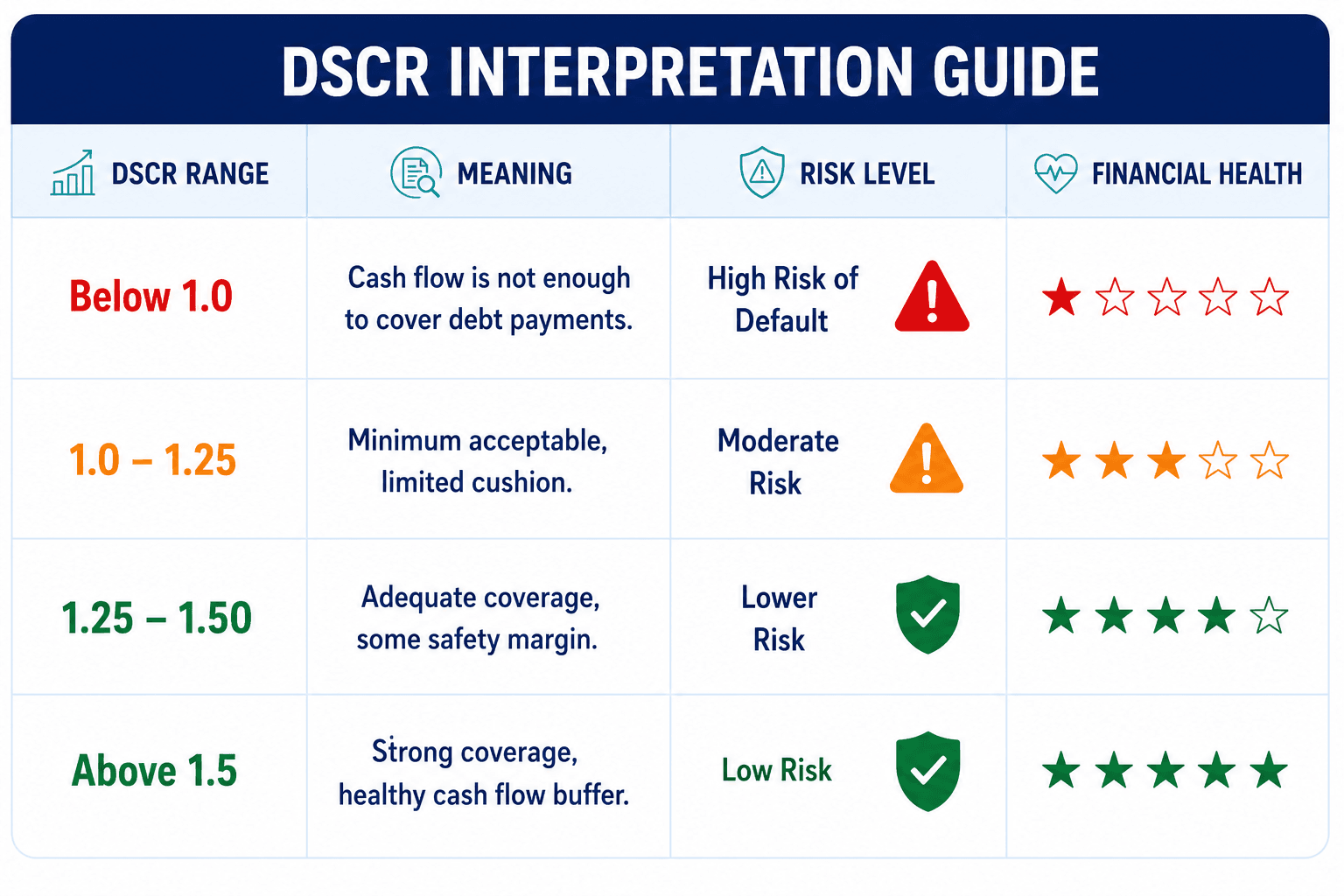
Different DSCR Ranges And Their Meaning
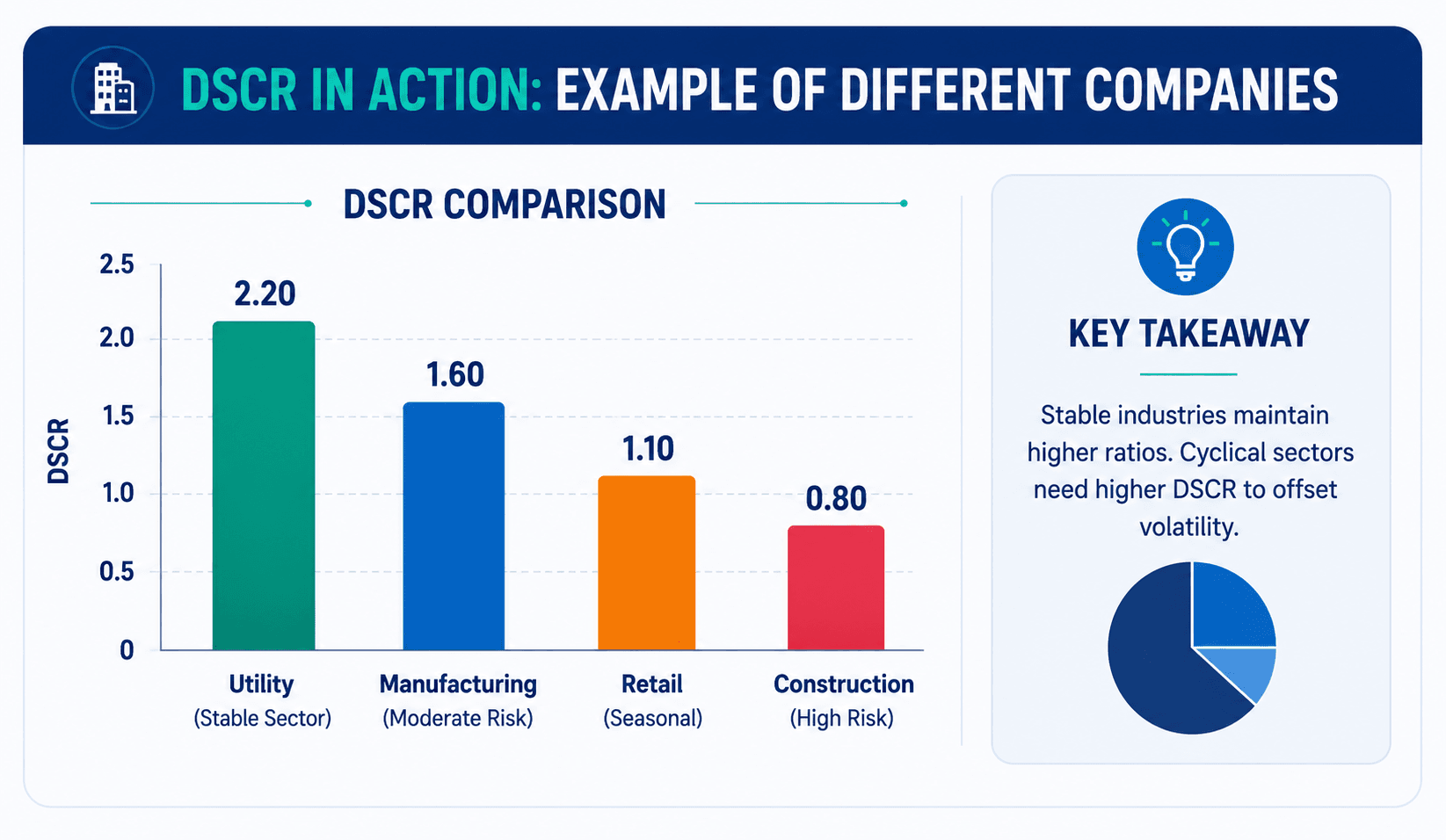
The benchmarks differ from industry to industry. For example, stable sectors, like utilities, can afford lower ratios, while cyclical industries need higher values regarding payments.
Hypothetical Example
Let’s consider a retail chain business that sells seasonal goods and thus has varying DSCR ratios. Any lender will most likely want the average DSCR ratio to be much higher than the actual averaged one.
Limitations Of DSCR Threshold
The debt service coverage ratio might not take into consideration seasonality or lack of cash flow in certain periods of time. It may also be affected by one-time income or expenses and differences in accounting practices. Each industry is vastly different in nature, thus making it possible to come up with a challenging comparison.
The appropriate DSCR threshold varies across lenders, industries, and loan agreements, making it important to interpret the ratio in context.
Note: Make sure to conduct a comparison with interest coverage (EBITDA to interest) and other financial ratios for a more comprehensive analysis. You can get a more detailed view of the cash flow situation by calculating the EBITDA to debt service ratio, while the covenant DSCR is used in a loan agreement to set minimum requirements.
Factors That Influence DSCR
Several factors can increase or reduce a company's Debt Service Coverage Ratio.
1. Operating Profitability
Higher operating income generally improves DSCR by increasing the cash available for debt servicing.
2. Borrowing Levels
Additional loans increase principal and interest obligations, which may reduce the ratio unless earnings also grow.
3. Interest Rates
A rise in floating-rate borrowing costs can increase debt servicing requirements and lower DSCR.
4. Capital Expenditure
Large business investments may temporarily reduce operating cash available for debt repayment.
5. Business Cycles
Companies operating in cyclical industries may experience fluctuations in earnings, causing DSCR to vary over time.
How To Interpret The Debt Service Coverage Ratio
The DSCR should always be interpreted in context. While higher ratios generally indicate stronger repayment capacity, the acceptable level varies across industries, lenders, and loan agreements.
| DSCR | Interpretation |
| Below 1.0 | Operating income is insufficient to meet debt obligations. The borrower may struggle to repay debt without additional funding. |
| 1.0 | Income is just enough to cover debt payments, leaving little margin for unexpected expenses. |
| 1.2–1.5 | Generally considered acceptable by many lenders, although requirements vary by industry and loan type. |
| Above 1.5 | Indicates a stronger ability to service debt and provides a larger cushion against fluctuations in earnings. |
A higher DSCR does not automatically mean lower investment risk. Investors should also examine whether the company's earnings are stable and sustainable over time.
Why Should Bond Investors Look At DSCR?
Before investing in a corporate bond, investors should assess whether the issuer generates sufficient cash flow to meet its repayment obligations. DSCR helps answer this question by comparing operating income with scheduled debt payments.
A consistently healthy DSCR may indicate that the issuer has a greater capacity to pay interest and repay principal on time. Conversely, a declining or persistently low DSCR may signal increasing financial stress, particularly when combined with rising debt levels or weakening profitability.
However, DSCR should not be viewed in isolation. Credit ratings, leverage, profitability, cash flows, and industry outlook should also be considered before making an investment decision.
Analysing Bond Issuers Beyond A Single Ratio
Sensible investors do not base their decisions on one figure. Instead, they combine the debt service coverage ratio with credit ratings, cash flow trends, and industry position to gain a deeper understanding along with measures such as the coupon coverage ratio, where applicable. Applying diversification across issuers and maturities helps to mitigate the risks.
The Debt Service Coverage Ratio (DSCR) is a crucial indicator in the field of credit analysis when evaluating the creditworthiness of borrowers and the value of investment in bonds in particular.
Platforms such as Grip Invest provide thorough information on issuers, which enables investors to consider various facets before they make decisions regarding fixed-income investments. While DSCR can provide useful insights into the creditworthiness of an entity, it works best when used in combination with other metrics and qualitative analysis.
FAQs On Debt Service Coverage Ratio
 |
Author: Grip Invest Editorial Team The Grip Invest Editorial Team is a group of Chartered Accountants, MBA (Finance) graduates, and Qualified Research Analysts dedicated to helping you invest smarter. We dive deep into India's fixed income landscape to deliver content that is accurate, up-to-date, and easy to understand. Whether you're exploring bonds, fixed deposits, or other fixed income opportunities, our guides cut through the noise and give you the clarity to make better financial decisions. |
Want to stay at the top of your finances?
Join the community of 4 lakh+ investors and learn more about Grip Invest, the latest financial knick-knacks, and shenanigans in the world of investing.
Happy Investing!
Disclaimer - Investments in debt securities/municipal debt securities/securitised debt instruments are subject to risks including delay and/ or default in payment. Read all the offer related documents carefully. The investor is requested to take into consideration all the risk factors before the commencement of trading.
This communication is prepared by Grip Broking Private Limited (bearing SEBI Registration No. INZ000312836 and NSE ID 90319) and/or its affiliate/ group company(ies) (together referred to as “Grip”) and the contents of this disclaimer are applicable to this document and any and all written or oral communication(s) made by Grip or its directors, employees, associates, representatives and agents. This communication does not constitute advice relating to investing or otherwise dealing in securities and is not an offer or solicitation for the purchase or sale of any securities. Grip does not guarantee or assure any return on investments and accepts no liability for consequences of any actions taken based on the information provided. For more details, please visit www.gripinvest.in
Registered Address - 106, II F, New Asiatic Building, H Block, Connaught Place, New Delhi 110001


