

Form 15G Scrapped? What Replaces It And What Investors Should Do Now


In a quest to consistently improve the ease of investment and tax assessment, the Income Tax Department introduces numerous changes and updates to the existing regulations.
One of the recent developments is the scrapping of Form 15G and the introduction of a simpler, user-friendly form that serves the same purpose while reducing confusion and technicalities.
From the perspective of investors, Form 15G helped ensure that TDS (Tax Deducted at Source) was not applicable to interest income, as their anticipated income fell below the prescribed ranges.
Investors used to submit Form 15G to banks and financial institutions where they held Fixed Deposits or other fixed-income securities. This was a standard practice.
However, with the new financial year, it is anticipated that Form 15G is scrapped, and the government is moving towards a simplified and unified declaration system (discussed later). This shift aims to streamline compliance and reduce confusion, especially as Form 15G abolished April 2026 discussions continue to emerge.
What Was Form 15G
As per Section 194A and 193 of the Income Tax Act, 1961, a bank or a financial institution is bound to deduct TDS on interest on deposits and securities if the payment exceeds a certain threshold, as suggested in the given sections.
For example, if you have a Fixed Deposit of INR 10 lakhs in SBI at 7.5% per annum, you are entitled to an interest income of INR 75,000/- per year. However, when paying interest, the bank is required to deduct 10% at source, so you will only receive 67,500.
Form 15G was a self-declaration form that individuals could submit to financial institutions to request non-deduction of TDS on interest income, provided their total taxable income was below the prescribed limit.
For senior citizens, a separate form (Form 15H) was required.
It was a critical aspect of the personal financial planning process to avoid TDS on FD interest and maintain liquidity without waiting for tax refunds.
Also Read: Tax Planning For Long Term Investors
Why Form 15G Has Been Scrapped
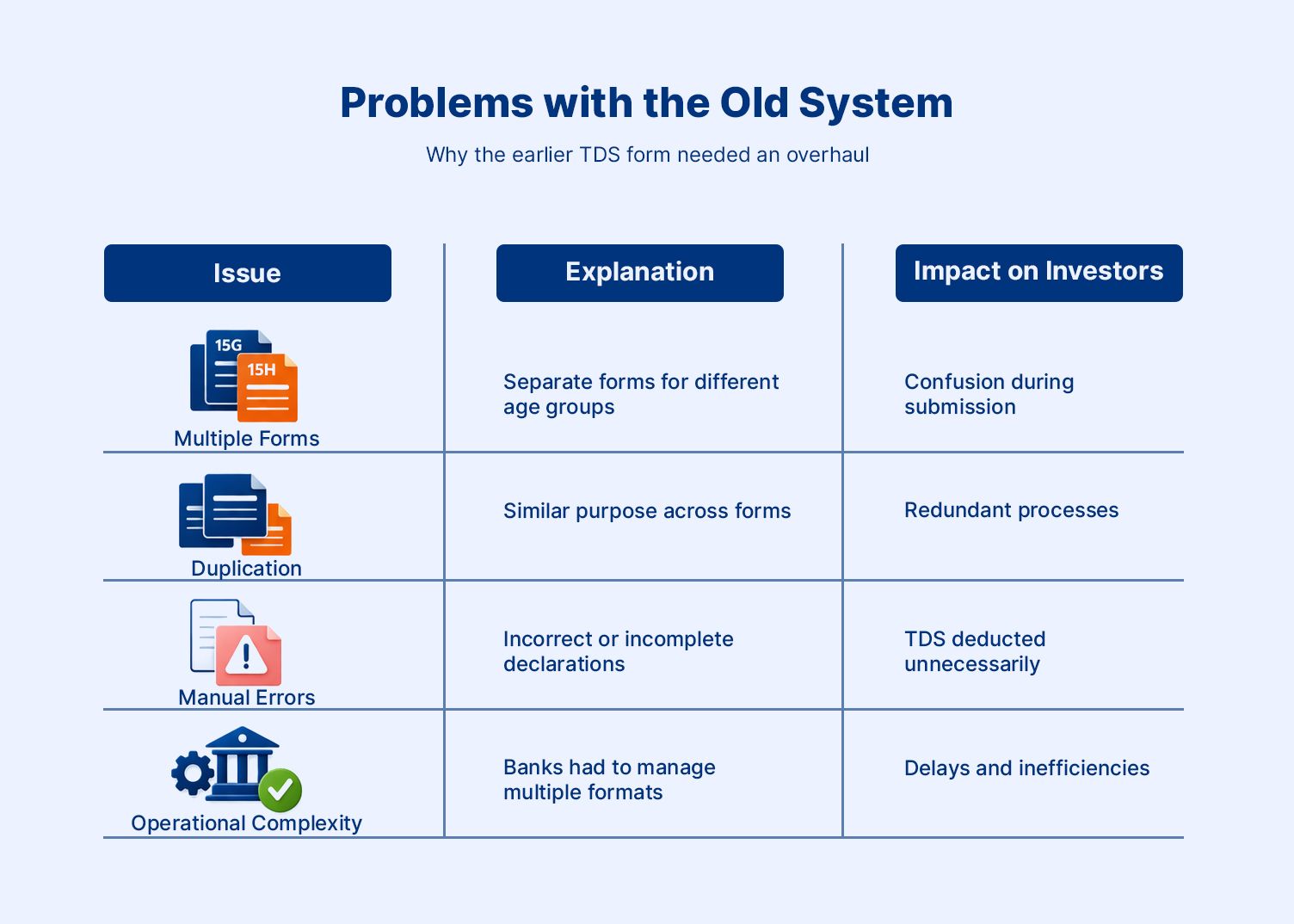
As underlined before, the primary purpose of scrapping Form 15G is to simplify and integrate the TDS process for the taxpayers. It is also a critical step in digitising the entire process. There were duplication issues in the existing system, and the coexistence of two different forms (15G and 15H) created inefficiencies. As a result, discussions around Form 15H scrapped new form have also emerged as part of the same reform initiative.
The government is now focusing on creating a single declaration form TDS India approach to ensure uniformity and ease of compliance.
Here is a table showing the problems with the old system.
What Replaces Form 15G
With a view to addressing these legacy issues, the government is all set to introduce a unified declaration mechanism, referred to as Form 121 new TDS declaration form.
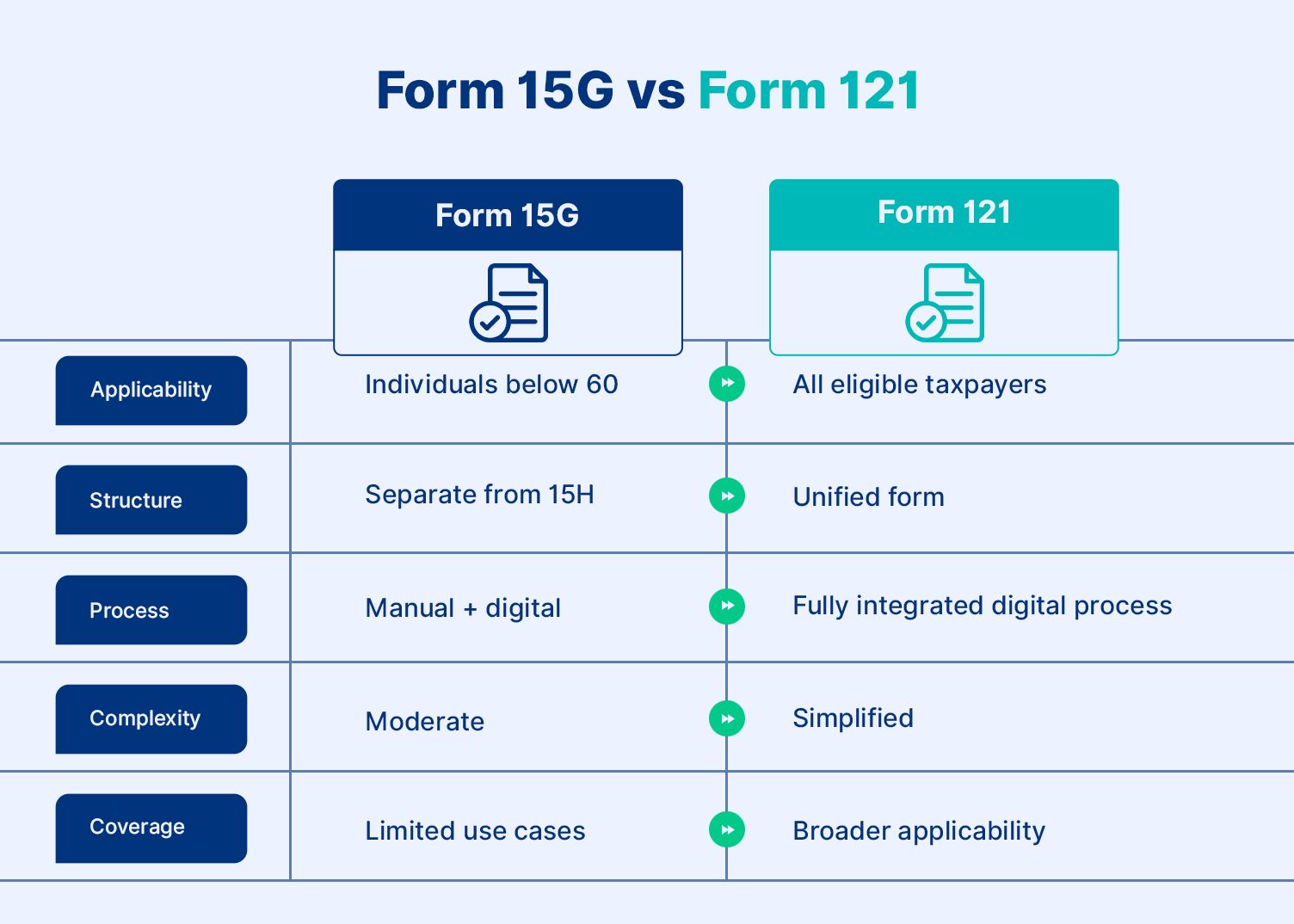
The new form will act as a replacement for both the forms (15G and 15H). The entire process will be more streamlined and accessible for all eligible taxpayers.
The Form 15G replacement aims to eliminate ambiguity and improve integration with digital tax systems. As per the new requirements, the eligibility criteria is based on income thresholds and not on the age of the taxpayer.
Some of the key features of the new Form 121 are as follows:
1. Single declaration form for all eligible individuals
2. Making Form 121 PAN mandatory
3. Making the submission process highly simplified
4. Integration of the form with the income tax system and digitalisation of the tax planning process.
Here is a comparison table for Form 15G and Form 121:
How To Avoid TDS On Interest Income Now
Investors do not need to worry about avoiding TDS on interest income, as they can submit the updated declaration form. With the changes in the income tax slabs, you can continue to avoid TDS on FD interest in 2026, as the process remains the same in principle.
If your anticipated income is less than the threshold limit, your income tax liability shall be nil. You can file the new form with your bank or financial institution, as the entire process will be digitally integrated.
At the same time, you should cross-check that all the details are correct and that you are not understating your income, as this will have a further impact on the tax return. For details on your expected income, we suggest you contact your tax advisor.
Impact On FD, Bonds and Fixed Income Investors
The shift to a unified declaration system is expected to simplify TDS compliance across fixed-income instruments, including fixed deposits, bonds, and other interest-bearing securities. Instead of managing multiple forms, investors can rely on a single, standardised process, reducing paperwork and operational friction.
For bond investors, especially those earning regular coupon income, this brings greater consistency in how TDS declarations are handled across issuers, banks, and platforms. It also improves visibility, as digitally integrated systems make it easier to track submissions and avoid missed declarations.
Overall, the change enhances ease of compliance, reduces the risk of unnecessary TDS deductions, and creates a more streamlined experience for investors managing multiple fixed-income investments.
Conclusion
The move to replace Form 15G with a unified declaration system marks a step toward simplifying tax compliance and reducing confusion for investors. A single, streamlined process can improve efficiency, minimise errors, and enhance overall investor confidence. However, it remains important to understand the differences between Form 121 and the earlier forms, and consult a tax advisor to assess its impact on your specific tax situation.
As you simplify tax planning, pairing it with smarter investment choices can further improve outcomes, platforms like Grip Invest offer access to fixed-income opportunities that bring more predictability and clarity to your portfolio.
FAQs
1. Is Form 15G scrapped in 2026?
Form 15G is expected to be phased out from April 2026 as part of a shift to a unified TDS declaration system.
2. What replaces Form 15G?
Form 121 is expected to replace Form 15G and 15H as a single, simplified declaration form for TDS exemption.
3. Who can submit Form 121?
All eligible taxpayers with nil tax liability and income below the threshold can submit Form 121, regardless of age.
4. Can I still use Form 15G?
Form 15G may continue temporarily, but it is likely to be discontinued once the new system is fully implemented.
 |
Author: Grip Invest Editorial Team The Grip Invest Editorial Team is a group of Chartered Accountants, MBA (Finance) graduates, and Qualified Research Analysts dedicated to helping you invest smarter. We dive deep into India's fixed income landscape to deliver content that is accurate, up-to-date, and easy to understand. Whether you're exploring bonds, fixed deposits, or other fixed income opportunities, our guides cut through the noise and give you the clarity to make better financial decisions. |
Want to stay at the top of your finances?
Join the community of 4 lakh+ investors and learn more about Grip Invest, the latest financial knick-knacks, and shenanigans in the world of investing.
Happy Investing!
Disclaimer - Investments in debt securities/municipal debt securities/securitised debt instruments are subject to risks including delay and/ or default in payment. Read all the offer related documents carefully. The investor is requested to take into consideration all the risk factors before the commencement of trading.
This communication is prepared by Grip Broking Private Limited (bearing SEBI Registration No. INZ000312836 and NSE ID 90319) and/or its affiliate/ group company(ies) (together referred to as “Grip”) and the contents of this disclaimer are applicable to this document and any and all written or oral communication(s) made by Grip or its directors, employees, associates, representatives and agents. This communication does not constitute advice relating to investing or otherwise dealing in securities and is not an offer or solicitation for the purchase or sale of any securities. Grip does not guarantee or assure any return on investments and accepts no liability for consequences of any actions taken based on the information provided. For more details, please visit www.gripinvest.in
Registered Address - 106, II F, New Asiatic Building, H Block, Connaught Place, New Delhi 110001


