

Fund Overlap Analysis: Why Investing In Multiple Mutual Funds May Not Diversify


A common misconception amongst people is that ‘more is better’. For example, when trying to stay fit, you may consider working through multiple fitness regimes, without understanding whether these regimes overlap with each other or not. Maybe adding another regime to your fitness journey is not really benefiting you? The same applies to mutual funds.
Mutual funds are financial tools known for their ‘diversification’ benefits. However, what happens when you hold multiple mutual funds? Does it multiply the associated diversification benefits? It may not. Here, factoring in mutual fund overlap analysis is important to assess whether the mutual fund portfolio is appropriately diversified or is overexposed to certain securities. This guide will help you understand what stock overlap in a mutual fund is and how to check it to eliminate portfolio overlap risks.
What Is Fund Overlap?
Portfolio diversification in India largely correlates with mutual funds. A mutual fund overlap occurs when you invest in multiple mutual funds having similar objectives. This ultimately leads to holding identical securities across each fund. A fund overlap analysis measures the degree of this similarity to quantifiably assess the overlap.
To understand mutual fund overlap, consider the example below.
Akshay invests in two mutual funds, thinking he has successfully diversified:
- Fund 1: Equity Fund
- Fund 2: Bluechip Fund
He puts INR 1,00,000 in each fund.
Here is how his investment looks:
| Company | Fund 1 | Fund 2 |
| Company A | 10% | 9% |
| Company B | 9% | 10% |
| Company C | 8% | 7% |
| Company D | 7% | 8% |
| Company E | 6% | 6% |
| Other companies | 60% | 60% |
The above table shows that both funds hold investments in similar companies. If these holdings perform poorly, the entire portfolio is negatively impacted. This is due to the fund’s overlap.
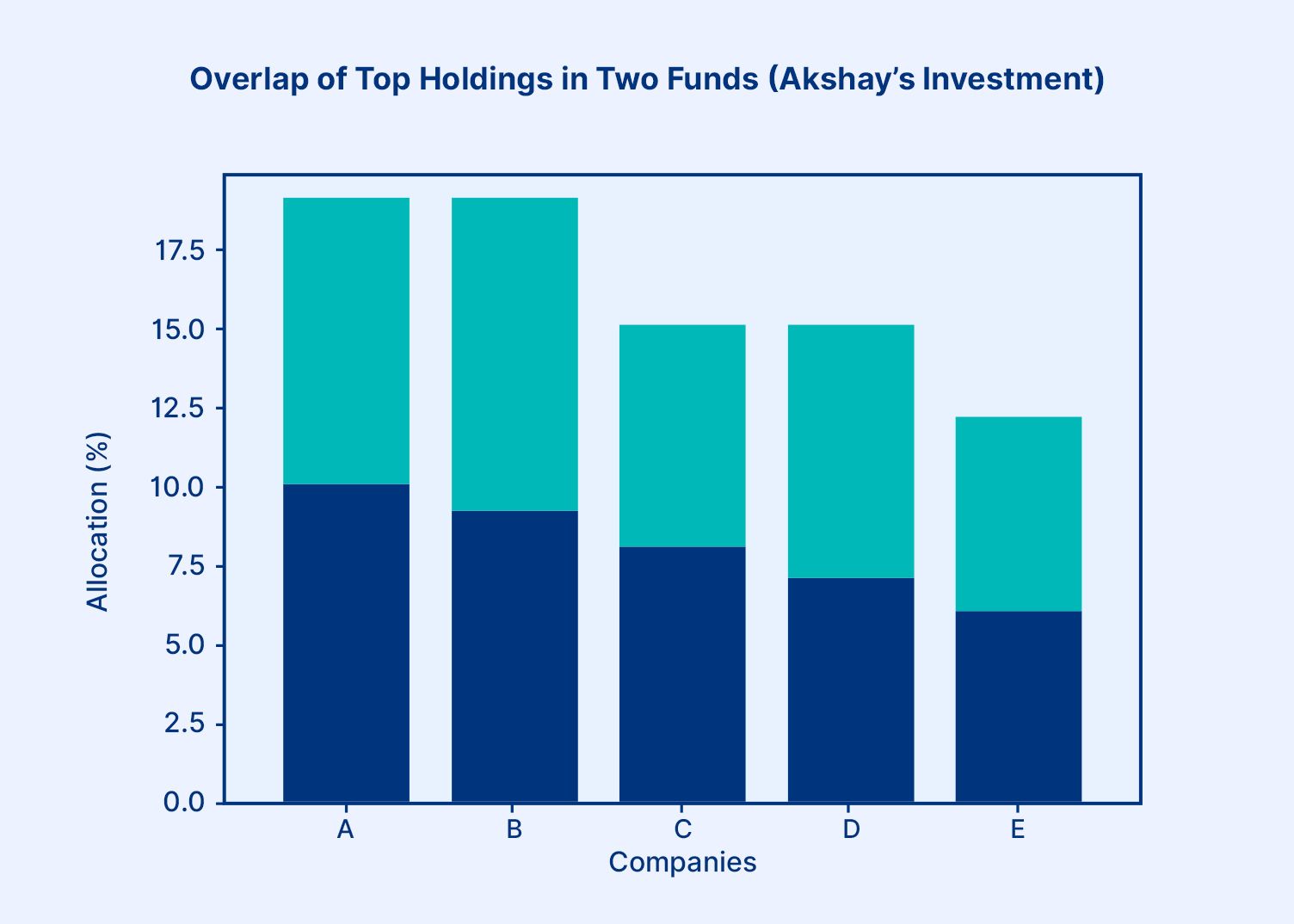
The image above displays how both funds in Akshay’s portfolio are overly concentrated in the same holdings.
How To Calculate Fund Overlap
Mutual fund overlap can be calculated using simple online mutual fund overlap calculators. The manual way to calculate it involves checking and reviewing the portfolios of your invested mutual funds. Some steps to follow include:
1. Monitor the monthly portfolios: It is important to check and monitor the holdings of your mutual funds to identify any common stocks.
2. Check the weight in each common stock: Additionally, check the weightage of the common stocks in each mutual fund.
3. Determine the overlap: For each common stock, take the lower of the two weightages and add them together. The total you get is the overlap percentage between the two funds.
For example, if your portfolio holds Nippon India Large Cap Fund and HDFC Large Cap Fund, some top common stocks include:
| Stock | Nippon India Large Cap Fund (approx. weight) | HDFC Large Cap Fund (approx. weight) |
| HDFC Bank Ltd | 8.84% | 9.34% |
| Reliance Industries Ltd | 6.03% | 6.09% |
| ICICI Bank Ltd | 5.85% | 9% |
| Axis Bank Ltd | 3.90% | 3.35% |
| Infosys Ltd | 3.05% | 3.15% |
| NTPC Ltd | 2.16% | 2.41% |
*Data as on 31.01.2026
Using an online overlap calculator, it is observed that a total of 32 common stocks are found in both these funds, indicating a portfolio overlap of 50%1.
Why Overlap Can Be Risky
A truly well-diversified portfolio steers away from overlapping funds, which carry the following risks:
1. No diversification benefits: If you hold multiple funds that have identical stocks in their portfolio, the purpose of diversification is defeated. You may be over-exposed to a few stocks without any diversification.
2. Amplified losses: Holding overlap funds leads to overexposure in a few stocks. If these stocks underperform, the portfolio may be widely impacted. Instead of diversifying the loss, the overlap results in amplified losses throughout the portfolio.
3. Increased cost: Holding many funds can lead to paying expense ratios for each of these funds, with any additional benefits.
4. Reduce fund manager expertise: A major advantage of holding mutual funds is investing through the professional, experienced guidance of fund managers. However, if you hold multiple funds with similar investing approaches, you may not benefit from any specialised guidance.
Tools To Check Fund Overlap
Fund overlap can be measured using a simple framework and by analysing the fund’s holdings. Various online mutual fund portfolio overlap tools allow for free checking of the overlap between two funds. These tools suggest the percentage of overlap, the number of common and uncommon stocks, and the exact weightage of similarity across each common stock.
Ideally, an overlap of 10% or less is considered acceptable between funds. However, any overlap above 40% may be risky2.
How To Build A Truly Diversified Portfolio
The benefits of a diversified portfolio can be retained if you avoid overlap in mutual funds. Here are some tips to ensure an optimally diversified portfolio and reduce fund duplication:
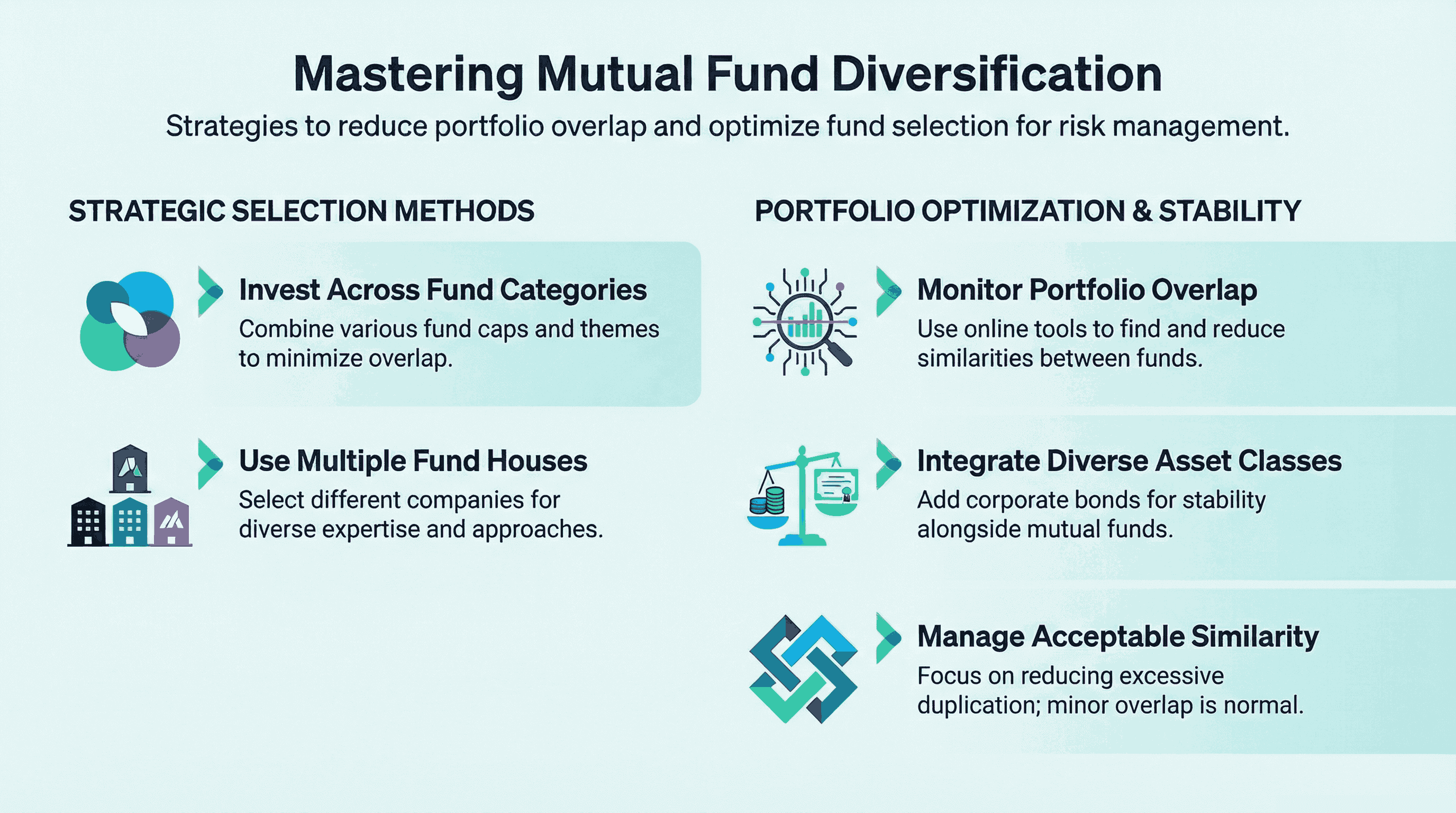
1. Hold different fund categories: One way to eliminate the risk of overlap across mutual funds is to invest across mutual funds that belong to different categories. For instance, holding 4 mutual funds: one small-cap, one mid-cap, one large-cap, and one thematic fund.
2. Hold funds from different fund houses: Another way is to invest across mutual fund houses that have different expertise and approaches. For example, holding funds from distinctive asset management companies such as Nippon India, Edelweiss, Aditya Birla Sun Life, etc.
3. Check portfolio overlap: Before investing in multiple mutual funds, check the overlap between each fund through online tools.
4. Some similarity is acceptable: It is essential to understand that a certain degree of similarity may commonly exist between mutual funds. This may not hamper diversification benefits as such. Only when the percentage is high, overdiversification concerns arise.
5. Diversify across other products: Diversification can also be achieved by adding other products to your portfolio. For example, adding corporate bonds to the portfolio can provide stability and balance with predictable returns. Grip Invest has a wide range of corporate bond options that you can check out.
Conclusion
An overlapped portfolio can reduce the efficiency of returns in your portfolio. Therefore, utilising online tools to calculate portfolio overlap can help avoid the risks of overconcentration and diluted returns in your portfolio. Ensure you review your mutual fund portfolio periodically to avoid high overlaps.
Visit Grip Invest today!
FAQs On Fund Overlap
1. What is a good fund overlap percentage?
Ideally, an overlap below 10% is considered healthy. If the overlap exceeds 40%, it may indicate excessive concentration in similar stocks, reducing the real diversification benefit.
2. How can I check mutual fund portfolio overlap?
You can use a mutual fund overlap calculator available on various financial platforms. Alternatively, you can manually compare monthly portfolio disclosures of funds and calculate the common stock weightage.
3. Is some level of mutual fund overlap normal?
Yes, a small degree of overlap is common, especially in large-cap funds where top stocks are widely held. The concern arises only when a significant portion of holdings is identical.
4. Does holding more mutual funds always improve diversification?
Not necessarily. If multiple funds invest in the same stocks or follow similar strategies, you may end up duplicating exposure instead of diversifying your portfolio.
References:
1. The fundoo, accessed from: https://thefundoo.com/Tools/PortfolioOverlap
2. Groww, accessed from: https://groww.in/blog/mutual-fund-overlap
Want to stay at the top of your finances?
Join the community of 4 lakh+ investors and learn more about Grip Invest, the latest financial knick-knacks, and shenanigans in the world of investing.
Happy Investing!
Disclaimer - Investments in debt securities/municipal debt securities/securitised debt instruments are subject to risks including delay and/ or default in payment. Read all the offer related documents carefully. The investor is requested to take into consideration all the risk factors before the commencement of trading.
This communication is prepared by Grip Broking Private Limited (bearing SEBI Registration No. INZ000312836 and NSE ID 90319) and/or its affiliate/ group company(ies) (together referred to as “Grip”) and the contents of this disclaimer are applicable to this document and any and all written or oral communication(s) made by Grip or its directors, employees, associates, representatives and agents. This communication does not constitute advice relating to investing or otherwise dealing in securities and is not an offer or solicitation for the purchase or sale of any securities. Grip does not guarantee or assure any return on investments and accepts no liability for consequences of any actions taken based on the information provided. For more details, please visit www.gripinvest.in
Registered Address - 106, II F, New Asiatic Building, H Block, Connaught Place, New Delhi 110001


