

How To Purchase Direct Mutual Funds In India: A Step-By-Step Guide For Investors


With a growing sense of becoming more cost-effective and digitally conscious, investors are exploring ways to purchase direct mutual funds through online platforms. Unlike regular mutual funds that rely on traditional distributor options, direct mutual funds eliminate these intermediary commissions, helping investors retain a higher portion of their returns.
Important debates about cost savings vs convenience have sparked with the increased interest in direct plans. Regular plans come with advisory support, which adds to the expense, eroding long-term growth. On the other hand, direct mutual funds reward investors who research and manage their portfolios independently.
What Is A Direct Mutual Fund?
Direct Mutual Fund is a kind of mutual fund that is purchased directly from the respective fund house. The purchase does not include any distributors, brokers, or advisors.
Due to the elimination of the middleman, the direct mutual fund expense ratio is lower compared to regular mutual funds. This advantage helps improve the investors’ overall return over a long period of time.
Ways To Purchase Direct Mutual Funds In India
A direct mutual fund can be purchased via any SEBI-regulated platform. Through these direct mutual fund platforms, you are allowed to invest without the involvement of any distributor. Each of these options has different features and uses.
- AMC websites
AMC websites, also known as Asset Management Company websites, allow you to purchase schemes directly from the fund house. To invest, you can create an account, complete your KYC, and pick a plan that suits you. These options are best suited for investors who seek a limited number of AMCs.
- MF Central
Backed by CAMS and KFintech, the MF Central direct plan is a centralized platform that allows investors to buy, track, and manage mutual funds across numerous AMNs in a single place. Multiple investors use this route to buy direct mutual funds in India. This method also supports portfolio consolidation and transaction tracking history.
- RTAs like CAMS and KFintech
RTAs or Registrar and Transfer agents act as an official service provider for mutual fund houses. These RTAs include platforms like CAMS and KFintech, allowing investors to purchase direct mutual fund plans, minus the involvement of advisors and distributors. The RTA portals help investors complete important actions such as KYC verification, access multiple mutual fund schemes, and create investment portfolios.
Step-By-Step Process To Buy Direct Mutual Funds In India
To experience seamless future investments, you must learn the initial setup for buying a direct mutual fund. The table below discusses how you can purchase a direct mutual fund.
Step | Action | Process |
1 | Complete KYC and Account Setup |
|
2 | Choosing Mode of Investment |
|
3 | Selecting the Direct plan and Scheme. |
|
4 | Making the Investment | Units are allotted via the applicable NAV after you select the scheme of choice and invest an amount confirming payment through net banking or UPI. |
5 | Regularly Monitoring Your Portfolio | Review your performance regularly. This includes expense ratio, tracking returns, and alignment with financial goals. |
6 | Switching and Redemption | You are allowed to switch between schemes and redeem your purchased units online. |
Expense Ratio Impact On Long-Term Returns
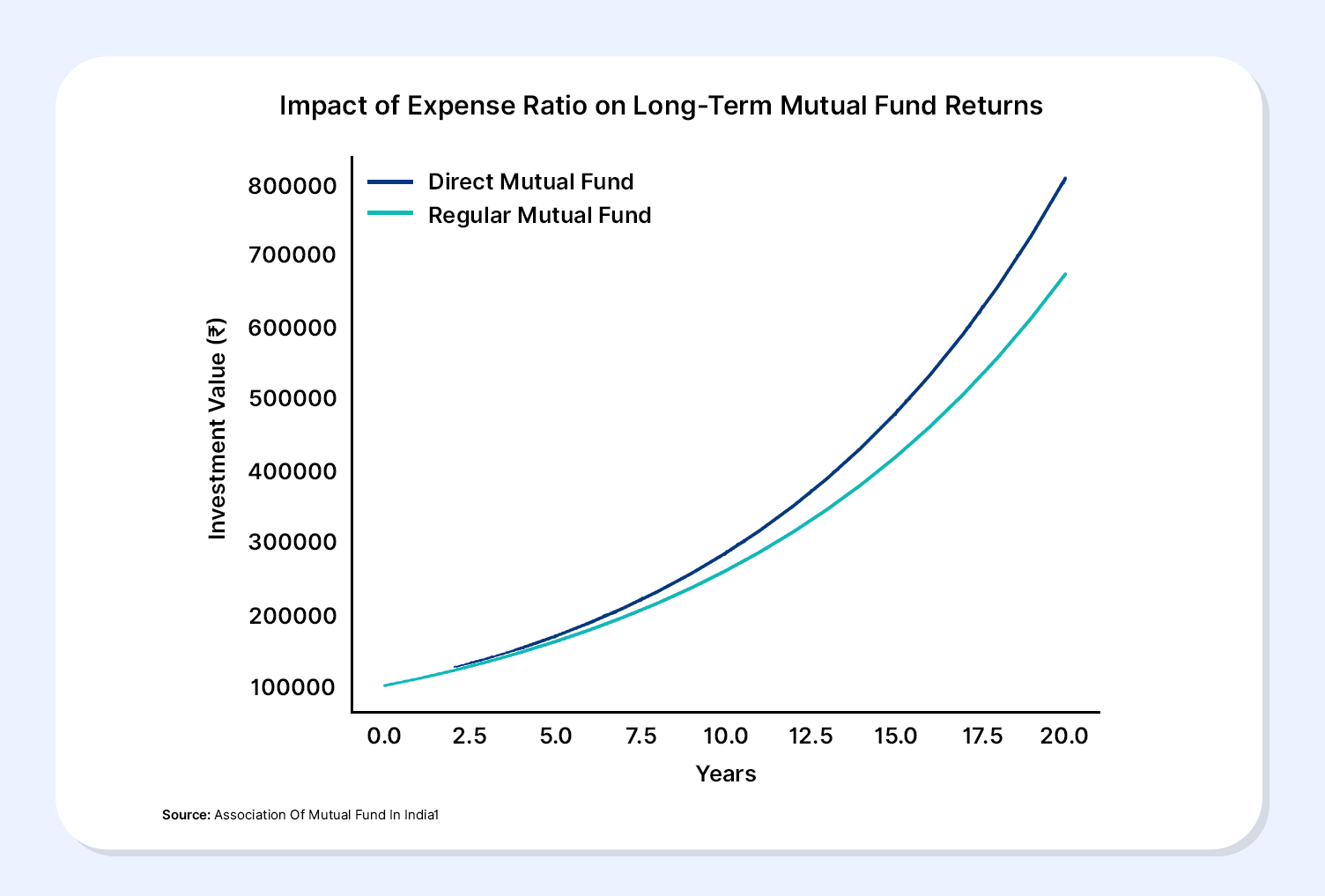
Source: Association Of Mutual Fund In India1
Who Should Choose Direct Mutual Funds?
Investors who are comfortable managing their investment independently are best suited for direct mutual funds. These investments offer higher return potential but require discipline and informed decision-making.
- DIY investors
These investors choose to research their funds in a way that is most beneficial to them. They are comfortable analysing fund performance, risk levels, and asset allocation.
- Long-term goal-based investors
Investors saving for retirement, a home purchase, or their children’s education can seek advantages from the returns from direct plans. When considered over longer periods of time, the lower ratio of expenses while investing in direct plans compounds more meaningfully.
- Balancing equity funds with fixed income and bonds for stability
Optimising returns through cost efficiency can be obtained by investors who diversify their portfolios using fixed-income, equity, bonds, and debt funds. Volatility can also be managed by pairing equity mutual funds with fixed-income instruments. Trusted platforms like Grip Invest offer their users a curated list of such instruments, enabling better portfolio balance along with mutual fund investments.
Conclusion
The picture of wealth creation has changed for the better due to the involvement of direct mutual fund options. They help control your financial decisions by lowering costs, offering higher transparency, and allowing easy digital access. You can reduce long-term costs and improve portfolio efficiency by understanding how to purchase direct mutual fund plans.
The direct plans work best when paired with informed decision-making and proper diversification. Investors can obtain stability by balancing direct mutual funds with fixed-income instruments and bonds alongside equity mutual funds that bring growth. Platforms like Grip offer access to such curated instruments that are non-market-linked fixed-income options. Combining these aspects, investors can obtain a stable income and build a resilient portfolio for themselves.
For cost-effective investments and complete transparency, start investing with Grip Invest today!
FAQs On How To Purchase Direct Mutual Funds
1. Are direct mutual funds better than regular plans?
Direct mutual funds are better than regular plans in terms of being cost-efficient; in other words, they have a lower expense ratio. This is because they do not include a distributor commission.
2. Can I convert regular mutual funds to direct?
Yes, you are allowed to convert regular mutuals to direct mutual funds. You can do this by redeeming units from the regular plan and reinvesting them in the direct plan with the same scheme.
3. Is it safe to buy mutual funds directly online?
If you use authorised platforms, buying mutual funds directly online is deemed safe. These platforms include MF Central, AMC websites, and RTAs like KFintech, which are SEBI-registered.
References:
1. Association Of Mutual Fund In India accessed from: https://www.amfiindia.com/investor-corner/knowledge-center/total-expense-ratio.html
Want to stay at the top of your finances?
Join the community of 4 lakh+ investors and learn more about Grip Invest, the latest financial knick-knacks, and shenanigans in the world of investing.
Happy Investing!
Disclaimer - Investments in debt securities/municipal debt securities/securitised debt instruments are subject to risks including delay and/ or default in payment. Read all the offer related documents carefully. The investor is requested to take into consideration all the risk factors before the commencement of trading.
This communication is prepared by Grip Broking Private Limited (bearing SEBI Registration No. INZ000312836 and NSE ID 90319) and/or its affiliate/ group company(ies) (together referred to as “Grip”) and the contents of this disclaimer are applicable to this document and any and all written or oral communication(s) made by Grip or its directors, employees, associates, representatives and agents. This communication does not constitute advice relating to investing or otherwise dealing in securities and is not an offer or solicitation for the purchase or sale of any securities. Grip does not guarantee or assure any return on investments and accepts no liability for consequences of any actions taken based on the information provided. For more details, please visit www.gripinvest.in
Registered Address - 106, II F, New Asiatic Building, H Block, Connaught Place, New Delhi 110001


