

New-Age AMCs Are Here: What It Means For Mutual Fund Investors


Just like the way you browse online retail stores to buy clothes, you can use direct mutual fund platforms to start investing in mutual funds. The new asset management companies in India, with their digital mobile-first platforms, allow you to invest with just INR 100 through mutual fund SIPs. Investing in the stock market has never been more accessible. Such platforms not only encourage investment but also educate investors to make better choices. Keep reading to know how new Asset Management Companies (AMCs) are disrupting the mutual fund market.
The Mutual Fund Landscape Is Changing: Traditional Vs New-Age AMCs
India's mutual fund landscape is undergoing rapid changes. New asset management firms in India, particularly those founded on fintech DNA, are disrupting the status quo.
Old-fashioned AMCs, such as SBI or ICICI, rely on heritage strengths. They have strong research teams, established trust, and broad distributor networks. Their products include equity, debt instruments, and hybrid funds, among others.
In contrast, new-generation AMC platforms in India are more digital-centric. They concentrate on direct mutual fund plans, offering low-cost mutual funds in India. Investors also invest in passive mutual funds in India, such as Exchange Traded Funds (ETFs) and index schemes, and these new-age AMCs make it easier for them.
These direct mutual fund platforms are making investing democratic:
- You don't need to look for a trusted mutual fund distributor to compare options.
- Use mobile phones to start investing with as low as INR 100.
- Low-cost mutual funds in India are becoming the standard, with several options to compare.
- Even without extensive knowledge on investment strategies, investors can use curated investment buckets to achieve diversification with minimal effort.
To investors, this change translates to options. You now have scalable, technology-enabled options for investing in mutual funds. Just be mindful of fees, platform ease of use, and fund performance.
What’s Driving This Disruption?
Until a few years ago, mutual fund investments were largely reserved for informed investors. Even then, their investment portfolios were managed by mutual fund distributors who gained commissions based on the investment plans they offered to the investors. The choices were limited. Digital disruption and fintech evolution have completely changed the way the younger generation invests.
1. Rise Of DIY Investors And Mobile-First Investing
India's mutual fund industry is witnessing an increase in self-directed investors, who prefer apps created for simple, friction-free investing. Platforms that focus on direct mutual funds through mobile have enabled users to transact without intermediaries.
2. Urge For Reduced Costs And Transparent Fee Plans
The total expense ratio (TER) is the total cost of managing a mutual fund annually. Typically, it comes out of your returns, so your actual returns will always be lower than investment returns. SEBI limits TER in terms of AUM, with equity funds at around 1.05% for funds over INR 50,000 crore and 0.80% for debt funds1. TER is 2.25% for equity funds up to INR 500 crore AUM. Despite the new age discount brokers capturing the market, the total commission earned by the asset management companies has grown rapidly during the last 4-5 years.
Financial Year | Total Commission Paid (? Crore) | YoY Growth (%) |
| FY 2019–20 | INR 6,138 | — |
| FY 2020–21 | INR 7,500 (approx.) | ~22% |
| FY 2021–22 | INR 10,400 (approx.) | ~39% |
| FY 2022–23 | INR 12,049 | ~16% |
Source: Money Control2
Next-generation fintech-led AMCs often focus on passive mutual funds or direct schemes, reducing operational layers and distributor commissions. TER can be as low as 0.29% depending on the type of fund and AMC.
New advancements, like SEBI eliminating transaction charges on distributors, further convert into savings for the investor. Lower TER implies your net returns are greater, particularly in the long run.
Who Are These New-Age Players?
India's fintech-driven mutual fund industry is making rapid strides. Let's examine the characteristics of five of the major forces behind this shift.
1. Zerodha AMC
Opened in mid-2023, already surpassed INR 6,400 crore in AUM in 18 months. The LIQUIDCASE ETF stands out and has INR 4,700 crore under it alone3. The main strategy for success is: direct-to-consumer distribution, zero marketing, affordable ETFs, and index funds. That simplicity has strongly resonated with retail investors.
2. Groww AMC
Its entry through the acquisition of Indiabulls AMC in May 2023 tripled its AUM, six times to approximately INR 2,000 crore by mid-20254. Groww provides a combination of equity index funds, such as the Total Market Fund, along with a simple platform supported by educational content in various Indian languages.
3. Navi Mutual Fund
Supported by Sachin Bansal's Navi Group, passive funds were launched under the mutual fund business. Navi mutual fund emphasises affordability, digital-first access, and passive approaches geared toward retail inclusion. Investor feedback questions execution and reliability, though.
4. Samco
Better recognised as a brokerage platform, Samco's RankMF platform provides curated baskets of mutual funds, SmartSIP (market-smart SIPs), and SmartSwitch (no-charge portfolio optimisation)5. It blends mutual fund investing with trading capabilities, focusing on smart automation and transparency.
5. WhiteOak
Established by ex-Goldman CIO Prashant Khemka, WhiteOak AMC has strong institutional support and a global footprint. This AMC manages about INR 8,800 crore AUM as of March 20246. A model of research-driven performance and disciplined process attracts investors towards WhiteOak.
Here's a quick overview of the AUM of these top new-age AMCs as of June 2025:
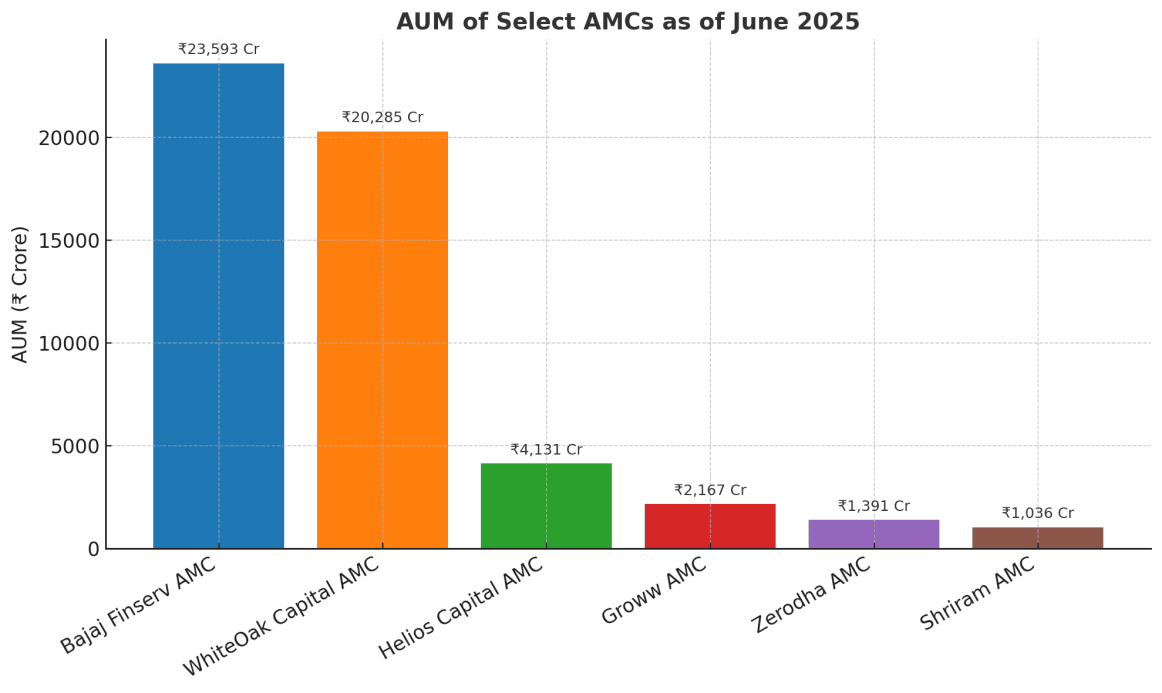
Source: Morningstar7
What It Means For Retail Investors
When several new AMCs enter the market, the industry's competitiveness increases. It benefits retail investors who are looking for affordable investments with better returns.
A. More Choice, Lower Costs, Greater Transparency
New-age AMC platforms are handing over the control of investments back to the investors. You have low-cost passive funds, direct mutual fund platforms, and simplified investing paths available to you now.
Transparency has been enhanced largely due to SEBI's recent regulations. Expense ratios, returns, and levels of risk are now separately disclosed by mutual funds for direct plans and regular plans. That makes it easier to compare and decide.
B. Push Toward Direct Plan Adoption
Direct plans are much more affordable than regular plans, mainly because there is no middleman, and they eliminate those charges. Latest figures indicate a definite change:
The total number of direct plans as a percentage of total AUM increased from 27.4% in March 2019 to 41.2% as of March 2024. Regular plans, on the other hand, declined from 62.6% to 58.8%8.
In FY25, out of new SIP accounts (less than 1 year old), 45% were direct plans that represented INR 85,618 crore AUM. Older SIPs (more than 5 years old) continue to be dominated by regular plans, with 77% of accounts and 87% of AUM in that category9.
Challenges To Watch Out For
You can invest with a simple touch. But it's not without challenges. You become responsible for your profits and losses.
- DIY Responsibility: Proper fund selection is crucial for direct plans. Without an intermediary, you need the appropriate tools and self-discipline. Making informed choices, understanding your risk appetite, and choosing the right investment horizon matter.
- Behavioural Risks: Without advisory scrutiny, there is a risk of chasing hot trends or new stars. This can affect long-term returns.
SEBI recently waived off exit loads for investors moving from regular plans to direct plans in the same scheme. So, you can make the switch without a huge cost. But think if it's right for you before you act.
Are New-Age AMCs the Future?
India's mutual fund sector is growing at speed. Latest trends indicate that new-gen AMCs may actually be dictating the future direction.
Passive funds, including ETFs and index funds, now control about 17% of industry AUM (mid-2025). This indicates a significant shift from active strategies. Active equity funds' proportion has also increased to 46% in December 2024, from 39% in March 2023. Overall mutual fund AUM has risen to INR 74–75 lakh crore as of mid-202510.
The new-age AMCs are making it easier for investors to invest in a variety of schemes directly.
| Factor | Insight |
| Active vs Passive | Passive AUM share more than doubled in four years. Investors are embracing low-cost, transparent passive funds. Active equity still retains dominance, but passive is catching up. |
| Direct vs Regular Plans | Though specific data on direct vs regular for new-age AMCs is scarce here, the broad rise in passive also reflects strong uptake of direct plans via digital platforms. Referrals and traditional channels are losing ground. |
Conclusion
The new-generation AMCs are responsible for a significant increase in investors' interest. Investors prefer easier, cost-effective products that mirror indexes or themes, and passive mutual funds provide that opportunity. Simplified onboarding and transparency work with modern investor habits.
As the adoption of passive and direct plans increases, the digital mutual fund platforms might dominate traditional competitors in the long run. Nevertheless, active management is still relevant. The future probably prefers a hybrid approach where digitally-led, low-cost strategies exist alongside some selective active options for investors who require human-led, active management. To learn more about mutual fund investments and portfolio diversification, sign up on Grip Invest today
References:
1. AMFI India, accessed from: https://www.amfiindia.com/investor-corner/knowledge-center/Expense-Ratio.html
2. Money Control, accessed from: https://www.moneycontrol.com/news/business/personal-finance/meet-indias-20-biggest-mutual-fund-distributors-based-on-commission-earned-11287791.html
3. Economic Times, accessed from: https://economictimes.indiatimes.com/mf/mf-news/zerodha-amcs-silent-success-aum-worth-rs-6400-crore-in-18-months-liquidcase-etf-emerges-as-a-retail-hero/articleshow/121491978.cms
4. Money Control, accessed from: https://www.moneycontrol.com/technology/ipo-bound-groww-s-mutual-fund-assets-reach-rs-2-000-crore-in-may-article-13162716.html
5. Samco, accessed from: https://www.samco.in/
6. Groww, accessed from: https://groww.in/mutual-funds/amc/whiteoak-capital-mutual-funds
7. Morning Star, accessed from: https://www.morningstar.in/tools/mutual-fund-amfi-average-aum-by-fund-house.aspx
8. Upstox, accessed from: https://upstox.com/news/personal-finance/investing/direct-vs-regular-mutual-funds-5-interesting-investment-trends-from-amfi-crisil-factbook/article-149387/
9. Cafe Mutual, accessed from: https://cafemutual.com/news/industry/34763-6-out-of-10-sips-are-from-regular-plans
10. Economic Times, accessed from: https://economictimes.indiatimes.com/markets/bonds/passive-funds-gain-traction-now-17-of-indias-rs-74-lakh-crore-mf-industry/articleshow/123112166.cms
Want to stay at the top of your finances?
Join the community of 4 lakh+ investors and learn more about Grip Invest, the latest financial knick-knacks, and shenanigans that take place in the world of investing.
Happy Investing!
Disclaimer - Investments in debt securities/municipal debt securities/securitised debt instruments are subject to risks including delay and/ or default in payment. Read all the offer-related documents carefully. The investor is requested to take into consideration all the risk factors before the commencement of trading.
This communication is prepared by Grip Broking Private Limited (bearing SEBI Registration No. INZ000312836 and NSE ID 90319) and/or its affiliate/ group company(ies) (together referred to as “Grip”) and the contents of this disclaimer are applicable to this document and any and all written or oral communication(s) made by Grip or its directors, employees, associates, representatives and agents. This communication does not constitute advice relating to investing or otherwise dealing in securities and is not an offer or solicitation for the purchase or sale of any securities. Grip does not guarantee or assure any return on investments and accepts no liability for the consequences of any actions taken based on the information provided. For more details, please visit www.gripinvest.in
Registered Address - 106, II F, New Asiatic Building, H Block, Connaught Place, New Delhi 110001


