

Joint FD Interest Tax In 2026: Rules, TDS And Tax Liability Explained


Fixed Deposits (FDs) continue to be one of the most trusted investment options in India.
Whether you're saving for retirement, your child's education, or simply looking for stable returns, FDs offer security and predictable earnings.1 However, when an FD is opened jointly with a spouse, parent, child, or another family member, many investors become confused about one important question:
Who Actually Pays Tax On The Interest Earned From A Joint FD?
Is the interest divided equally? Does the primary holder bear the entire tax burden? What happens if one holder is a senior citizen? And how do TDS rules apply in 2026?
Understanding the taxation of joint fixed deposits is essential because incorrect reporting can lead to notices from the Income Tax Department and unnecessary tax complications.2
In this guide, we'll break down the latest Joint FD Interest Tax rules for 2026 in a simple and practical manner.
What Is A Joint FD?
A Joint Fixed Deposit is an FD account opened in the names of two or more individuals. Banks generally allow multiple holders, with one person designated as the primary or first holder.3
Joint FDs are commonly opened by:
- Husband and wife
- Parents and children
- Siblings
- Business partners
Many people assume that because multiple names appear on the FD, the interest income is automatically shared equally for tax purposes. However, taxation works differently.
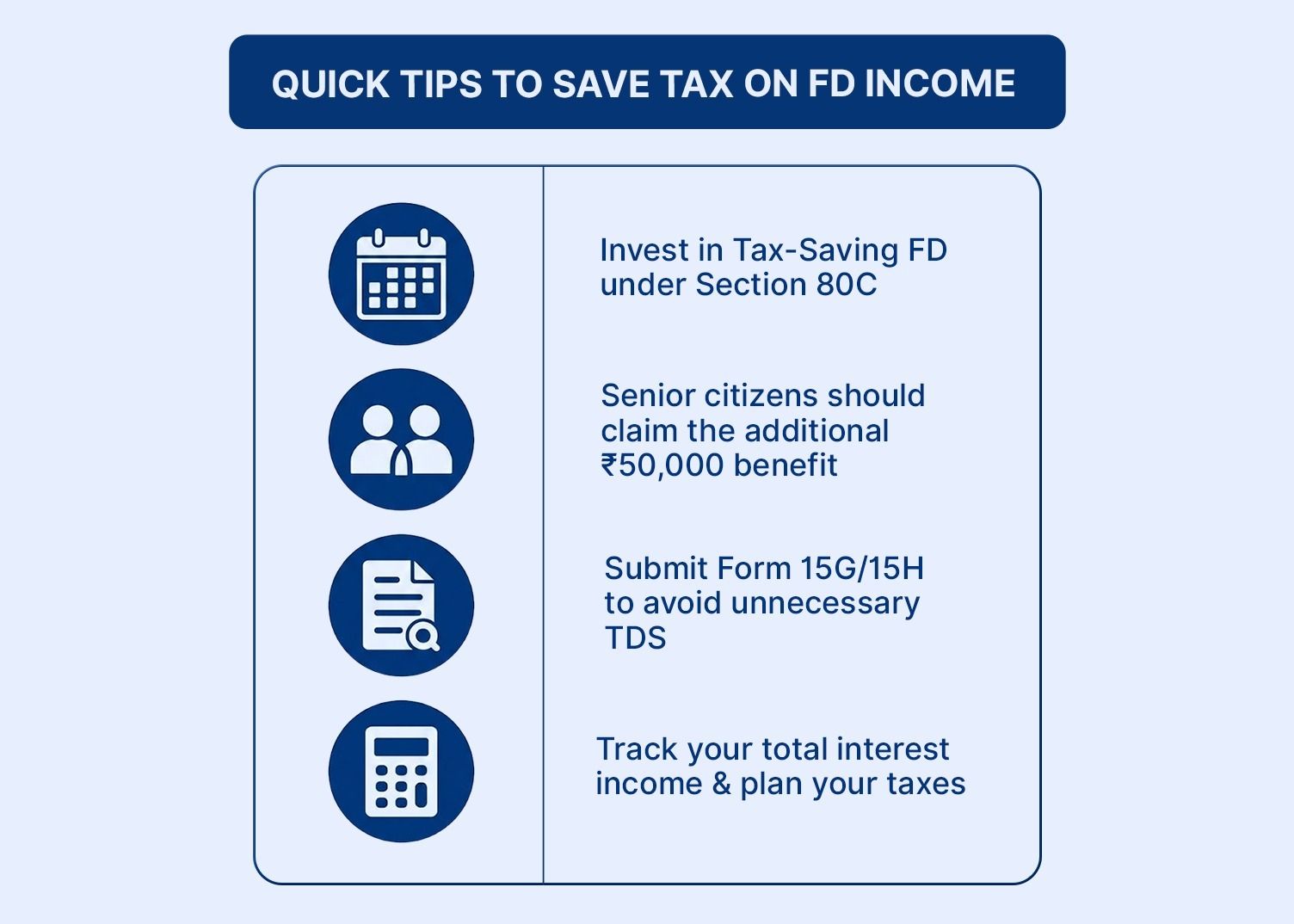
How Is Joint FD Interest Taxed?
Under Indian income tax laws, FD interest is taxable under the head "Income from Other Sources."
The key principle is:
The person who contributes the funds for creating the FD is generally liable to pay tax on the interest earned.
The ownership of the money matters more than the number of names mentioned on the FD account.4
Example 1: Single Contributor
Suppose:The entire
- Raj invests INR 10 lakh in a Joint FD.
- His wife Priya is added as the second holder.
- The FD generates INR 75,000 annual interest.
Even though Priya's name appears on the FD, Raj contributed the entire amount. Therefore:
- Taxable Interest for Raj = INR 75,000
- Taxable Interest for Priya = INR 0
Raj must report the full interest income in his Income Tax Return (ITR).
Example 2: Equal Contribution
Suppose:
- Raj contributes INR 5 lakh.
- Priya contributes INR 5 lakh.
- Total FD amount = INR10 lakh.
- Annual interest earned = INR 80,000.
In this case:
- Raj reports INR 40,000.
- Priya reports INR 40,000.
Since both contributed equally, the interest income is divided proportionately.
Also read on FD Tax Efficiency Comparison
Who Pays Tax On FD Interest?
The Income Tax Department generally follows the concept of beneficial ownership rather than mere account ownership.5
Tax Liability Depends On:
Situation | Tax Liability |
One person contributes entire amount | Entire interest taxable to contributor |
Multiple contributors | Interest taxable according to contribution ratio |
Gifted money used for FD | Clubbing provisions may apply |
Joint holders without contribution | No tax liability on interest
|
Therefore, simply adding someone's name to a Joint FD does not automatically transfer tax liability.
TDS Rules On Joint FD In 2026
Tax Deducted at Source (TDS) remains one of the most misunderstood areas of joint FD taxation.
As per current FD TDS rules:
- Banks deduct TDS when interest crosses the prescribed threshold.
- TDS is generally linked to the PAN of the first holder.
- The first holder receives the TDS credit in Form 26AS and AIS.
Example
Assume:
- Joint FD earns INR 1,20,000 interest.
- Bank deducts TDS of INR 12,000.
- Raj is the first holder.
- Raj and Priya contributed equally.
Actual taxable income:
- Raj = INR 60,000
- Priya = INR 60,000
However, TDS may appear entirely under Raj's PAN.
In such situations, proper disclosure should be made while filing returns so that the income and TDS credit are appropriately adjusted.
Can Form 15G Or Form 15H Be Submitted?
Yes. Eligible investors can submit:
This helps avoid TDS deduction if total taxable income remains below the applicable tax limits.
Joint FD Between Family Members
Joint FDs among family members are extremely common, but they can trigger additional tax considerations.
Husband and Wife Joint FD
If a husband gifts money to his wife and she invests it in a Joint FD, the clubbing provisions under the Income Tax Act may apply.
This means the interest income may still be taxable in the husband's hands, even though the FD includes the wife's name.6
Parent And Child Joint FD
If parents invest their own funds and add a child as a joint holder:
- Parents remain liable for tax.
- Child generally has no tax liability unless they contribute funds.
Senior Citizen and Child Joint FD
Many families add children as joint holders for operational convenience. However, tax treatment still depends on who contributed the funds.
The presence of a child's name alone does not transfer ownership or tax responsibility.
Joint FD vs Individual FD: Tax Difference
Many investors wonder whether opening a Joint FD provides any special tax advantage.
The answer is: Not necessarily.
Individual FD
- Tax liability is straightforward.
- Entire interest belongs to one person.
- Easy reporting in ITR.
Joint FD
- Requires tracking of actual contributions.
- TDS may appear under one PAN.
- Additional documentation may be needed.
- Useful for succession planning and operational convenience.
Quick Comparison:
Feature | Individual FD | Joint FD |
| Ownership | Single | Multiple |
| Tax Reporting | Simple | Contribution-based |
| TDS Credit | Single PAN | Usually first holder PAN |
| Succession Benefits | Limited | Better |
| Documentation | Minimal | Moderate
|
Common Mistakes Investors Make
Many taxpayers unknowingly make errors while reporting FD income.
Mistake 1: Splitting Interest Equally Without Contribution Proof
Tax allocation should be based on actual contribution, not assumptions.
Mistake 2: Ignoring AIS and Form 26AS
The Annual Information Statement (AIS) now captures FD interest details reported by banks.
Mistake 3: Claiming Full TDS Credit Incorrectly
Only eligible holders should claim the relevant TDS credit.
Mistake 4: Forgetting Clubbing Provisions
This is especially common in spouse-related investments.
Avoiding these mistakes can prevent tax notices and compliance issues.
Conclusion
Joint FDs offer convenience and shared ownership, but the tax liability depends on who contributed the funds, not simply whose name appears on the deposit. Understanding contribution-based taxation, TDS rules, and income reporting can help avoid tax-related issues and ensure compliance.
At Grip Investment, we believe informed investing leads to better financial outcomes. Before opening a Joint FD, evaluate both its returns and tax implications to make smarter, more tax-efficient investment decisions.
Grip offers corporate bonds and other fixed-income investment options with yields up to 12.5% and institutional-grade security features. Visit Grip Today!
FAQs On Joint FD Tax
 |
Author: Grip Invest Editorial Team The Grip Invest Editorial Team is a group of Chartered Accountants, MBA (Finance) graduates, and Qualified Research Analysts dedicated to helping you invest smarter. We dive deep into India's fixed income landscape to deliver content that is accurate, up-to-date, and easy to understand. Whether you're exploring bonds, fixed deposits, or other fixed income opportunities, our guides cut through the noise and give you the clarity to make better financial decisions. |
Want to stay at the top of your finances?
Join the community of 4 lakh+ investors and learn more about Grip Invest, the latest financial knick-knacks, and shenanigans in the world of investing.
Happy Investing!
Disclaimer - Investments in debt securities/municipal debt securities/securitised debt instruments are subject to risks including delay and/ or default in payment. Read all the offer related documents carefully. The investor is requested to take into consideration all the risk factors before the commencement of trading.
This communication is prepared by Grip Broking Private Limited (bearing SEBI Registration No. INZ000312836 and NSE ID 90319) and/or its affiliate/ group company(ies) (together referred to as “Grip”) and the contents of this disclaimer are applicable to this document and any and all written or oral communication(s) made by Grip or its directors, employees, associates, representatives and agents. This communication does not constitute advice relating to investing or otherwise dealing in securities and is not an offer or solicitation for the purchase or sale of any securities. Grip does not guarantee or assure any return on investments and accepts no liability for consequences of any actions taken based on the information provided. For more details, please visit www.gripinvest.in
Registered Address - 106, II F, New Asiatic Building, H Block, Connaught Place, New Delhi 110001


