

Macaulay Duration Explained: What It Tells You About Bond Maturity and Risk


When investing in a bond, one of the major concerns of every investor is its maturity and the risk associated with that duration. Knowing such information about a particular bond can help you better choose bonds per your risk appetite. This is exactly what Macaulay duration can help you with.
If you do not know much about it, read on till the end. In this blog, we will cover Macaulay duration meaning, and how it is calculated in detail.
What Is Macaulay Duration?
Macaulay duration tells you how long it takes to recover your bond investment, based on when you receive its cash flows. Basically, it shows the average time until your bond pays you back, accounting for both interest payments and principal.
Each cash flow is given a weight based on its present value, not just its timing. Cash flows you receive earlier matter more than those received later. These weights are calculated by comparing the present value of each payment to the bond’s current price.
You will often see Macaulay duration used by portfolio managers who follow an immunization strategy. This means they structure bond portfolios to reduce the impact of interest rate changes on returns.
How Macaulay Duration Is Calculated?
Macaulay duration helps you understand how long it actually takes for a bond to return your invested money. Instead of focusing only on the maturity date, you look at the timing and value of every cash flow the bond pays you. This includes regular interest payments and the final principal amount. The idea is simple. Money received sooner has more value than money received later.
To capture this idea, Macaulay duration uses a formula that combines time, cash flows, and present value.
Formula to Calculate Macaulay Duration
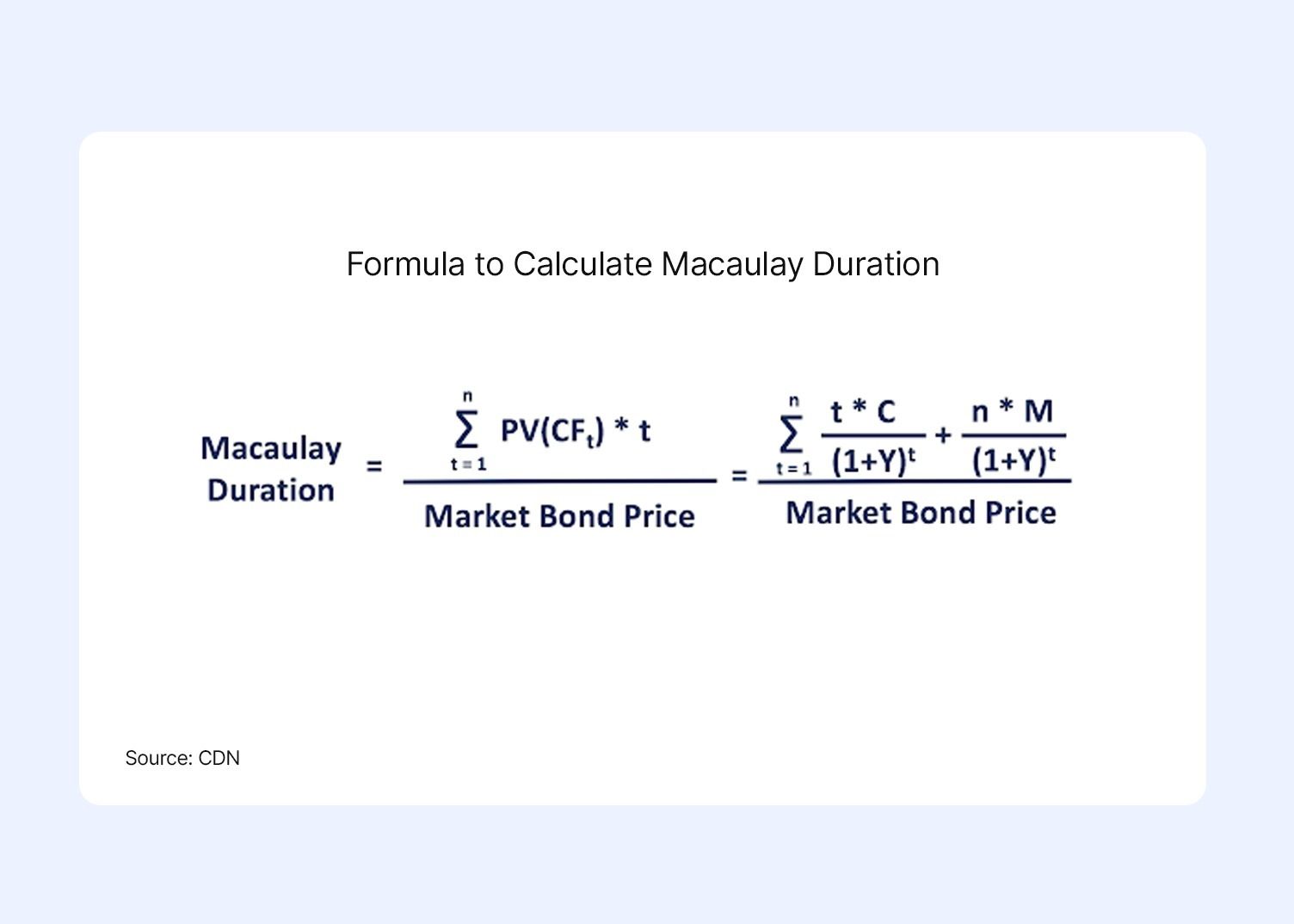
Here:
- PV(CFt) is the present value of the cash flow received in period t. This is usually the coupon payment, adjusted for today’s value.
- t is the time period when the cash flow is received.
- C is the periodic coupon payment paid by the bond.
- n is the total number of periods until maturity.
- M is the value received at maturity, usually the face value.
- Y is the periodic yield used to discount future cash flows.
Example of Calculating Macaulay Duration
Suppose you invest in a three-year bond with a face value of INR 1,000. The bond pays INR 100 as interest every year and offers a yield of 10 percent. You buy the bond at INR 1,000.
You receive INR 100 at the end of the first year, another INR 100 at the end of the second year, and INR 1,100 at the end of the third year, which includes the final interest payment and the principal.
Each of these amounts is discounted to its present value using the 10 percent yield. You then multiply each present value by the year in which it is received. When you add these values and divide the total by INR 1,000, you get the Macaulay duration.
The result is lower than three years because part of your investment is recovered earlier through interest payments. This number tells you, in practical terms, how long your money stays invested in the bond and how sensitive it is to changes in interest rates.
Macaulay Duration Vs Bond Maturity
Macaulay duration and bond maturity may sound similar, but they tell you different things about a bond. Here is a clear comparison between the two:
| Basis | Macaulay Duration | Bond Maturity |
| Meaning | Shows the average time it takes to get your investment back | Shows the date when the bond expires |
| What it considers | Timing and value of all cash flows | Only the final repayment date |
| Measured in | Years | Years |
| Effect of coupons | Shortens the duration if coupons are paid earlier | Does not change maturity |
| Sensitivity to interest rates | Higher duration means higher interest rate risk | Maturity alone does not show risk clearly |
| Practical use | Used to assess interest rate risk and portfolio management | Used to know how long the bond runs |
What Macaulay Duration Reveals About A Bond?
Macaulay duration helps you look beyond the bond’s maturity date. It shows how the timing of cash flows affects both risk and price sensitivity.
Here’s what Macaulay duration tells you:
- How long does it take, on average, to recover your invested money
- How sensitive is the bond to changes in interest rates
- Whether the bond carries a higher or lower interest rate risk
- How early coupon payments reduce overall risk
- How suitable is the bond for long-term or short-term investment goals
How Can Two Bonds With the Same Maturity Have Different Durations?
Two bonds can mature on exactly the same date but return cash to investors at different times. This results in different durations.
Coupon rate is one of the main reasons. A higher-coupon bond returns more money before maturity, while a lower-coupon bond places greater weight on the final principal repayment.
Consider two illustrative bonds:
Particulars | Bond A |
Face value | INR 1,000 |
Remaining maturity | 5 years |
Coupon rate | 6% |
Coupon frequency | Half-yearly |
YTM | 8% |
Approximate market price | INR 918.89 |
Macaulay duration | 4.36 years |
Modified duration | 4.19 |
Illustrative calculations based on standard Macaulay and modified duration formulas.
Both bonds mature after five years. However, Bond A has a longer duration because its lower coupon returns less money during the investment period.
Bond B pays a higher coupon. A greater share of its value reaches the investor earlier, reducing its weighted average payback time.
When the bond term remains the same, a higher coupon rate generally results in a shorter duration.
Apart from coupon rates, bonds with the same maturity may have different durations for the following reasons:
1. Different YTMs
A higher YTM reduces the present value assigned to distant cash flows. Duration therefore generally falls when YTM rises, assuming other factors remain unchanged.
2. Different Coupon Payment Frequencies
A bond paying coupons half-yearly returns cash earlier than a comparable bond paying annually. More frequent coupon payments may therefore result in a slightly shorter duration.
3. Different Principal Repayment Structures
A bullet bond repays the entire principal at maturity. An amortising bond returns portions of the principal during its tenure, which generally reduces duration.
4. Call and Put Options
Indian bonds may contain call or put options. A call option allows the issuer to redeem the bond early, while a put option allows the investor to seek repayment before maturity.
These features can change the expected timing of cash flows. Therefore, simple Macaulay or modified duration figures may not fully reflect the interest-rate sensitivity of bonds with embedded options.
How Investors Use Macaulay Duration In Practice
Macaulay duration is mainly used to decide where and how to invest in bonds based on interest rate risk and holding period. It helps you compare options and choose instruments that match your investment timeline.
- Debt funds
In debt mutual funds, Macaulay duration shows how sensitive the fund is to interest rate movements. A higher duration means the fund’s value can change more when rates move. A lower duration suggests more stability.
- Long-term vs short-term bonds
Long-term bonds usually have a higher Macaulay duration, which means higher interest rate risk. Short-term bonds have a lower duration, so they are less affected by rate changes. You can use this to choose bonds that fit your time horizon and risk comfort.
Modified Duration Vs Macaulay Duration: Key Differences
The table below compares Modified duration vs Macaulay duration in detail based on different key parameters.
| Particulars | Macaulay duration | Modified duration |
| Meaning | Weighted average time to generate cashflows (Principal+Interest) from bond investment | Percentage change in price due to 1% change in the yield of bonds |
| Formula | ?(Time×PV of Cashflow)?/Bond Price | Macaulay / (1 + Yield) |
| Interpretation | A 6-year Macaulay duration means that it will take a particular bond investment 6 years to recover the principal and coupon (interest) | If the Modified duration is 6, a 1% yield increase will trigger 6% decrease in market price. Similarly, a 1% yield decrease can trigger a 6% increase in market price |
| Primary Use | Portfolio matching and immunisation to guarantee specific future cash needs | Ascertain individual bond risk by analysing their market price sensitivity to interest rate fluctuation |
A nuanced understanding of Modified duration vs Macaulay duration is incomplete without exploring the wider concept of how duration reflects interest rate risk. Although the meaning and interpretation of each metric is covered before, an overall interest rate impact with respect to duration must be understood for effective analysis.
Modified Duration Formula
The modified duration formula can be stated as Macaulay Duration divided by (1 + yield per period). Macaulay duration gives a weighted average of when you will receive payments from the bond. The yield per period is the total yield divided by the number of payments you receive each year.
This modification makes it easy to estimate how much the bond price will fall as a result of a change in interest rates.
For instance, if you had a 5-year bond with a 5% yield, then the Macaulay Duration would be 4.5 years, and the Modified Duration would be approximately 4.3 years. Similarly, if the interest rate were to increase by 1%, then the bond would decrease in value by 4.3%.
Bond Price Impact
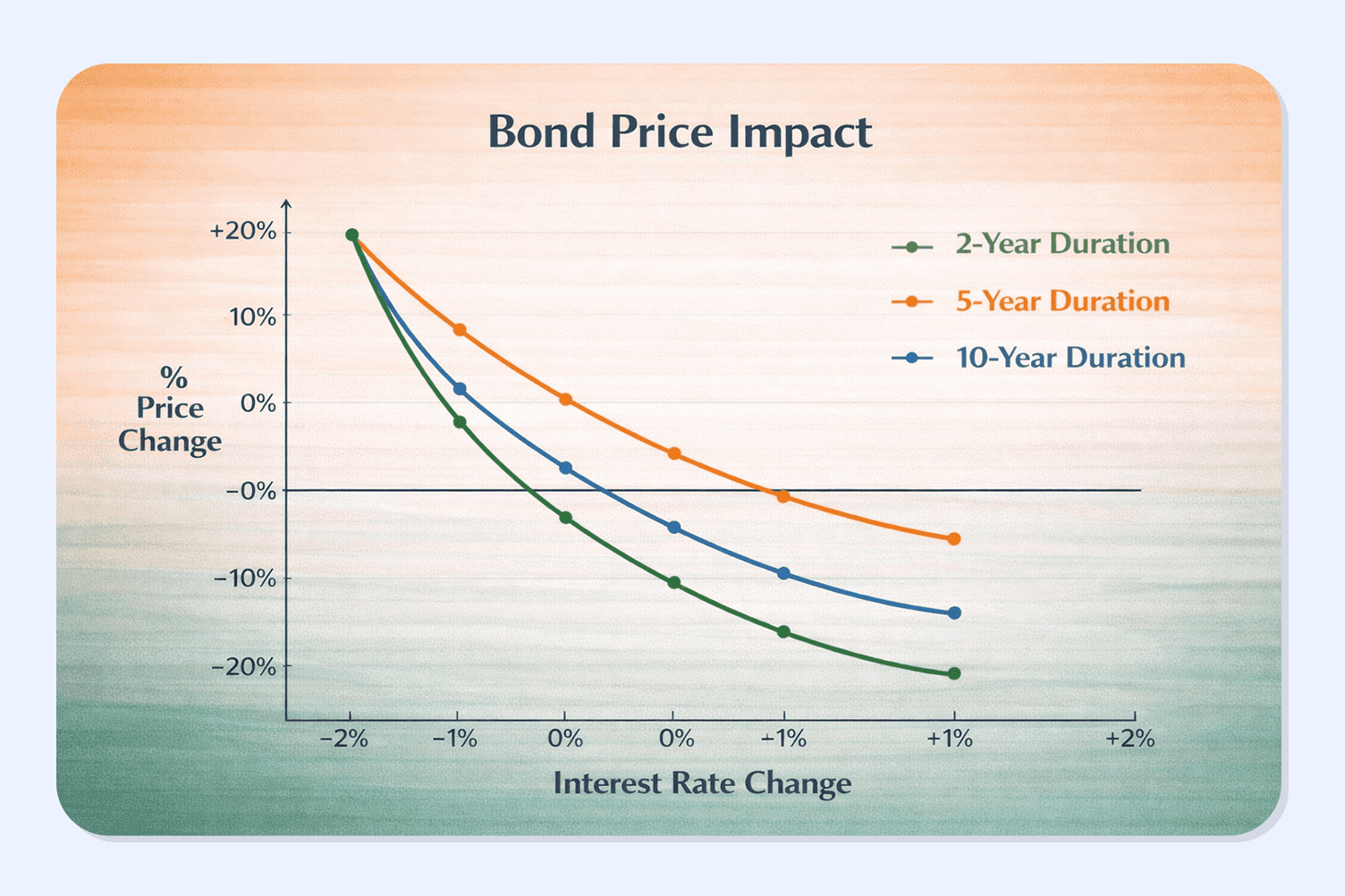
Knowing that the bond price and the bond price sensitivity, modified duration are inversely proportional to interest rate fluctuations. It will assist in making decisions when constructing your portfolio. By matching your views on interest rates to the Bond Price Sensitivity, you will be creating the possibility of achieving your investment goals.
1. Rate Rise Effect
If you owned a bond with a Modified Duration of 5, your bond would decline in value by 5% as a result of a 1% increase in the interest rate.
2. Rate Drop Benefit
If you owned the same bond as before, after an interest rate decrease of 1%, your bond would increase in value by 5%.
3. Convexity Role
Duration assumes straight-line change, but convexity adds a curve. It refines estimates for big shifts. Example: Actual drop is less than predicted for sharp rises.
How Duration Reflects Interest Rate Risk
Let us take an imaginary situation to illustrate how duration reflects interest rate risk. The graph below illustrates the price response of a short-duration bond and a long-duration bond.
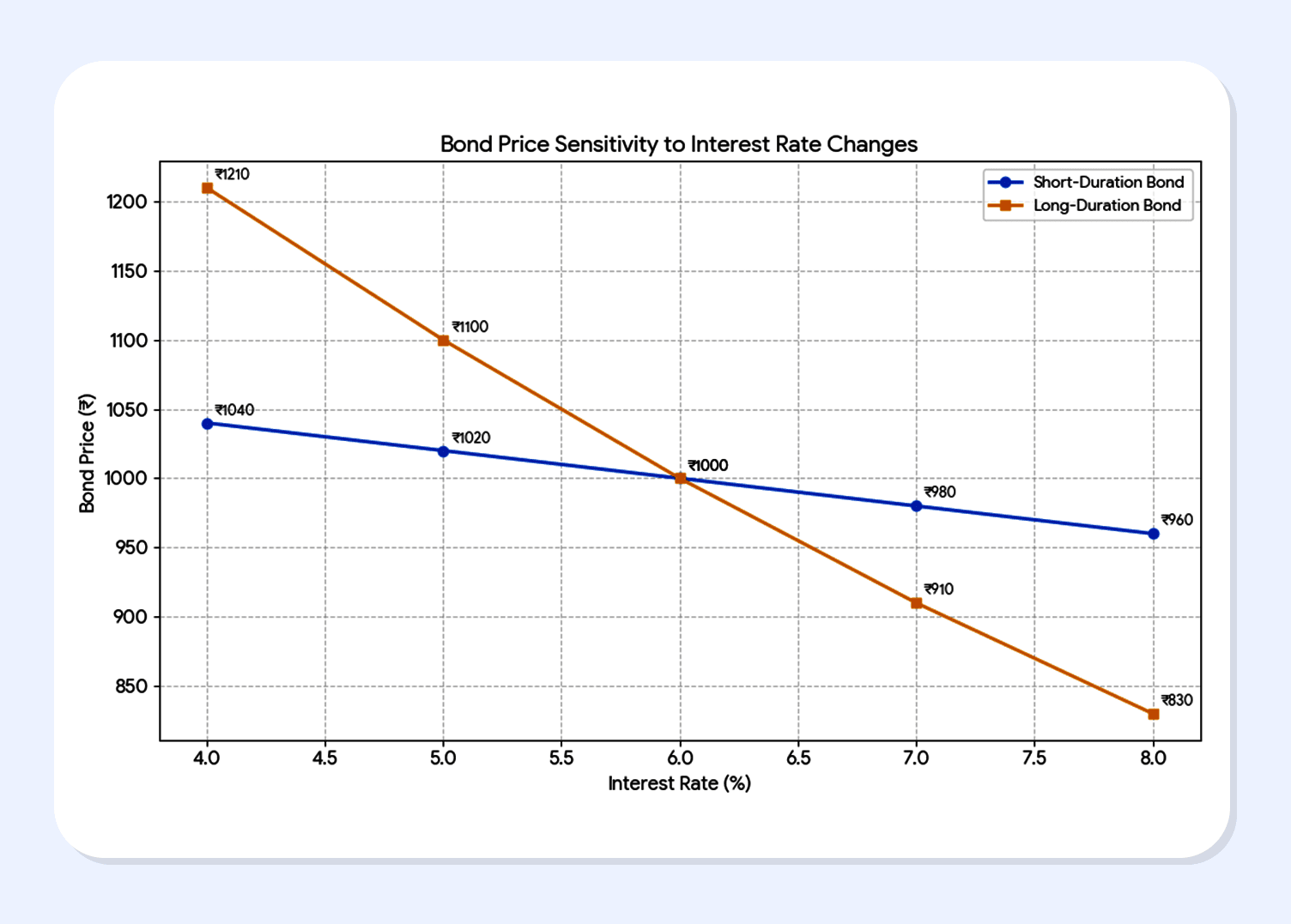
As the interest rate increases from 4% to 8%, the price of both bonds falls, indicating an inverse relationship between bond price and interest rate. However, the decline is sharper for the long-duration bond, indicating that for the same interest-rate movement, a change in long-duration bond price is greater than the change in short-duration bond price.
For example, when interest increased from 5% to 6%, the short-duration bond price fell by INR 20, but the long-duration bond price fell by INR 100.
Therefore, the steeper slope indicates a greater price sensitivity. Thus, in this case, duration reflects interest rate risk through the steepness of the price-yield line. Since duration measures how strongly the bond price reacts to interest rate movements, a flatter line (low duration) indicates lower interest-rate risk and a steeper line (higher duration) indicates greater interest-rate risk.
Given this understanding of the duration vs yield concepts, retail investors must explore their practical implementation for optimal bond market investing.
Conclusion
To conclude, Macaulay duration is one of the most crucial tools for an investor. It can help you determine the risks and set your expectations from a particular avenue appropriately.
However, there is yet another factor that plays a crucial role when investing: choosing a credible investment platform. This is exactly where signing up with Grip Invest can come in handy. It is an intuitive investment platform that facilitates you with alternative investment avenues like bonds and SDIs. Moreover, with Grip, you can start investing at INR 1000 only.
FAQs
1. What is the Macaulay duration in bonds?
Macaulay duration tells you the average time it takes for a bond to return your invested money, based on the timing and present value of all its cash flows.
2. Is Macaulay duration the same as maturity?
No. Maturity shows when the bond ends, while Macaulay duration shows when you recover your money on average, considering all interest payments and the final principal.
3. Why is Macaulay duration important?
Macaulay duration is important because it helps you understand a bond’s interest rate risk and how sensitive its price is to rate changes, not just its maturity.
References:
1. CDN, accessed from: https://cdn.corporatefinanceinstitute.com/assets/macaulay-duration.png
Want to stay at the top of your finances?
Join the community of 4 lakh+ investors and learn more about Grip Invest, the latest financial knick-knacks, and shenanigans in the world of investing.
Happy Investing!
Disclaimer - Investments in debt securities/municipal debt securities/securitised debt instruments are subject to risks including delay and/ or default in payment. Read all the offer related documents carefully. The investor is requested to take into consideration all the risk factors before the commencement of trading.
This communication is prepared by Grip Broking Private Limited (bearing SEBI Registration No. INZ000312836 and NSE ID 90319) and/or its affiliate/ group company(ies) (together referred to as “Grip”) and the contents of this disclaimer are applicable to this document and any and all written or oral communication(s) made by Grip or its directors, employees, associates, representatives and agents. This communication does not constitute advice relating to investing or otherwise dealing in securities and is not an offer or solicitation for the purchase or sale of any securities. Grip does not guarantee or assure any return on investments and accepts no liability for consequences of any actions taken based on the information provided. For more details, please visit www.gripinvest.in
Registered Address - 106, II F, New Asiatic Building, H Block, Connaught Place, New Delhi 110001


