

Multi-Asset Allocation Fund: The All-Weather Investment Strategy


Every investment advisor will suggest investments based on your risk appetite and the long-term goals for which you are saving. Mutual funds have come along as an excellent investment alternative for financial milestones as well as for wealth building.
If you are looking to strike a balance between risk and return, one of the best investment strategies is to invest in multi-asset allocation funds. These funds not only help in earning high returns but also limit the overall risk assumed by an investor for diversification purposes.
Let us find out more about multi-asset allocation funds, how these work, and what the alternatives are if you wish to earn a higher bit of return with limited risk.
What Is A Multi-Asset Allocation Fund ?
A multi asset allocation mutual fund NAV represents a scheme that invests across types of hybrid mutual funds, including equity, debt and precious metals (such as gold and silver). These are different from the conventional balanced mutual funds India, which focus primarily on equity and debt instruments. The purpose of these funds is to reduce risk and enhance performance and is preferred by investors seeking a bit of higher return without taking too much risk.
How It Differs From Hybrid Funds
You might think that a hybrid structure makes a multi-asset allocation fund similar to a hybrid fund. While the types of hybrid mutual funds (such as aggressive hybrid or balanced advantage fund) combine different asset classes such as debt and equity, these funds have an additional layer protection in the form of gold or silver which not only acts as a hedge but can be a critical factor to enhance total returns, especially in circumstances that we are witnessing right now (both gold and silver are at all time high).
Why SEBI Mandates At Least 3 Asset Classes
The hybrid structure ensures that the fund can attain high growth (with equity), stability (with debt), and protects against inflation and volatility (with gold and silver). As per SEBI’s guidelines, every multi-asset fund must allocate a minimum of 10% to each asset class at all times.
How Multi-Asset Funds Work
Typical Asset Mix (Equity, Debt, Gold, etc.)
A typical allocation involves equity (40-60% of the fund), debt (20-40% of the fund) and remaining gold or any other commodity (10-20% of the fund) for inflation protection and hedging. Due to this structured fund allocation, the fund achieves multiple objectives, and the fund performs well across different market conditions.
Automatic Rebalancing and Diversification Benefits
The funds often follow a dynamic asset allocation funds approach. Hence, these are rebalanced periodically to ensure ideal proportions, maintaining the balance between risk and return. Based on the market signals and conditions, the fund manager shifts allocations between equity, debt, and gold. This multi asset fund diversification strategy helps investors to attain long-term goals, and any emotional or erratic decisions (to invest or withdraw) could be avoided.
How These Funds Perform Across Market Cycles
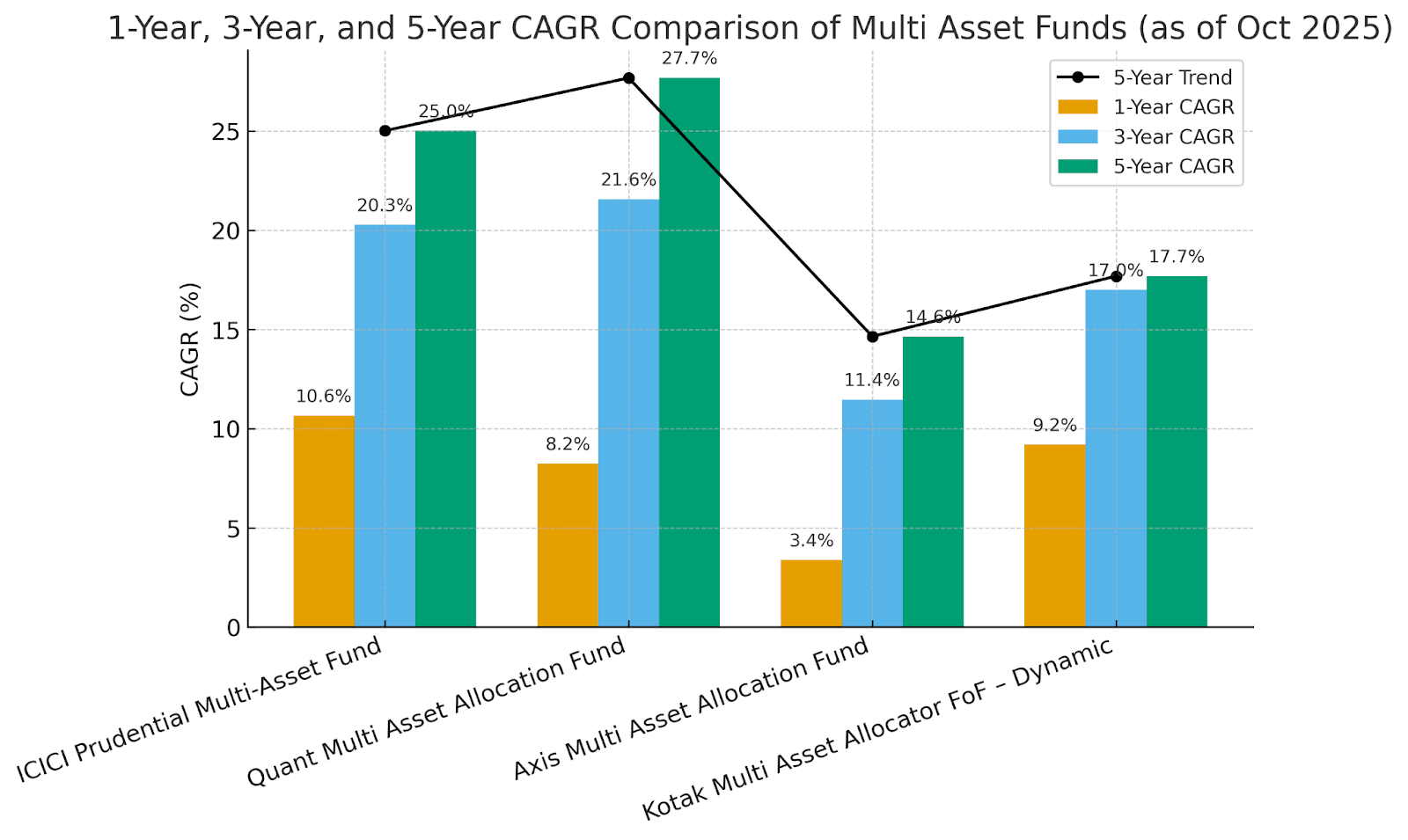
Each asset class performs differently across market cycles. When equity faces headwinds, debt provides stability, and gold often rallies during uncertainty. This multi-layered performance buffer results in smoother returns and controlled downside risk. We have chosen four popular multi-asset funds and evaluated the performance (yearly, 3-year and 5-year CAGR):
Pros And Cons Of Multi-Asset Allocation Funds
Key Benefits Of Multi-Asset Allocation Funds
1. Diversification Across Multiple Asset Classes:
Multi-asset allocation funds invest across at least three distinct asset classes — primarily equity, debt, and commodities like gold or silver — as mandated by SEBI. This broad exposure reduces concentration risk significantly, protecting your portfolio from the adverse impact of a downturn in any single asset class. Diversification is a proven strategy to enhance portfolio resilience over market cycles.
2. Reduced Volatility Through Balanced Asset Mix:
By blending growth-oriented equities with the stability of debt and the inflation hedge provided by gold, these funds naturally smooth out the portfolio’s overall volatility. When equities face headwinds, debt instruments and commodities often perform better, cushioning the impact and minimizing drawdowns, which is crucial for risk-averse or moderate investors.
3. Professional and Dynamic Rebalancing:
Fund managers actively monitor market conditions and economic indicators to adjust the asset allocation, maintaining the ideal balance between risk and return. This dynamic rebalancing ensures that your investment stays aligned with its objectives and adapts to changing market trends, removing the need for investor intervention and reducing emotional decision-making.
4. Enhanced Risk-Adjusted Returns:
Through effective diversification and tactical asset shifts based on valuations and market cycles, multi-asset funds target superior risk-adjusted returns. These funds typically deliver more consistent performance over time compared to pure equity funds, making them an ideal core component for investors seeking balanced growth alongside capital preservation.
Limitations: Expense Ratio, Taxation Differences
While multi-asset allocation funds offer significant diversification and risk mitigation benefits, investors should be aware of a few important limitations to make informed decisions:
1. Expense Ratio:
Due to active management and the complexity of balancing multiple asset classes like equity, debt, and commodities, multi-asset funds generally have higher expense ratios compared to pure equity or debt funds. In 2026, top multi-asset funds in India typically charge between 0.5% to 1.5%, reflecting costs for professional rebalancing and research-driven asset allocation. Investors should weigh these costs against the fund’s risk-adjusted return potential.?
2. Taxation Differences:
Tax treatment depends on the equity exposure in the fund. If equity allocation is below 65%, capital gains are taxed as debt funds: short-term gains added to income tax slab; long-term gains taxed at 20% with indexation. When equity exposure exceeds 65%, gains are taxed as equity funds at 10% LTCG exceeding INR 1 lakh annually, which is more favorable. Understanding this distinction is critical for tax-efficient investing.?
3. Overlap Risks:
Investors holding multiple multi-asset funds—or supplementing them with standalone equity or debt funds—may face portfolio overlap, where the same underlying stocks or bonds appear in different funds. This reduces diversification benefits and may unnecessarily concentrate risk. It is advisable to analyze fund portfolios and consult advisors to minimize duplication.
Despite these considerations, the benefits of multi-asset allocation funds — diversified exposure, professional management, and reduced volatility — often outweigh the drawbacks, especially for moderately conservative investors seeking steady, long-term growth.
Who Should Invest In Multi Asset Allocation Funds?
Investors seeking moderate returns while not taking too much risk should consider investing in these funds.
Ideal for Moderate-Risk Investors
Multi-asset funds are best suited for investors with a moderate risk appetite who want balanced growth and limited volatility.
Suitable Investment Horizon and Goals
A multi-asset fund investment horizon of three to five years is ideal. The approach suits long-term financial goals like children’s education, retirement planning, or wealth preservation.
Alternatives To Explore
Fixed-Income Opportunities Through Bonds
If you are someone who does not want to take too much risk and is happy with a moderate return while easily beating market volatility, one of the approaches will be to invest in bonds or fixed-income securities. These investments offer predictable returns and low correlation with equity markets, helping stabilize long-term returns.
Corporate Bonds as a Diversification Layer
Fixed income securities such as high–quality corporate bonds can offer predictable cash flows with relatively lower volatility. Many curated platforms like Grip Invest facilitate access to bonds that yield in the range of 9–12%— making them suitable for investors with a lower risk appetite or defined financial goals.
When paired with multi-asset or equity-oriented funds, corporate bonds can help build a more resilient portfolio — one that combines steady income with the potential for long-term capital appreciation. This blend reduces reliance on a single asset class and creates an “all-weather” investing approach.
Conclusion
The multi-asset fund option provides you with an excellent yet simple tool to balance growth and protection. It can be easily included in your portfolio and helps in attaining long-term financial goals. Whether you’re new to investing or refining your financial strategy, multi-asset funds can form the backbone of your portfolio. And when combined with Grip Invest’s fixed-income opportunities, you gain the perfect mix of stability, liquidity, and growth.
FAQs On Multi Asset Allocation Funds
1. Are multi asset allocation funds good for beginners?
Yes. They offer automatic diversification across equity, debt, and gold, making them a simple and balanced entry point for new investors.
2. How are these funds taxed in India?
If the equity exposure is 65% or more, they’re taxed like equity funds, 10% on long-term gains (after one year) and 15% on short-term gains. Otherwise, they follow debt-fund tax rules.
3. What’s the minimum investment period?
Ideally, investors should stay invested for three to five years to ride out market cycles and benefit from compounding.
4. How are they different from balanced advantage funds?
Balanced advantage funds dynamically adjust equity-debt ratios within two asset classes, while multi-asset funds invest in three or more (usually equity, debt, and gold) for broader diversification.
Want to stay at the top of your finances?
Join the community of 4 lakh+ investors and learn more about Grip Invest, the latest financial knick-knacks, and shenanigans in the world of investing.
Happy Investing!
Disclaimer - Investments in debt securities/municipal debt securities/securitised debt instruments are subject to risks, including delay and/ or default in payment. Read all the offer-related documents carefully. The investor is requested to take into consideration all the risk factors before the commencement of trading.
This communication is prepared by Grip Broking Private Limited (bearing SEBI Registration No. INZ000312836 and NSE ID 90319) and/or its affiliate/ group company(ies) (together referred to as “Grip”) and the contents of this disclaimer are applicable to this document and any and all written or oral communication(s) made by Grip or its directors, employees, associates, representatives and agents. This communication does not constitute advice relating to investing or otherwise dealing in securities and is not an offer or solicitation for the purchase or sale of any securities. Grip does not guarantee or assure any return on investments and accepts no liability for the consequences of any actions taken based on the information provided. For more details, please visit www.gripinvest.in
Registered Address - 106, II F, New Asiatic Building, H Block, Connaught Place, New Delhi 110001


