

SEBI's New Mutual Fund Only-PMS Proposal: What Investors Need To Know


As part of its ongoing efforts to democratize investment in the stock market, the securities regulator has proposed major changes to PMS (Portfolio Management Services), with lower minimum investment requirements and simplified rules.
The proposals in the SEBI Consultation Paper (23rd July, 2026) also aim to introduce a new PMS category that will sit between the existing options.
Under the proposed Mutual Fund Only-PMS, investors will have the option to access professionally managed portfolios comprising mutual fund products with a lower minimum investment threshold of INR 25 lakh.
This will have a major impact on investors who currently have investable surpluses but fail to meet the eligibility criteria as per the conventional PMS.
SEBI Proposes Mutual Fund Only PMS: The Big Announcement
One of the biggest announcements made through the consultation paper is the proposal to review the Portfolio Managers Regulations, 2020. The paper talks about the introduction of Mutual Fund Only-PMS, which will be designed to manage portfolios comprising mutual fund products only.
As per the proposed framework, portfolio managers can invest clients’ money into direct plans of mutual fund schemes, including Exchange-Traded Funds (ETFs) and Specialized Investment Funds (SIFs). The minimum investment would be INR 25 lakh, half the INR 50 lakh threshold applicable to traditional PMS.
The regulator has sought comments from stakeholders on the proposal before finalizing any changes to the existing regulatory framework.
Why Is SEBI Introducing This New PMS Category?
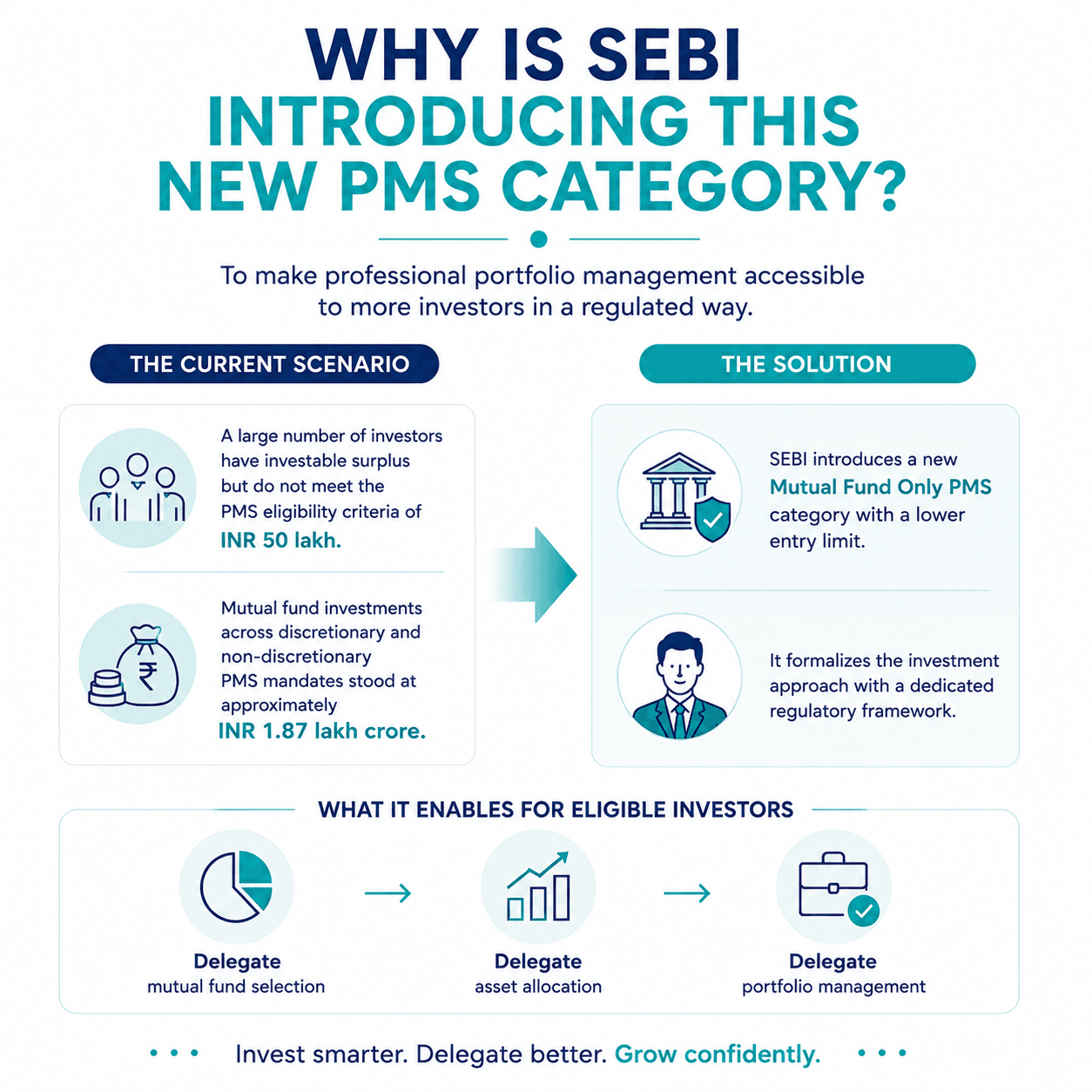
One of the biggest reasons for introducing this new category is the presence of a large number of investors who have investable surplus but do not meet the eligibility criteria of INR 50 lakh. As per a SEBI update, mutual fund investments across discretionary and non-discretionary PMS mandates stood at approximately INR 1.87 lakh crore.
With the introduction of a new mutual fund-only category with a lower entry limit, SEBI aims to formalize the investment approach with a dedicated regulatory framework allowing eligible investors to delegate mutual fund selection, asset allocation and portfolio management to a professional manager instead of independently selecting and monitoring multiple schemes.
Mutual Fund Only PMS vs Traditional PMS
The most critical difference lies in the securities in which a portfolio manager can invest clients’ money. The proposed MF-PMS will operate in a narrower investment universe, centred on mutual funds only.
The table below highlights the key differences between the two PMS categories:
Parameter | Mutual Fund Only PMS (Proposed) | Traditional PMS |
Minimum investment | INR 25 lakh | INR 50 lakh |
Investment universe | Direct plans of mutual funds, ETFs and SIFs | Equities, debt securities, mutual funds and other permitted securities |
Portfolio management | Professional management of mutual fund allocation | Professional management across permitted securities |
Direct stock selection | No | Yes, depending on the strategy |
Entry threshold | Lower | Higher |
Consider an investor with an investable surplus of INR 40 lakh. As per the conventional PMS regulations, the INR 50 lakh threshold is not met, but if the proposed framework is implemented, it opens investment avenues for the investors and many others, becoming eligible for MF-PMS while retaining exposure through professionally managed mutual fund products.
Mutual Fund Only PMS vs Regular Mutual Funds
Conceptually, the investment flows from the clients to mutual funds. Both options provide exposure to mutual fund schemes. If an investor with surplus funds has the skills and knowledge to invest in mutual funds directly, they can select schemes and finalize the investments.
On the other hand, with MF-only PMS, the investment decision will be delegated to a professional portfolio manager who will charge a management and performance fee, as per the regulations.
Here are the differences between the two concepts:
Parameter | Mutual Fund Only PMS (Proposed) | Regular Mutual Funds |
Minimum investment | INR 25 lakh | Varies by scheme; generally much lower |
Scheme selection | Managed by portfolio manager | Chosen by investor/advisor |
Asset allocation | Professionally managed | Determined by investor/advisor |
Portfolio customisation | Can be managed according to the PMS mandate | Investor chooses individual schemes |
Underlying plans | Direct plans only | Direct or regular plans |
Additional PMS fee | Yes | No PMS management fee |
Reporting | Consolidated PMS-level reporting | Scheme/account-level statements |
Under the proposed framework, MF-PMS providers may charge a fixed management fee of up to 2.5% of assets under management (AUM). Alternatively, they may offer a performance-linked fee model or a hybrid structure combining fixed and performance-based fees, subject to the investor’s explicit consent.
Advantages And Limitations Of Mutual Fund Only PMS
Mutual Fund Only PMS opens avenues for portfolio management by professional fund managers and gives an excellent opportunity for investors who are not currently within the eligible criteria to have their mutual fund portfolios managed by people with the skills and expertise in the stock market.
However, it is equally important to weigh both the pros and cons of the new proposal:
Potential Advantages | Potential Limitations |
Professional fund selection and asset allocation | Minimum investment of INR 25 lakh |
Portfolio monitoring and rebalancing handled by a professional manager | Additional PMS-level fees over underlying fund expenses |
Investments restricted to direct plans, avoiding distributor commissions | No direct investment in individual stocks or other securities |
Lower entry threshold than traditional PMS | Professional management does not guarantee better returns |
Consolidated management of multiple mutual fund exposures | Value depends on the manager’s ability to justify the additional cost |
What Could This Mean for India’s Asset Management Industry?
Since the regulator has asked for stakeholders’ comments on the proposal, it implies that, if introduced, this could create a new distinct segment between existing self-managed mutual fund portfolios and traditional PMS. Portfolio managers and asset management businesses might need to develop specialized strategies to manage funds of investors requiring professional oversight without direct security selection.
The overall competitiveness of portfolio managers, investment advisors, and wealth management platforms is also expected to rise as the number of eligible investors will increase. However, the exact impact can be calculated only after the final regulations are notified, along with fees and whether the investors perceive sufficient value in paying an additional layer of fees for professional mutual fund portfolio management.
FAQs On SEBI Proposes Mutual Fund
 |
Author: Grip Invest Editorial Team The Grip Invest Editorial Team is a group of Chartered Accountants, MBA (Finance) graduates, and Qualified Research Analysts dedicated to helping you invest smarter. We dive deep into India's fixed income landscape to deliver content that is accurate, up-to-date, and easy to understand. Whether you're exploring bonds, fixed deposits, or other fixed income opportunities, our guides cut through the noise and give you the clarity to make better financial decisions. |
Want to stay at the top of your finances?
Join the community of 4 lakh+ investors and learn more about Grip Invest, the latest financial knick-knacks, and shenanigans in the world of investing.
Happy Investing!
Disclaimer - Investments in debt securities/municipal debt securities/securitised debt instruments are subject to risks including delay and/ or default in payment. Read all the offer related documents carefully. The investor is requested to take into consideration all the risk factors before the commencement of trading.
This communication is prepared by Grip Broking Private Limited (bearing SEBI Registration No. INZ000312836 and NSE ID 90319) and/or its affiliate/ group company(ies) (together referred to as “Grip”) and the contents of this disclaimer are applicable to this document and any and all written or oral communication(s) made by Grip or its directors, employees, associates, representatives and agents. This communication does not constitute advice relating to investing or otherwise dealing in securities and is not an offer or solicitation for the purchase or sale of any securities. Grip does not guarantee or assure any return on investments and accepts no liability for consequences of any actions taken based on the information provided. For more details, please visit www.gripinvest.in
Registered Address - 106, II F, New Asiatic Building, H Block, Connaught Place, New Delhi 110001


