

Nifty 500 Index In 2026: Composition, Performance And How To Invest In It


The Indian stock exchange provides several opportunities for individuals to invest, and among these, the broad market index, the Nifty 500 Index, is the largest representation of the investment market.
This index covers a large portion of the Indian Stock Exchange and offers exposure to different companies based on their size as well as their business industry.
This index has recently been popularised by many investors as a way of diversifying their portfolio beyond simply investing in large-cap companies. Now let's look at some of the features of the Nifty 500 Index composition and how to invest in it.
What Is The Nifty 500 Index?
The Nifty 500 Index is a broad market index representing 500 listed companies on the NSE (National Stock Exchange). It makes up a large proportion of the overall capitalisation of the Indian stock market. The Nifty 500 Index covers the entire cap stocks and has mid and small cap stocks, making this a truly representative index of the complete Indian economy.
More so, as opposed to short indices such as a few selected stock indices that are mirroring only fully established (blue chip stocks), this index includes many emerging companies as well as some emerging market leaders.
Thus, many investors use this index as their representation of the entire Indian government investing in public equity. Also, the NSE Nifty 500 Index's composition includes companies listed in many different sectors, providing long-term investors with diversification benefits.
How Nifty 500 Stocks Are Selected?
There are specific guidelines to select the stocks for the Nifty 500. This includes
- Minimum levels of market cap, liquidity, and trading frequency.
- Eligible stocks generally are in the top 800 by average daily turnover and market cap over the last six months.
- They must also have traded on at least 90% of those days.
- Although the top 350 companies by full market cap are normally given automatic eligibility for inclusion on Nifty 500.
- All eligible companies will be included based on their liquidity.
The eligibility process ensures that only liquid and material companies are included in the index, with regular reviews of the index composition. This ensures that it reflects current market conditions. For example, a firm in the automotive ancillary industry may grow its market cap and trading volume, and so it meets the minimum liquidity requirements and is therefore part of the Nifty 500 during the next rebalancing. This can lead to higher visibility to other investors.
Nifty 500 Sectoral Weightage
The financial services sector usually has the highest weighting in the index, followed by other key sectors, and this distribution reflects the overall structure of the Indian economy.
Nifty 500 vs Nifty 50 vs Nifty Midcap 150: How They Relate?
The indices serve various functions as follows;
- Nifty 50 is based on 50 of India’s largest companies and provides representation of stability and blue-chip-like returns.
- Nifty Midcap 150 is used to measure the medium-sized or mid-sized companies and demonstrates growth potential, but they are much more volatile.
As mentioned above, Nifty 500 is a broad index that covers large-cap, mid-cap and small-cap type companies.
In the case of the Nifty 500 Index, it consists of the Nifty 50 plus numerous companies from the mid-cap and small-cap indices. Thus, this index can provide more exposure potential over a longer term than does Nifty 50. It also presents a moderate additional risk compared to the Nifty 50, as it has a larger representation of all the different cap segments combined. This type of relationship provides portfolio builders with another opportunity. Nifty 50 could be used for core allocation to achieve stability, and Nifty 500 could be used for broader exposure.
Historical Performance Of Nifty 500 Over 5 And 10 Years
The historical returns of Nifty 500 have been attractive when considered over extended periods of time. Over the last 5 years, it has achieved strong compound capital growth in the range of 12%-15% per year.
On the other hand, Nifty 500’s returns have been even more pronounced and demonstrated the rate of growth of the Indian economy as shown over the previous 10-year period. Additionally, as the Nifty 500 has had strong performance over multiple cycles of the market, it has benefited from the growth of its mid-cap and small-cap segments. It also has proven stability due to the growth of large-cap stocks. The historical performance of Nifty 500 compared favourably against narrow large-cap indices.
Top Nifty 500 Index Funds In India
Investing passively in the Nifty 500 index is easily done by choosing a great selection of index funds from providers such as Motilal Oswal, Nippon India, UTI and Axis, among others. These will track the index with minimal difference to its actual performance. There are also many options available for buying and selling Nifty 500 ETFs through stock exchanges during regular trading hours, just like any other stock.
For Example:
Rahul starts off with an investment of INR 10,000 each month into a Nifty 500 index fund through a SIP (systematic investment plan). Rahul’s investment will be invested primarily into the 500 companies that comprise the Nifty 500 index.
Please keep in mind that all equity investments are subject to market risk due to fluctuations in the market. Fluctuations in the market are likely to be greater for funds that invest in mid- and small-cap companies than for large cap only funds. Thus, the likelihood of increased volatility from an investment in a Nifty 500 index fund versus an investment in a pure large-cap fund is very real.
Additionally, during times of economic downturn or geopolitical turmoil, there may be potential negative impacts to the performance of Nifty 500 index funds. So, please be sure to assess your own tolerance for risk before making any investments in either Nifty 500 index funds or any other fund that invests in equities.
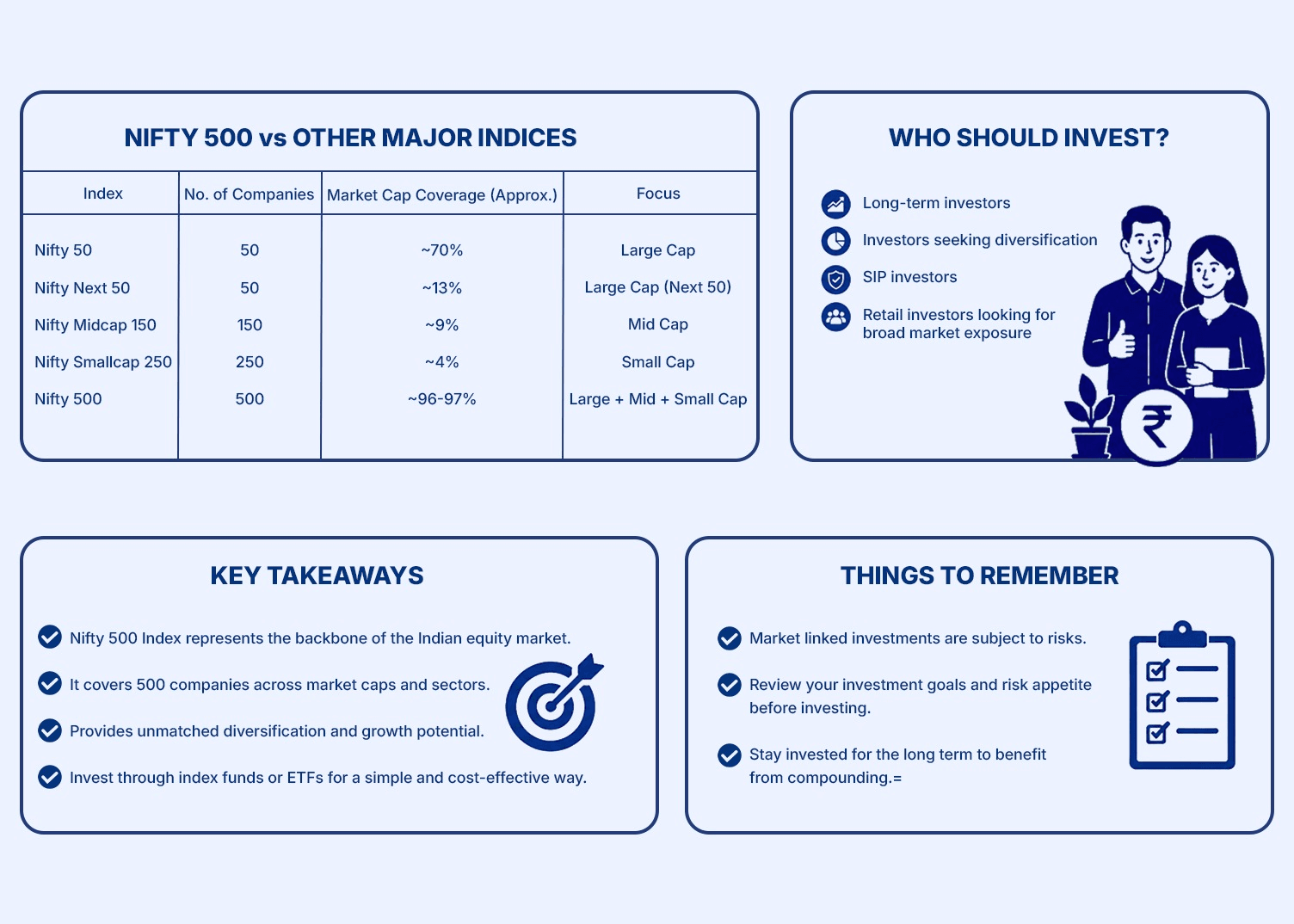
Should You Invest In Nifty 500?
Investors who want to invest in the entire share market with one fund can benefit from Nifty 500. It provides investment opportunities across all sectors of the economy and across all company sizes. By combining a Nifty 500 SIP with bond investments, you can combine the potential for future capital appreciation with an income-producing security.
When this is done, you have an opportunity to create a portfolio that is well diversified and can withstand the various phases of the market. Before placing your funds, it is important to know your investment objective, the length of your investment and your level of risk tolerance. You should gradually add to your investments through SIPs and review your portfolio regularly.
Additional Relevant Aspects
The Nifty 500 index has grown and changed along with the economy over time. As the economy changes and new sectors develop or new companies grow rapidly, their weight in the index increases.
This evolution and changing landscape keep the index relevant and interesting. It also provides investors with a good investment vehicle to use when determining the allocation to a core portfolio. Many investors will also combine it with other types of funds, such as thematic or actively managed funds that provide additional growth.
Over the past decade, advancements in technology have made it much easier for investors to track the performance of this index and invest in it. The Nifty 500 is a representation of the largest portion of India’s listed companies. Its performance will generally reflect the overall health of the Indian economy as a whole.
Conclusion
Both the Nifty 500 index’s composition and performance make it an attractive option for a number of investors. Whether you invest through a Nifty 500 index fund or a Nifty 500 ETF in India, the Nifty 500 provides an easy way for you to take part in India’s growth story. To start out, plan ahead, remain disciplined and regularly assess your investment status.
Grip offers corporate bonds and other fixed-income investment options with yields up to 12.5% and institutional-grade security features. Visit Grip Today!
FAQs On Nifty 500
 |
Author: Grip Invest Editorial Team The Grip Invest Editorial Team is a group of Chartered Accountants, MBA (Finance) graduates, and Qualified Research Analysts dedicated to helping you invest smarter. We dive deep into India's fixed income landscape to deliver content that is accurate, up-to-date, and easy to understand. Whether you're exploring bonds, fixed deposits, or other fixed income opportunities, our guides cut through the noise and give you the clarity to make better financial decisions. |
Want to stay at the top of your finances?
Join the community of 4 lakh+ investors and learn more about Grip Invest, the latest financial knick-knacks, and shenanigans in the world of investing.
Happy Investing!
Disclaimer - Investments in debt securities/municipal debt securities/securitised debt instruments are subject to risks including delay and/ or default in payment. Read all the offer related documents carefully. The investor is requested to take into consideration all the risk factors before the commencement of trading.
This communication is prepared by Grip Broking Private Limited (bearing SEBI Registration No. INZ000312836 and NSE ID 90319) and/or its affiliate/ group company(ies) (together referred to as “Grip”) and the contents of this disclaimer are applicable to this document and any and all written or oral communication(s) made by Grip or its directors, employees, associates, representatives and agents. This communication does not constitute advice relating to investing or otherwise dealing in securities and is not an offer or solicitation for the purchase or sale of any securities. Grip does not guarantee or assure any return on investments and accepts no liability for consequences of any actions taken based on the information provided. For more details, please visit www.gripinvest.in
Registered Address - 106, II F, New Asiatic Building, H Block, Connaught Place, New Delhi 110001


