

Pan Card For NRI: Eligibility, Application Process, And Common Mistakes


A PAN (Permanent Account Number) card is essential for Non-Residents’ financial transactions in India. It provides a unique 10-character alphanumeric code that identifies you to the Indian government for tax purposes and also provides access to various ways of investing your money.
The PAN card allows NRIs to open Non-Resident External or Non-Resident Ordinary accounts, without having to pay taxes on them.
If you do not own a PAN card, higher taxes will be withheld on your Indian-source income. In addition to clarifying how non-residents will be taxed in India, the PAN card allows non-residents to conduct banking and real estate transactions abroad without difficulty.
Why NRIs Need A PAN Card
When filing taxes as a non-resident Indian, a PAN card is necessary for compliance. Without one, the Indian Government taxes a non-resident on income earned from Indian sources. For example, if you are making a rental income, you are taxed at a higher rate than if they had a PAN card and it is around 30% of the total income earned1.
PAN cards also help non-residents to open NRE/NRO bank accounts and to invest in India. For instance, Raj who lives in the USA wants to invest in Mutual funds. He needs a PAN card to buy units online.
Who Is Eligible For Pan Card As NRI
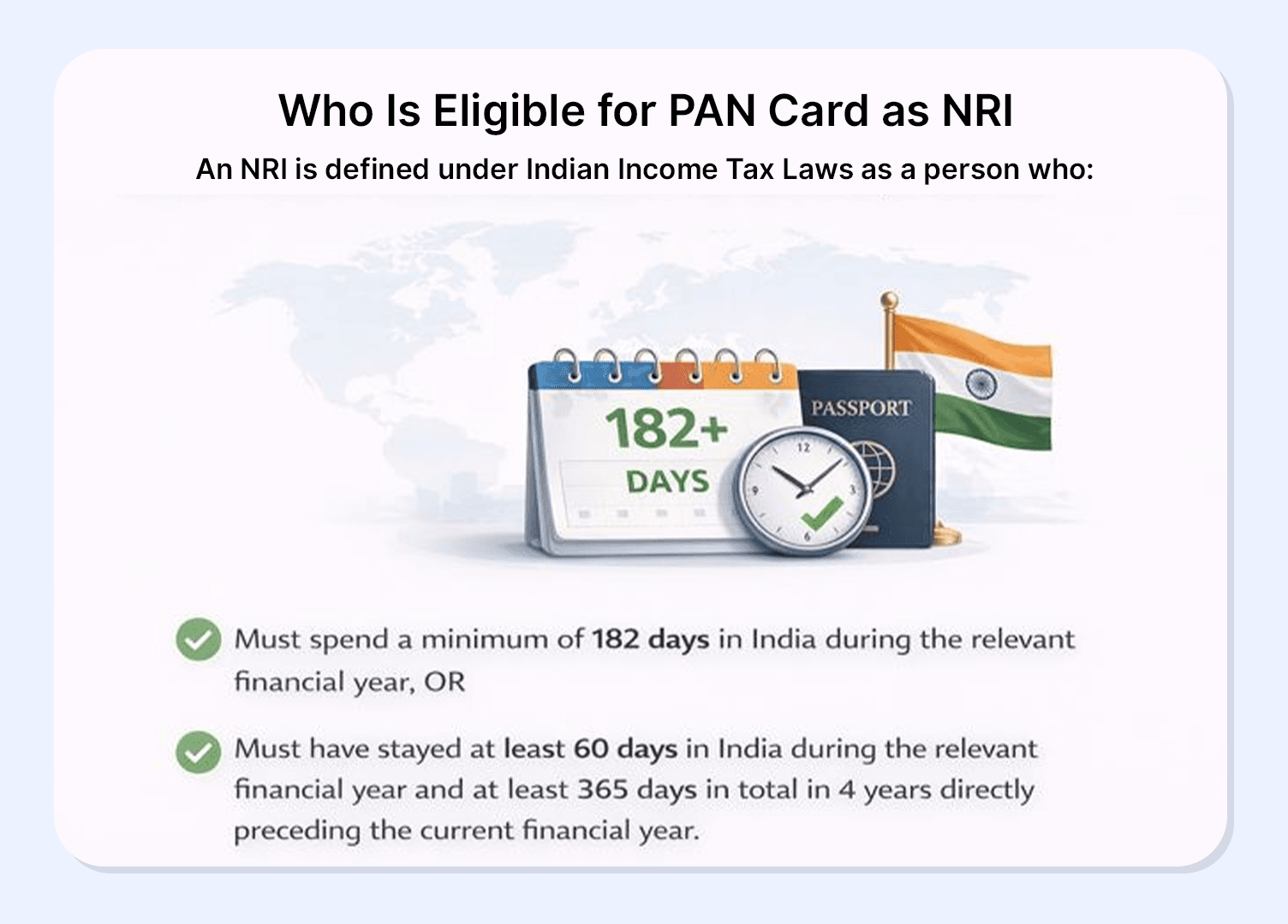
An NRI is defined under Indian Income Tax Laws as a person who:
- Must spend a minimum of 182 days in India during the relevant financial year, OR
- Must have stayed at least 60 days in India during the relevant financial year and at least 365 days in total in 4 years directly preceding the current financial year.
PIO (Person of Indian Origin) and OCI (Overseas Citizen of India) cardholders also qualify to become resident Indians and it is based on their residency status.
All foreign citizens that deal with businesses in India, including purchasing property, must obtain a PAN issued by the Indian Government. Additionally, individuals who are eligible for a PAN are tied to NRI requirements for obtaining a PAN.
Documents Required For NRI PAN Card
Below are the essential NRI pan card requirements for one to proceed:
1. Core Requirement (All NRIs)
- Passport-sized photographs: Provides clear identity visuals for verification.
- Indian Passport copy: Confirms nationality and date of birth details.
2. Proof of Identity (POI)
- OCI or PIO card: Validates overseas Indian status quickly and reliably.
- Foreign Passport copy: Proves current citizenship for global residents.
- Aadhaar Card: Optional but useful for pan card NRI without aadhaar alternatives.
3. Proof of Address (POA)
- Overseas bank statement: Shows recent foreign residency with transactions.
- NRE/NRO account statement: Links India finances to abroad address.
- Foreign Residence Permit: Official proof of living permission overseas.
- Utility Bills: Everyday evidence like electricity bills from abroad.
- Foreign Driving License: Combines ID and address in one document.
4. Proof of Date of Birth (DOB)
- Passport: Primary document covering birth details comprehensively.
- Birth Certificate: Official record from birth authorities directly.
- Matriculation Certificate: School-issued pro
5. Special Category Documents
- Employer's Certificate
- Indian Embassy Attestation
How NRIs Can Apply For PAN Card
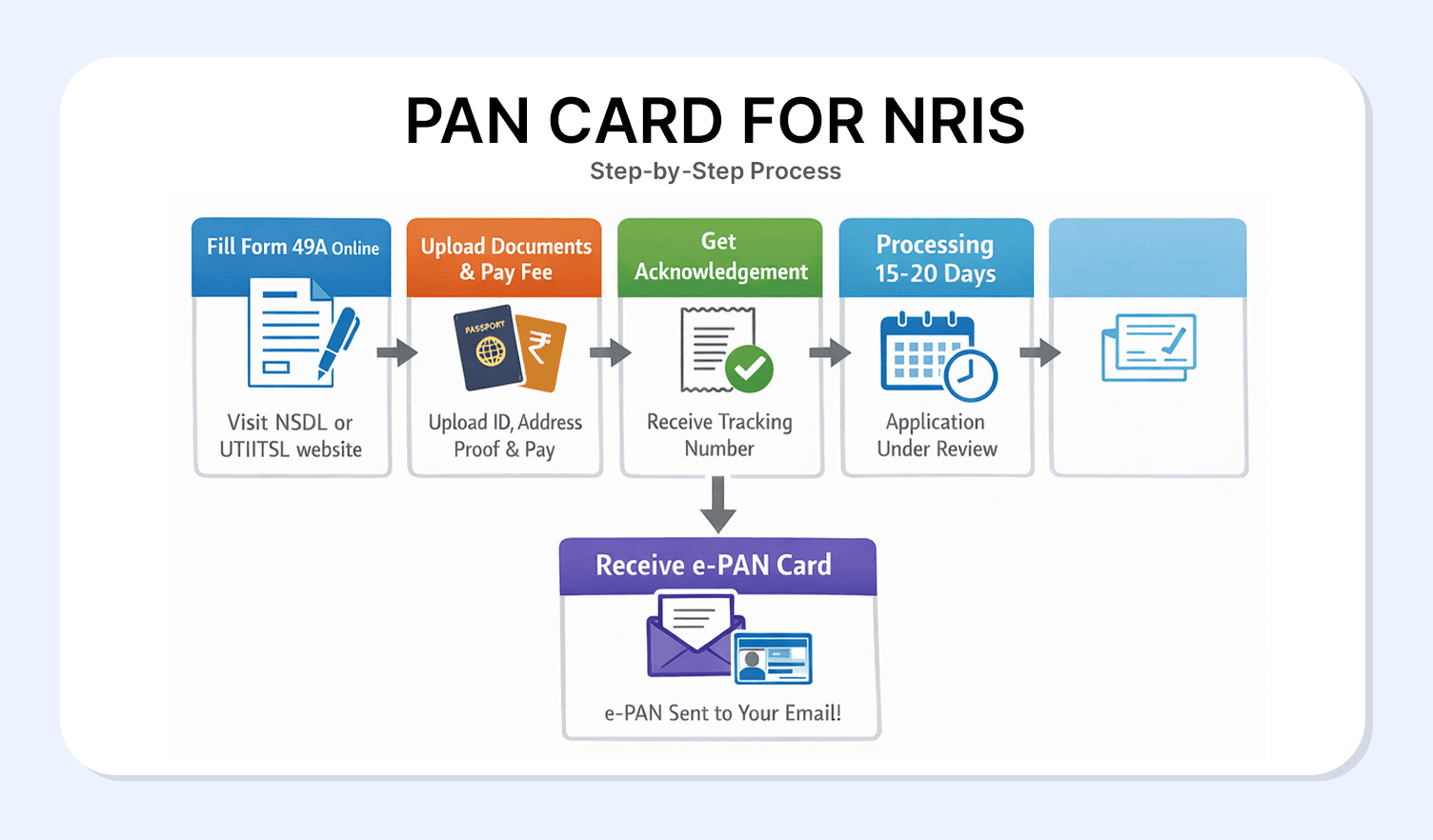
NRIs who want to apply for a pan card NRI can do so online through either the NSDL or UTIITSL websites. To submit your online application, download and complete Form 49A and scan it to upload. Or you can apply for a pan card abroad through Indian embassies located overseas for the convenience of applying from abroad.
Here are the essential step-by-step process for you to follow to apply for pan card for NRI:
- Visit tin.tin.nsdl.com or utiitsl.com.
- Select new pan card for NRI, enter details accurately.
- Upload pan card NRI documents and pay Rs 1,000 fee abroad.
- Get acknowledgement with a 15-digit number to track NRI pan card status.
It generally takes 15 to 20 days to complete the processing of your application and your e-PAN will be sent to you via email. There are PAN application NRI USA agencies who can provide assistance with applying for a pan card NRI. Approximately 95% of applications submitted to apply for a pan card NRI successfully receive approval on their first attempt when all supporting documents are provided.
Additional Benefits And Uses
One of the major benefits of NRI PAN cards is receiving lower tax deductions on Fixed Deposits (FDs. There are many more like:
- A PAN card for NRI opens the door to sell property without facing a 20% tax because you do not have a PAN card.
- NRIs may also use their PAN card when they want to open a demat account.
- Also they can use it to receive the full proceeds of their investments back into their foreign bank account through repatriation.
For example, an NRI living in the UK has inherited land from a family member. He can sell this property smoothly and without complications by using his PAN card.
NRI PAN Card: An Example For Complete Clarity
Priya, who is based in Canada, has been faced with challenges while trying to resolve her NRI pan card for foreign income from properties in Mumbai. As her property was assessed for tax purposes without a PAN card, she received a TDS rate of 30%. Under these circumstances, Priya was forced to apply for a PAN card online, using her passport as an identification document, to receive her NRI PAN card with 10% TDS rate. Thus, Priya was able to save thousands of dollars each year due to a reduced TDS rate.
On the other hand, Amit, an NRI currently residing in Dubai, is planning to repatriate the estate he inherited. With no NRI PAN number, Amit's inheritance was subject to a TDS of 20%. To obtain his NRI PAN card, Amit prepared and submitted the appropriate documentation, including evidence of foreign utility bills to prove that he lived in Dubai. After he submitted his application, Amit was able to repatriate his entire estate without any issues. Amit obtained his NRI PAN card renewal through UTIITSL in just 10 days, gaining access to many NRI PAN card benefits, including access to Demat accounts.
Priya and Amit are two examples of how easy the processes associated with obtaining NRI PAN cards can be.
Common Mistakes NRIs Should Avoid
NRIs often forget to provide proof of their current residence outside of India when applying for their NRI PAN card. This may result in delays in the processing of the application. It is very important to provide utility bills or some other proof of your current residence outside of India. This is the only way that the tax authorities will know where to send your application.
Another common mistake is selecting the incorrect residency status. This may cause the NRI to use the wrong form for the PAN card application, either 49A or 49AA. Thus, NRIs should be sure to select the correct residency status.
Another mistake to avoid is making typographical errors when filling out the application for their NRI PAN card. Even small mistakes can prevent an NRI from being able to have their repatriation funds approved. So, ensure that there are no misspelled words as it can prevent the NRI from providing adequate proof of their repatriation of funds.
Conclusion
A PAN card is more than a compliance requirement for NRIs; it is a gateway to smoother taxation, hassle-free banking, and efficient investing in India. With the right documents and a correctly filed application, NRIs can avoid excess TDS, simplify repatriation, and access a wider range of financial opportunities. Platforms like Grip Invest help NRIs make informed investment decisions by offering access to regulated fixed-income options, clear tax insights, and a streamlined approach to managing Indian investments with confidence.
FAQs
1. Is PAN a must for NRIs?
Technically, no. However, NRIs must apply for PAN if:
- They receives an income in India,
- They sell something for more than Rs.2 lakh,
- Or, open a bank account in India.
2. Does an NRI have to have an Indian address to apply for a PAN Card in India?
No, foreign addresses will work just fine. You will be able to apply for an NRI PAN Card online by providing your passport as proof of identity.
3. How do I track my NRI PAN Card status?
You can easily track your NRI PAN Card status via your acknowledgment number on the NSDL website.
4. Can NRIs use the same PAN card after returning to India permanently?
Yes. A PAN card is permanent and remains valid even if an NRI becomes a resident Indian again. Only the residential status needs to be updated in income tax records, not the PAN itself.
5. Is PAN required for filing Form 15CA/15CB for overseas remittances?
Yes. PAN is mandatory for filing Form 15CA and obtaining Form 15CB when transferring funds from India to a foreign account, including rent, dividends, or sale proceeds.
6. Can NRIs hold multiple PAN cards for different countries?
No. An individual is legally allowed to have only one PAN card, regardless of how many countries they live in or earn income from. Holding multiple PANs can attract penalties under Indian tax law.
7. What happens if an NRI earns Indian income without a PAN card?
In such cases, tax is deducted at a higher rate under Section 206AA, often at 20–30%, and claiming refunds later becomes more complicated and time-consuming.
References:
1. Income tax, accessed from: https://www.incometax.gov.in/iec/foportal/help/individual/return-applicable-0
2. DBS bank, accessed from: https://www.dbs.bank.in/in/treasures/articles/nri-hub/live-enriched/ppf-account-for-nri-rules-investment-options
3. NRI helpline, accessed from: https://nrihelpline.com/how-to-apply-for-a-pan-card-for-nri-documents-process/
Want to stay at the top of your finances?
Join the community of 4 lakh+ investors and learn more about Grip Invest, the latest financial knick-knacks, and shenanigans in the world of investing.
Happy Investing!
Disclaimer - Investments in debt securities are subject to risks. Read all the offer-related documents carefully. The investor is requested to take into consideration all the risk factors before the commencement of trading. This communication is prepared by Grip Broking Private Limited (bearing SEBI Registration No. INZ000312836 and NSE ID 90319) and/or its affiliate/ group company(ies) (together referred to as “Grip Invest”) and the contents of this disclaimer are applicable to this document and any and all written or oral communication(s) made by Grip Invest or its directors, employees, associates, representatives and agents. This communication does not constitute advice relating to investing or otherwise dealing in securities and is not an offer or solicitation for the purchase or sale of any securities. Grip Invest does not guarantee or assure any return on investments and accepts no liability for the consequences of any actions taken based on the information provided. For more details, please visit https://www.gripinvest.in/.
Registered Address - 106, II F, New Asiatic Building, H Block, Connaught Place, New Delhi 110001.


