

PPF Interest Rate In 2026: Current Rate, Calculation And Returns


The Public Provident Fund or PPF is the most secure long-term savings vehicle in India. Millions of Indians use the PPF as a way to save due to the fact that their fixed returns can not be affected by fluctuations in other investments.
Reasons why millions of Indian families use the PPF are that they want to save for their children’s education and for their own retirement. The PPF allows families to build up wealth and maintain that wealth over the course of decades without having to worry about the economy.
While interest rates on the PPF can change periodically as a result of a review process, the current interest rate of around 7.1% makes the PPF an attractive investment for small savers in India.
It is ideal for the ones who are looking for solid returns. During periods of uncertainty, the PPF is a great source of both stability and long-term investment growth.
In the most recent quarters, there has been very little variability in the PPF interest rate history chart except for some minor adjustments throughout the history of the program. This consistency serves to reinforce the government’s commitment to small savers across the country.
Current PPF Interest Rate 2026 In India
The government has now set the interest rate for the Public Provident Fund (PPF) for each quarter of the year 2026 at a rate of 7.1%. This means that investors won't experience sudden changes or volatility. This will provide an opportunity for both current and new PPF account holders to have confidence in their savings.
The current economic climate supports a steady future for the Indian economy, which is a good reason to use the PPF.
Latest Interest Rate Announced by the Government
The Government of India has set the first quarter 2026 PPF Interest Rate at 7.1%, which corresponds with previous quarterly periods.
In addition, all PPF accounts will have the same interest rate (7.1%), which promotes a higher level of trust for depositors on an India-wide basis. After each quarterly revision of the PPF interest rate, visit official government websites related to PPF/Interest Rates in order to obtain reliable information about future quarterly changes to the PPF interest rate.
Frequency of Revisions
Generally speaking, the government will be reviewing the PPF interest rate every 3 months based on changes in the yield on sovereign bonds; this is how the PPF will remain linked to the Indian stock markets while ensuring stability at all times.
Stable times such as today build a great deal of confidence, which allows for increased stability in long-term financial planning by all PPF account holders.
How PPF Interest Is Calculated
Demonstrating a PPF example showcases how valuable completed PPFs accumulate over long periods based on accumulating regular monthly investments by using various approaches appropriately.
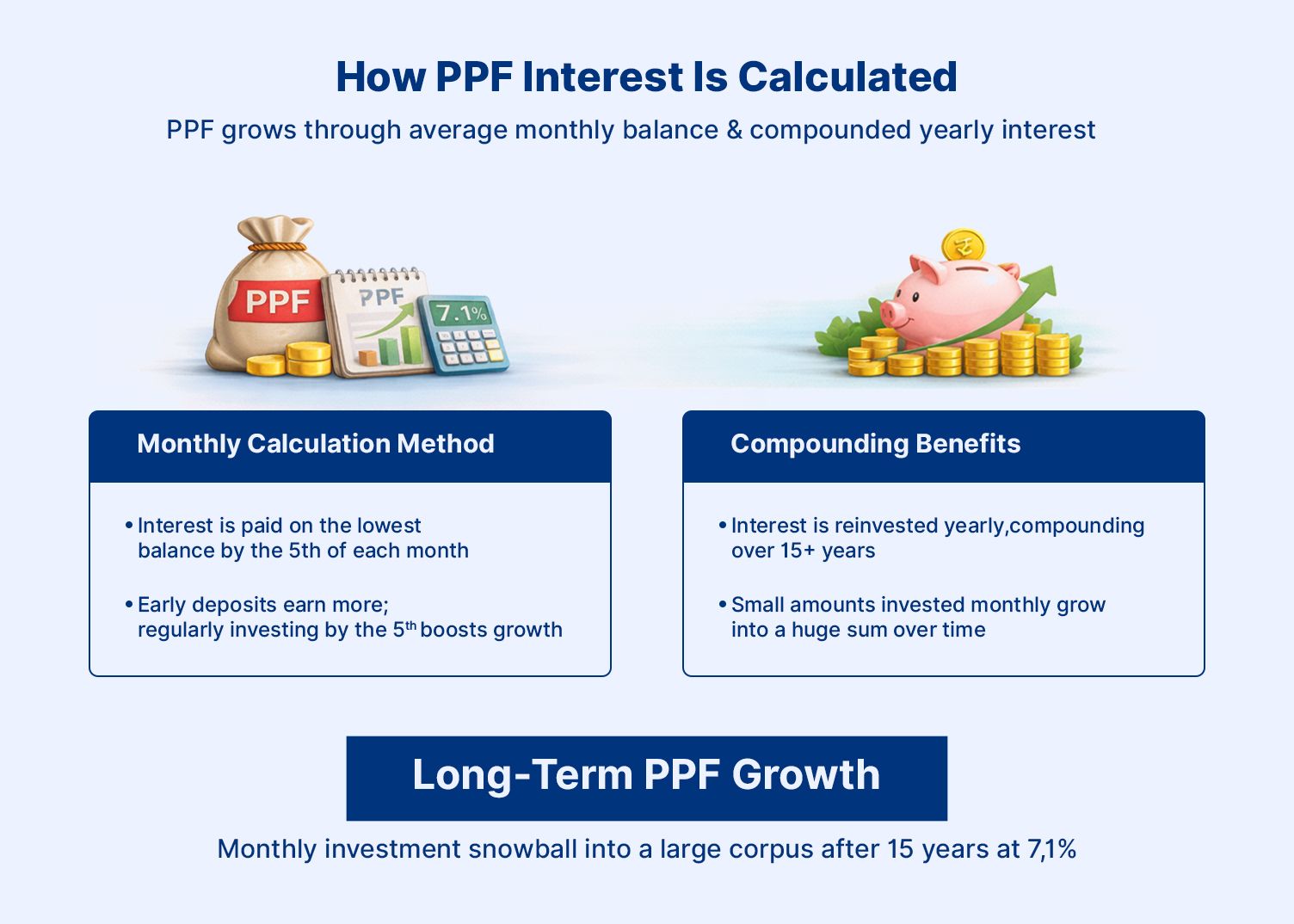
The accumulation method is based on the average monthly balance of an account with respect to compounding interest credited at the end of each year.
Monthly Calculation Method
The monthly method uses the same method as a PPF calculator does for estimating earnings. Any early payments made on a regular monthly basis will have a greater contribution to the amount that gets deposited during the next month without any additional interest charges.
Each monthly contribution contributes toward the full number of days between the first and last day of the month. You can get a PPF calculator online free.
Compounding Benefits
PPF compound interest crediting works like this: All the interest earned on the original principal amount will be reinvested into the original principal until the end of each of the 15 years. This results in a much larger accumulation of original principal over the entire period of time.
This results in a larger overall savings legacy to pass down to future generations.
15 years is a long time; starting with a 1 lakh investment will gradually compound and produce an enormous legacy after 15 years.
Also Read: Learn More About The Power Of Compounding
PPF Interest Rate History (2000 to 2026)
The PPF interest rate has seen a dramatic decline over the last two and a half decades, falling from a peak of 12% in the late 1990s to the current 7.1%, a reflection of India's broader monetary easing and declining inflation trajectory
| Period | PPF Interest Rate |
| January 2026 onwards | 7.10% |
| April 2020 to December 2025 | 7.10% |
| July 2019 to March 2020 | 7.90% |
| October 2018 to June 2019 | 8.00% |
| January 2018 to September 2018 | 7.60% |
| July 2017 to December 2017 | 7.80% |
| April 2017 to June 2017 | 7.90% |
| April 2016 to March 2017 | 8.10% |
| April 2015 to March 2016 | 8.70% |
| April 2014 to March 2015 | 8.70% |
| April 2013 to March 2014 | 8.70% |
| April 2012 to March 2013 | 8.80% |
| December 2011 to March 2012 | 8.60% |
| April 2011 to November 2011 | 8.00% |
| March 2003 to March 2011 | 8.00% |
| April 2002 to February 2003 | 9.00% |
| March 2001 to March 2002 | 9.50% |
| January 2000 to February 2001 | 11.00% |
Source: FinCalC1
PPF Returns vs Other Fixed Income Investments
Because of the tax-free nature of PPF returns in India, the effective yield of PPF will always exceed the stated yield when compared with fixed deposits. Fixed income investments are diverse in their risk and return profiles, enabling investors to select the right investment for their long-term goals.
Fixed Deposits
Currently, PPF vs FD returns are essentially the same. However, due to the tax implications on fixed deposits, PPF will produce a greater return after taxes than fixed deposits over time.
While fixed deposits do have liquidity, the interest earned from fixed deposits is taxed annually, and the tax will reduce the amount of return you ultimately receive from your investment.
The interest paid on fixed deposits is driven by market conditions, and as such, the amount you earn from your investment on a fixed deposit will fluctuate each time the bank resets the interest rates. PPF is a government-backed investment and therefore will always offer a consistent yield.
‘A’ Rated Corporate Bonds
Corporate bonds with an "A" rating provide a yield that is higher than fixed deposits and present a moderate amount of credit risk due to the strength of the underlying corporation.
PPF will provide a guaranteed return of principal while corporate bonds present a risk of default; however, the risk of default from an "A" rated corporate bond is minimal.
While all conservative investors will only want to own PPF to maintain their capital preservation, many aggressive investors may choose to own both PPF and corporate bonds in order to maximize their returns.
PPF Extension Rules After 15 Years
On completing 15 years, a PPF account does not automatically close. The account holder has three distinct options to choose from, making PPF one of the most flexible long-term savings instruments available to Indian investors.
1. Option 1 - Close and Withdraw
You can fully withdraw the maturity amount, which is entirely tax-free. This is the simplest route if the funds are needed immediately.
2. Option 2 - Extend Without Contribution
If you do not submit any extension request, your account automatically continues without fresh deposits. You continue earning 7.1% interest on the existing balance, the EEE tax exemption remains applicable, and you can make one partial withdrawal per financial year of any amount. This is ideal for retirees who want passive tax-free income without locking in new funds.?
3. Option 3 - Extend With Contribution (5-Year Blocks)
You can actively extend the account in blocks of 5 years indefinitely, there is no upper limit on the number of extensions. To do this, you must submit Form 4 (formerly Form H) to your bank or post office within one year of the maturity date.
If you miss this window, the account defaults to Option 2 (extension without contribution) and fresh deposits are no longer accepted. Under this option, you can withdraw up to 60% of the balance at the beginning of each 5-year extension block, spread across multiple withdrawals.
The extension-with-contribution route is particularly powerful for wealth compounding — since the interest on interest continues to accumulate on a larger base, extending by even one 5-year block post-maturity can significantly enhance your final corpus compared to closing at 15 years.
Source: Rights Of Employees2
Tips To Maximize PPF Returns
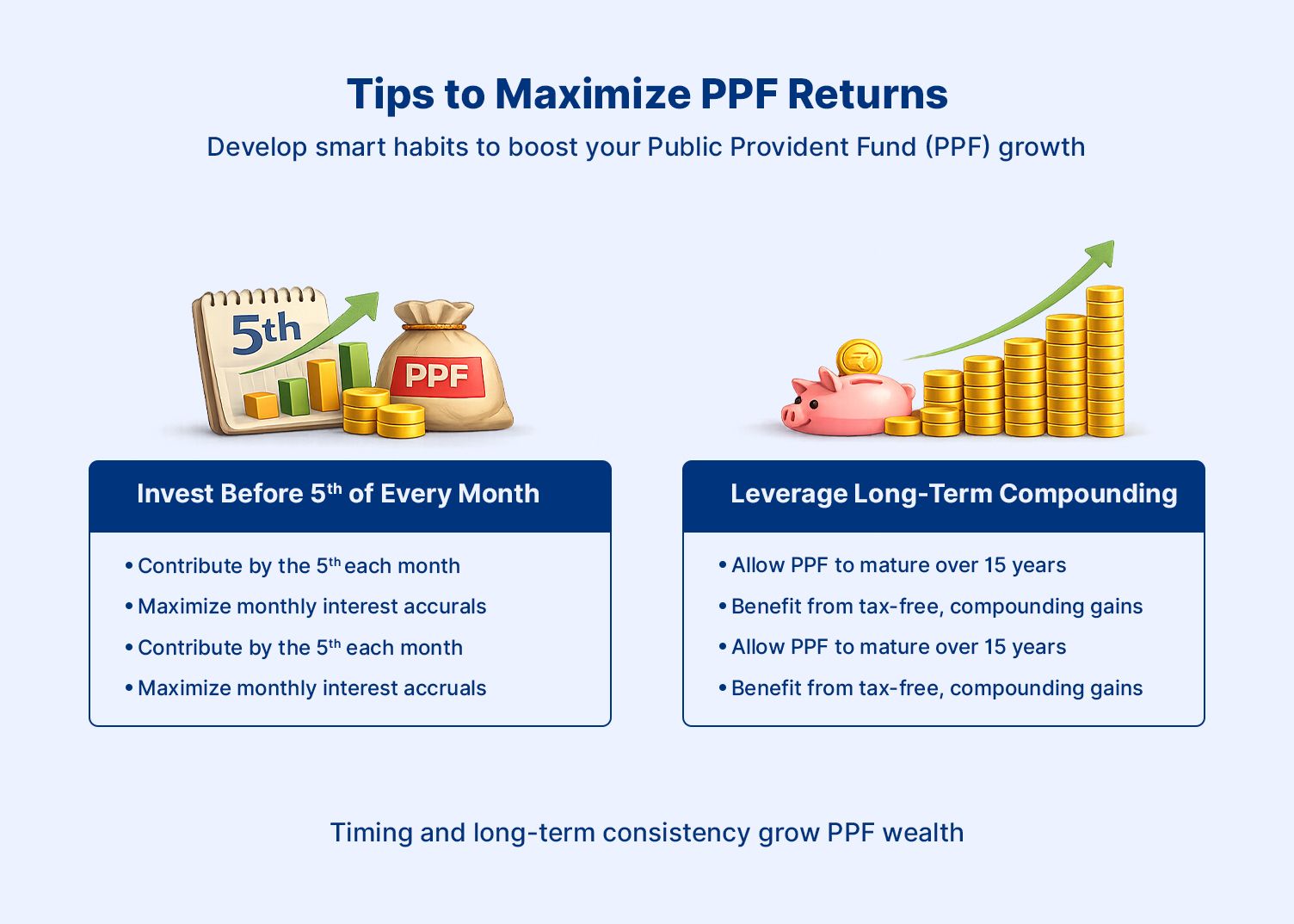
A strategy for potentially creating substantial wealth through the long term can be achieved through open doors through the growth potential associated with compounding PPF interest; the key to creating significant wealth is establishing smart habits early in the process.
Investing Before the 5th of Every Month
To earn interest and maximally deposit annually in a public provident fund (PPF), deposits of at least a certain sum must be made by the 5th of each month of every calendar year for the next 12 months after creating a PPF account. By having made your deposits into the PPF monthly for the next 12 months, the compounding of your monthly deposit will result in your balance being much greater.
Long Term Compounding Strategy
If an individual maintains their PPF account for the entire 15 years of their term and allows the power of the PPF interest calculation formula to work during this time, their PPF account will have increased to a substantial level. Once the person reaches the end of the fifth year of making monthly deposits into their PPF account, they will have the ability to gain access to part of their monthly deposited funds.
Beyond Basics: Account Rules And Extensions
There are limits and restrictions on how many PPF accounts a family can have and the number of people in the family that can each hold a PPF account. Couples can have a PPF account for themselves and their spouse.
All PPF accounts inside the same family will be aggregated for purposes of determining the combined amount allowed to be deposited each year.
PPF account holders can avail a loan against their balance starting from the 3rd financial year up to the end of the 6th financial year from the year of account opening. The maximum loan amount is 25% of the balance at the end of the 2nd year preceding the loan application, and only one loan can be active at a time during this window.
The PPF interest is taxable or exempt under Section 80C of the Indian Income Tax Act. Therefore, a person with a PPF account has tripled the attractiveness of the PPF as an investment due to the tax benefits derived from three different tax-exempt statuses under the Income Tax Act.
Common Misconceptions Cleared
The PPF interest rate is fixed for the entire year. Therefore, PPF is a predictable source of investment income, unlike other types of income, which may be more difficult to estimate due to fluctuations in the markets. Several websites offer interest calculators for PPF accounts, which will allow for calculating how much deposit is needed to achieve a specific objective and to plan accordingly.
NRI account holders continue to hold their PPF accounts after repatriating the entire balance upon maturity. They may be able to transfer any outstanding balance amounts upon the in-liquidation of their PPF account.
Integrating with Financial Planning
With your company match program and potentially an India NPS plan for your retirement savings vehicle, the PPF may provide you with a tax-efficient vehicle for your investments. In addition, you will receive the benefit of having withdrawn from your PPF account as your NPS and other retirement savings accounts mature.
You can easily track your PPF account as part of your overall financial plan using online mobile banking applications that provide you with the convenience of tracking real-time balances.
Conclusion
The Public Provident Fund continues to be one of the most dependable long-term investment options in India, especially for risk-averse investors. With a stable interest rate of 7.1% in 2026, tax-free returns, and the power of compounding over 15 years, PPF offers a strong foundation for financial goals like retirement and children’s education. Its consistency, government backing, and EEE tax status make it a preferred choice during both stable and uncertain economic conditions.
However, while PPF ensures stability, investors looking to diversify and potentially enhance returns can consider complementing it with other fixed-income options based on their risk appetite and financial goals.
Looking to go beyond traditional options like PPF? Explore curated bond investment opportunities on Grip Invest to diversify your portfolio with transparent and accessible fixed-income products.
FAQs On PPF Interest Rates 2026
1. What is the current PPF interest rate?
The PPF interest rate for quarter 1, 2026, is 7.1%, which remains constant with governmental backing, providing consistent reliability for savers.
2. How is PPF interest calculated?
PPF interest is calculated on the lowest balance between the 5th and the last day of each month. This means any deposit made after the 5th of the month will not earn interest for that month. The interest is computed monthly but credited to the account only at the end of the financial year (March 31).
This is why financial advisors consistently recommend depositing your PPF contribution before the 5th of April every year to maximise annual interest earnings.
3. Is the PPF interest tax-free?
Yes, under EEE (exemption, exemption, exemption) classification, the interest on your PPF account is considered tax-free or tax-exempt, thereby permitting a totally tax-free income for the investor.
References:
1. FinCalC, accessed from: https://fincalc-blog.in/ppf-interest-rate-history-with-calculator/
2. Rights Of Employees, accessed from: https://www.rightsofemployees.com/ppf-extend-rules-what-is-the-rule-of-extend-in-ppf-how-to-use-it-for-regular-income/
Want to stay at the top of your finances?
Join the community of 4 lakh+ investors and learn more about Grip Invest, the latest financial knick-knacks, and shenanigans in the world of investing.
Happy Investing!
Disclaimer - Investments in debt securities/municipal debt securities/securitised debt instruments are subject to risks including delay and/ or default in payment. Read all the offer related documents carefully. The investor is requested to take into consideration all the risk factors before the commencement of trading.
This communication is prepared by Grip Broking Private Limited (bearing SEBI Registration No. INZ000312836 and NSE ID 90319) and/or its affiliate/ group company(ies) (together referred to as “Grip”) and the contents of this disclaimer are applicable to this document and any and all written or oral communication(s) made by Grip or its directors, employees, associates, representatives and agents. This communication does not constitute advice relating to investing or otherwise dealing in securities and is not an offer or solicitation for the purchase or sale of any securities. Grip does not guarantee or assure any return on investments and accepts no liability for consequences of any actions taken based on the information provided. For more details, please visit www.gripinvest.in
Registered Address - 106, II F, New Asiatic Building, H Block, Connaught Place, New Delhi 110001


