

SBI FD Interest Rates 2026: Latest SBI Fixed Deposit Rates, Schemes & Senior Citizen FD


The State Bank of India (SBI), the largest commercial bank in India, offers competitive interest rates for fixed deposits at varying tenures. The interest rates for regular citizens range from 3.05% to 6.40%, while senior citizens enjoy higher rates at 3.55% to 7.05%.
The SBI fixed deposit scheme for 5 years and above carries the highest rates for senior citizens and can reach up to 7.05%.1
Furthermore, the bank also offers tax-saving fixed deposits that enjoy deductions under the Income Tax Act.
This blog illustrates the SBI fixed deposit rates in detail to aid comparative analysis with other schemes, such that investors can make optimal investment decisions.
SBI FD Interest Rates 2026
The State Bank of India revised their FD rates, which have been in effect since 15 December 2025. The table below shows the latest FD rates of SBI for deposits below INR 3 crore for regular and senior citizens, as of 14 May 2026.
| Tenure | General Citizens | Senior Citizens |
| 7 days to 45 days | 3.05 | 3.55 |
| 46 days to 179 days | 4.90 | 5.40 |
| 180 days to 210 days | 5.65 | 6.15 |
| 211 days to less than 1 year | 5.90 | 6.40 |
| 1 Year to less than 2 years | 6.25 | 6.75 |
| 2 years to less than 3 years | 6.40 | 6.90 |
| 3 years to less than 5 years | 6.30 | 6.80 |
| 5 years and up to 10 years | 6.05 | 7.05 |
*Includes additional senior citizen premium under special long-term FD provisions.
Let us now compare these SBI fixed deposit scheme interest rates with those of other banks to get a perspective on what suits investor needs.
Comparison Between FDs
Return on any asset is proportional to the degree of risk taken. Therefore, the interest rate on fixed-income assets is often lower than that on equity. Even among FD schemes, this theory holds.
Given the strong market position of SBI and its sovereign backing, its rates are often lower than those of private banks, small finance banks, or non-banking finance companies.
The table below compares the SBI fixed deposit with other competitive FDs.
| Name | Interest Rate (p.a.) | Tenure | Minimum Deposit |
| Bajaj Finance Ltd. | 6.41% to 7.75% | 1 year to 5 years | INR 25,000 |
| Suryoday SF Bank | 6.50% to 8.25% | 6 Months 1 Day to 10 Years | INR 25,000 |
| Slice SF Bank | 6.25% to 7.75% | 6 Months 1 Day to 4 Years 6 Months 10 Days | INR 25,000 |
| Shivalik SF Bank | 6.00% to 8.30% | 1 Year to 5 Years | INR 25,000 |
| Shriram Finance | 7.00% to 8.10% | 1 Year to 5 Years | INR 25,000 |
Investors can compare the FD plans of the same or different institutions using an FD calculator to determine which options fit them the most.
SBI FD Calculator
The fixed deposit calculator of SBI is a digital tool that enables investors to enter data like principal amount, tenure, and rate to automatically calculate the interest and maturity amount after the completion of the tenure.
The formula used by the calculator is given.
Compounded Amount = P x (1+R/F^(T X F))
Where,
P = Principal
R = Interest Rate
F = Compounding Frequency
T = Tenure
While the meaning of variables like principal, interest, and tenure is known to most people, compounding frequency might need further clarification. The number of times interest is calculated and added to the investment per year is called compounding frequency.
The table below highlights different compounding frequencies.
| Compounding Frequency | Value of F |
| Quarterly | 4 |
| Half Yearly | 2 |
| Monthly | 12 |
| Yearly | 1 |
Suppose Mr K invests INR 1,00,000 in an FD scheme with 6% p.a. interest for 5 years, compounded quarterly. The table below shows their details.
| Particulars | Value |
| Principal | INR 1,00,000 |
| Tenure | 5 Years |
| Interest rate | 6% p.a. |
| Compounding frequency | 4 |
| Compounded Amount | INR 1,34,686 |
Investors can simply search and visit the SBI FD calculator website, enter the variable into the calculator and hit calculate. The tool automatically calculates and shows the amount at maturity and returns.
With this, let us explore the different ways to invest in an SBI FD plan.
How To Open An SBI Fixed Deposit?
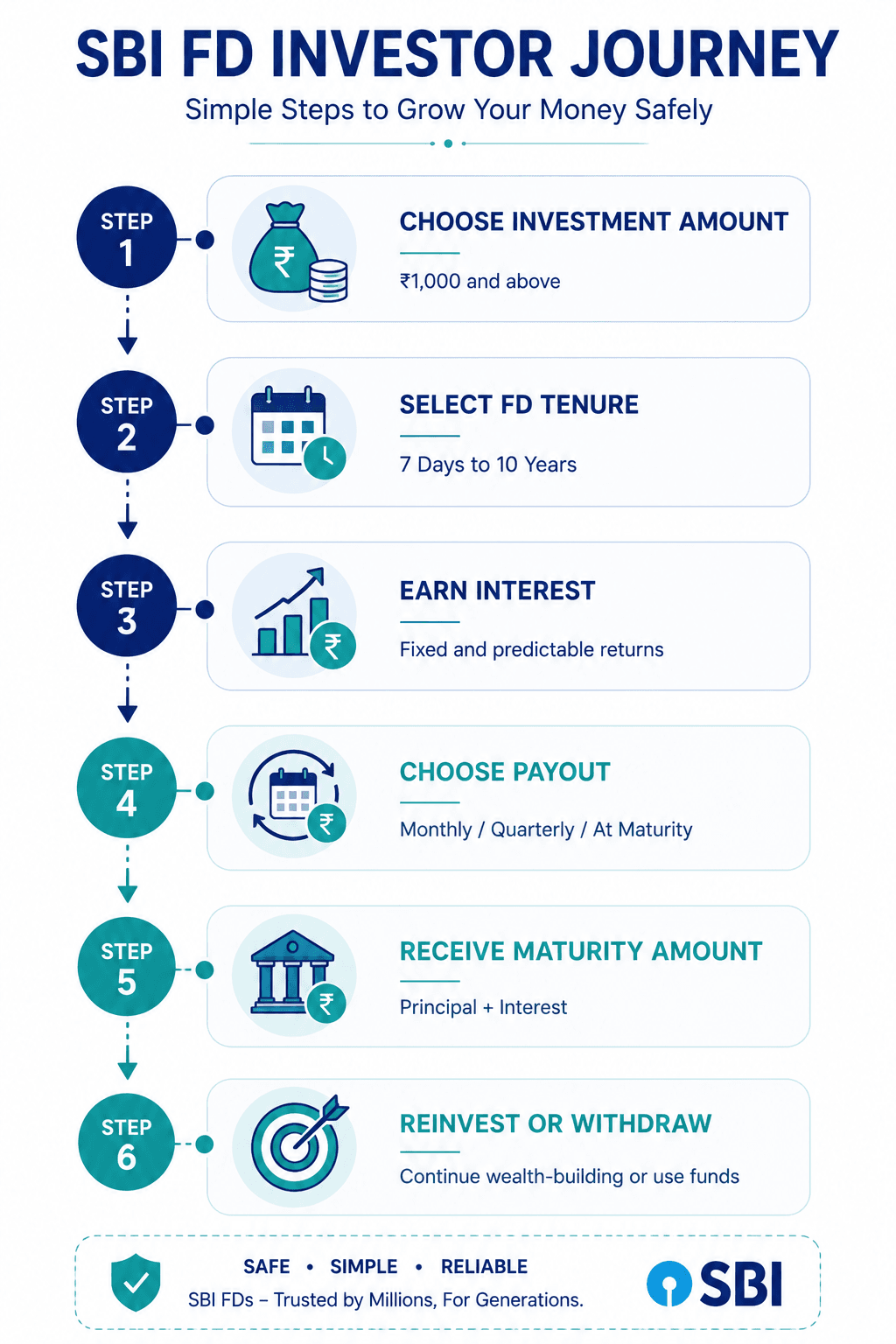
Investors can open an SBI FD with a minimum deposit of INR 1,000 and no upper limit. The minimum and maximum deposit periods are 7 days and 10 years, respectively. Similar to any other FD, SBI requires the following documents to open an FD.
- Identity proof: Documents that prove the name, age, etc., serve as identity proof, like Aadhaar card, PAN card, Passport, Driver’s Licence, etc.
- Address proof: ID proofs that mention the address can also serve as address proof. However, in certain cases in which the current address and permanent address are different, like for people living in a rented apartment, rent agreements, utility bills, etc., can also become address proof.
- Others: Passport-size photographs, signatures, etc., are also required.
Furthermore, there are three different ways to open an SBI FD. These methods are discussed below.
1. You Only Need One (YONO) App
The YONO app is the official SBI app that can be used by investors to open an FD account. Discussed below are the steps to do the same.
Step 1: Log in to the YONO SBI app with your ID, MPIN, etc.
Step 2: From the Deposits and My Deposit section, select Fixed Deposits.
Step 3: Select Open Fixed Deposit, then enter the required information, like FD type, principal, tenure, maturity instructions, etc.
Step 4: If there are multiple savings accounts with SBI, choose the one from which you want the FD amount to be deposited.
Step 5: Review the selections made, approve the terms and conditions, and proceed to create the FD
2. Net Banking
Investors can also visit the net banking website of SBI to open a fixed deposit account. The steps listed below can guide investors.
Step 1: Log in to the SBI internet banking portal.
Step 2: From the fixed deposit section, e-TDR, where TDR is a term deposit, or e-STDR, which stands for special term deposit.
Step 3: Choose the FD type and select Proceed.
Step 4: In case there are multiple savings accounts with SBI, choose the one from which you want the FD amount to be deposited.
Step 5: Choose the deposit amount, tenure, maturity payout options, nominee, etc.
Step 6: Approve the terms and conditions and proceed to open the FD.
3. Offline Bank Branch Visit
Investors can also physically visit a bank branch and approach a customer relations manager or any such designated individual to open an SBI FD. They would help fill out the required forms and guide the investors throughout the investment process. In this case, the representative takes the onus of getting the paperwork completed and starts the FD.
The popularity of SBI FD plans emerges due to key reasons.
Why SBI FDs Remain Popular?
As depicted in the previous part, SBI had the lowest interest rates out of the three major banks. Even though the difference was quite marginal, it is still significant given the modest returns often offered by fixed deposits. The fact that SBI has the highest number (and amount) of fixed deposits in India is quite interesting.
India’s largest lender with an extensive branch and digital footprint, SBI offers unmatched accessibility for customers across metros, Tier-2, and rural regions. Its public-sector lineage reinforces the perception of stability, which is a key decision driver for conservative savers.
SBI is one of the most trusted names in the banking sector of the country.
With continuous digitalization (such as the SBI FDI Calculator) and the adoption of easy-to-use tools, the overall popularity of SBI products has increased even further. Further, deposits are protected under the standard INR 5 lakh DICGC insurance cover, adding a formal layer of safety.
Limitations Of SBI FDs
SBI Fixed Deposits are quite popular and are often the default option for investors seeking a safe, low-risk investment alternative. However, there are a few limitations which you should remember before choosing SBI FDs for your personal financial goals:
1. Low Real Returns: Post-tax and post-inflation returns often compress to minimal levels, especially for investors in higher tax brackets.
2. FD Premature Withdrawal Charges: Breaking an FD early leads to lower applicable interest or might lead to penalty deductions, reducing effective returns.
3. Rate rigidity: FD rates remain fixed for the entire tenure; investors cannot benefit if interest rates rise later.
4. Limited flexibility vs. modern instruments: No secondary-market liquidity, no transparency into yield-to-maturity, and no scope for diversification within the FD itself.
5. Opportunity cost: When fixed-income platforms offer higher yields with short- to medium-term tenures, sticking to FDs may mean sacrificing better return potential.
6. Full taxation: FD interest is taxed as per the slab rate, reducing net yield for anyone above the 10% bracket.
Also Read: What Is The Difference Between Low-Risk and High-Risk Investments?
Premature Withdrawal, Loan Against FD And Nomination in SBI Fixed Deposits
Sometimes, unforeseen financial needs may require you to access your Fixed Deposit (FD) funds before maturity. SBI allows premature withdrawal of FDs but with certain conditions and penalties.
- Premature Withdrawal Rules and Penalties
If you break your SBI FD before maturity, a penalty is imposed on the interest earned, lowering your effective returns. For FD amounts up to INR 5 lakh, SBI charges a penalty of 0.50% on the applicable interest rate regardless of the deposit tenure. For deposits above INR 5 lakh and up to INR 1 crore, the penalty is 1% across all tenures.
If the FD is withdrawn within 7 days of opening, no interest is paid. However, SBI waives penalties in special cases like the depositor’s death or under specific senior citizen schemes. It is advisable to check SBI’s terms before opting for premature closure, as interest is recalculated at a lower rate, reducing your earnings significantly.
If you need liquidity without closing your FD, SBI offers loans against your Fixed Deposit amounting up to 90% of the FD value. This option provides quick access to funds at attractive interest rates without disturbing your investment or forfeiting interest. This is a smart alternative to premature withdrawal, helping protect your FD returns while meeting urgent cash needs.
- Nomination Facility
SBI offers a nomination facility on all Fixed Deposits. By nominating a beneficiary, you ensure a smooth transfer of FD proceeds to your nominee in case of unforeseen events.
Adding a nominee is simple and can be done during FD opening or any time later by submitting a nomination form at an SBI branch or online. This enhances security for your FD investment and provides peace of mind for you and your family.
How to Request Premature Withdrawal or Loan?
You can apply for premature withdrawal or loan easily by visiting your nearest SBI branch or using the Online SBI banking portal/YONO app. Carry your FD receipt and valid ID proof for branch requests. For loan applications, submit relevant documentation as required by the bank.
Also Read: TDS On FD Interest Explained: Rules, Rates, And How To Avoid Excess Tax
Modern Alternatives To Traditional FDs
Not just SBI, there are inherent limitations to fixed deposits, irrespective of the issuer. Fixed Deposits might appear risk-free, but they do carry a certain amount of risk (such as the failure of the issuing bank) and are affected by low interest rates and inflation. There are limited SBI FD tenure options, making it highly inflexible.
In such a situation, corporate bonds are an excellent alternative to traditional fixed deposits. Platforms like Grip curate corporate bonds, listed debentures, and other fixed-income securities that offer the potential for higher yields, better transparency, and improved liquidity. These securities are rated by the top credit rating agencies (AAA to A-), and hence you have better visibility into the issuer's strengths and weaknesses.
Unlike FDs, many of these instruments are tradable on exchanges, allowing early exit without the penalty structure associated with premature FD withdrawals. For investors who prefer predictable outcomes, these products offer disclosed yield-to-maturity (YTM), predefined coupon payouts, and clear repayment schedules.
Overall, if you are looking for a safer investment option for diversification or to achieve critical personal financial goals, there are better options than traditional fixed deposits that help you earn higher returns without altering your risk profile much.
SBI FD vs Corporate FD: A Clear Comparison for Fixed-Income Investors
If you’re reviewing the latest SBI FD interest rates and wondering how they measure up against corporate fixed deposits available via Grip, the table below gives a crisp side-by-side view.
| Parameters | SBI Fixed Deposits | Corporate FDs |
| Issuer | State Bank of India, which is owned and backed by the Indian government | Highly-rated NBFCs, small-finance banks or corporates selected by Grip |
| Interest rate as of 15 May 2026 | 3.05% to 7.05% | 8% to 10% on Grip |
| Risk level | Very low (bank-backed) | Moderate (depends on issuer’s credit rating) |
| Safety cover | Insurance cover via DICGC up to INR 5 lakh for bank deposits | No DICGC cover; safety relies on the issuer and the due diligence undertaken by Grip |
| Tenure and flexibility | Broad tenures from short (7 days) to long (10 yrs), often with branch/online convenience | Tenures vary; they may have fewer liquidity options or early withdrawal flexibility compared to bank FDs |
| Liquidity | Premature withdrawal possible (with penalty) | Liquidity depends on issuer terms; early withdrawal may be restricted or subject to heavier penalties |
| Ideal investor group | Conservative investors seeking guaranteed returns with minimal hassle | Investors open to slightly higher risk in exchange for better yield, willing to evaluate issuer credit |
| Where to access | SBI branch or online banking portal | Via Grip Invest’s corporate FD offerings: “Corporate Fixed Deposits: Higher Returns with Safety” by Grip. |
Conclusion
SBI Fixed Deposits have been quite reliable and popular, especially for conservative investors who prioritize capital protection and require consistent returns without taking on too much risk. However, in an inflationary environment with high taxes, FDs might not be enough to provide consistent returns and help you attain your long-term financial goals. You can look for alternatives such as corporate bonds or debentures that offer higher yield potential, transparency, and liquidity without taking on disproportionate risk on the Grip Invest platform.
FAQs On SBI FD Interest Rates 2026
1. What is the SBI FD rate today?
SBI’s latest FD rates (below INR 3 crore) range from 3.05% to 6.45% for regular depositors and 3.55% to 7.05% for senior citizens, depending on the tenure.
2. Is SBI FD better than private bank FDs?
SBI offers stronger perceived safety due to its PSU backing, though private banks sometimes offer slightly higher rates. For most retail investors, SBI remains the more trusted choice, while private banks may suit those prioritizing yield over brand security.
3. Can investors get higher returns elsewhere with similar safety?
Yes. Listed corporate bonds, high-rated debentures, and regulated fixed-income instruments often provide higher yields with clear disclosures, credit ratings, and liquidity, offering better real returns while maintaining a conservative risk profile.
4. How does the RBI repo rate affect SBI FD rates?
Changes in the RBI repo rate influence banks’ cost of funds. When the repo rate is cut, banks like SBI may revise FD interest rates downward over time.
5. What happens if an SBI FD is withdrawn before maturity?
Premature withdrawal of an SBI FD attracts a penalty of 0.50% to 1% on the applicable interest rate, depending on the deposit amount and tenure.
6. Are there alternatives to SBI FDs that offer higher returns?
Yes. High rated corporate bonds, debentures, and regulated fixed income instruments available on platforms like Grip may offer higher yields with defined tenures and disclosures.
7. What is the SBI FD interest rate for 1 year?
The SBI FD interest rates for regular and senior citizens for a period of 1 year is 6.25% and 6.75%, respectively, as of 15 May 2026.
8. Which SBI FD scheme gives the highest interest?
For regular citizens, the SBI FD scheme for 2 years to less than 3 years gives the highest interest at 6.40%. On the other hand, the highest interest rate for senior citizens is 7.05% for a tenure of 5 years to 10 years.
9. Is SBI's 5-year FD tax-free?
The regular SBI FD plan for 5 years is not tax-free, but investors can opt for a tax-saving FD at SBI, which has a lock-in of 5 years.
10. What is the minimum amount for an SBI FD?
Investors can begin their SBI FD investment with a minimum amount of INR 1,000. There is no maximum limit.
11. Which is better, SBI FD or Post Office FD?
The highest SBI FD interest for regular citizens is 6.40% and 7.05% for senior citizens. The National Savings Time Deposit of the Post Office offers a maximum interest of 7.5%. The Monthly Income Scheme of the post office, which functions like an FD with monthly interest payout, also offers a maximum interest of 7.4%. In both cases, the minimum deposit amount is INR 1,000. However, the post office deposits might not offer certain additional features like FD-backed credit cards. Therefore, investors can choose an avenue, depending on their requirements.
References:
1. SBI Bank, accessed from: https://sbi.bank.in/web/interest-rates/deposit-rates/retail-domestic-term-deposits
 |
Author: Grip Invest Editorial Team The Grip Invest Editorial Team is a group of Chartered Accountants, MBA (Finance) graduates, and Qualified Research Analysts dedicated to helping you invest smarter. We dive deep into India's fixed income landscape to deliver content that is accurate, up-to-date, and easy to understand. Whether you're exploring bonds, fixed deposits, or other fixed income opportunities, our guides cut through the noise and give you the clarity to make better financial decisions. |
Want to stay at the top of your finances?
Join the community of 4 lakh+ investors and learn more about Grip Invest, the latest financial knick-knacks, and shenanigans in the world of investing.
Happy Investing!
Disclaimer - Investments in debt securities/municipal debt securities/securitised debt instruments are subject to risks including delay and/ or default in payment. Read all the offer related documents carefully. The investor is requested to take into consideration all the risk factors before the commencement of trading.
This communication is prepared by Grip Broking Private Limited (bearing SEBI Registration No. INZ000312836 and NSE ID 90319) and/or its affiliate/ group company(ies) (together referred to as “Grip”) and the contents of this disclaimer are applicable to this document and any and all written or oral communication(s) made by Grip or its directors, employees, associates, representatives and agents. This communication does not constitute advice relating to investing or otherwise dealing in securities and is not an offer or solicitation for the purchase or sale of any securities. Grip does not guarantee or assure any return on investments and accepts no liability for consequences of any actions taken based on the information provided. For more details, please visit www.gripinvest.in
Registered Address - 106, II F, New Asiatic Building, H Block, Connaught Place, New Delhi 110001


