

Sterling Silver Vs Silver: What Is The Difference And Which Is Better For Investors?


When discussing silver, one cannot ignore its duality as a precious metal and a widely used material in everyday products. It is passed down through generations as jewellery or even bought during festive seasons, symbolising culture. It has always attracted Indian buyers for various purposes.
However, when it comes to investing in silver, investors or buyers sometimes struggle to differentiate between sterling silver vs silver, assuming both have similar value and returns. International markets show that the global demand for silver has crossed one billion ounces in recent years. This has caused buyers to take an increased interest in silver investments in India.
Why Sterling Silver Vs Silver Confuses Buyers And Investors
The confusion between sterling silver and silver stems from how silver is marketed in India. Many showrooms mislabel products or jewellery simply by writing ”silver”, misleading buyers, and failing to explain the purity. This causes many buyers to assume that all silver products hold the same value and could provide similar returns.
Apart from mislabelling and purity confusions, another major factor is the overlap between jewellery buyers vs investment buyers. While jewellery buyers prioritise design, durability and appearance, investors, on the other hand, focus on purity, price, transparency and resale value. Sterling silver is more suitable for jewellery purposes due to its durability and resistance to damage.
Pricing structure also adds to misunderstandings related to sterling silver and silver. Many charges, like wastage, design premiums and making charges, are included while purchasing sterling jewellery, which are rarely covered in resale. By setting clear estimations between usage and investment, you can choose the right form of silver based on your financial goal.
What Is Pure Silver?
Pure silver is the silver metal in 99.% purity, hence sometimes referred to as 999 silver or fine silver. It has the least amount of impurities. You might notice that, in India, silver is mainly sold in the form of coins rather than bars or biscuits. This is due to the long-standing Indian tradition of gifting silver coins during festive or cultural events.
It is easier to value and trade pure silver from an investment perspective as its price closely tracks international silver rates. The price of silver is also influenced by factors such as industrial demand, inflation trends, and global economic conditions. As pure silver does not include making charges or design premiums, investors can very easily assess gains and losses based on market movements.
What Is Sterling Silver?
Sterling silver is an alloy. It combines 92.5 % pure silver with 7.5 % of other metals, which is usually copper. Due to this, it has increased stability, retaining its shape and quality. Its durability makes it suitable for making jewellery, cutlery, and decorative items. These items are commonly stamped with 925 silver, indicating the purity level. Although these products contain a high quantity of silver, they are not considered pure silver.
To an investor, sterling silver is not as attractive as pure silver due to the metals added to it. Sterling silver does not track market prices closely, and it is better viewed as a consumer product rather than a financial asset.
Sterling Silver Vs Silver: Key Differences At A Glance
Both forms of silver have their individual purposes and have significantly different outcomes. It is essential to consider all major differentiating factors before investing or purchasing.
The table below shows some of these major differences.
Basis | Pure Silver | Sterling Silver |
Purity | 99.9% silver, hence labelled as 999 silver or fine silver | 92.5% silver, the rest is other metals such as copper. |
Primary Use | Coins, bars, investments | Decorative items and jewellery |
Durability | Easily bent and soft due to high purity. | More durable and stronger due to the mixing of other metals. |
Pricing | Closely linked to market rates | Includes making and design charges. |
Resale Value | Transparent, high | Depends on the condition of the items, which is usually lower. |
Investment Suitability | Best suited for investors | Not ideal for investors. |
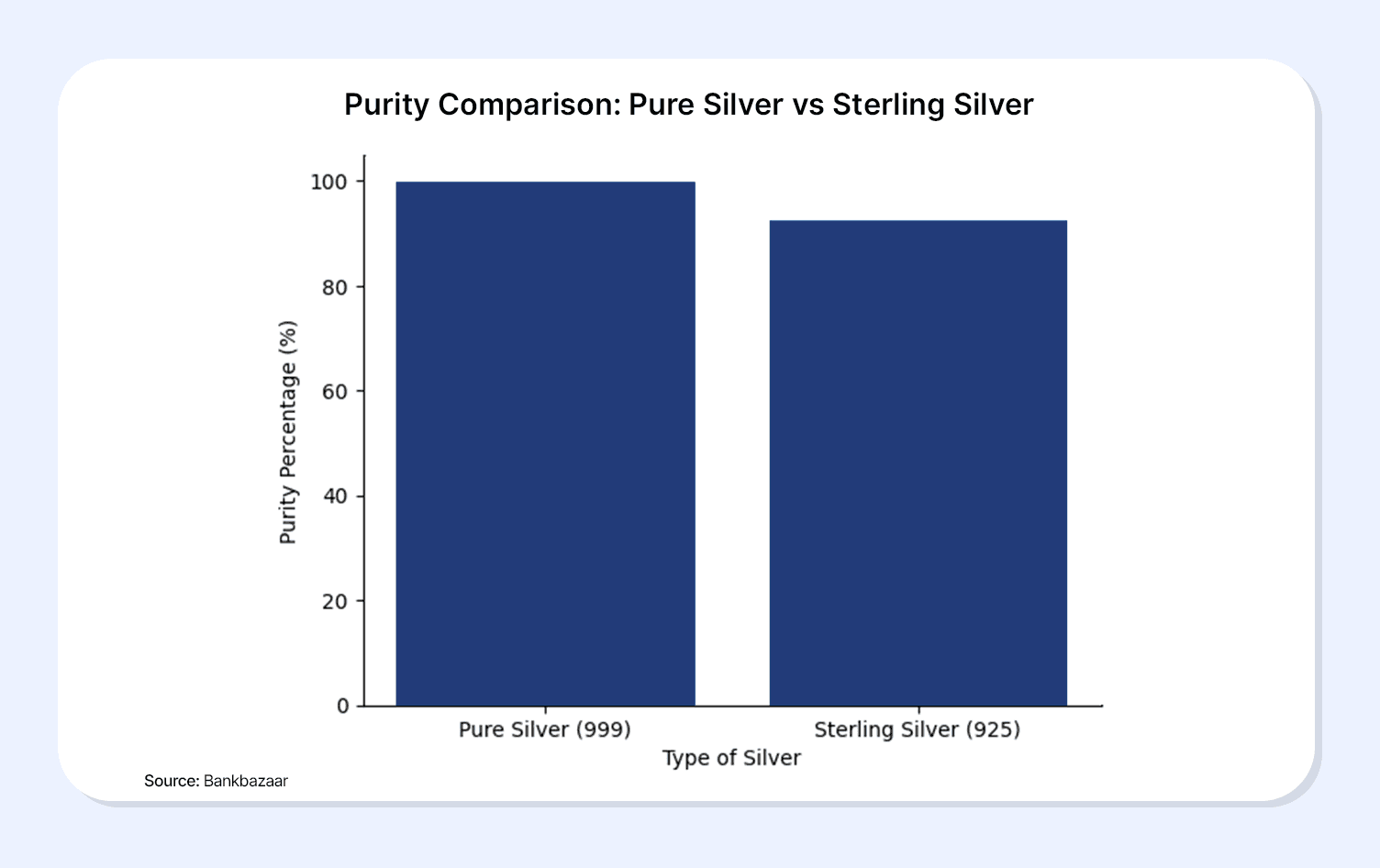
Source: Bankbazaar1
Jewellery Vs Investment Assets: What Should You Choose?
Your financial objective is the deciding factor for choosing between jewellery and investment-grade silver. Factors like liquidity, cost structure, and predictability of returns make the distinction clearer while comparing sterling silver vs silver.
The table below covers factors that you should consider while comparing sterling silver vs silver.
Factor | Silver Jewellery (Sterling Silver) | Investment-Grade Silver |
Primary Purpose | Personal use and aesthetics | Wealth preservation and returns |
Purity Level | Usually 92.5% | Usually 99.9 % |
Liquidity | Limited and inconsistent | High and market-linked |
Pricing Transparency | Includes making and design charges | Closely tracks market silver prices |
Resale Value | Often discounted | Based on prevailing rates |
Cost Recovery | Making charges are not recoverable | Minimal deductions |
Investor Suitability | Not suitable for serious investors | Suitable for portfolio diversification |
Conclusion
It is crucial to understand silver investments in India before purchase, as multiple factors could affect returns in the future. While one works best for jewellery, the other is better for investment purposes. Due to its durability and appearance, sterling works best for jewellery but does not offer pricing and purity when compared to 999 silver.
Taking everything into consideration, silver prices can be volatile, and returns may vary depending on the market. Most investors create a balance by investing in pure silver alongside making investments in fixed-income instruments such as corporate bonds. This provides better cash flow and lower uncertainty, stabilizing overall portfolio. Investing with trusted platforms like Grip Invest makes the process even better, resulting in a strong and diversified portfolio.
To explore the best investment options, invest with Grip Invest today!
FAQs
1. Is sterling silver a good investment?
The primary use of sterling silver is for jewellery and decoration. Due to this, sterling silver is mixed with copper and other metals for durability, making it less suitable as an investment.
2. Does sterling silver have resale value in India?
Sterling silver has limited resale value in India. It is mostly valued by buyers for its silver content rather than its design. Comparing silver jewellery vs silver coins, coins and bars offer better transparency and liquidity.
3. Is pure silver better than gold for investment?
Gold and pure silver investments have completely different investment roles and benefits. While silver is more affordable and has industrial demand, gold is often seen as a stable hedge during economic uncertainty.
References:
1. Bankbazaar, accessed from: https://www.bankbazaar.com/silver-rate/silver-price-trend-in-india.html
Want to stay at the top of your finances?
Join the community of 4 lakh+ investors and learn more about Grip Invest, the latest financial knick-knacks, and shenanigans in the world of investing.
Happy Investing!
Disclaimer - Investments in debt securities/municipal debt securities/securitised debt instruments are subject to risks including delay and/ or default in payment. Read all the offer related documents carefully. The investor is requested to take into consideration all the risk factors before the commencement of trading.
This communication is prepared by Grip Broking Private Limited (bearing SEBI Registration No. INZ000312836 and NSE ID 90319) and/or its affiliate/ group company(ies) (together referred to as “Grip”) and the contents of this disclaimer are applicable to this document and any and all written or oral communication(s) made by Grip or its directors, employees, associates, representatives and agents. This communication does not constitute advice relating to investing or otherwise dealing in securities and is not an offer or solicitation for the purchase or sale of any securities. Grip does not guarantee or assure any return on investments and accepts no liability for consequences of any actions taken based on the information provided. For more details, please visit www.gripinvest.in
Registered Address - 106, II F, New Asiatic Building, H Block, Connaught Place, New Delhi 110001


