

Union Bank FD Rates 2026: Latest Interest Rates For Regular And Senior Citizens


Union Bank of India is a public sector bank established in 1919 and headquartered in Mumbai, Maharashtra. The bank is led by MD & CEO A. Manimekhalai and is known for its nationwide branch network, strong government backing, expanding digital banking services, and broad retail and corporate banking presence across India.
The Union Bank fixed deposit interest rates on deposits of less than INR 3 crores range from 2.70% to 6.60% per annum for regular citizens.1 In comparison, senior citizens enjoy an additional 0.50% per annum interest over and above the regular rates.
Similar to any FD, interest rates here vary with tenure, which can range from 7 days to 10 years. Different FD types might have different lock-ins. For example, a tax-saving Union Bank FD will have a 5-year lock-in. Investors can begin their investment with INR 1,000 only, and there are no maximum limits.2
Suppose Mr K invests INR 10,000 for 4 years, 79 days to get the highest Union Bank of India FD rate, which is 6.60% p.a. for regular citizens. After maturity, his amount would be INR 13,179.
Although FD investment might seem straightforward, understanding the nuances of interest, tenure, terms of investment, types of FD, and other features is crucial for efficient investing.
This blog decodes Union Bank FD rates along with other features in detail.
Union Bank FD Rates
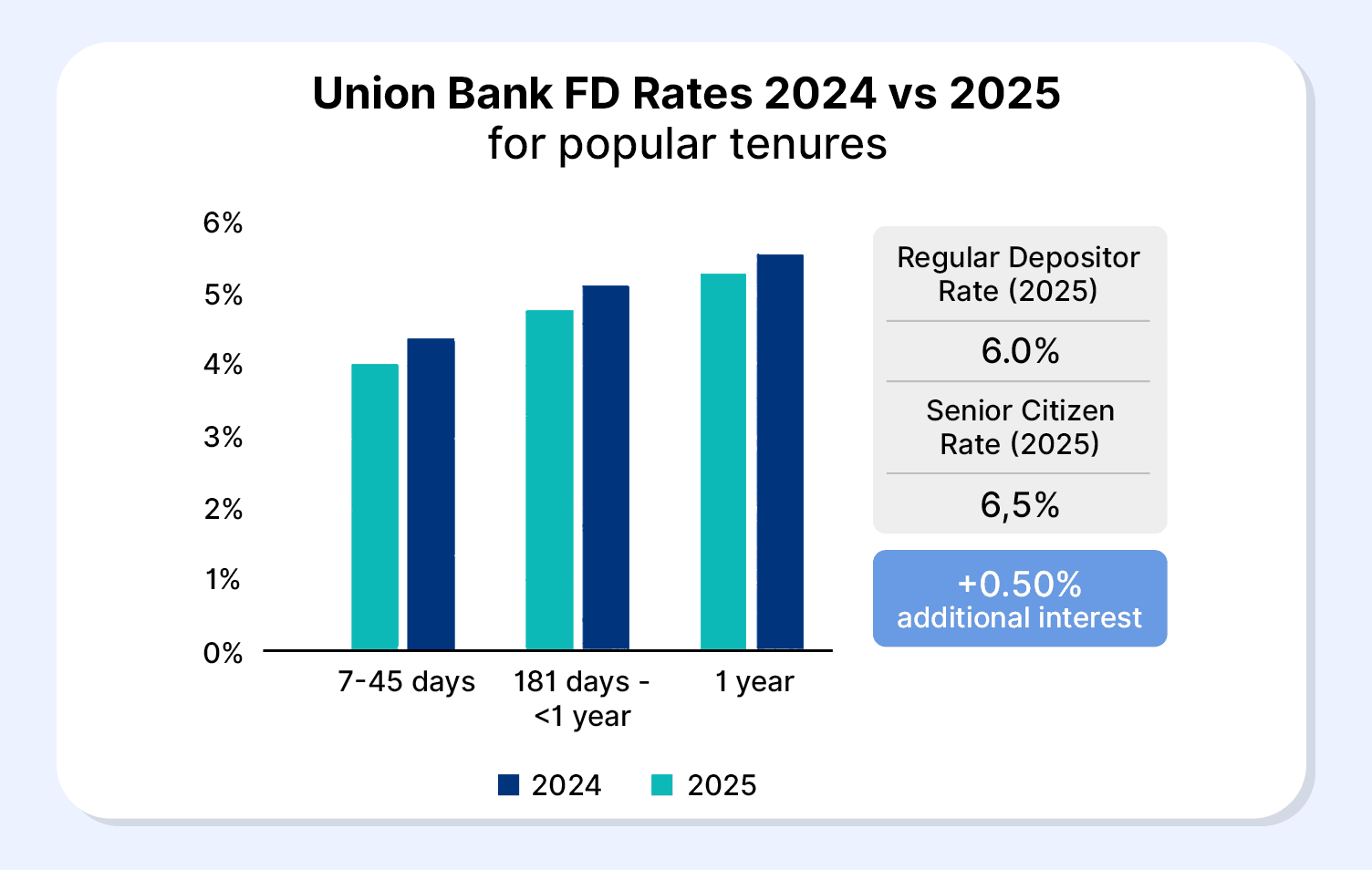
From 20 April 2026, the latest Union Bank FD rates became effective. The table below shows the Union Bank FD Rates 2026, levied on deposits of less than INR 3 crores made by regular investors and senior citizens.
Tenures | Union Bank FD rates 2026 | |
Regular Citizens | Senior Citizens | |
| 7 to 14 days | 2.70% | 3.20% |
| 15 to 30 days | 2.80% | 3.30% |
| 31 to 45 days | 3.00% | 3.50% |
| 46 to 90 days | 4.00% | 4.50% |
| 91 to 120 days | 4.50% | 5.00% |
| 121 to 180 days | 5.00% | 5.50% |
| 181 to 270 days | 5.60% | 6.10% |
| 271 to 364 days | 5.90% | 6.40% |
| 1 year to 399 days | 6.25% | 6.75% |
| 400 days | 6.35% | 6.85% |
| 401 to 443 days | 6.25% | 6.75% |
| 444 days | 6.60% | 7.10% |
| 445 days to 996 days | 6.20% | 6.70% |
| 997 days | 6.15% | 6.65% |
| 998 days to 3 years | 6.20% | 6.70% |
For comparable tenures, the Union Bank FD rates for senior citizens are usually 0.50% higher than those of normal depositors. However, there are different types of Union Bank FDs, which have different rates.
Union Bank FD Schemes
Apart from the regular FD schemes, the Union Bank of India also offers other types of fixed deposits that might have varying Union Bank FD rates. These schemes are discussed below.
1. Tax Saver FD: This deposit allows investors to claim deductions under Section 80C of the Income Tax Act. It allows deductions up to INR 1.5 lakhs. These FDs have a lock-in of 5 years. Premature withdrawal is allowed only in case of the death of the holder, and no penalty is levied.
2. Monthly Income Scheme: Investors can avail a tax-saver or regular FD under the Monthly Income Scheme (MIS). Under this option, the principal remains deposited in the FD and earns interest, which is credited monthly to the linked savings account. On maturity, only the principal matures and gets paid out. It helps generate a fixed, periodic income that can serve as a passive income.
3. Green Deposit: A type of thematic FD, the Union Bank Green Deposit invests in eco-friendly projects, the returns generated from which are paid out as fixed income to FD investors. It functions as a regular FD, but the bank allocates the principal to fund a particular type of project.
4. Flexi FD: This FD combines features of enhanced liquidity, along with regular FD benefits. If the savings account balance increases beyond a certain threshold, the surplus is converted into an FD. The bank automatically liquidates the FD tranches to cover debits when your savings account requires money, often on a LIFO basis.
5. NRE/NRO FD: The bank also allows FD investment from Non-Resident External (NRE) and Non-Resident Ordinary (NRO). NRIs who have income in India, like rent, dividends, etc., often use these FDs to invest ongoing income.
6. Senior Citizen FD: As discussed before, the Union Bank senior citizen FD rates are 0.50% per annum interest over and above their regular deposit rates.
The table below compares some of the unique Union Bank of India FD schemes.
| Parameters | Union Tax Saver | Short Deposit Receipt | Fixed Deposit Receipt | Monthly Income Scheme | Union Green Deposit |
| Minimum Investment | INR 1,000 | INR 1,000 | INR 1,000 | INR 1,000 | INR 1,000 |
| Maximum Investment | INR 1.5 lakhs in a Financial Year | No Limit | No Limit | No Limit | No Limit |
| Interest Rate | As per the interest table | As per the interest table | As per the interest table | As per the interest table | General Customer: 6.30% Sr Citizens: 6.80% Super Sr Citizens: 7.05% |
| Tenure | 5 years lock-in | 7 days to 179 days | 6 months to 120 months | 6 months to 120 months | 997 days |
Source: Union Bank Of India3
The Union Bank fixed deposit interest rates are a key factor when choosing a plan. However, analysing the other features of its deposits is crucial as well.
Key Features Of Union Bank FDs
a) Union Bank FD tenure options
You can invest for very short durations (7 days) up to 10 years1.
This variety makes them flexible for different goals (short-term parking, medium planning, long-term corpus build-up).
b) Auto-renewal
If no instruction is given at maturity, your FD is automatically renewed for the same duration at the prevailing rate.
c) Nomination and Loan facility
You can nominate a beneficiary, and many FDs let you take a loan against your deposit if needed.
d) Union Bank FD interest payout options
You can choose cumulative (interest reinvested) or periodic payouts (monthly/quarterly), depending on the scheme type. The choice affects cash flow and tax implications.
e) Union Bank FD premature withdrawal
If you withdraw before maturity (except for locked-in schemes like tax-saver FD), you’ll incur a penalty. For instance, deposits under INR 2 crore withdrawn before tenure completion may lose 1% interest2.
Knowing the penalty is crucial if you might need liquidity.
Also Read: Post Office 1 Year FD Interest Rate 2026
Comparing Union Bank Of India FD Rates With Others
The table below compares the latest Union Bank FD rates and features to those offered by other banks, non-banking finance companies, small finance banks, etc. Note that the interests mentioned are for regular investors, as of 25 May 2026.
| FD Issuer | Interest Rate Range | Tenure | Minimum Investment |
| Union Bank | 2.70% to 6.60% | 7 days to 10 years | INR 1,000 |
| SBI | 3.05% to 6.05% | 7 days to 10 years | INR 1,000 |
| Bajaj Finance | 6.60% to 7.40% | 1 year to 5 years | INR 15,000 |
| Suryoday SF Bank | 4.00% to 8.10% | 7 days to 10 years | INR 1,000 |
| Axis Bank | 3.00% to 6.45% | 7 days to 10 years | INR 5,000 |
Taxation And Real Returns
1. TDS rules
Interest earned on FDs is taxable as per your slab. For resident senior citizens, interest up to INR 1,00,000 per year doesn’t attract TDS if Form 15H is submitted. For regular depositors, the limit is INR 50,000. If PAN isn’t given, TDS may be 20%.
2. Post-tax effective returns (hypothetical example)
Let’s assume you’re a regular assessee in the 30% tax slab, and pick the 1-year rate of 6.40% for an INR 1 lakh deposit. The table below shows the computation.
| Gross interest | INR 6,400 |
| Tax @ 30% | INR 1,920 |
| Net interest (INR 6,400 - INR 1,920) | 4,480 |
| Effective return | 4.48% p.a. |
3. Inflation and real returns
While nominal Union Bank FD interest rates today may appear decent, inflated costs erode real buying power. If inflation is higher than net returns, value diminishes. For instance, in the example before, if inflation is, say, 2%, the real return becomes 2.48% (4.48% - 2.00%).
4. Use the Union Bank FD calculator
Before committing, use the bank’s or third-party FD calculator to estimate maturity amounts, interest earned, and compare scenarios. Doing so helps you plug in the amount, tenure, payout frequency, etc., to decide if the FD meets your goals.
However, other than fixed deposits, investors can also choose other asset classes for investment. A comparative analysis of FD with other investments can help build a healthy portfolio.
FD Alternatives For Higher Yield
| Instrument | Return | Risk |
| Union Bank FD | Up to 6.60% | Low |
| Corporate FD | Up to 10% | Low to medium |
| Corporate Bond | Up to 12.5% | Low to medium |
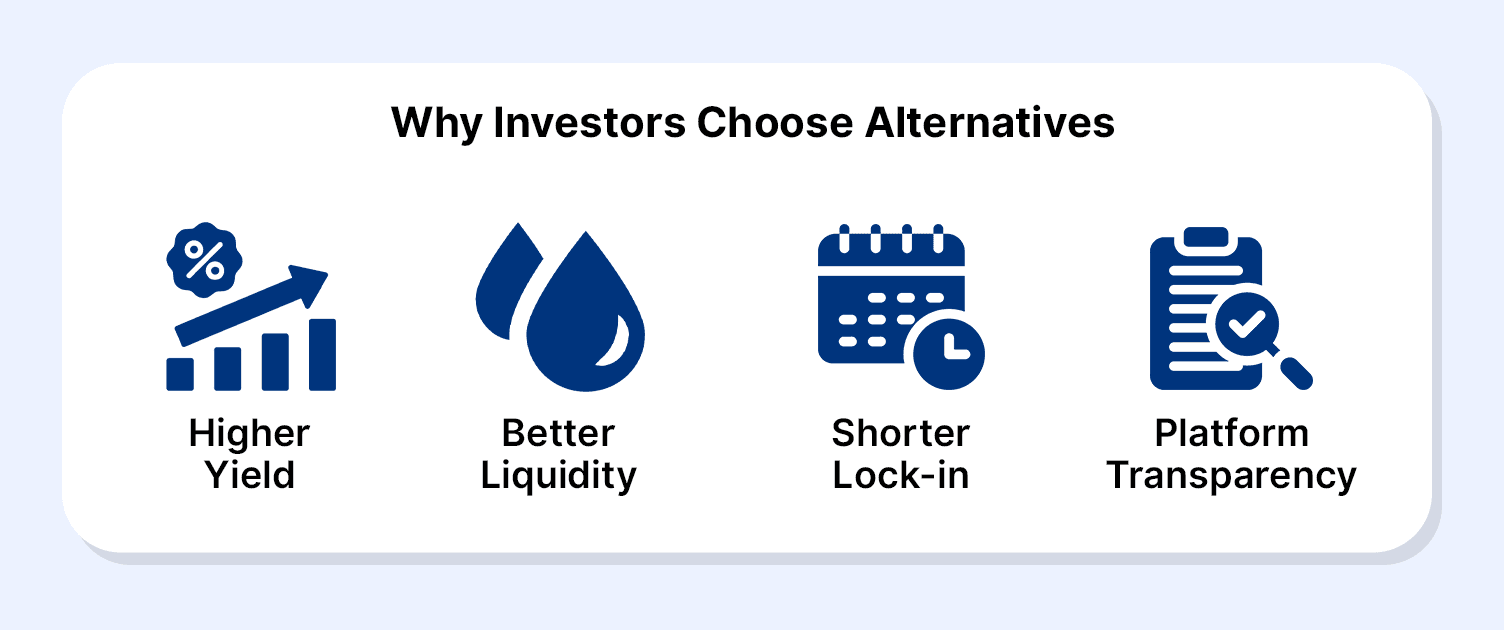
Why Look Beyond Bank FDs?
- Yields are relatively modest given the current inflation and interest-rate environment.
- Some alternate fixed-income instruments may offer better returns, liquidity or flexibility.
If you want to explore options beyond traditional bank FDs, corporate FDs available through platforms like Grip Invest offer an attractive route. These corporate FDs often provide higher interest rates, flexible tenures, and simplified digital onboarding. Many issuers also offer additional features such as periodic payouts, making them suitable for investors looking for predictable cash flows along with better yield potential.
Unlike bank FDs, where rates may fall short after tax and inflation, select corporate FDs curated by Grip Invest can help investors enhance their post-tax returns while still staying within the fixed-income category. However, corporate FDs carry issuer-level risk, so it’s important to review the financial strength of the company and choose options that match your risk appetite and liquidity needs.
Also Read: TDS On FD Interest Explained: Rules, Rates, And How To Avoid Excess Tax
Matching Your Goals
If your priority is capital-preservation with moderate yield, then a reliable FD such as from Union Bank of India may work.
If your priority is better real return or flexibility, exploring curated fixed-income alternatives makes sense.
Conclusion
roughly 2.75% to about 6.60% p.a. for the general public depending on the tenure, with senior citizens typically earning an additional ~0.50% p.a. over the regular rate on most tenures. While the bank offers strong features, varied Union Bank FD tenure options, automatic renewal, nomination and payout choice, the real returns after tax and inflation may be modest.
Using the Union Bank FD calculator will help you estimate your actual maturity outcome and decide if the FD suits your needs. In the meantime, in case you want a greater post-tax and inflation-adjusted return, it is worth considering a curated fixed-income option.
Visit Grip Invest today!
FAQs On Union Bank FD Rates 2026
1. What is the FD rate in Union Bank for 1 year?
For regular depositors, the 1-year FD rate at Union Bank of India is 6.60% p.a.; for senior citizens, it’s 7.10% p.a. (latest as of January 2026, for deposits under INR 3 crore)
2. Does Union Bank deduct TDS on FD interest?
Yes, if your total interest exceeds INR 40,000 (regular) or INR 50,000 (senior citizens) in a financial year and you haven’t submitted Form 15G/15H, TDS will be deducted at the applicable rate.
3. Are there safer alternatives with better returns than Union Bank FDs?
Yes, although the Union Bank FDs are highly secure (public-sector bank), other similar offerings with a higher yield (like those offered by platforms like Grip Invest) or greater liquidity or flexibility are possible. It is simply a matter of balancing your risk appetite, tenure and liquidity requirements.
4. What is the Union Bank FD rate today?
For ordinary individuals, the Union Bank fixed deposit interest rates vary from 2.70% to 6.60% annually on deposits under INR 3 crores. Senior citizens, on the other hand, receive an extra 0.50% annual interest rate on top of the standard rates.
5. Which Union Bank FD gives the highest interest?
The highest Union Bank of India FD rate is 6.60% p.a. for regular citizens for a deposit of 4 years 79 days. The senior citizen rate for this is 7.10%.
6. Is Union Bank FD safe?
Fixed deposit is among the most conventional investment mediums, often chosen due to its fixed interest and low risk profile. DIGCC insures deposits up to INR 5 lakhs per bank per depositor.
7. Can I withdraw an FD before maturity?
Withdrawal of FD before maturity attracts a penalty and fines. However, in some cases, if withdrawal is made due to the death of the depositor, no penalty is levied. For instance, in the case of Union Banks, deposits under INR 2 crore withdrawn before tenure completion may lose 1% interest.
8. What is the minimum FD amount?
For Union Bank of India, FD deposits can start from INR 1,000. However, different banks have different minimum investment limits. Investors must check them before investing.
9. Does Union Bank offer tax-saving FD?
Yes, Union Bank of India offers a tax-saver FD that has a lock-in of 5 years. The deposit allows investors to claim deductions up to INR 1.5 lakhs under Section 80C of the Income Tax Act.
References:
1. Union Bank of India, accessed from: https://www.unionbankofindia.bank.in/en/details/rate-of-interest
2. Paisa Bazaar, accessed from: https://www.paisabazaar.com/union-bank-of-india/fixed-deposits/
3. Union Bank Of India, accessed from: https://www.unionbankofindia.bank.in/en/details/fixed-deposit-receipt-fdr
 |
Author: Grip Invest Editorial Team The Grip Invest Editorial Team is a group of Chartered Accountants, MBA (Finance) graduates, and Qualified Research Analysts dedicated to helping you invest smarter. We dive deep into India's fixed income landscape to deliver content that is accurate, up-to-date, and easy to understand. Whether you're exploring bonds, fixed deposits, or other fixed income opportunities, our guides cut through the noise and give you the clarity to make better financial decisions. |
Want to stay at the top of your finances?
Join the community of 4 lakh+ investors and learn more about Grip Invest, the latest financial knick-knacks, and shenanigans in the world of investing.
Happy Investing!
Disclaimer - Investments in debt securities/municipal debt securities/securitised debt instruments are subject to risks including delay and/ or default in payment. Read all the offer related documents carefully. The investor is requested to take into consideration all the risk factors before the commencement of trading.
This communication is prepared by Grip Broking Private Limited (bearing SEBI Registration No. INZ000312836 and NSE ID 90319) and/or its affiliate/ group company(ies) (together referred to as “Grip”) and the contents of this disclaimer are applicable to this document and any and all written or oral communication(s) made by Grip or its directors, employees, associates, representatives and agents. This communication does not constitute advice relating to investing or otherwise dealing in securities and is not an offer or solicitation for the purchase or sale of any securities. Grip does not guarantee or assure any return on investments and accepts no liability for consequences of any actions taken based on the information provided. For more details, please visit www.gripinvest.in
Registered Address - 106, II F, New Asiatic Building, H Block, Connaught Place, New Delhi 110001


