

FD Vs Small Savings Scheme In India 2026: Key Differences And Returns



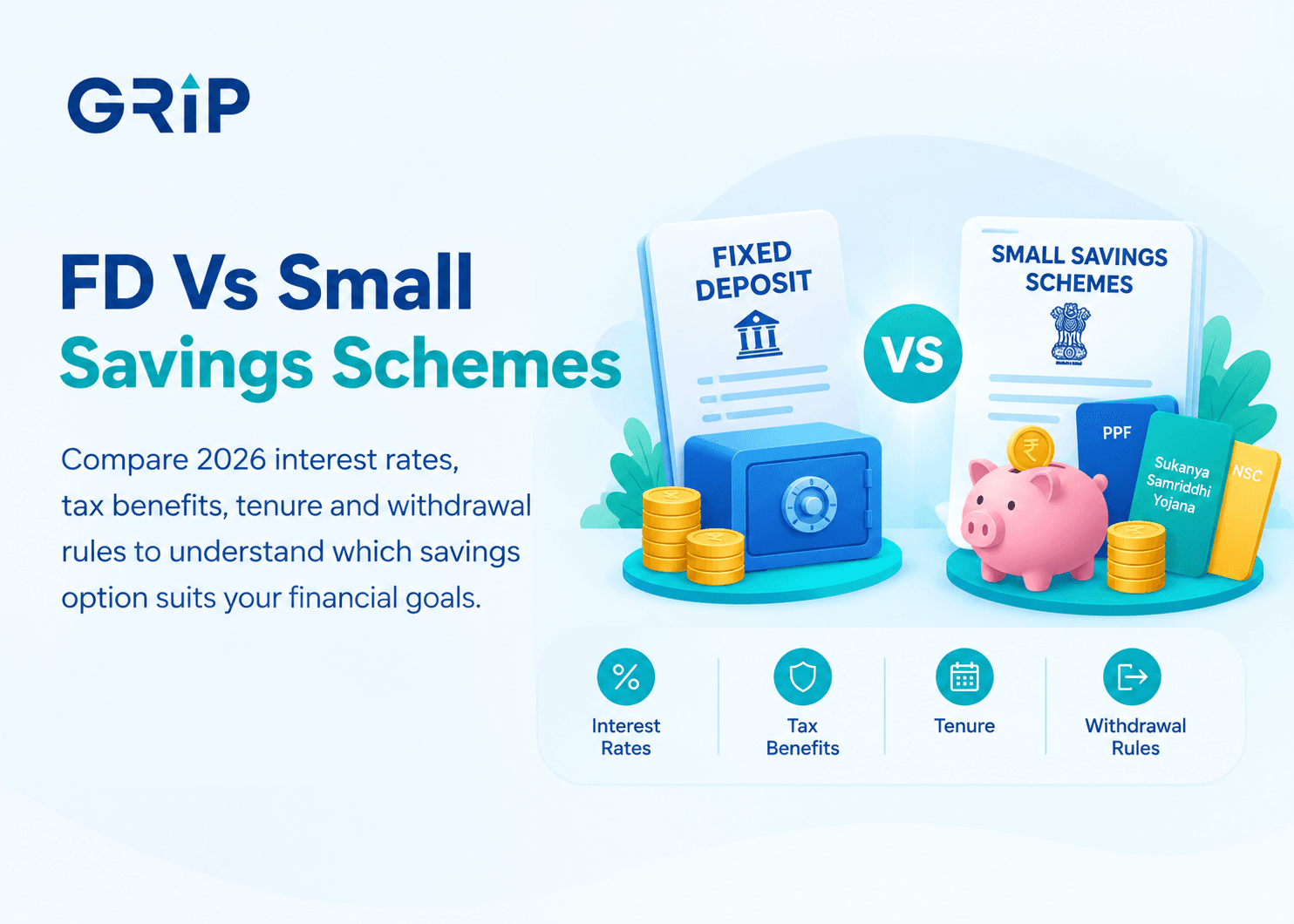
FD Vs Small Savings Scheme: What’s the Difference?
A fixed deposit (FD) is a low-risk financial instrument where you deposit a lump-sum amount of money with a bank or financial institution for a set period at a predetermined, locked-in interest rate. limited
On the contrary, a small savings scheme is a group of government-backed savings products rather than a single investment. It comprises products such as Public Provident Fund (PPF), National Savings Certificate (NSC) and Post Office Time Deposits, each with different interest rates, tenures, tax treatment, eligibility and withdrawal rules.
While bank FDs offer highly flexible tenures ranging from 7 days to 10 years and variable rates depending on the bank, small savings schemes feature government-regulated interest rates, fixed tenures and tax-saving benefits under the Income Tax Act 1961, Section 80C.1 These provisions have been replaced by the Income Tax Act 2025, Section 123, Schedule XV, which provides the corresponding INR 1.5 lakh aggregate deduction for specified savings instruments.2 This forms the basis of the fixed deposit vs small savings scheme comparison.
What Are Small Savings Schemes In India?
Small savings schemes in India are government-backed savings instruments administered by the Ministry of Finance and distributed mainly through post offices and authorised banks. They are designed to encourage household savings while providing returns under government-notified scheme rules. The interest rates are reviewed and notified by the government every quarter.
These schemes broadly fall into three categories:
- Postal Deposits: Post Office Savings Account, Recurring Deposit and Time Deposit.
- Savings Certificates: National Savings Certificate (NSC) and Kisan Vikas Patra (KVP).
- Social Security Schemes: Public Provident Fund (PPF), Sukanya Samriddhi Account and Senior Citizens’ Savings Scheme (SCSS).
Their purposes range from short-term deposits and fixed-tenure savings to retirement and long-term financial planning.
How Do Bank FDs Work?
Bank FDs are a low-risk and predictable form of fixed-income investment.
- Deposit money: You deposit a lump sum with the bank for the chosen period.
- Select tenure: FD tenures can range from 7 days to 10 years, depending on the bank.3
- Lock the rate: Since the interest rate stays constant, your returns are unaffected by market fluctuations.
- Earn interest: You can also select how you want to receive interest, periodically or accumulate it until maturity.
- Receive maturity amount: Upon maturity, the bank returns your principal with applicable interest at maturity.
- Withdraw early: Banks may allow premature withdrawals, but may apply penalties or reduced interest.
FD Vs Small Savings Scheme: Key Differences
The key bank FD vs government savings scheme difference is in how they are offered, priced and taxed. The table below compares the two:
Basis | Bank FD | Small Savings Schemes |
| Provider | Banks set their own FD rates and terms. | Rates and scheme rules are notified by the Government. |
| Interest rate | Varies across banks and tenures. | Scheme-specific rates are notified quarterly. |
| Tenure | Usually ranges from 7 days to 10 years. | Depends on the scheme, from 1-year TDs to 15-year PPF.4 |
| Tax treatment | Interest is taxable as per applicable income-tax rules. | Tax treatment varies by scheme, with some offering Section 80C benefits.5 |
| Withdrawal | Premature closure is generally permitted, subject to bank terms. | Withdrawal rules differ significantly across schemes. |
FD Vs Small Savings Interest Rates In 2026
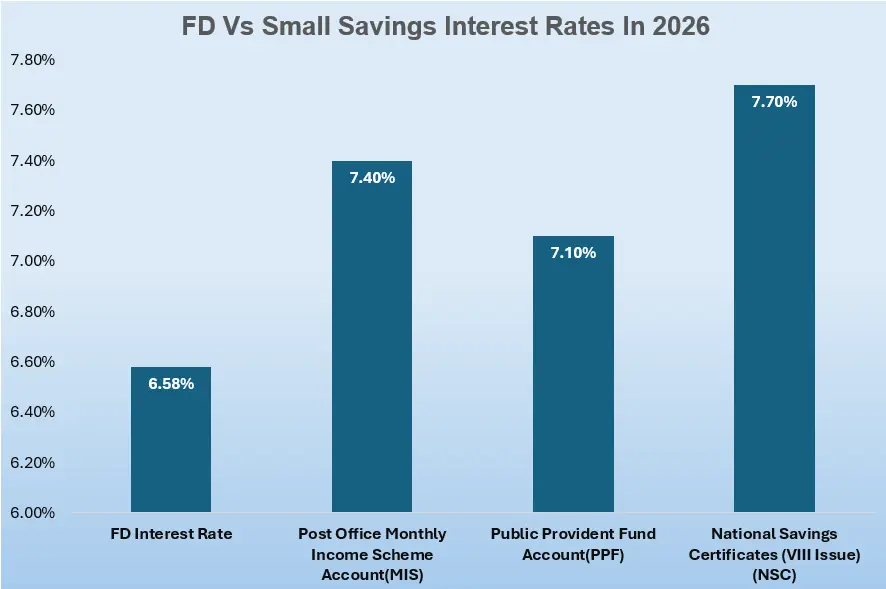
Note: FD average is calculated based on major Indian banks across public, private and small finance. All rates are per annum. Small savings interest rates 2026 are applicable during the period July-September 2026.6
How Are FD And Small Savings Interest Rates Set?
Bank FD interest rates are set by individual banks based on their deposit and funding requirements, market conditions and the tenure of the deposit. RBI allows banks to determine their domestic term-deposit rates, subject to applicable regulatory requirements. This distinction is relevant when comparing bank FD vs government savings scheme.
Small savings interest rates are not set separately by each bank or post office. The Government reviews and notifies these rates, with the rates applicable to different schemes announced for each quarter. The Department of Economic Affairs publishes these notifications for schemes such as PPF, NSC, SCSS and Post Office deposits.
The FD rates, as a result, differ between banks and tenures, while the same small savings scheme carries the notified rate across its applicable channels and this becomes relevant when assessing government savings schemes vs FDs.
Liquidity And Premature Withdrawal
Liquidity differs across FDs and small savings schemes as each product has its own withdrawal rules and lock-in conditions. Bank FDs can usually be closed before maturity, although the bank may reduce the applicable interest rate or levy a premature-withdrawal penalty.
The withdrawal rules for small savings schemes depend on the product.
- PPF: PPF has a 15-year lock-in, but limited premature closure is allowed after completion of 5 years from the end of the year the account was opened.7
- NSC: NSC has a fixed 5-year lock-in and strictly restricts premature encashment, except in specified circumstances like death, court order, or forfeiture.8
- Post Office Time Deposits: It can generally be closed prematurely after 6 months, with graduated interest penalty rules depending on the tenure completed.9
Liquidity is therefore an important factor when comparing fixed-income opportunities, including corporate bonds. This shows that a product might offer a higher return, but it may not suit everyone who requires access to the invested money before maturity. The same consideration applies when comparing FD vs PPF, FD vs NSC and FD vs SCSS.
Conclusion
The comparison between an FD and a small savings scheme depends on the specific products being considered. PPF, NSC, SCSS and Post Office Time Deposits differ in tenure, interest rates, tax treatment and withdrawal conditions, so their features cannot be compared as one category.
The key consideration is therefore not just the headline interest rate. Tenure, liquidity, tax treatment and the time for which you can keep your money invested can materially affect which option fits your financial requirement.
FAQs

Want to stay at the top of your finances?
Join the community of 22 lakh+ investors and learn more about Grip Invest, the latest financial knick-knacks, and shenanigans in the world of investing.
Happy Investing!
Disclaimer - Investments in debt securities/municipal debt securities/securitised debt instruments are subject to risks including delay and/ or default in payment. Read all the offer related documents carefully. The investor is requested to take into consideration all the risk factors before the commencement of trading.
This communication is prepared by Grip Broking Private Limited (bearing SEBI Registration No. INZ000312836 and NSE ID 90319) and/or its affiliate/ group company(ies) (together referred to as “Grip”) and the contents of this disclaimer are applicable to this document and any and all written or oral communication(s) made by Grip or its directors, employees, associates, representatives and agents. This communication does not constitute advice relating to investing or otherwise dealing in securities and is not an offer or solicitation for the purchase or sale of any securities. Grip does not guarantee or assure any return on investments and accepts no liability for consequences of any actions taken based on the information provided. For more details, please visit www.gripinvest.in
Registered Address - 106, II F, New Asiatic Building, H Block, Connaught Place, New Delhi 110001


