

Gold Price Crash History In India: Is A Major Gold Crash Coming In 2026?


Gold is considered one of the safest investments in India. When stock markets go down, investors rush towards gold to add stability to their portfolio. However, after reaching a peak and then a crash in gold price in 2026, highlights the volatility that gold investments bring to your portfolio. After a record peak of INR 1,80,779 per 10 grams in January, prices plunged 13.5% to INR 1,56,993 by mid-February1.
This gold price crash today stems from a surging US dollar and reports of Russia resuming dollar-based trade. Investors are also assuming that gold prices will go below INR 1 lakh by 2027.
In this article, we will analyse the gold crash and its reasons. We will also focus on the impact that it brings to a retail investor’s portfolio.
Gold Crash In 2026: A Case Study In Volatility
The year 2026 has delivered two distinct and dramatic gold crashes, first in January-February, and then again in March, making it arguably the most volatile year for gold in four decades.
The First Crash (January–February 2026)
Gold started 2026 at a peak of INR 1,80,779 per 10g before crashing sharply. By mid-February, prices had fallen to INR 1,56,993, a 13.5% drop.
On January 31 alone, gold saw a 10% single-day fall, its sharpest one-day crash since 1983. The key triggers were:
- A strengthening US Dollar that made gold expensive for buyers using other currencies
- New US Fed leadership under Kevin Warsh, which boosted investor confidence in dollar-denominated assets
- Reports of Russia resuming US Dollar usage for trade, further reinforcing dollar demand and reducing gold's appeal as an alternative reserve
In India, the crash was amplified by forced selling from traders meeting margin calls, which pushed domestic prices down even further.
The War Rally and the Second Crash (February–March 2026)
Just as gold was recovering, the US-Israel strikes on Iran (February 28, 2026) triggered a sharp safe-haven surge, pushing gold to an all-time high of INR 1,69,349 per 10g on 2 March 2026 and $5,300+ per ounce globally. However, this rally also collapsed fast. By the week of March 16 to 22, gold recorded its worst weekly fall in nearly 40 years, with domestic 24K prices plunging by INR 1,43,500 per 100g (INR 1,435 per gram) in just 7 days.
As of March 24, 2026, gold is trading at approximately INR 1,38,686 per 10g (24K), down over 18% from its March ATH.
Here is the full price journey of 2026 so far:
| Period | Gold Price (USD/oz) | India Price (INR/10g) |
| January 2026 (ATH) | ~$3,100+ | INR1,80,779 |
| Mid-February 2026 (first crash) | ~$2,800 | INR1,56,993 |
| 28 Feb 2026 (war begins) | ~$3,100+ | INR1,40,000+ |
| 2 March 2026 (war ATH) | ~$5,300+ | INR1,69,349 |
| 13 March 2026 | ~$5,200 | ~INR1,65,000 |
| 22 March 2026 (lowest March) | ~$4,354 | INR1,31,936 |
| 24 March 2026 (current) | ~$4,400 | INR1,38,686 |
Gold Falls to a 7 Month Low in June 2026
Gold prices continued to weaken in June 2026, slipping to a seven-month low in international markets. Unlike the earlier declines that were triggered by policy changes and geopolitical developments, this phase was driven by a combination of stronger US economic sentiment and shifting investor preferences.
The key reasons behind the latest fall were:
A stronger US Dollar, which made gold more expensive for overseas buyers.
Expectations that the US Federal Reserve could keep interest rates higher for longer, reducing the appeal of non-interest-bearing assets like gold.
A broad technology stock rally that encouraged investors to move away from traditional safe-haven assets.
Easing demand for defensive investments as market sentiment improved.
The June decline highlights that gold prices are influenced by multiple global factors, including interest rates, currency movements, investor sentiment, and geopolitical risks. Even after strong rallies, the precious metal can experience sharp corrections when macroeconomic conditions change.
Gold Price History In India (1964–2026)
While looking at the history, we see gold prices have grown over 1400 times since 1964 in India. In 1964, it was just INR 63.25 per 10 grams, and in January 2026, it crossed INR 1,80,779 per 10 grams. However, with all these gains, it has corrected as well from time to time. Let us have a look at the ups and downs in the gold price in India:
- 1960s–1970s (Controlled Markets): During this decade, the prices were mostly governed by the government. It rose from INR 63 in 1964 to INR 184 in 1970 as inflation began to affect the Indian economy.
- 1980s (Oil Shocks): Due to global oil shocks in 1980, the gold saw a big jump and rose to INR 1,330 per 10 grams.
- 2000–2010 (The Financial Crisis): During this decade, the global financial crisis took place. Investors found gold as a safe haven for their money, which led to a huge surge in the price of gold as it rose by 320%, jumping from INR 4,400 to INR 18,500.
- 2020–2026 (Pandemic and Modern Volatility): During the last 5 to 6 years, the world has seen different conflicts and challenges. First, it was COVID-19 and then wars between big economies like Russia and Ukraine; Iraq - Iran and Israel - Hamas. The instability further made gold the preferred choice, leading to all time high price of gold in 2026.
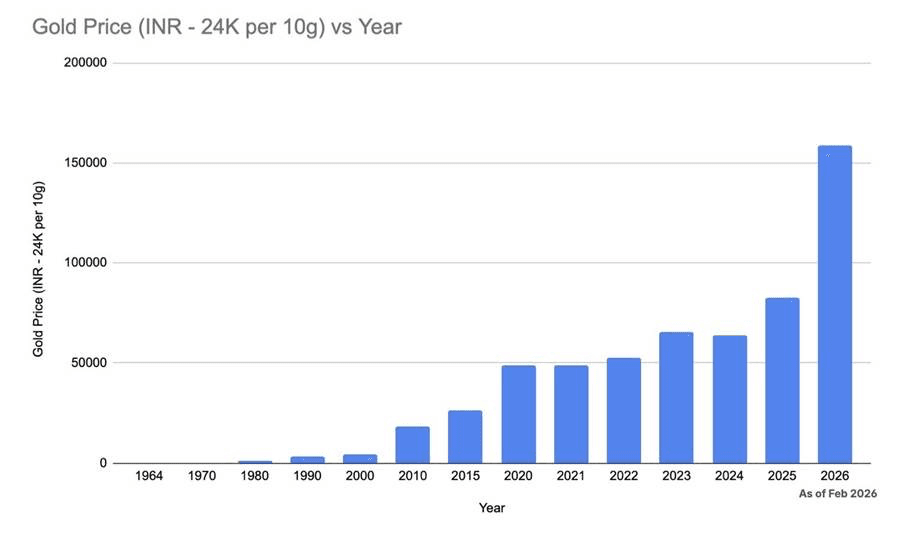
History tells us that gold has seen an upward trend. But it has experienced corrections in the price, too. For example, in February 2026, it saw a huge drop of 13.5%. In 2013, the gold price crashed due to different reasons, including a stronger dollar, equity shifts, and India’s 10% import duty hike. It came down to INR 25,000 per 10 grams from INR 31,000, which is a 30% decline3.
What Triggers A Gold Price Crash?
With the above discussion, we can understand that there is no single factor that leads to a crash in the gold prices. We can consider the following major reasons that lead to a crash in the gold price:
1. Strengthening US Dollar: If the US Dollar appreciates, it makes gold expensive for international buyers. Due to this, the demand for gold reduces, leading to low prices.
2. Rising Bond Yield: Bonds are fixed-income opportunities offering predictable returns. If the bond yield rises, investors will start preferring bonds rather than gold. This also leads to a crash in the gold prices.
3. Profit Booking After Rallies: Once the prices are at their peak, the big players start booking profits by selling their holdings. This leads to a crash in the prices.
4. Stable Geopolitical Scenario: It sounds a little awkward, but yes, when the geopolitical scenario is in order, investors start looking for other income-generating assets like equity, crypto, real estate, etc. Due to this, the demand for gold decreases.
5. Lower Inflation or Central Bank Pauses: Gold is considered a hedge against inflation, but what if the inflation is lower? People will start looking at other assets. Similarly, if the central bank, like the Reserve Bank of India (RBI), stops buying gold, it also hampers the sentiments of the investors towards gold.
Is A Major Gold Crash Coming? Expert Predictions For 2027
Because of a huge spike in the price and then a crash in 2026, there is a buzz in the market that it may come down below INR 1 lakh per 10 grams. But these are just assumptions and discussions on social media platforms. As far as experts' opinion is concerned, no major crash in gold prices is predicted in 2026 or 2027. In fact, most of the forecasts are bullish about the gold prices. They are predicting that it will reach INR 1.2 - 1.6 lakhs per 10 grams in India4. The prices might rise due to the central bank buying more gold, inflation and ongoing global uncertainty.
A crash can only happen if the US dollar appreciates sharply and interest rates rise. Still, it can bring gold prices down to INR 1 - 1.1 lakh per 10 grams. Overall, the scenario is pointing toward an upward direction, not a crash5.
Impact On The Indian Market And Retail Investors
A crash in the gold prices hits the Indian market hard. Due to the crash, investor confidence goes down, and overall investments from retail investors get hampered. Retail buyers and households, who keep the gold for different purposes, like weddings and festivals; they also feel the pain due to a loss in the overall value of the metal. In past drops like 2013 and 2026, MCX prices fell 20-30%, forcing many to delay purchases or sell at lows. Retail investors lose the portfolio value assigned to gold ETFs and Sovereign Gold Bond.
However, history says that patience pays off. Investors should stay invested and diversify their portfolio effectively so that such crashes do not impact their overall return to a larger extent. To protect the portfolio, adding fixed income opportunities like corporate bonds and corporate fixed deposits to your portfolio becomes essential. Corporate bonds on Grip Invest offer fixed returns of up to 12.5% p.a. Register today to explore the live opportunities.
Conclusion
The gold price crash in 2026 highlights an important reality for investors — even traditionally safe haven assets can experience short term volatility. Factors such as a stronger US dollar, shifting interest rate expectations, profit booking after record highs, and evolving geopolitical developments can all influence gold prices in the near term.
However, historical trends suggest that gold has maintained its long term relevance as a store of value and a portfolio diversifier despite periodic corrections. For Indian investors, the key takeaway is not to react emotionally to price swings but to focus on disciplined asset allocation and diversification across multiple investment categories.
A well balanced portfolio that combines gold with fixed income instruments and growth assets can help reduce the impact of market cycles and improve overall financial resilience.
For investors looking to diversify beyond gold, exploring curated fixed income opportunities on Grip Invest can be a useful step toward building a more stable and income oriented portfolio.
FAQs On Gold Crash
References:
1. News 24, accessed from: https://news24online.com/business/gold-price-alert-gold-price-may-crash-to-below-rs-1-lakh-due-to-this-country-not-china-us-name-is-russia/749142/
2. BBC, accessed from: https://www.bbc.com/news/articles/c87r2700dq8o
3. Livemint, accessed from: https://www.livemint.com/market/commodities/gold-rate-in-india-may-crash-below-rs-1-lakh-comex-gold-price-to-touch-3-000-oz-after-this-reported-russian-move-11771147554560.html
4. EBC Financial Group, accessed from: https://www.ebc.com/forex/gold-rate-prediction-for-next-5-years-in-india-expert-outlook
5. JP Morgan, accessed from: https://www.jpmorgan.com/insights/global-research/commodities/gold-prices
Want to stay at the top of your finances?
Join the community of 4 lakh+ investors and learn more about Grip Invest, the latest financial knick-knacks, and shenanigans in the world of investing.
Happy Investing!
Disclaimer - Investments in debt securities/municipal debt securities/securitised debt instruments are subject to risks including delay and/ or default in payment. Read all the offer related documents carefully. The investor is requested to take into consideration all the risk factors before the commencement of trading.
This communication is prepared by Grip Broking Private Limited (bearing SEBI Registration No. INZ000312836 and NSE ID 90319) and/or its affiliate/ group company(ies) (together referred to as “Grip”) and the contents of this disclaimer are applicable to this document and any and all written or oral communication(s) made by Grip or its directors, employees, associates, representatives and agents. This communication does not constitute advice relating to investing or otherwise dealing in securities and is not an offer or solicitation for the purchase or sale of any securities. Grip does not guarantee or assure any return on investments and accepts no liability for consequences of any actions taken based on the information provided. For more details, please visit www.gripinvest.in
Registered Address - 106, II F, New Asiatic Building, H Block, Connaught Place, New Delhi 110001


