

Types of Government Bonds in India: Features, Benefits And How To Choose


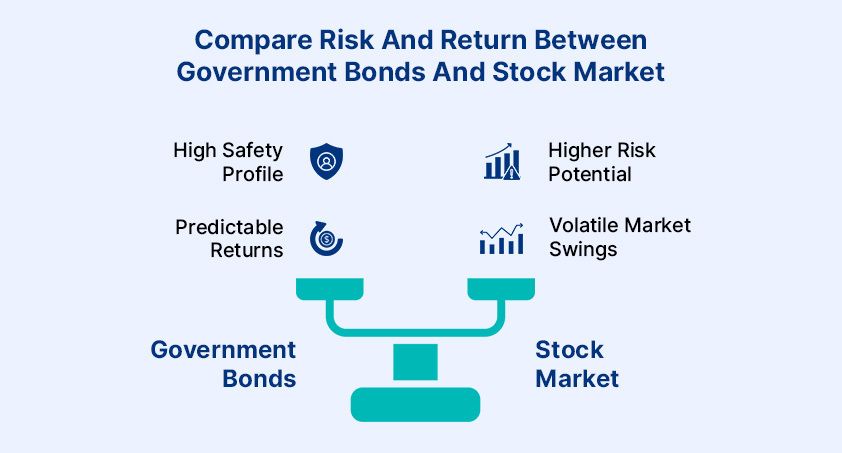
Government bonds in India are synonymous with safety and stability. Unlike equities or other high-risk investments, government securities offer predictable returns and lower risk, making them an attractive option for conservative investors.
In 2025, Indian investors can choose from a variety of government bonds including treasury bills, sovereign gold bonds, and inflation-linked bonds.
Understanding the features, returns, and tax benefits of these bonds can help investors build a secure and well-diversified portfolio while achieving long-term financial goals.
Why Government Bonds Are A Safe Investment
What Are Government Bonds And How They Work
Government bonds are fixed income securities India issued by the government to raise funds for infrastructure projects, manage fiscal deficits, and finance other public expenditures. When you invest, you are lending money to the government, receiving periodic interest payments and the principal at maturity. This structure makes them accessible even to novice investors seeking stability.
Safety And Risk Factors Compared To Other Investment Options
The primary appeal lies in their safety profile. Since they are backed by the sovereign, the risk of default is minimal. The government’s power to tax and print currency means these obligations are almost always honoured. While the Indian stock market has seen multiple corrections of over 20% in the last decade, government securities India have consistently delivered their promised returns.
These bonds are not entirely risk-free; they are subject to interest rate risks and inflation risk. When interest rates rise, bond prices fall, potentially causing mark-to-market losses if sold before maturity. However, compared to other investments, these risks are more predictable and manageable, especially with a well-planned holding strategy.
Types Of Government Bonds In India
1. Treasury Bills (T-Bills): Short-term Options
Treasury Bills India are short-term instruments available in three tenures: 91 days, 182 days, and 364 days. These zero-coupon securities are sold at a discount to face value and are considered the most liquid among government securities.
For example, you might buy a INR 100 face value T-bill for INR 98. At maturity, you receive INR 100, with the INR 2 difference being your return.
T-bills offer high liquidity, zero default risk, and secondary market availability. They’re ideal for emergency funds, temporary cash parking, and as part of a bond laddering strategy.
2. Government Securities (G-Secs): Long-term Debt Instruments
Long-term government bonds India or G-Secs, have maturities ranging from 1 to 40 years. Unlike T-bills, they pay periodic interest at fixed rates, typically semi-annually or annually, depending on the issue.
The government issues G-Secs across various maturity “buckets”, short (1-5 years), medium (5-10 years), and long (10+ years).
Long-term government bonds India offer tax efficiency when held to maturity and predictable income, making them valuable for retirees and institutional investors with long-term liabilities.
3. Sovereign Gold Bonds: Benefits And Tax Incentives
Sovereign Gold Bonds India are government-backed securities denominated in gold grams, combining government stability with potential gold appreciation. Introduced in 2015, they’ve become increasingly popular among retail investors seeking gold exposure without physical storage concerns.
Each SGB unit represents 1 gram of gold, with an 8-year tenure and 2.50% annual interest. The real advantage is in capital gains; if gold prices rise, you benefit from that appreciation. Best of all, long-term capital gains from Sovereign Gold Bonds India are tax-exempt.
With gold prices showing strong performance amid global uncertainties, these bonds offer a unique combination of steady interest and potential capital appreciation.
4. Inflation-Indexed Bonds: Hedge Against Inflation
Inflation-indexed bonds India protects investors from inflation by adjusting the principal amount with inflation rates. Interest is calculated on this adjusted principal, providing a “real” return above inflation.
For instance, with INR 10,000 invested, a 5% inflation rate would adjust your principal to INR 10,500, with interest calculated on this new amount. This ensures that your purchasing power remains protected, unlike conventional bonds, where inflation erodes real returns. They’re particularly suitable for pension funds and conservative investors who prioritise preservation of purchasing power over maximising nominal returns.
How To Invest In Government Bonds In India
With the rise of digital investment platforms, investing in bonds—including government securities—has become far more accessible for everyday investors. Platforms like Grip simplify not just the investment process but also the ongoing management and tracking of your bond portfolio.
This shift toward digital investing has significantly boosted retail participation in government securities, as investors now prefer options that offer predictable returns, lower volatility, and complete transparency. For anyone exploring how to invest in G-Secs in India, these platforms remove paperwork, reduce friction, and make fixed income investing smoother than ever.
Investing In Government Bonds Via Grip
In one way or another, Grip is a kind of revolution as it has democratized investment in bonds. The process, when done via conventional channels, was time-consuming, and there was an inherent factor of lower accessibility.
Here is how the process works:
| Sign up and complete KYC | Create an account and verify your identity through a quick online KYC process. |
| Explore available government securities | Browse the government bonds listings, with coupon rates details, maturities, credit standing, and expected yield. |
| Select the bond and start investing | Choose the amount you want to invest. Most listings offer a low minimum investment thresholds. This enables easy entry for new investors. |
| Track holdings and returns | Investors can track the interest to be received and overall performance directly on the platform. |
In addition to Grip, you can still invest in government bonds through the conventional modes.
Other Ways To Invest In Government Bonds
Here are some conventional ways of investing in bonds, besides the Grip platform:
- RBI Retail Direct: This allows investors to open an account directly with the RBI. Through which you can buy and sell government securities in both the primary and the secondary market.
- NSE and BSE Platforms: Selected government bonds are listed on both platforms. Investors can buy or sell these bonds through a registered stockbroker, like trading shares.
- Banks: Many banks offer government bonds during their primary issuance. Investors can apply through their bank when new bond issues are available.
- Debt Mutual Funds and ETFs: Debt mutual funds and ETFs invest in government securities and other debt instruments. This makes them suitable for those who prefer to invest in government bonds.
Current Interest Rates Across Bond Types
The interest rate across government bonds varies across instruments, with the yield shifting based on maturity, liquidity, inflation, and policy changes made by the RBI.4
Here are the sovereign bond interest rates in India as of early FY 2027:
Bond type | Current interest rate |
| Government securities (10-year G-sec) | 6.27% up to 7.49% |
| Treasury bills | 5.29% to 5.69% |
| State Development Loans (SDLs) | 7.43% to 7.80% |
| RBI Floating Rate Savings Bonds 2020 (Taxable) | 8.05% |
| Government of India Floating Rate Bond 2033 (FRB 2033) | 6.82% |
| Sovereign gold bonds | 2.5% fixed rate |
Source: RBI, CCIL India, economic times, business standard, 5,6,7,8,9,10
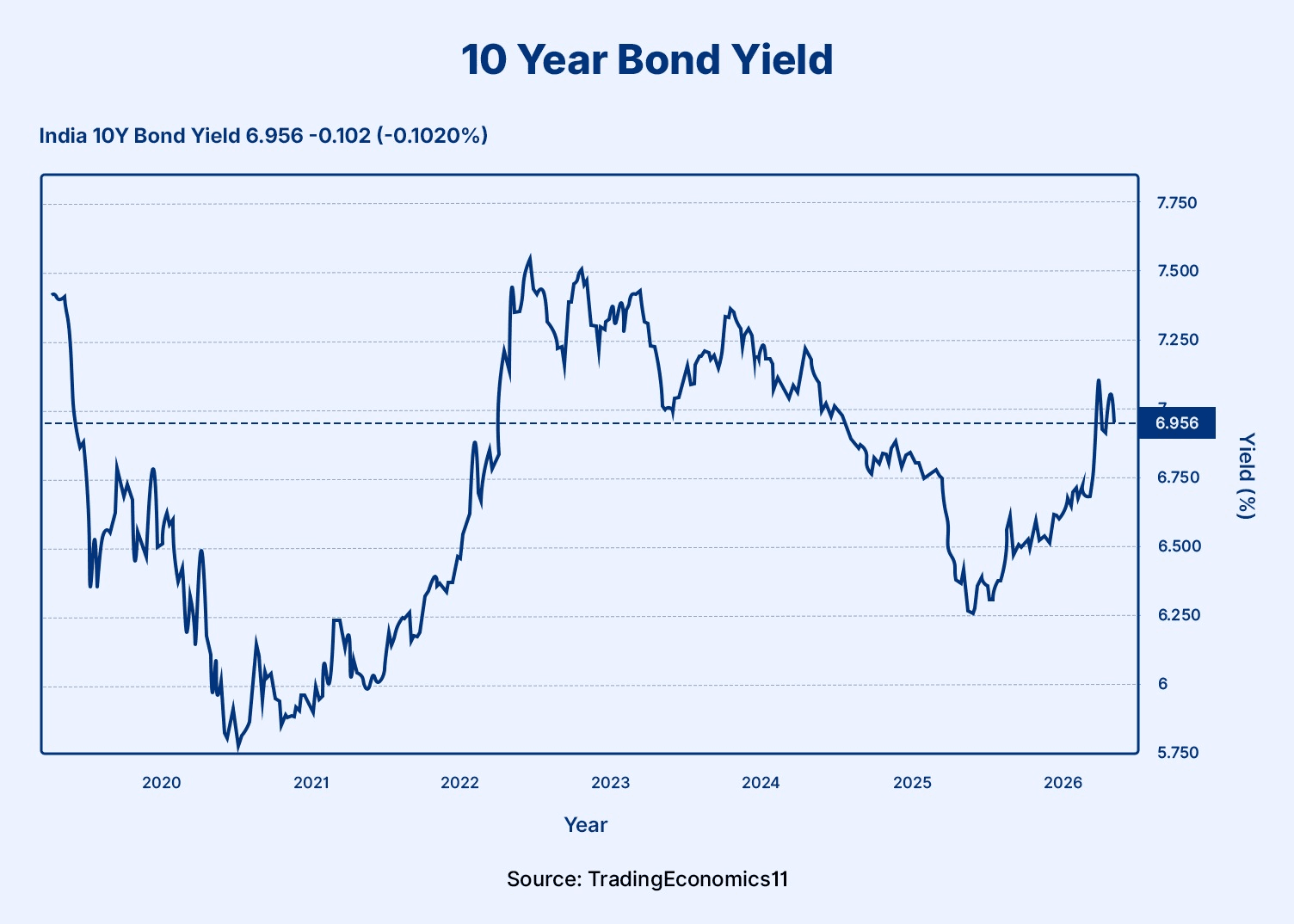
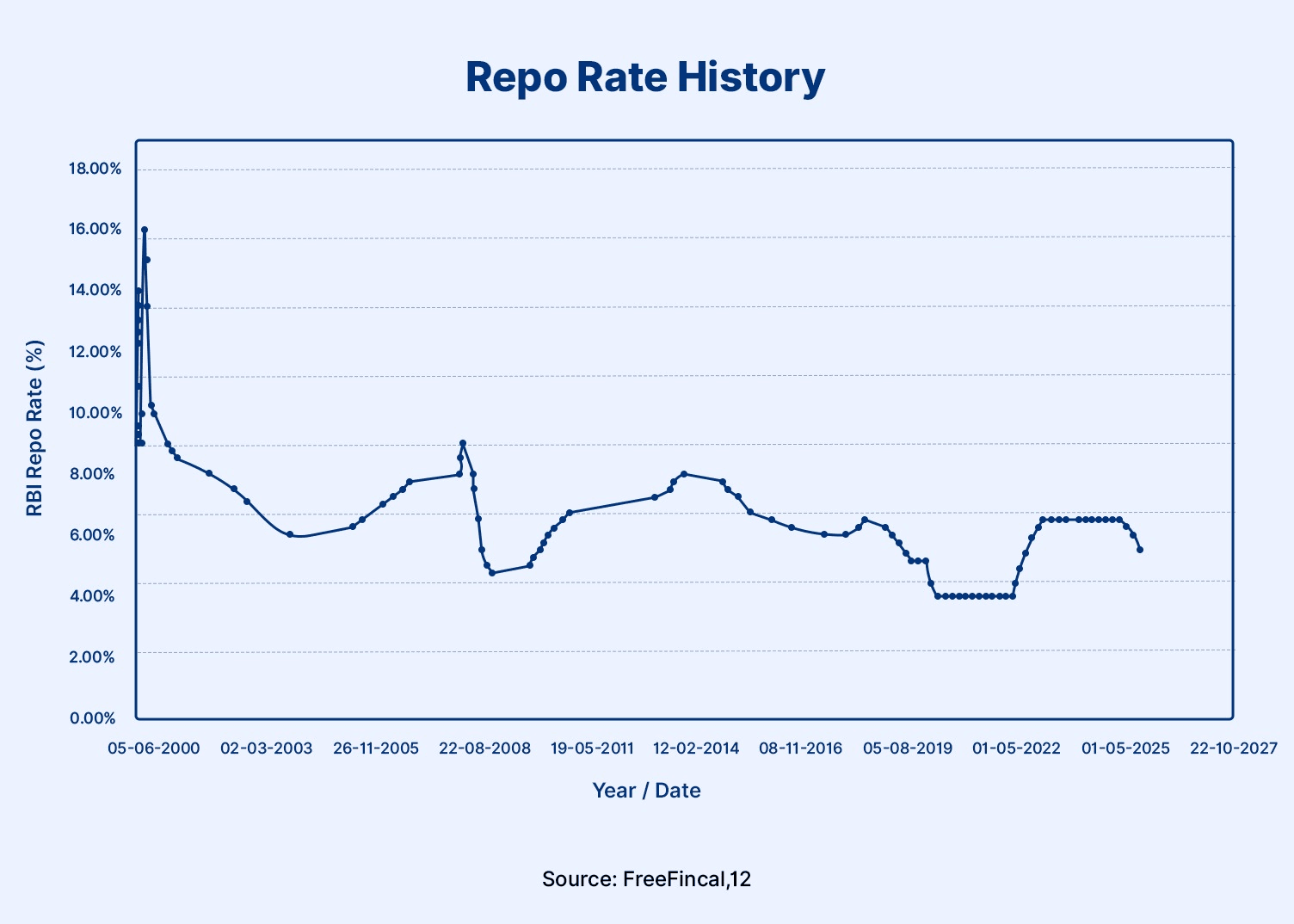
Over the last five years, the 10-year bond yield in India has moved closely with the RBI repo rate. While the repo rates rose significantly after 2022, G-Sec yields stayed elevated due to borrowing pressure, inflation concerns, and changing global interest rate expectations.
Inflation, Fiscal Deficit And Their Impact on Yields
Inflation and fiscal deficit both impact bond yields, but in a slightly different way. Inflation impacts the real return expectations and RBI policy, while fiscal deficit affects perceived sovereign risk and borrowing needs. Discussed below is a detailed breakdown of both these aspects.
1. Inflation and bond yield impact
The interest rate on bonds is fixed. Therefore, if inflation increases, the real return of bonds falls. For example, if the inflation increases from 2% to 3%, the real return from a 7% bond falls from 5% to 4%.
Furthermore, if inflation is above the target, the RBI typically increases the repo rate to control demand. A higher repo rate increases the interest rate of new G-Secs, resulting in a falling market price of existing bonds.
2. Fiscal deficit and bond yield impact
When the total expenditure of the government exceeds its total revenue, a fiscal deficit emerges. A higher fiscal deficit of the government implies the government needs to borrow through the issue of debt funds, like bonds, to bridge the gap. If the demand for such fixed-income assets remains constant, the government has to offer a higher yield to attract customers.
However, it is important to note that a persistent high deficit raises concerns about the fiscal health of the government. It raises the risk profile of the bonds, and thus their yield. Such trends can also trigger sell-offs, causing volatility in the secondary bond market.
Based on these trends, investors can analyse market data to invest in bonds with optimal yield.
How RBI Monetary Policy Affects Government Bond Interest Rates
The Reserve Bank of India (RBI) plays a direct role in determining government bond interest rates through its monetary policy decisions, primarily the repo rate.
The Core Relationship: Repo Rate and Bond Yields
When the RBI changes its repo rate, government bond yields follow:
- RBI cuts repo rate - New bonds are issued at lower rates ? Existing bonds with higher coupons become more valuable - Bond prices rise, yields fall
- RBI hikes repo rate - New bonds offer higher returns ? Older bonds become less attractive ? Bond prices fall, yields rise
Simply put: bond yields and RBI rate decisions move in the same direction, while bond prices move in the opposite direction.
Where India Stands in 2026
The RBI has cut the repo rate by a cumulative 125 bps since 2025, bringing it to 5.25%. This easing cycle means government bond yields have softened — making it a good time for investors to lock in current rates before further cuts compress yields.
Other RBI Tools That Impact Bond Rates
Beyond the repo rate, two other tools influence bond yields:
- Open Market Operations (OMO): When RBI buys G-Secs, it injects liquidity, pushing yields lower. When it sells, yields rise.
- CRR And SLR: Higher reserve requirements reduce available funds in the banking system, putting upward pressure on yields.
Government Bonds vs. Other Fixed-Income Instruments
Government bonds in India provide the highest safety due to sovereign backing, offering predictable and stable returns with minimal default risk. Compared to other fixed-income options like corporate bonds, mutual fund debt schemes, and bank fixed deposits (FDs), government securities prioritize capital preservation and lower risk.
| Feature | Government Bonds | Corporate Bonds | Mutual Fund Debt Schemes | Bank Fixed Deposits (FDs) |
| Issuer | Central or State Government | Private or Public Corporations | Asset Management Companies | Banks |
| Risk Level | Lowest risk due to sovereign guarantee | Higher risk—depends on company creditworthiness | Moderate—depends on underlying portfolio risk | Low, but slightly higher risk than govt bonds |
| Typical Returns | 6.5% – 7.5% (varies by tenure & type) | 7% – 9% or more (higher yield for lower ratings) | Varies by fund type; generally 6% – 8% | 5.5% – 7.5% (varies by bank and tenure) |
| Liquidity | High liquidity in secondary markets | Moderate liquidity, depends on issuer and rating | High liquidity, traded on exchanges | Moderate liquidity; premature withdrawal penalties apply |
| Tax Benefits | For some types (SGBs, tax-free bonds) | Interest taxable; no tax exemption | Depends on capital gains and dividend rules | Interest taxable; some tax saving FDs available |
| Investment Horizon | Short to long-term (91 days to 40 years) | Mostly medium to long-term | Flexible: short, medium, long | Short to medium term (7 days to 10 years) |
Source: Trading Economics, The Economic Times
Difference Between Government Bonds And Private Bonds
A few of the significant differentiating factors between Government Bonds and Private Bonds are as under:
Parameters | Government Bonds | Private Bonds |
Yield and Coupon Rate | Offer lower yields due to their lower risk profile. | Offers higher coupon rates to compensate investors for the additional risk they carry. |
Credit Risk | Default risk is nil as they are backed by the Sovereign Guarantee. | Default Risk is higher compared to Government Bonds. Within Private Bonds, A, AA, and AAA rated bonds are considered safest and the industry has seen limited defaults in such bonds |
Embedded Options – Call Provision and Call Risk
| May have provisions wherein the issuer has the option to buy back (call option) or the investors have the option to sell the bond (put option) to the issuer during the tenure of the bond after the initial lockout period. | May have a call and put options that allow the issuer or investor to redeem the bonds before maturity. |
Covenants and Terms of the Bonds
| Have standard terms and conditions without any complex covenants. They are straightforward investments with transparent terms. | May have customised terms and conditions, including covenants related to collateral, and contractual obligations. |
Diversification Benefits and Portfolio Fit | Are considered low-risk investments, providing stability and capital preservation. They can serve as a core component in a diversified investment portfolio, offering stability and income. | Can provide higher yields and potential for higher returns but carry additional credit risk. They can be suitable for investors seeking higher income and willing to take on additional risk. |
Issuer Information and Financial Health | The government is considered a highly reliable and financially stable issuer. There is transparency in terms of its financial statements, policy decisions, and market information. The government's fiscal health is closely monitored providing investors with a higher level of confidence. | The financial health and issuer information of private companies issuing bonds varies. Investors need to conduct thorough research on the financial statements of the issuer, their track record and management quality, and industry prospects to assess the issuer's ability to meet its debt obligations. |
Debt investments can be a novel experience for many. Investors investing in government bonds or corporate bonds should analyse their risk appetite and align it with that of the instrument to avoid any inconvenience.
How To Choose the Right Government Bond Based On Your Financial Goals
Different types of government bonds serve different financial needs. Choosing the right one depends on your investment horizon, income requirement and risk appetite. Choose the right government bond based on your financial goals
1. Emergency Corpus
Treasury Bills are a suitable option for emergency funds. With a short maturity period of 91, 182 or 364 days, they offer liquidity and lower risk.
2. Retirement Planning
For retirement planning, investors can consider Fixed Rate Government Bonds. These bonds have long tenure and provide fixed interest payments at regular intervals of time.
3. Regular Income
Investors looking for consistent income can invest in Fixed Rate Government Bonds or State Development Loans (SDLs). Both offer periodic interest payments, and SDLs may provide slightly higher yield than central government bonds.
4. Inflation Protection
Inflation-indexed bonds are considered to protect money from inflation. The returns are linked to inflation, and they help maintain the purchasing power of your investment over time.
5. Capital Preservation
Conservative investors who want safety on their principal can choose Government Securities (G-Secs). These bonds are backed by the Government of India and carry lower credit risk.
Government Bonds Maturity Comparison
| Type of Government Bond | Typical Maturity | Interest Payment | Best For |
| Treasury Bills | 91, 182, or 364 days | No periodic interest | Short-term investment |
| Fixed-Rate Government Bonds | 5-40 years | Fixed coupon paid semi-annually | Long-term wealth and regular income |
| Floating Rate Bonds | 5-10 years | Variable interest rate | Investors expecting high interest rates |
| Inflation Indexed Bonds | 5-10 years | Inflation-adjusted returns | Inflation protection |
| State Development Loans (SDLs) | 5-30 years | Fixed coupon paid semi-annually | Higher yields with relatively low risk |
| Sovereign Gold Bonds | 8 years (exit after 5years is permitted on interest payment dates) | 2.5% annual interest
| Long-term gold investment |
| Zero Coupons | Typically 10-20 years | No periodic interest | Long-term capital appreciation |
Which Government Bond Should You Choose?
The right Government bond depends on the investor’s financial goals, risk tolerance and investment period. Here are some common investor personas and best government bonds to match their needs.
1. First-Time Investors
If you are new to investing, then fixed-Rate Government Bonds purchased through RBI Retail Direct are the best choice. They are easy to invest in and backed by the Government of India. It offers fixed interest payments, which makes them suitable for new investors.
2. Conservative Retiree
A retiree looking for a steady income and capital safety can choose Fixed Rate Government Bonds or State Development Loans (SDLs). These bonds provide regular income with relatively lower risk.
3. Long-Term Wealth Builder
For building long-term wealth and protecting it from inflation, investors can consider Inflation Indexed Bonds or Sovereign Gold Bonds (SGBs).
4. Short-Term Investors
Investors can choose Treasury Bills (T-Bills) for short-term investment. These bonds have shorter maturity periods, which makes them suitable for any unexpected expense.
Recent Changes In Government Bond Investing
Government bond investing has become more accessible and convenient in recent years. Here are some changes in Government bond investing:
- RBI Retail Direct
It allows individual investors to open a Retail Direct Gilt Account with the RBI and invest directly in government securities. Investors can participate in primary auctions and buy/sell eligible government bonds.
- Online Bond Platform
Several SEBI-regulated online bond platforms now provide easy access to government bonds in India. Investors can compare different bonds and invest digitally.
- Lower Investment Threshold
Retail participation has increased as government bonds are now available with a lower minimum investment amount. It is now accessible to small investors who want to diversify beyond FDs.
- Increasing retail participation
Growing awareness about low-risk investment options with digital platforms can encourage more individuals to invest in government bonds in India.
- Global bond index inclusion and why it matters for investors
India’s inclusion in major global bond indices is expected to attract higher foreign investment into G-Secs. Increased foreign participation can improve market liquidity, enhance price discovery, and strength overall government bond market.
Conclusion
Investing in government bonds in India provides a reliable way to preserve capital, earn predictable returns, and maintain liquidity. By understanding your financial goals and investment horizon, you can choose the right type of bond to complement your portfolio and manage risk effectively.
For investors looking for seamless access to high-quality bonds with enhanced transparency and liquidity, platforms like Grip Invest make building a diversified bond portfolio easier than ever.
FAQs On Types Of Government Bonds
References:
1. RBI Retail Direct, accessed from: https://rbiretaildirect.org.in/
2. Trading Economic, accessed from: https://tradingeconomics.com/india/government-bond-yield
3. The Economic Times, accessed from: https://economictimes.indiatimes.com/markets/bonds/corporate-bonds-vs-government-bonds-finding-the-right-balance-for-indian-investors/articleshow/123501156.cms
Want to stay at the top of your finances?
Join the community of 4 lakh+ investors and learn more about Grip Invest, the latest financial knick-knacks, and shenanigans in the world of investing.
Happy Investing!
Disclaimer - Investments in debt securities/municipal debt securities/securitised debt instruments are subject to risks including delay and/ or default in payment. Read all the offer related documents carefully. The investor is requested to take into consideration all the risk factors before the commencement of trading.
This communication is prepared by Grip Broking Private Limited (bearing SEBI Registration No. INZ000312836 and NSE ID 90319) and/or its affiliate/ group company(ies) (together referred to as “Grip”) and the contents of this disclaimer are applicable to this document and any and all written or oral communication(s) made by Grip or its directors, employees, associates, representatives and agents. This communication does not constitute advice relating to investing or otherwise dealing in securities and is not an offer or solicitation for the purchase or sale of any securities. Grip does not guarantee or assure any return on investments and accepts no liability for consequences of any actions taken based on the information provided. For more details, please visit www.gripinvest.in
Registered Address - 106, II F, New Asiatic Building, H Block, Connaught Place, New Delhi 110001


