

Government Borrowing In India 2026: What It Means For Bond Investo



Government borrowing in India refers to funds the government raises to help finance the gap when its total expenditure exceeds its receipts, excluding borrowings. Borrowing is a crucial source of financing for the fiscal deficit.
The Union Government uses various methods and sources to raise funds. These include dated government securities borrowings (G-Secs), Treasury Bills, the National Small Savings Fund (NSSF), and other financing sources. The government issues securities through auctions organised by the Reserve Bank of India (RBI), which serves as the government's debt manager.
The government has budgeted gross market borrowing of INR 17.20 lakh crore and net market borrowing of INR 11.73 lakh crore through dated securities for FY 2026–27. This borrowing forms part of the overall financing of the fiscal deficit.1
It is important to distinguish between gross borrowing and net borrowing. Gross borrowing refers to the total amount raised through fresh issuance, including borrowing used to refinance maturing debt. Net borrowing is the amount that remains after accounting for repayments or redemptions during the year.
Government Borrowing Plans for 2026–27
The Union Budget provides details of the government's borrowing plans for FY 2026–27. The comparison below should not be viewed as a comparison of actual borrowings, as FY 2025–26 is represented by the Revised Estimates (RE) and FY 2026–27 by the Budget Estimates (BE).
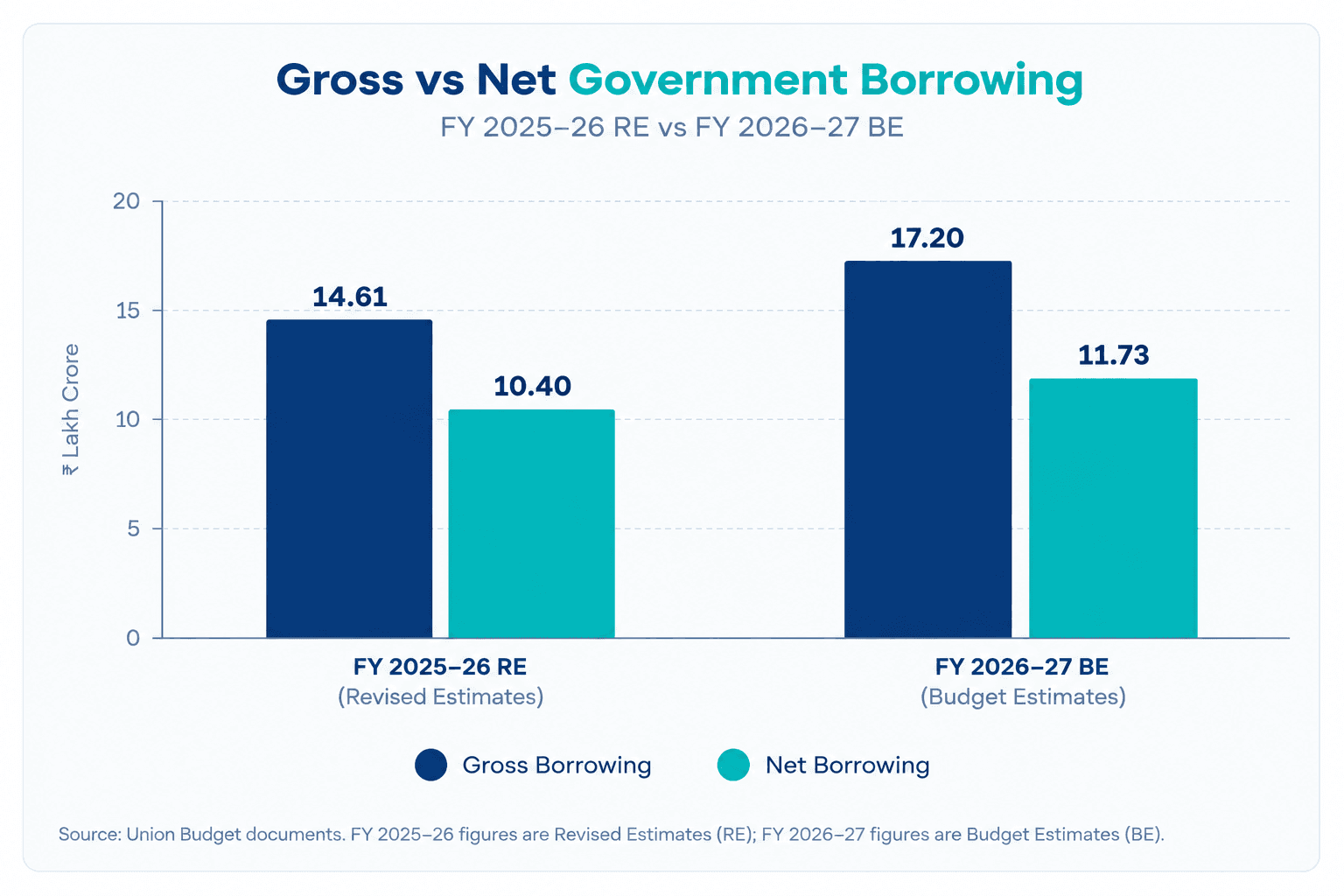
Source: India Budget2
Particulars | FY 2025–26 RE | FY 2026–27 BE | Change |
Gross borrowing through dated securities | INR 14.61 lakh crore | INR 17.20 lakh crore | ~17.7% |
Net borrowing through dated securities | INR 10.40 lakh crore | INR 11.73 lakh crore | ~12.8% |
The government's FRBM document also says that borrowing via dated securities is part of a broader financing mix, alongside NSSF, external assistance and others. For FY 2026–27, financing through securities issued against the National Small Savings Fund (NSSF) is estimated at around INR 3.87 lakh crore.
This rise in planned gross borrowing should therefore be considered in the context of the government's fiscal deficit, its redemption needs, the financing mix and anticipated market conditions.
How Can Government Borrowing Affect Bond Yields and Prices?
The correlation between government borrowing and bond yields is driven mainly by supply and demand.
The more government bonds are issued, the more bonds are available in the market. With no change in investor demand, investors may require a higher yield to absorb the extra supply. A rise in required yields would generally be accompanied by a decline in existing bond prices, since bond prices and bond yields tend to move in opposite directions.
For example, suppose the government plans to issue more bonds while investor demand remains unchanged. Investors may then require a higher yield to absorb the additional supply, for instance, 6.70% instead of 6.50%. Existing bonds offering returns based on the earlier 6.50% market yield may consequently fall in price so that their effective yield becomes more competitive with newly issued securities.
However, increased government borrowing does not always raise yields. If banks, insurers, pension and mutual funds, or other investors boost demand enough, supply can rise without pushing yields higher.
The RBI says G-Sec prices reflect supply and demand, interest rates, inflation expectations, liquidity, and domestic and global market developments. Government borrowing should therefore be assessed within the broader market context.
What Other Factors Determine the Impact of Government Borrowing?
Government borrowing is only one of several factors that can influence India's government bond market and the way yields respond.
The RBI's monetary policy is particularly important. A change in the policy rate and/or expectations about future policy may affect the overall interest-rate environment and G-Sec yields.
Inflation expectations are also important. If investors expect higher inflation, they may demand higher nominal yields to compensate for the potential erosion of real returns.
Market liquidity affects how easily the market absorbs new government securities. Strong liquidity supports demand, while tighter liquidity can affect pricing.
Investors may be affected by expectations of future interest rates or borrowing needs, as well as by growth and fiscal outlook.
Depending on economic and monetary circumstances, the government borrowing impact on bond market can vary.
How Does Government Borrowing Affect Different Parts of the Bond Market?
Government borrowing can affect different segments of the fixed-income market and securities with varying maturities.
At the short end of the yield curve, Treasury Bills and other short-term securities can be particularly sensitive to liquidity conditions and near-term monetary policy expectations. Treasury Bills are government-issued securities with an original maturity of less than one year.
At the medium and long ends, dated G-Secs are influenced by inflation expectations, economic growth, fiscal and monetary policy, and future G-Sec supply.
Government borrowing can also influence State Government Securities (SGSs), commonly known as State Development Loans (SDLs), as central and state government securities compete for investor demand. Changes in the supply of government securities can therefore also influence the pricing and yields of SDLs.
The corporate bond market is also linked to the G-Sec yield curve. Corporate bonds are commonly valued by starting with the current government bond yield and adding a spread to account for other factors, including credit risk and liquidity.
When comparing a corporate bond with other fixed-income alternatives, investors may therefore consider its yield, maturity, credit quality and liquidity, not just its yield.
What Could Government Borrowing Plans Mean for Bond Investors?
The government borrowing plan 2026-27 is an important signal to investors about the potential supply of government securities for the year. However, the ultimate impact on bond prices and yields will depend on how this supply interacts with investor demand, monetary policy, inflation, liquidity, and global market conditions.
Changes in market yields may affect the market value of existing bonds before maturity, to the investor's benefit or detriment. G-Secs carry negligible credit risk because they are backed by the Government of India. However, their market prices can fluctuate with changes in interest rates and yields, so investors may face market risk if they sell before maturity.
Therefore, when evaluating fixed-income options, consider yield alongside tenure, credit quality, liquidity and your investment horizon. A higher yield may reflect higher credit or liquidity risk, so understand what drives the additional return before comparing investment opportunities.
FAQs

Want to stay at the top of your finances?
Join the community of 22 lakh+ investors and learn more about Grip Invest, the latest financial knick-knacks, and shenanigans in the world of investing.
Happy Investing!
Disclaimer - Investments in debt securities/municipal debt securities/securitised debt instruments are subject to risks including delay and/ or default in payment. Read all the offer related documents carefully. The investor is requested to take into consideration all the risk factors before the commencement of trading.
This communication is prepared by Grip Broking Private Limited (bearing SEBI Registration No. INZ000312836 and NSE ID 90319) and/or its affiliate/ group company(ies) (together referred to as “Grip”) and the contents of this disclaimer are applicable to this document and any and all written or oral communication(s) made by Grip or its directors, employees, associates, representatives and agents. This communication does not constitute advice relating to investing or otherwise dealing in securities and is not an offer or solicitation for the purchase or sale of any securities. Grip does not guarantee or assure any return on investments and accepts no liability for consequences of any actions taken based on the information provided. For more details, please visit www.gripinvest.in
Registered Address - 106, II F, New Asiatic Building, H Block, Connaught Place, New Delhi 110001


