

Inverse ETFs In India 2026: Why Unavailable, Global Access And Alternatives


While inverse ETFs thrive globally as tactical tools for market downturns, they remain unavailable in India due to SEBI restrictions on retail derivative products. No inverse or leveraged ETFs listed on NSE/BSE as of 2025, leaving Indian investors curious about their mechanics and seeking domestic alternatives amid rising volatility.
These funds aim to deliver opposite daily returns to an index profiting when markets fall but their daily reset structure makes them high-risk for anything beyond short-term trades. This guide explains inverse ETF meaning, risks, global access via LRS, and SEBI-approved hedging options like put options and fixed-income strategies.
What Is An Inverse ETF And How Does It Work?
Inverse ETFs can be defined as funds designed to deliver returns opposite to the market index for a single trading day. In other words, if the market index falls by 1%, the inverse ETF tries to gain the same for that day and vice versa.
Note: These are unavailable in India due to SEBI restrictions on retail derivative ETFs.
1. Daily Reset Structure
The inverse ETF works on a daily reset method, which aims to inverse the index only for a single trading day. Depending on the new index level for the day, the funds reset each morning.
As markets fluctuate, this adjustment matters significantly when repeated multiple days. Since volatility causes a compounding effect, a simple inverse effect return can extensively cause a difference in performance.
2. Performance Deviation Over Time
Performance Deviation can happen due to a few reasons that take place over several days. These include no equal cancellation of gains and losses, compounding of returns different from the index, and tracking errors due to derivative costs. These are also reasons why inverse ETFs are recommended for short-term instead of longer holding periods.
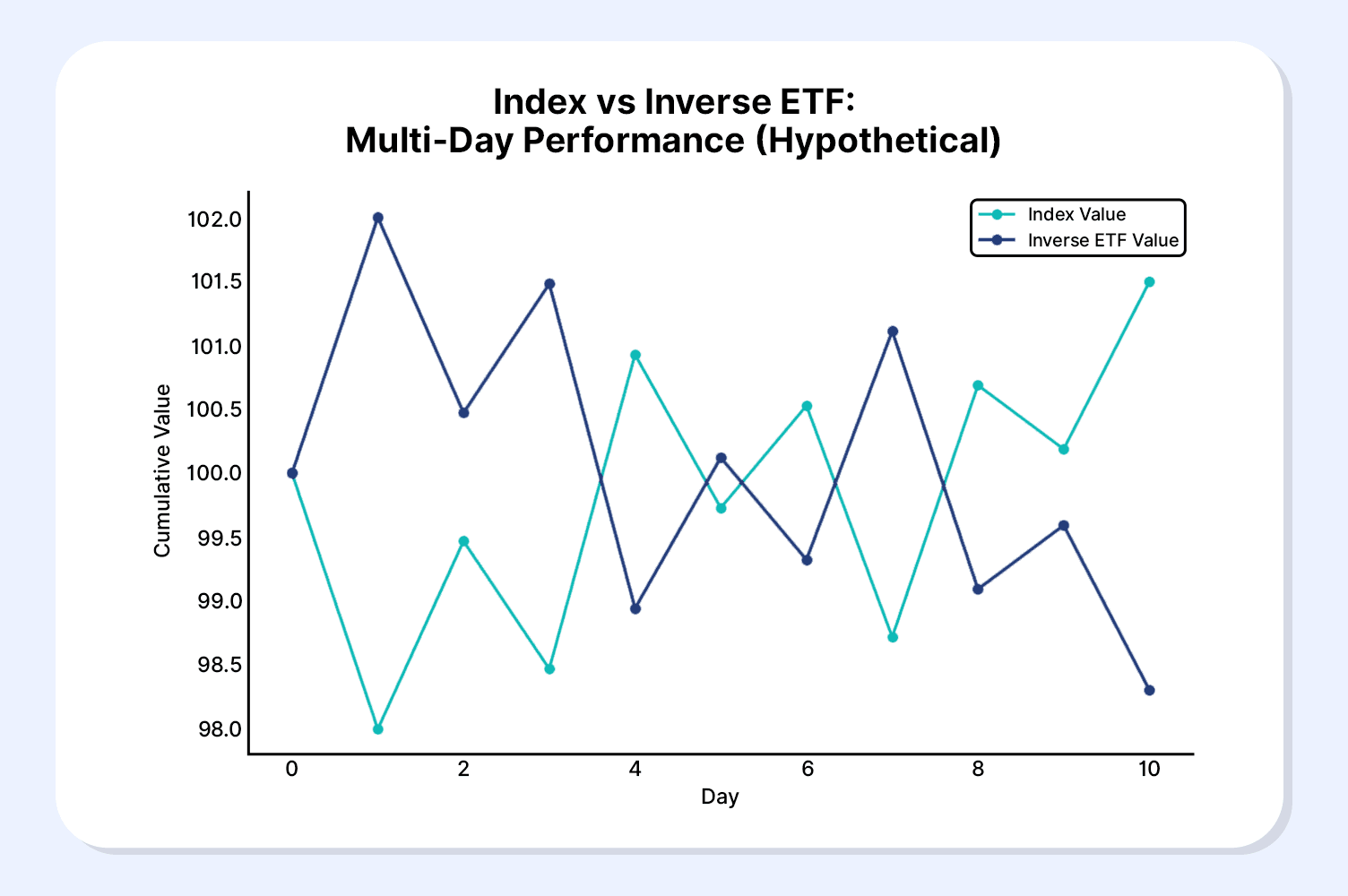
Example: A chart showing how performance can deviate over time.
Let us say the starting value of both the Index and the Inverse ETF is 100, where the Index ETF return is equal to the product of -1 and the Index daily return. Also, there are no tracking fees or tracking errors included. Taking hypothetical data, the following chart can be derived.
When Indian Investors Might Consider Alternatives To Inverse ETF
Inverse ETF is a tactical tool not meant for long-term, regular investments, and can be used in certain market situations. They give the best outcomes when used to hedge an uncertain market, capturing unexpected downside movement in equity markets.
Some common scenarios that could use inverse ETFs include the following:
1. Hedging During Short-term Volatility.
In the event of an unexpected market decline or macro events facilitating market panic, using an inverse ETF can help combat losses on equity holdings until conditions improve.
2. Tactical trading and Quick Market Moves.
Without short selling or taking leverage directly, as an active trader, you can benefit from expected short-term falls by using inverse ETFs.
3. Comparison with Normal ETFs and Index Funds.
In the case of traditional ETFs, they aim for long-term growth while tracking the market, where index funds benefit from compounding or a rising market over a period of time.
Whereas inverse ETFs move opposite to the market index and are used only for a single day. They do not help in long-term portfolio building and require continuous monitoring.
Key Risks Investors Must Know
Although inverse ETFs offer downside protection, they also have some complexities. It is necessary that you understand these risks before you use them in your portfolio. Even for global access via Liberalised Remittance Scheme (LRS), these risks apply
1. Daily rebalancing risk
Inverse ETFs aim to offer an opposite return, but for a single day only, which leads to daily resets. These returns are heavily dependent on volatility. Sometimes this leads to a deviation from the investor’s expectations. Inverse ETFs may show losses even if the index ends near the same level.
2. High volatility and tracking error
As markets trend upward over a longer time period, inverse ETFs consistently lose value. When the market is swinging both ways, short-term volatility can accelerate losses. When you keep them for extended holdings, the price erosion becomes severe.
3. Unsuitability for buy-and-hold
Compared to index funds, which can be used for long-term investments, inverse ETFs are not meant for extended holdings. Investors might face compounding drags if these ETFs are held for weeks or months, resulting in a higher fee impact.
Inverse ETFs Vs Alternative Hedging Strategies
Among several other inverse ETFs are tools against market declines, but each strategy comes with its own set of factors. You must understand these before choosing your inverse ETF.
Strategy | Benefits | Limitations | India Availability |
Inverse ETF | Easy profit in case of a Short-term market fall. | Not suited for long-term holdings due to daily resets. | No (SEBI ban on retail derivative ETFs) |
Put Options | Fixed premium gives limited downside. | Skill needed to choose the strike and expiry | Yes (NSE derivatives segment) |
Index Futures | Direct exposure to the market | Leads to high risk if the market rises. | Yes (NSE FandO, for approved traders) |
Defensive Funds or Dynamic Asset Allocations | Flexible allocations with lower volatility | Lags in fast-changing conditions | Yes |
Corporate Bonds and Other Fixed-Income Strategies | No market bets and steady returns | Equity rallies result in limited upside. | Yes (Platforms like Grip Invest) |
Conclusion
Inverse ETFs serve as powerful tactical tools for global investors seeking to profit from short-term market declines, but Indian investors must turn to SEBI-approved alternatives due to the domestic ban on these products. Put options, index futures shorting, defensive funds, and fixed-income strategies offer effective hedging without daily reset risks or compounding drag, ensuring compliance and accessibility via NSE or platforms like Grip Invest.
For true market-neutral stability amid volatility, pair your equity exposure with Grip Invest's curated corporate bonds and fixed-income options, delivering steady yields uncorrelated to Nifty movements. Build a resilient portfolio today with Grip Invest!
FAQs On Inverse ETFs In India
Q1. Are inverse ETFs available in India?
Currently, there are no inverse ETFs available in India. This is because the SEBI does not permit these instruments. Investors seeking such products should access them through global markets.
Q2. Are inverse ETFs suitable for beginners?
An Inverse ETF is designed for investors with high risk tolerance and an understanding of the short-term market movement. Hence, these may prove to be unstable for beginners.
Q3. How long can I hold an inverse ETF?
Inverse ETFs are designed for short-term trading, which can be up to a few days. You may witness unexpected divergence if you hold on to it for a longer period.
Want to stay at the top of your finances?
Join the community of 4 lakh+ investors and learn more about Grip Invest, the latest financial knick-knacks, and shenanigans in the world of investing.
Happy Investing!
Disclaimer - Investments in debt securities/municipal debt securities/securitised debt instruments are subject to risks including delay and/ or default in payment. Read all the offer related documents carefully. The investor is requested to take into consideration all the risk factors before the commencement of trading.
This communication is prepared by Grip Broking Private Limited (bearing SEBI Registration No. INZ000312836 and NSE ID 90319) and/or its affiliate/ group company(ies) (together referred to as “Grip”) and the contents of this disclaimer are applicable to this document and any and all written or oral communication(s) made by Grip or its directors, employees, associates, representatives and agents. This communication does not constitute advice relating to investing or otherwise dealing in securities and is not an offer or solicitation for the purchase or sale of any securities. Grip does not guarantee or assure any return on investments and accepts no liability for consequences of any actions taken based on the information provided. For more details, please visit www.gripinvest.in
Registered Address - 106, II F, New Asiatic Building, H Block, Connaught Place, New Delhi 110001


