

Trigger SIP: What It Is And How Smart Investors Use It


Indians have been able to develop their wealth by accumulating using systematic investment plans (SIPs). Nevertheless, some investors wish to enhance their entry timing without needing to check daily. This is where Trigger SIPs come into play.
What Is Trigger SIP?
Trigger SIP is an advanced mutual fund investing approach that allows investors to automate investments based on predefined conditions, wherever such facilities are available. It helps you time how and when to invest based on various triggers that you can set for yourself.
This is different from a normal investment as trigger SIP waits to see whether or not the specified criteria is met before commencing the investments plans.
The trigger SIP mutual fund option provides the same automation as standard mutual fund investments but applies the additional intelligence of the defined trigger.
The distinction between a regular SIP vs trigger SIP is very visible.
- With a regular SIP, you will invest a defined amount on a defined day of every month regardless of what the market conditions may be.
- A trigger SIP will wait until it has received your trigger or condition that you have established for the investment to begin. By allowing you to automatically make your investment based on a trigger, this process minimizes the emotional aspects of investing.
Many individuals choose to utilize an automated SIP investing service due to the fast pace of everyday and financial markets.
Automation in SIPs allows individuals to construct their financial portfolio that will create the possibility of investment returns driven by mathematical logic instead of continuing to check the prices and market news daily.
How Trigger SIP Works?
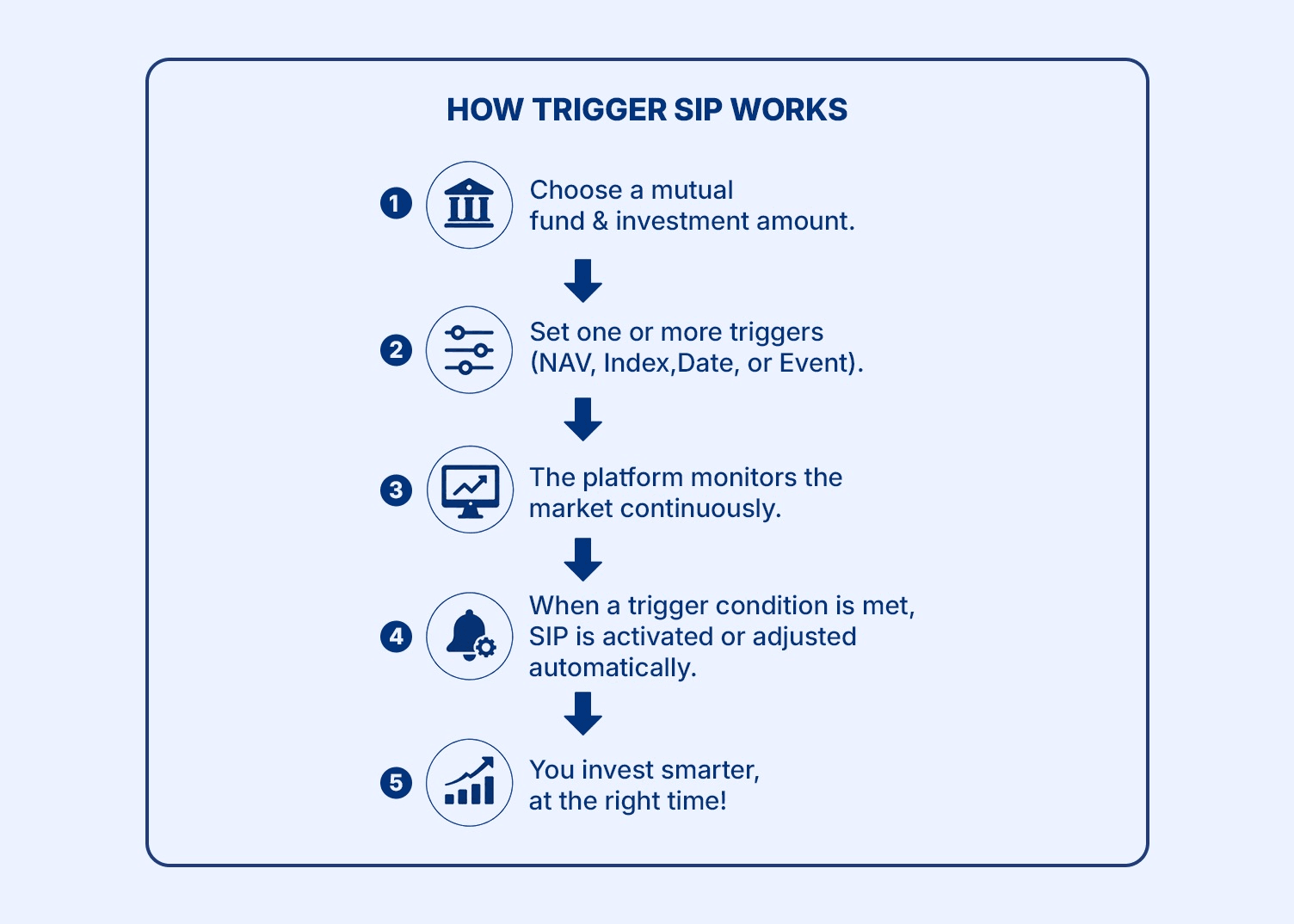
Trigger SIPs operate as an intelligent alarm for investing. You determine the conditions to trigger your investment, and when the condition is fulfilled, the system automatically processes your investment.
To use trigger-based SIPs, select a mutual fund scheme and an investment amount, and set one or more triggers. The platform monitors the market continuously. Once one of your triggers is triggered, your SIP is activated or changed without the need for manual approval every time.
SIPs with NAV triggers are a popular option for many investors. Investors can configure their trigger to only invest when the NAV of the mutual fund reaches a specific level, allowing them to acquire additional units when they feel the price is low.
Investors can also use index or market based SIP triggers. For example, if you believe that purchasing the Nifty 50 index below 22,000 will yield a good price, you can set up a trigger to initiate a new SIP or double your existing SIP if the Nifty index hits that number.
Date-based triggers follow calendar dates. For instance, you may want to increase your SIP on a monthly basis; you may also want to increase your SIP after the quarterly earnings are released.
Event-based triggers can include reaction to news (for example, if interest rates are cut) and major economic announcements (for example, GDP growth of 4% above expected value).
Hypothetical Example:
Rahul plans to invest 10,000 rupees each month into an equity fund using what’s called an NAV-based SIP trigger strategy. In this case, he will only make that full investment when the NAV of his equity fund declines by 8% from its highest recent price point.
If there is a sudden drop in the overall market, he will benefit from the fact that his money will be deployed into lower-priced securities. After the NAV increases by 15% from its last high price point, his SIP will stop investing until the NAV comes back down again.
Therefore, he will be able to effectively implement a disciplined method of buying low.
Common Types Of Trigger SIPs
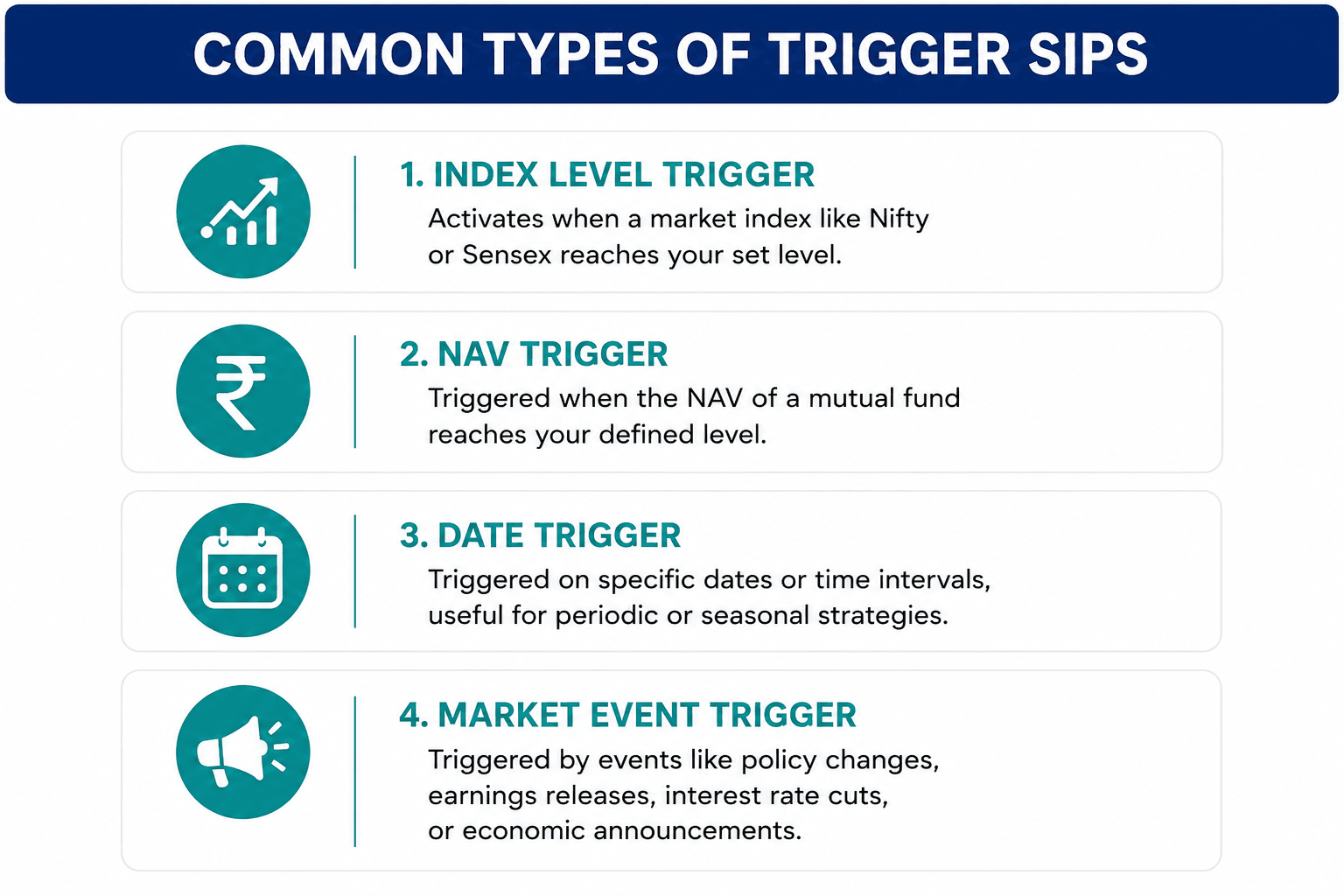
There are many trigger methods to choose from; some of the more common types are:
1. Index Level Trigger: This trigger activates when a specific market index such as the Sensex or Nifty reaches the investor’s predetermined level. Use this type of trigger if you wish to follow a broad market strategy.
2. NAV Trigger: This trigger is linked directly to the price of the mutual fund. If you follow the NAV of a particular mutual fund for financing purposes, then you should select this as your trigger type.
3. Date Trigger: In this case, you will use specified timeframes to take action. For example, you will make additional investments to take advantage of seasonal trends around holidays or during the quarter that has historically produced additional opportunities.
4. Market Event Trigger: You would use this type of trigger to respond to any fundamental development that has occurred in the world around you.
Examples might be changes in government policy, the quarterly corporate earnings season, or other economic-related developments. This would allow you to execute a tactical approach to mutual fund investing.
Also read on Top SIP Plans for Short-Term Investments
Benefits And Risks Of Trigger SIP
Benefits
A thoughtful investor will benefit greatly from Trigger SIP.
- It allows an investor to set up automated investments through SIP, and also gives them an enhanced sense of market timing. The investor can potentially accumulate more units during dips in the market and decrease their unit exposure during periods of high market valuation. As a result, compared to traditional monthly investing, overall returns could be enhanced by avoiding blind investing during various market cycles.
- Automation will maintain investment discipline since it will handle order execution. Emotional investment decisions may be reduced to a minimum, as Trigger SIPs pre-establish rules. Risk management may also be enhanced through Trigger SIPs by setting up pauses during periods of high volatility.
- In addition to representing a good method for planning, Trigger SIPs also allow an investor to set and execute financial objectives in conjunction with life events.
Risks
There are risks involved with Trigger SIPs as well that you must know about.
- Setting the wrong trigger, due to poor judgment, can result in an opportunity being missed. For example, if the market continues to rise and your buy trigger is never reached, you will not have purchased any additional units. If an investor relies on using “market timing,” then they may reduce the benefits of investment consistency.
- Beginners may find it hard to operate trigger SIPs. Even though triggers are automated, there is still a need to monitor them constantly. Therefore, a basic knowledge of the market is still necessary.
- In very stable bull market conditions, a trigger SIP may perform worse than simply making fixed monthly contributions at equal intervals because orders will be delayed and not executed as quickly.
- Taxation applies to trigger and regular SIPs in a similar manner. Taxation will apply to both Trigger SIP and regular SIP gains based on how long an investor has owned the security. For example, if the security is an equity fund, then if it has been held for at least one year, it will have favorable tax treatment for any gains.
Trigger SIP vs Regular SIP: Which Is Better?
The major distinction between a regular SIP and a trigger SIP derives from the investor's level of experience and their investment objectives. For long-term wealth creation through rupee cost averaging and compounding, a regular SIP is the clear winner. It eliminates the need to time the market, and this effective strategy has continued to work for investors over many decades. A majority of investors will benefit from the simplicity and consistent nature of regular SIPs.
A trigger SIP is beneficial to the tactical mutual fund investor. For experienced investors who analyze the markets, a trigger SIP is a vehicle to potentially enhance their returns. Trigger SIPs are a hybrid of fully passive and actively managed strategies.
Appropriate types of investors based on their type include:
- Beginners: Regular SIP for building a habit of investing.
- Busy Professionals: Trigger SIP via ease of setting and monitoring.
- Active Investors: Combination of both strategies throughout the various funds.
- Conservative Savers: Regular SIP to mitigate the risk of timing their investment.
A number of savvy investors will utilize a combination strategy. They tend to use regular SIPs to form their base to build stability, while Trigger SIPs use a smaller portion of capital for opportunistic investing.
Also read on How SIPs Help Build Long-Term Wealth
Additional Insights For Investors
The trend of advanced SIP features such as trigger options is emerging rapidly in Indian markets. Most of them will allow you to set up online in less than 30 minutes. It’s a good idea to check your trigger settings every few months and then make any necessary changes in accordance with your own goals or the current economic climate.
Diversifying your investment is still paramount. Never invest all your money into one fund or trigger type, and always test the trigger SIP before increasing your investment amount. Liquidity and exit strategies are flexible with trigger SIPs, just like they are in regular SIPs. If you need to, you can stop your investment or redeem your investment based on the rules of each Fund House.
Using Trigger SIP as a part of your total financial plan would give you the best chance at success versus using it as the sole solution to becoming financially secure in your future.
Conclusion
Trigger SIPs bring an additional layer of flexibility to mutual fund investing by allowing investors to follow predefined rules instead of reacting to every market movement. By setting conditions based on factors like NAV levels, index movements, dates, or market events, investors can automate certain investment decisions while maintaining discipline.
However, Trigger SIPs are not a shortcut to predicting the market. The effectiveness of any trigger depends on how well it aligns with an investor’s goals, risk appetite, and understanding of market cycles. For most long-term investors, consistency through regular SIPs remains a strong foundation, while trigger-based strategies can be considered as an additional approach by experienced investors.
The key to successful investing is not just choosing the right feature, but building a diversified portfolio, staying invested, and making decisions aligned with long-term financial goals.
For investors looking beyond traditional options, Grip offers access to curated fixed-income opportunities like corporate bonds and fixed deposits that can complement your overall wealth-building strategy.
FAQs On Trigger SIP
 |
Author: Grip Invest Editorial Team The Grip Invest Editorial Team is a group of Chartered Accountants, MBA (Finance) graduates, and Qualified Research Analysts dedicated to helping you invest smarter. We dive deep into India's fixed income landscape to deliver content that is accurate, up-to-date, and easy to understand. Whether you're exploring bonds, fixed deposits, or other fixed income opportunities, our guides cut through the noise and give you the clarity to make better financial decisions. |
Want to stay at the top of your finances?
Join the community of 4 lakh+ investors and learn more about Grip Invest, the latest financial knick-knacks, and shenanigans in the world of investing.
Happy Investing!
Disclaimer - Investments in debt securities/municipal debt securities/securitised debt instruments are subject to risks including delay and/ or default in payment. Read all the offer related documents carefully. The investor is requested to take into consideration all the risk factors before the commencement of trading.
This communication is prepared by Grip Broking Private Limited (bearing SEBI Registration No. INZ000312836 and NSE ID 90319) and/or its affiliate/ group company(ies) (together referred to as “Grip”) and the contents of this disclaimer are applicable to this document and any and all written or oral communication(s) made by Grip or its directors, employees, associates, representatives and agents. This communication does not constitute advice relating to investing or otherwise dealing in securities and is not an offer or solicitation for the purchase or sale of any securities. Grip does not guarantee or assure any return on investments and accepts no liability for consequences of any actions taken based on the information provided. For more details, please visit www.gripinvest.in
Registered Address - 106, II F, New Asiatic Building, H Block, Connaught Place, New Delhi 110001


