

Daily SIP Investment: How It Works, Pros, Cons And Who Should Choose It?


Investing in mutual funds through an SIP (Systematic Investment Plan) is quite popular for its convenience and effectiveness. For salaried employees and small or medium-sized business owners, dedicating a large sum of money for investment can be quite difficult given their usual financial commitments.
On the other hand, SIPs can ensure that a significant corpus is built over a longer period and that market volatility is smoothed, especially compared to a situation where an investor enters an overvalued market immediately followed by a bearish run.
With monthly SIP options becoming increasingly popular, newer alternatives such as weekly and daily SIP mutual funds are emerging. Rather than dedicating a fixed amount per month, investors are given enormous flexibility, as they can invest on a daily basis. Recently, some AMCs introduced daily SIPs of INR 10 for select schemes, making investment accessible for people with low disposable incomes.
Let us understand how a daily SIP works, how it compares with a monthly SIP and whether it is the right choice for your financial goals.
Daily SIP Mutual Fund: What Is It And How Does It Work?
It is an investment facility provided by an AMC (Asset Management Company) that allows you to invest a predetermined amount into a mutual fund on every business day. The investment, therefore, is spread across multiple trading days throughout the month.
The amount is automatically debited from the investor's registered bank account and units are allotted based on the Net Asset Value (NAV) applicable on each investment day.
For example, if you wish to invest INR 6,000 every month, you may choose to invest approximately INR 300 per day over around 20 business days instead of making a single monthly investment of INR 6,000. This ensures that the total monthly investment remains roughly the same, while the contributions are spread across multiple days.
Like any other mutual fund SIP, a daily SIP benefits from automation, helping investors maintain discipline without having to manually invest each time.
Daily SIP vs Monthly SIP
Both Daily SIP and Monthly SIP follow the same core investment principle of investing a fixed amount regularly to build wealth over time. The key difference lies in the investment frequency. With a Daily SIP, your investment is made on every trading day, while a Monthly SIP invests the amount once each month on a predetermined date.
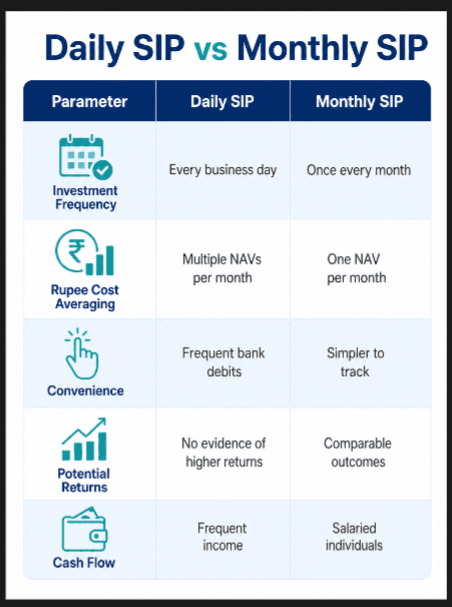
Although Daily SIPs purchase units at more NAVs throughout the month, studies have found no consistent evidence that they generate significantly higher long term returns than Monthly SIPs. The right choice ultimately depends on your cash flow, convenience, and investment preferences.
Let us understand the most critical differences between the two:
Parameter | Daily SIP | Monthly SIP |
Investment frequency | Every business day | Once every month |
Rupee cost averaging | Purchases units at multiple NAVs during the month | Purchases units at one NAV each month |
Convenience | Requires frequent bank debits | Simpler to track and manage |
Potential returns | No consistent evidence of materially higher long-term returns | Comparable long-term outcomes |
Cash flow management | Suitable for investors with frequent income | Well-suited for salaried individuals with monthly income |
1. Investment Frequency
As suggested, the most noticeable difference between the two is the investment schedule. A daily SIP investment spreads contributions across every business day, whereas a monthly SIP invests the given amount on a single chosen date for each month.
2. Rupee Cost Averaging
Both options help with rupee cost averaging, especially compared to a lump-sum investment in a mutual fund. However, since daily SIP spreads purchases across more trading sessions, it may slightly reduce the impact of short-term market fluctuations. However, in the long term, the impact might not be substantial.
3. Convenience
Monthly SIPs are often preferred because they are simple to understand and have a fixed schedule. Daily SIPs, even though the process remains automated, might bother an investor due to constant reminders and investment updates.
4. Returns
Many investors assume that investing daily automatically generates superior SIP returns. However, historical market behaviour suggests that the difference between daily and monthly SIP returns is often marginal over long investment periods.
5. Cash Flow Management
If you have regular cash flow from salaries, rent or other income, monthly SIPs can be quite effective. On the other hand, if you have frequent cash inflows, such as a kirana store owner or a dairy shop owner, spreading investment over a daily schedule can be preferable.
Benefits And Limitations Of Investing Through A Daily SIP
Like any investment approach, a daily SIP has both advantages and limitations.
Benefits
- Encourages disciplined investing through automatic daily contributions.
- Distributes investments across multiple market sessions, reducing dependence on any single day's NAV.
- Can suit investors who prefer investing smaller amounts more frequently.
- Helps remove emotional decision-making by following a predefined investment schedule.
Limitations
- The improvement in averaging compared to monthly SIPs is often modest over long investment horizons.
- More frequent transactions do not necessarily translate into better investment performance.
- Daily investments may not align with the cash flow of salaried investors.
- Managing multiple daily deductions may feel less intuitive, even though the process is automated.
How To Start Daily Monthly SIP?
Use this as a simple, reader-friendly section:
1. Define your investment goal.
Decide whether you are investing for wealth creation, a medium-term goal, or long-term planning.
2. Check your cash flow.
If you receive income daily or frequently, a daily SIP may suit you. If your income comes monthly, a monthly SIP is usually easier.
3. Choose the mutual fund scheme.
Pick a fund based on your risk appetite, investment horizon, and asset allocation needs.
4. Select SIP frequency.
Choose daily, weekly, or monthly based on convenience rather than expected return differences.
5. Set the investment amount.
Make sure the amount is affordable and can be invested consistently without affecting essential expenses.
6. Complete the auto-debit setup.
Link your bank account and enable mandate so investments happen automatically.
7. Track and review periodically.
Review your SIPs every few months to ensure they still match your goal and risk profile.
Which SIP Type Is Right for You?
The right SIP type depends more on your income pattern and investing comfort than on expected returns. If you receive salary once a month and want a simple, low-maintenance approach, a monthly SIP is usually the better fit. If you have frequent or irregular cash inflows and prefer spreading investments across the month, a daily SIP may suit you better.
In most cases, the long-term difference in returns between the two is small, so consistency matters more than frequency.kotakmf+2
- Choose a monthly SIP if you are salaried, prefer easy budgeting, and want fewer transactions to track.paytmmoney+1
- Choose a daily SIP if you are self-employed, earn money regularly throughout the month, or want more frequent rupee cost averaging.bajajfinserv+1
- Choose either one confidently if your main goal is disciplined investing, because the best SIP is the one you can continue without interruption
Should You Choose A Daily SIP?
There is no universal answer to the daily vs monthly SIP debate because the ideal choice depends on your financial situation and investing preferences. If you are a business owner or someone with a steady inflow of money throughout the month, daily SIPs might be preferable. However, if this is not the case, you can prefer the monthly SIP mode of investment, as it is more convenient and the returns and rupee cost averaging factors between the two alternatives do not change much in the long term.
Diversify Beyond SIPs With Infinite
While investing regularly through a daily or monthly SIP can help build long term wealth, relying on a single asset class may not always be enough. Market conditions change, and different investments perform differently across economic cycles. This is why portfolio diversification remains an important part of financial planning.
Along with equity mutual funds, investors can consider adding fixed income investments to create a more balanced portfolio. These investments can provide relatively stable returns and help reduce the overall impact of market volatility.
Infinite by Grip Invest is a feature that automatically invests the monthly interest earned from eligible bond investments into a mutual fund SIP of your choice. This helps your bond returns stay invested, enabling compounding while reducing the need for manual reinvestment.
Whether you invest daily or monthly through SIPs, combining equity exposure with fixed income investments can help you build a more resilient investment strategy aligned with your long term financial goals.
Why consider Infinite alongside your SIP investments?
- Diversify beyond equity mutual funds
- Access curated fixed income investment opportunities
- Potentially reduce overall portfolio volatility
- Build a more balanced long term investment portfolio
- Invest alongside your regular SIPs without changing your investment discipline
FAQs On Systematic Investment Plan
 |
Author: Grip Invest Editorial Team The Grip Invest Editorial Team is a group of Chartered Accountants, MBA (Finance) graduates, and Qualified Research Analysts dedicated to helping you invest smarter. We dive deep into India's fixed income landscape to deliver content that is accurate, up-to-date, and easy to understand. Whether you're exploring bonds, fixed deposits, or other fixed income opportunities, our guides cut through the noise and give you the clarity to make better financial decisions. |
Want to stay at the top of your finances?
Join the community of 4 lakh+ investors and learn more about Grip Invest, the latest financial knick-knacks, and shenanigans in the world of investing.
Happy Investing!
Disclaimer - Investments in debt securities/municipal debt securities/securitised debt instruments are subject to risks including delay and/ or default in payment. Read all the offer related documents carefully. The investor is requested to take into consideration all the risk factors before the commencement of trading.
This communication is prepared by Grip Broking Private Limited (bearing SEBI Registration No. INZ000312836 and NSE ID 90319) and/or its affiliate/ group company(ies) (together referred to as “Grip”) and the contents of this disclaimer are applicable to this document and any and all written or oral communication(s) made by Grip or its directors, employees, associates, representatives and agents. This communication does not constitute advice relating to investing or otherwise dealing in securities and is not an offer or solicitation for the purchase or sale of any securities. Grip does not guarantee or assure any return on investments and accepts no liability for consequences of any actions taken based on the information provided. For more details, please visit www.gripinvest.in
Registered Address - 106, II F, New Asiatic Building, H Block, Connaught Place, New Delhi 110001


